Automotive NAND Flash (eMMC, UFS) Market Insights
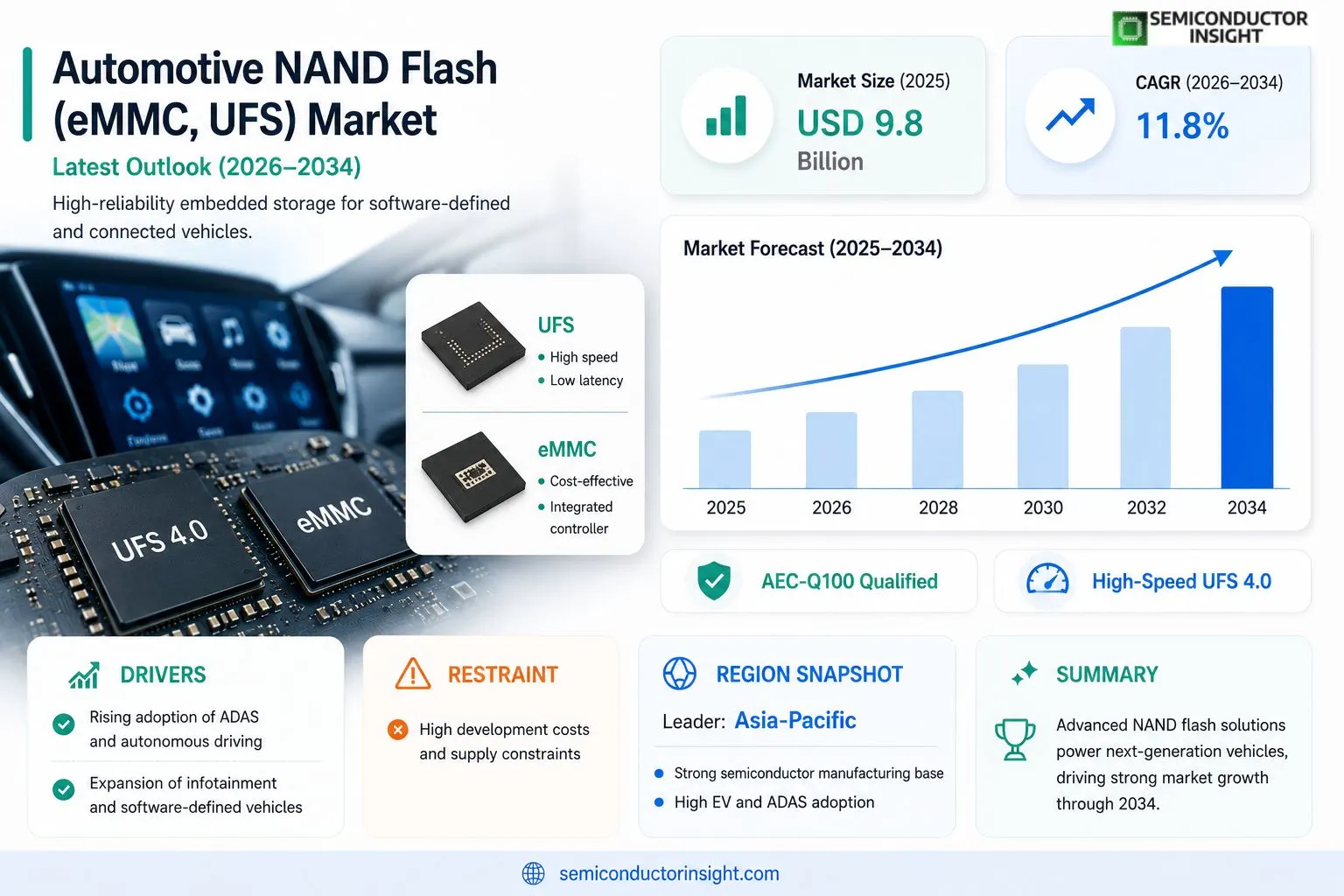
Global Automotive NAND Flash (eMMC, UFS) market size was valued at USD 9.8 billion in 2025. The market is projected to grow from USD 10.7 billion in 2026 to USD 24.6 billion by 2034, exhibiting a CAGR of 11.8% during the forecast period.
Automotive NAND Flash solutions, primarily in the form of eMMC and UFS, are high-reliability embedded storage technologies designed for the demanding conditions of vehicle electronics. These components provide non-volatile memory essential for storing operating systems, applications, maps, sensor data, and firmware in connected and autonomous vehicles. eMMC offers a cost-effective embedded storage option with integrated controller and flash memory, while UFS delivers superior performance with faster data transfer speeds, lower latency, and better power efficiency, making it ideal for advanced applications.
The market is experiencing robust growth due to several factors, including the rapid adoption of software-defined vehicles, increasing integration of Advanced Driver Assistance Systems (ADAS), and the expansion of in-vehicle infotainment systems. Furthermore, the shift toward electric vehicles and higher levels of vehicle autonomy requires significantly more onboard storage for over-the-air updates, high-definition mapping, sensor fusion, and real-time data logging. Advancements in automotive-grade memory solutions that meet stringent AEC-Q100 qualifications and wide temperature ranges are also contributing to market expansion. Initiatives by key players continue to drive innovation, with leading semiconductor manufacturers enhancing UFS 3.1 and UFS 4.0 interfaces for automotive use cases. Samsung Electronics, SK Hynix, Micron Technology, and Kioxia are some of the key players that operate in the market with a wide range of automotive-qualified portfolios.
MARKET DRIVERS
Rising Demand for ADAS and Autonomous Driving Technologies
Automotive NAND Flash (eMMC, UFS) Market is experiencing robust growth driven by the rapid proliferation of Advanced Driver Assistance Systems (ADAS) and the progression toward higher levels of vehicle autonomy. Modern vehicles require substantial high-speed, reliable storage to handle massive data streams from cameras, radar, LiDAR, and sensors for real-time processing and logging. UFS solutions are increasingly favored over traditional eMMC for their superior bandwidth and lower latency in these data-intensive applications.
Expansion of Connected and Software-Defined Vehicles
Infotainment systems, digital cockpits, and over-the-air (OTA) update capabilities in connected vehicles are fueling demand for higher-capacity NAND flash storage. Automotive manufacturers are transitioning from eMMC to advanced UFS interfaces to support rich multimedia content, 3D navigation maps, and complex software environments. This shift supports the evolution of software-defined vehicles (SDVs), where storage needs continue to scale with vehicle electrification and connectivity features.
➤ Automotive-grade NAND solutions must meet stringent AEC-Q100 qualifications and wide temperature ranges (-40°C to 105°C) while delivering the performance required for next-generation vehicle architectures.
The ongoing electrification of powertrains and integration of sophisticated battery management systems further amplify the need for durable, high-endurance eMMC and UFS memory components optimized for automotive environments.
MARKET CHALLENGES
Stringent Qualification and Reliability Requirements
Automotive applications demand extensive validation and qualification processes for NAND flash components, including prolonged thermal cycling, vibration testing, and functional safety compliance under ISO 26262 standards. These rigorous requirements extend development timelines and increase costs compared to consumer-grade solutions, posing significant hurdles for market participants.
Other Challenges
Supply Chain Volatility and Price Fluctuations
The automotive sector faces ongoing challenges from NAND price volatility and periodic supply disruptions, which complicate long-term forecasting and inventory management for Tier-1 suppliers and OEMs. Extended validation cycles for automotive-qualified parts further exacerbate these issues.
Transition Complexity from eMMC to UFS
While UFS offers performance advantages, the industry shift from established eMMC solutions involves significant engineering efforts, firmware adaptations, and ecosystem changes, creating integration challenges across diverse vehicle platforms.
MARKET RESTRAINTS
High Development Costs and Long Design Cycles
Automotive NAND Flash (eMMC, UFS) Market faces restraints from elevated costs associated with developing and certifying automotive-grade memory solutions. Achieving compliance with functional safety, extended temperature operation, and long product lifecycle support requirements demands substantial R&D investment, which can deter smaller players and slow broader adoption in cost-sensitive vehicle segments.
MARKET OPPORTUNITIES
Advancements in 3D NAND and Higher-Performance Interfaces
Continued innovation in 3D NAND architectures, including higher layer counts and improved UFS 4.0/4.1 specifications, presents significant opportunities for enhanced density, speed, and power efficiency in automotive applications. These advancements enable support for data-heavy features in next-generation ADAS, autonomous systems, and premium infotainment, driving stronger market penetration.
The expansion of electric and autonomous vehicle platforms creates substantial upside for high-capacity automotive NAND solutions, with projections indicating significantly higher storage requirements per vehicle compared to traditional models. Strategic partnerships between memory suppliers and automotive OEMs for customized, functionally safe solutions are poised to unlock new revenue streams in this high-growth segment.
Automotive NAND Flash (eMMC, UFS) Market Trends
Rising Demand Driven by Software-Defined Vehicles and ADAS Integration
Automotive NAND Flash (eMMC, UFS) Market is witnessing strong momentum as vehicle manufacturers accelerate the transition to software-defined vehicles. These advanced architectures rely heavily on reliable embedded storage solutions to handle complex operating systems, applications, and continuous data processing. eMMC continues to serve as a cost-effective option with its integrated controller and flash memory, while UFS gains prominence for applications requiring higher performance, offering faster data transfer speeds, reduced latency, and improved power efficiency essential for modern automotive environments.
Other Trends
Expansion in In-Vehicle Infotainment and Connectivity Features
Modern vehicles incorporate sophisticated infotainment systems that demand substantial storage capacity for high-resolution maps, multimedia content, and real-time navigation data. Automotive NAND Flash (eMMC, UFS) solutions enable seamless operation of these systems under stringent automotive conditions. The growing emphasis on connected vehicles further amplifies the need for robust memory components capable of supporting over-the-air updates and enhanced user experiences.
Shift Toward Electric Vehicles and Higher Autonomy Levels
Electric vehicles and those advancing toward higher autonomy levels require significantly increased onboard storage for sensor fusion, real-time data logging, and high-definition mapping. Automotive-grade NAND Flash technologies, qualified to AEC-Q100 standards and designed for wide temperature ranges, are critical in meeting these requirements while maintaining reliability in challenging operating environments.
Technological Advancements in UFS Interfaces
Innovation in UFS 3.1 and UFS 4.0 specifications tailored for automotive use cases is propelling Automotive NAND Flash (eMMC, UFS) Market forward. Leading semiconductor manufacturers are enhancing these interfaces to deliver superior performance for next-generation vehicle electronics. This evolution supports the intensive data demands of advanced driver assistance systems and autonomous driving functionalities, ensuring efficient storage and retrieval of critical information.
Key industry participants including Samsung Electronics, SK Hynix, Micron Technology, and Kioxia maintain strong positions through dedicated automotive-qualified portfolios. Their ongoing development efforts focus on delivering high-reliability solutions that address the unique thermal, endurance, and performance requirements of the automotive sector. As vehicle architectures become increasingly data-centric, the role of eMMC and UFS technologies continues to expand, supporting the industry’s broader digital transformation initiatives.
COMPETITIVE LANDSCAPE
Key Industry Players
Dominant Leadership by Major NAND Flash Manufacturers in Automotive eMMC and UFS Solutions
Automotive NAND Flash (eMMC, UFS) Market is highly concentrated among a few leading semiconductor giants with vertically integrated manufacturing capabilities. Samsung Electronics stands as the clear market leader, leveraging its advanced V-NAND technology and extensive automotive-qualified portfolio to supply high-reliability eMMC and UFS solutions for ADAS, infotainment, and domain controllers across global OEMs. The competitive structure is characterized by intense innovation in higher-speed UFS interfaces (UFS 3.1 and UFS 4.0), stringent AEC-Q100 qualifications, and wide-temperature performance essential for automotive environments.
Complementing the leaders are other significant players focusing on niche segments such as controller expertise and specialized automotive-grade solutions. Companies like Phison Electronics excel in providing high-performance controllers, while firms such as Silicon Motion and Longsys deliver targeted embedded storage products. This ecosystem supports the rapid transition toward software-defined vehicles requiring greater storage capacity for sensor data, HD mapping, and OTA updates.
List of Key Automotive NAND Flash Companies Profiled
- Samsung Electronics
- SK hynix Inc.
- Micron Technology
- Kioxia Holdings Corporation
- Western Digital Corporation
- Phison Electronics Corporation
- Silicon Motion Technology Corporation
- Kingston Technology Company Inc.
- Longsys Electronics
- Greenliant Systems Inc.
- ADATA Technology Co., Ltd.
- ATP Electronics, Inc.
- Apacer Technology Inc.
- Infineon Technologies AG
Segment Analysis:
| Segment Category | Sub-Segments | Key Insights |
| By Type |
|
UFS is gaining strong traction as the preferred solution for high-performance automotive applications due to its superior data transfer speeds, lower latency, and enhanced power efficiency. It excels in handling complex real-time data processing tasks essential for modern vehicle architectures. eMMC remains relevant for cost-sensitive implementations where balanced reliability and storage capacity suffice for basic system operations. Manufacturers prioritize UFS for its ability to support seamless over-the-air updates and rapid sensor data logging while maintaining thermal stability in harsh automotive environments. This shift reflects the industry’s move toward more responsive and efficient embedded storage solutions. |
| By Application |
|
Advanced Driver Assistance Systems (ADAS) represents a leading application area as it demands high-speed, reliable storage for processing vast amounts of sensor data, camera feeds, and real-time decision-making algorithms. These systems benefit immensely from low-latency memory that ensures safety-critical operations function without interruption. In-vehicle infotainment systems leverage NAND flash for rich multimedia content, user interface responsiveness, and connectivity features. Navigation applications require substantial storage for high-definition maps and dynamic updates, while telematics modules depend on durable memory for continuous data logging and vehicle-to-cloud communications. Overall, these applications drive the need for automotive-grade solutions that deliver consistent performance across temperature extremes and vibrations. |
| By End User |
|
Passenger Vehicles lead in adoption as consumers expect sophisticated connectivity, entertainment, and safety features that rely heavily on robust embedded storage. These vehicles integrate multiple systems requiring fast access to firmware, maps, and user data. Commercial vehicles utilize NAND flash for fleet management, logistics tracking, and operational efficiency tools that demand reliable long-term data retention. Autonomous vehicle developers push the boundaries with extensive sensor fusion and AI processing needs, favoring high-end UFS solutions capable of handling continuous high-volume data streams. Across end users, the emphasis remains on memory solutions that enhance vehicle intelligence while meeting rigorous durability and safety standards. |
| By Vehicle Type |
|
Electric Vehicles (EVs) are at the forefront of driving demand for advanced NAND flash solutions due to their reliance on sophisticated battery management, powertrain control, and extensive software ecosystems. These vehicles require substantial storage capacity for managing complex energy optimization algorithms, predictive maintenance data, and seamless integration with charging infrastructure. Hybrid vehicles balance performance needs between electric and traditional systems, benefiting from versatile memory that supports hybrid-specific control units. ICE vehicles continue to incorporate growing electronic content for efficiency and comfort features. The transition toward electrification amplifies the importance of reliable, high-performance storage that can withstand automotive environmental stresses while enabling future-ready software capabilities. |
| By Performance Requirement |
|
High-Speed Data Processing emerges as the dominant performance category, fueled by the need for instantaneous access to critical information in safety and autonomy systems. Solutions in this segment prioritize rapid read/write capabilities and efficient power management to support real-time analytics without compromising vehicle operation. Standard reliability storage serves entry-level and mid-range applications where consistent performance under normal conditions is sufficient. Extreme environment durability focuses on components engineered to operate flawlessly across wide temperature ranges, high vibration, and long operational lifecycles typical in automotive settings. This segmentation highlights the industry’s commitment to tailoring memory technologies to specific functional demands while upholding the highest quality and safety benchmarks. |
Regional Analysis: Automotive NAND Flash (eMMC, UFS) Market
Asia-Pacific
The region’s established semiconductor fabrication facilities enable efficient production of automotive-grade eMMC and UFS memory. Close proximity between chip manufacturers and automotive assembly plants reduces lead times and supports customization for specific vehicle platforms, enhancing overall market responsiveness to emerging demands in connected and autonomous mobility.
Rapid expansion of electric vehicles and sophisticated ADAS technologies drives substantial need for high-density, fast-access storage. UFS solutions particularly excel in handling large volumes of sensor data and real-time processing requirements, positioning the region at the forefront of intelligent vehicle architecture development.
Collaborative research initiatives between technology firms and automakers accelerate advancements in NAND flash durability and performance under extreme automotive conditions. This ecosystem nurtures development of next-generation storage that meets stringent safety and reliability standards essential for modern vehicles.
Integrated regional supply networks provide stability against global disruptions while allowing quick adaptation to shifting automotive specifications. Strategic partnerships ensure consistent availability of quality automotive NAND flash components critical for maintaining production schedules across major vehicle manufacturers.
North America
North America exhibits strong growth potential in Automotive NAND Flash (eMMC, UFS) Market, supported by leading technology companies and premium vehicle manufacturers focused on software-defined vehicles. The region emphasizes innovation in autonomous driving platforms where high-performance UFS storage becomes essential for processing vast amounts of real-time data. Domestic investments in semiconductor research contribute to development of advanced memory solutions tailored for harsh automotive environments. Consumer preference for feature-rich infotainment and connectivity features further propels demand for reliable NAND flash storage. Regulatory frameworks promoting vehicle safety and data security influence the adoption of robust eMMC and UFS technologies that ensure system integrity. Strategic collaborations between automakers and memory specialists drive customization efforts, positioning the market for steady expansion amid the transition toward electric and intelligent mobility solutions.
Europe
Europe maintains a sophisticated position in Automotive NAND Flash (eMMC, UFS) Market through its leadership in premium and electric vehicle segments. Strict environmental regulations and safety standards accelerate integration of advanced storage solutions in ADAS and autonomous systems. The region’s focus on sustainable mobility creates opportunities for efficient NAND flash that supports energy-optimized electronic architectures. Established automotive manufacturers collaborate closely with technology providers to enhance data management capabilities in connected vehicles. Emphasis on cybersecurity in automotive applications highlights the importance of secure eMMC and UFS implementations. Innovation clusters across key countries foster development of specialized memory solutions that meet rigorous quality requirements, supporting the region’s ambition to lead in future mobility technologies while maintaining exceptional reliability standards.
South America
South America represents an emerging market for Automotive NAND Flash (eMMC, UFS) solutions, with growth linked to increasing vehicle production and gradual adoption of connected features. Local manufacturing initiatives create opportunities for integration of cost-effective storage technologies in entry-level and mid-range vehicles. The region shows rising interest in basic ADAS and infotainment systems that utilize eMMC solutions for reliable performance. Economic development and expanding middle-class consumer base drive demand for vehicles equipped with modern electronics. Infrastructure improvements support connectivity features that benefit from NAND flash memory. While adoption lags behind more mature markets, strategic investments in automotive technology are expected to enhance the role of UFS and eMMC components as regional manufacturers modernize their product offerings.
Middle East & Africa
The Middle East and Africa region displays nascent but promising dynamics in Automotive NAND Flash (eMMC, UFS) Market, primarily driven by luxury vehicle imports and infrastructure development projects. Growing interest in smart transportation solutions creates initial demand for connected vehicle technologies requiring dependable storage. Harsh climatic conditions across many areas underscore the need for robust automotive-grade memory solutions capable of maintaining performance in extreme environments. Government initiatives aimed at economic diversification include investments in advanced manufacturing and technology sectors that could support future local production. Rising urbanization and focus on intelligent mobility create pathways for gradual adoption of eMMC and UFS technologies in both passenger and commercial vehicles, laying groundwork for expanded market presence.
Report Scope
This market research report provides a comprehensive analysis of the Automotive NAND Flash (eMMC, UFS) Market , covering the forecast period 2026–2034. It offers detailed insights into market dynamics, technological advancements, competitive landscape, and key trends shaping the industry.
Key focus areas of the report include:
- Market Overview: The report begins with an overview outlining its current market scenario, key growth indicators, and industry transformation drivers. It discusses macroeconomic factors, demand–supply balance, regulatory landscape, and the strategic role of semiconductors in powering advancements across industries such as automotive, telecommunications, consumer electronics, and industrial automation.
- Market Size & Forecast: Historical data and future projections for revenue, unit shipments, and market value across major regions and segments.
- Segmentation Analysis: Detailed breakdown by product type, technology, application, and end-user industry to identify high-growth segments and investment opportunities.
- Regional Insights: Insights into market performance across North America, Europe, Asia-Pacific, Latin America, and the Middle East & Africa, including country-level analysis where relevant.
- Competitive Landscape: Profiles of leading market participants, including their product offerings, R&D focus, manufacturing capacity, pricing strategies, and recent developments such as mergers, acquisitions, and partnerships.
- Technology Trends & Innovation: Assessment of emerging technologies, integration of AI/IoT, semiconductor design trends, fabrication techniques, and evolving industry standards.
- Market Drivers & Restraints: Evaluation of factors driving market growth along with challenges, supply chain constraints, regulatory issues, and market-entry barriers.
- Stakeholder Insights: Insights for component suppliers, OEMs, system integrators, investors, and policymakers regarding the evolving ecosystem and strategic opportunities.
Primary and secondary research methods are employed, including interviews with industry experts, data from verified sources, and real-time market intelligence to ensure the accuracy and reliability of the insights presented.
FREQUENTLY ASKED QUESTIONS:
What is the current market size of Automotive NAND Flash (eMMC, UFS) Market?
-> Automotive NAND Flash (eMMC, UFS) Market was valued at USD 9.8 billion in 2025 and is expected to reach USD 24.6 billion by 2034.
Which key companies operate in Automotive NAND Flash (eMMC, UFS) Market?
-> Key players include Samsung Electronics, SK Hynix, Micron Technology, and Kioxia, among others.
What are the key growth drivers?
-> Key growth drivers include rapid adoption of software-defined vehicles, increasing integration of Advanced Driver Assistance Systems (ADAS), expansion of in-vehicle infotainment systems, shift toward electric vehicles, and higher levels of vehicle autonomy.
Which region dominates the market?
-> Asia-Pacific is the fastest-growing region due to semiconductor manufacturing leadership and automotive production growth.
What are the emerging trends?
-> Emerging trends include advancements in UFS 3.1 and UFS 4.0 interfaces for automotive use, high-reliability AEC-Q100 qualified solutions, and increased storage for sensor fusion and over-the-air updates.

Get Sample Report PDF for Exclusive Insights
Report Sample Includes
- Table of Contents
- List of Tables & Figures
- Charts, Research Methodology, and more...
 Download Sample Report PDF