Key Statistics
Key Takeaways
- DRAM is the dominant value segment on the source page because server, PC and accelerator platforms require high-speed volatile memory for real-time processing, while NAND leads unit and bit-volume demand through smartphones, client SSDs and enterprise storage.
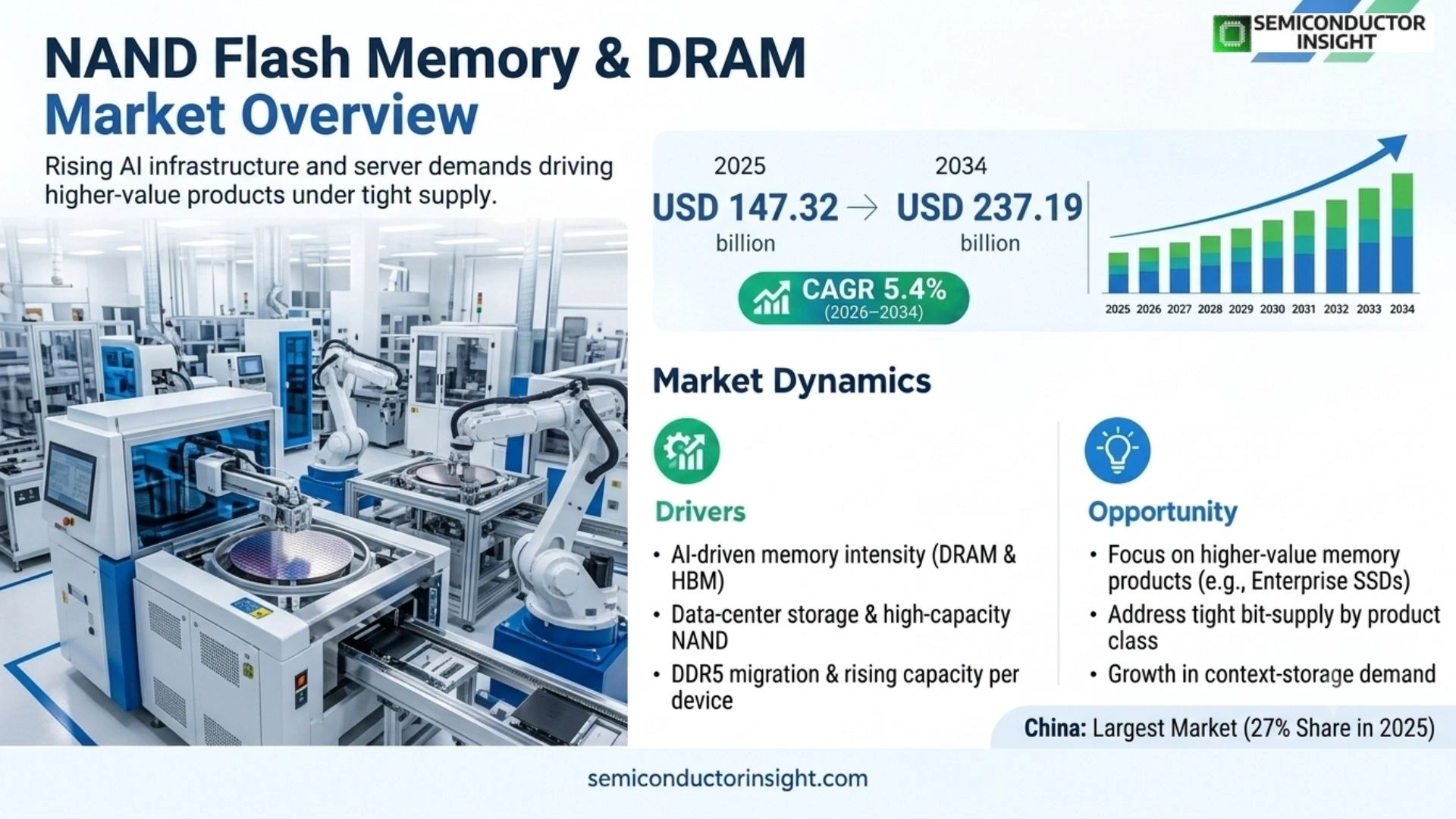
- Smartphone is identified as the largest application on the source page, but enterprise and data-center demand is currently the strongest strategic growth engine. Micron said in June 2026 that data-center DRAM and NAND bit shipments in calendar 2026 are expected to more than double from two years earlier as AI expands both compute and context-storage requirements.
- China is the largest single market on the source page at about 27%, followed by South Korea at about 24%. More broadly, Asia Pacific dominates memory manufacturing through Samsung, SK hynix, Kioxia and large backend ecosystems, while North America drives a disproportionate share of AI and hyperscale demand.
- Memory supply is tight in 2026. Samsung reported record memory results and expects server DRAM, enterprise SSD and HBM demand to accelerate, while Micron has described both DRAM and NAND supply as constrained by AI-related data-center demand.
- The source page’s printed 6.4% CAGR does not reconcile with its market-size anchors. USD 139.73 billion in 2024 and USD 213.37 billion in 2032 imply approximately 5.4% annual growth, which is used for the 2025–2034 rebasing.
NAND Flash Memory and DRAM Market Overview
NAND Flash Memory and DRAM market is rebased to USD 147.32 billion in 2025, increases to an estimated USD 155.33 billion in 2026, and is projected to reach USD 237.19 billion by 2034. The selected source-page size anchors imply a 5.4% CAGR during 2026–2034. China is the largest country market in 2025 based on the source page’s stated 27% share, while current demand is being reshaped by AI infrastructure, server DRAM, HBM, enterprise SSDs, high-capacity NAND, context-storage demand, DDR5 migration and an industry-wide shift toward higher-value memory products under tight supply.
NAND flash and DRAM are complementary memory technologies that sit at different levels of the computing hierarchy. DRAM provides high-speed volatile working memory for processors, GPUs and servers, while NAND provides non-volatile storage in smartphones, PCs, SSDs and enterprise systems. Their combined market is therefore influenced by both compute intensity and data retention, with pricing driven by bit supply, process transitions, product mix and inventory behavior rather than only end-device shipments.
The demand center is shifting toward AI infrastructure. Samsung’s second-quarter 2026 results said its Memory Business achieved record quarterly revenue and operating profit, with a record-high server share and expectations for accelerating server DRAM, enterprise SSD and HBM demand. Micron separately said calendar 2026 data-center DRAM and NAND bit shipments are expected to more than double versus two years earlier, showing that memory content per data-center system is expanding alongside server units.
Technology roadmaps are also diverging by product. DRAM suppliers are moving through DDR5, high-density server DIMMs and HBM4/HBM4E, while NAND suppliers are scaling 3D layer counts, improving controller architecture and introducing PCIe 6.0 enterprise SSDs. Samsung showed 400-plus-layer V10 BV-NAND in August 2026, Kioxia disclosed a 332-layer BiCS FLASH generation 10 approach, and SK hynix presented 375-layer 4D NAND and high-bandwidth flash concepts for AI workloads.
Segment Analysis: By Type
The source page segments the market into NAND Flash Memory and DRAM. DRAM is identified as the dominant value segment because it is essential for high-speed computing and server workloads, while NAND leads storage bit volume because it retains data without power and is used across smartphones, client SSDs and enterprise storage. The two segments share semiconductor manufacturing intensity but follow different technology, pricing and end-market cycles.
| Type | Technical / commercial role | Market position |
|---|---|---|
| NAND Flash Memory | NAND stores data in non-volatile cells arranged in increasingly tall 3D structures. Commercial products span embedded mobile storage, client SSDs, enterprise SSDs and removable storage, with TLC and QLC architectures balancing performance, endurance and cost per bit. AI is changing NAND’s role because enterprise SSDs are increasingly used for context stores, vector databases, checkpointing and capacity tiers close to GPUs. | Large bit-volume segment with renewed strategic importance. Samsung is targeting PCIe Gen6 server SSDs and AI-oriented KV-cache storage, Micron is shipping a 245TB QLC data-center SSD, Kioxia introduced PCIe 6.0 enterprise SSDs using BiCS FLASH generation 10, and SK hynix is developing High Bandwidth Flash. These developments raise value per NAND bit in data-center applications. |
| DRAM | DRAM stores data in capacitor-based cells and provides the high-speed working memory used by CPUs, GPUs, mobile processors and servers. Product families include DDR5, LPDDR5X, GDDR and HBM, with server and AI applications demanding larger capacity, greater bandwidth and tighter power efficiency. Advanced DRAM also requires increasingly complex packaging when dies are vertically stacked for HBM. | Dominant value segment on the source page. AI has shifted the product mix toward HBM4, high-density DDR5 and specialized server memory. Samsung reported record memory results in 2026, Micron is shipping HBM4 and 256GB DDR5 qualification samples, and SK hynix continues to expand an AI-memory portfolio spanning HBM, server DRAM and SSDs. |
Secondary segmentation: By End User
The source page further divides the market into Consumer Electronics, Enterprise & Data Centers, and Automotive & Industrial. Enterprise and data centers are described as the most influential end-user group because they purchase high-density DRAM and enterprise NAND at higher value per device, while consumer electronics remain the largest broad-volume base.
| End user | Commercial characteristics |
|---|---|
| Consumer Electronics | Smartphones, PCs, tablets and televisions consume very large quantities of mobile DRAM, client DRAM, embedded NAND and SSDs. The segment is highly sensitive to pricing and device replacement cycles, but memory content per device can continue to rise through AI-enabled PCs, higher-resolution media and larger application footprints even when unit growth is modest. |
| Enterprise & Data Centers | This segment drives server DDR5, HBM, high-capacity RDIMMs and enterprise SSDs. AI training and inference require both rapid working memory and large context or data stores, increasing DRAM and NAND demand together. Micron estimates data-center DRAM and NAND bit TAM exceeds half of industry bit TAM in 2026, illustrating the strategic shift toward infrastructure. |
| Automotive & Industrial | ADAS, infotainment, domain controllers, digital cockpits, robotics and industrial automation use increasingly large memory capacities with long lifecycle and reliability requirements. Suppliers must support wide-temperature operation, functional-safety expectations and extended availability, making this segment smaller than consumer or data-center but commercially attractive and less commodity-like. |
Secondary segmentation: By Technology Node
The source page classifies products into Leading-edge (<20nm), Mainstream (20–40nm) and Legacy (>40nm). This simplified node framework spans products that are manufactured with very different process conventions, but it correctly captures the commercial distinction between advanced density/performance products and long-lived specialty memory. For memory suppliers, the commercial consequence is that product mix, bit density, yield, advanced packaging and customer allocation determine revenue quality much more directly than broad device shipment growth.
| Technology node | Market implication |
|---|---|
| Leading-edge (<20nm) | Leading-edge products deliver the highest density and energy efficiency and support premium server, smartphone and SSD applications. The manufacturing burden is severe because DRAM cell scaling and high-layer-count 3D NAND require new materials, lithography, bonding and process-control techniques. Successful transitions reduce cost per bit but can constrain supply while yields ramp. |
| Mainstream (20–40nm) | Mainstream memory balances cost, mature yields and adequate performance for broad consumer, industrial and embedded applications. These technologies can remain economically attractive after leading-edge products launch because fully depreciated equipment and stable process windows lower cost, especially where customers do not need maximum density. |
| Legacy (>40nm) | Legacy memory serves industrial, automotive, networking and embedded applications that prioritize long-term availability and proven reliability over density. Specialty DRAM vendors such as Nanya and Winbond participate strongly here. Capacity can become strategically scarce because large manufacturers prefer to allocate capital toward higher-value leading-edge products. |
Secondary segmentation: By Product Density
The source page divides products into Low Density (<8Gb), Medium Density (8–32Gb) and High Density (>32Gb). High-density memory is identified as the leading segment because smartphones, servers and SSDs need more capacity in constrained physical space and because AI systems place a premium on memory bandwidth and data density.
| Product density | Demand profile |
|---|---|
| Low Density (<8Gb) | Low-density devices remain important in embedded controllers, legacy industrial systems and products where memory requirements are modest. The commercial challenge is maintaining supply after leading manufacturers migrate to newer nodes, creating opportunities for specialty suppliers that can support customers for many years. |
| Medium Density (8–32Gb) | Medium-density products serve mainstream PCs, consumer electronics, networking and broad embedded applications. They benefit from mature cost structures and large customer bases, but face persistent price pressure as advanced products move down the cost curve. |
| High Density (>32Gb) | High-density memory is strategically important in servers, premium smartphones, enterprise SSDs and AI systems. Higher density reduces board space and total device count while supporting larger models and datasets. Supplier roadmaps increasingly combine dense DRAM dies, multi-die stacking and very high-capacity NAND packages to maximize system-level memory capacity. |
Segment Analysis: By Application
By application, the source page lists Smartphone, PC, SSD, Digital TV and Others. Smartphone is identified as the leading application because it consumes both mobile DRAM and NAND storage in very high unit volumes. SSD is the strongest structural growth application because enterprise storage, AI context memory and HDD displacement increase NAND content per system, while PC demand gains from higher memory specifications in AI-enabled platforms.
| Application | Demand characteristics |
|---|---|
| Smartphone | Smartphones combine LPDDR-class DRAM for application processing with UFS or embedded NAND for storage. Premium models continue to increase memory capacity for AI features, cameras and gaming, but overall unit growth is mature and pricing remains highly competitive. Mobile demand therefore provides scale but less structural growth than AI data-center infrastructure. |
| PC | PCs consume DDR5 or LPDDR memory and client SSD NAND. AI PCs can increase baseline DRAM and SSD capacity, while enterprise refresh cycles support higher-value notebooks and workstations. However, PC demand is cyclical and can swing sharply with inventory, making it a less predictable driver than contracted server memory. |
| SSD | SSDs are the fastest strategic NAND application because enterprise and cloud customers are adopting higher-capacity drives and PCIe Gen6 for AI and data-intensive workloads. Micron is shipping 245TB drives, Kioxia has introduced PCIe 6.0 enterprise SSDs and Samsung expects server SSD demand to accelerate, validating both capacity and performance-driven growth. |
| Digital TV | Digital televisions use DRAM and NAND for operating systems, applications, video processing and local storage. Memory content rises with smart-TV software and higher-resolution interfaces, but the application is strongly cost-sensitive and smaller in value than smartphones, PCs or enterprise storage. |
| Others | Other applications include gaming consoles, networking, automotive, industrial, cameras, IoT and specialized computing. These markets collectively create meaningful demand because each has different density, endurance and lifecycle requirements, reducing the industry’s dependence on a single consumer platform. |
Regional Analysis
The source page identifies China as the largest country market with approximately 27% share, followed by South Korea at about 24%, while the broader Asia-Pacific region is described as the undisputed market leader. The region combines the largest memory manufacturing base with immense electronics consumption, whereas North America exerts disproportionate influence through hyperscale data centers and AI architecture.
How do manufacturing concentration and AI demand shape regional memory economics?
Memory is globally traded but geographically concentrated in production. South Korea leads DRAM and a large share of NAND through Samsung and SK hynix, Japan remains important through Kioxia and memory supply-chain technology, China is the largest consumption market and is expanding domestic NAND/DRAM capability, while North America hosts Micron and most hyperscale AI buyers. Europe, South America and MEA are primarily demand regions with limited leading-edge memory fabrication.
| Region | Position | Growth outlook | Demand profile | What decides supplier selection |
|---|---|---|---|---|
| Asia Pacific | Largest | High | Manufacturing, mobile and server-led | Technology leadership, fab scale, cost per bit and customer qualification |
| North America | AI demand center | High | Hyperscale, AI, enterprise and PC-led | High-value products, roadmaps, allocation and supply security |
| Europe | Specialized demand | Moderate | Automotive, industrial and embedded-led | Reliability, long lifecycle and specialty availability |
| South America | Import-led | Moderate | Smartphone, PC and cloud-led | Price, currency, channel availability and logistics |
| Middle East & Africa | Emerging | Moderate from small base | Data-center, mobile and government digitalization-led | Imported supply, system integration and availability |
Competitive Landscape
The source page describes a highly concentrated market in which Samsung, SK hynix and Micron collectively held about 73% of 2024 revenue. Kioxia, Sandisk/Western Digital flash operations, specialty DRAM suppliers and Chinese memory companies form the next competitive tier. The source list is retained for scope consistency, while recent corporate changes are explicitly acknowledged rather than silently rewriting the historical company roster.
Samsung competes across DRAM, HBM, NAND and enterprise SSDs and reported record memory results in 2026. SK hynix is strongest in HBM and is expanding a full AI-memory stack across DRAM and NAND, while Micron combines HBM4, server DDR5 and G9 NAND enterprise SSDs. These three suppliers can shift wafer and capital allocation toward the highest-value products, reinforcing concentration during periods of tight supply.
Kioxia remains a major NAND technology supplier and is using BiCS FLASH generation 10 in new PCIe 6.0 enterprise SSDs. Western Digital’s flash business separated into independent Sandisk in February 2025, so current flash competition should be analyzed under Sandisk rather than Western Digital even though the source page still lists Western Digital. The workbook reviewer note preserves that source-to-current-company distinction.
The source page also lists Intel, but Intel’s NAND and SSD business was acquired by SK hynix and operates through Solidigm. Nanya, Winbond, PSMC and ISSI remain relevant in specialty DRAM, while YMTC and other Chinese suppliers represent a growing localization challenge. Competition therefore varies sharply between leading AI memory, commodity storage and long-lifecycle specialty products.
| Competitive tier | Companies | Why they matter |
|---|---|---|
| Global memory leaders | Samsung Electronics; SK hynix; Micron Technology | These three companies dominate advanced DRAM and hold major NAND positions. Their scale, process technology, packaging capability and capital budgets allow them to prioritize HBM, server DDR5 and enterprise SSD products when AI demand is strongest, giving them disproportionate influence over global pricing and allocation. |
| Major NAND specialists | Kioxia; Sandisk (source page lists Western Digital); Solidigm | These suppliers compete strongly in client and enterprise NAND. Kioxia is advancing BiCS FLASH generation 10 and PCIe 6.0 SSDs, Sandisk became independent from Western Digital in 2025, and Solidigm represents the former Intel NAND/SSD business under SK hynix ownership. |
| Specialty and regional challengers | Nanya Technology; Winbond Electronics; PSMC; ISSI; YMTC; Macronix; ADATA | These companies serve specialty DRAM, embedded NAND, industrial memory or regional markets. Their opportunity is strongest where long lifecycle, domestic supply or application-specific products matter more than bleeding-edge density, though YMTC also competes increasingly in higher-density NAND. |
Companies profiled in the report
The source page profiles Samsung Electronics, Micron Technology, SK Hynix, Kioxia Holdings Corporation, Western Digital, Intel Corporation, Nanya Technology, Winbond Electronics, Powerchip Semiconductor Manufacturing Corp. (PSMC), Integrated Silicon Solution Inc. (ISSI), Yangtze Memory Technologies Corp. (YMTC), Macronix International and ADATA Technology. Current-company analysis notes that Western Digital separated its flash business as Sandisk in February 2025 and Intel’s NAND/SSD business operates through Solidigm under SK hynix.
Production Capacity Analysis
Memory production capacity is determined by wafer starts, process-node productivity, layer count, die size, yield and product mix rather than by finished-chip unit count alone. DRAM and NAND share semiconductor fab infrastructure but require different process flows, and high-value AI products such as HBM also consume advanced packaging capacity. During 2026, suppliers are prioritizing server and AI products, making effective commodity supply tighter even when total wafer capacity grows.
Samsung’s 2026 disclosures describe limited memory supply availability even as the company increases production. It is prioritizing HBM4, high-density DDR5, SOCAMM2 and enterprise SSDs, meaning allocation decisions can reduce the wafers or packaging resources available for mobile and PC products. Effective capacity therefore depends on product mix, not only installed fab tools.
Micron has said both DRAM and NAND data-center demand are constrained by inadequate supply. The company is expanding U.S. manufacturing over the long term, but new fabs require years to construct and qualify. In the near term, node migrations and yield improvements are the fastest ways to increase bit output, while HBM packaging remains an additional bottleneck outside front-end DRAM wafer fabrication.
NAND capacity is evolving through taller 3D stacks, bonding and controller improvements. Samsung unveiled 400-plus-layer V10 BV-NAND, Kioxia is using a 332-layer generation 10 design and SK hynix presented 375-layer 4D NAND. More layers can raise bits per wafer, but process time, bonding complexity and yield determine whether nominal density improvements translate into competitive cost per bit.
Market Dynamics
The combined market is driven by AI memory intensity, data-center storage, rising capacity per device and technology transitions, but it remains constrained by severe capital intensity, cyclical pricing, scaling complexity and geographic concentration. The most important commercial variable is the balance between bit demand and qualified bit supply by product class, not merely total semiconductor unit shipments.
Market Drivers
| Driver | Directional impact* | Commercial mechanism |
|---|---|---|
| AI infrastructure | High | AI training and inference increase HBM, server DRAM and enterprise SSD content per system. Micron expects 2026 data-center DRAM and NAND bit shipments to more than double versus two years earlier. |
| Server memory upgrades | High | DDR5, high-density RDIMMs and new CPU/GPU platforms increase capacity and bandwidth requirements, pulling suppliers toward premium server products. |
| Enterprise SSD adoption | High | PCIe Gen6, high-capacity QLC and context-storage workloads expand NAND value in data centers beyond traditional client SSD demand. |
| Higher device density | Medium | Smartphones, PCs and vehicles continue increasing DRAM and NAND capacity per system, offsetting slow unit growth in mature device categories. |
AI raises both bandwidth and storage requirements
AI systems need high-bandwidth DRAM close to accelerators and large amounts of NAND for datasets, context, checkpoints and inference storage. This is unusual because one end-market trend pulls both major memory technologies simultaneously. Suppliers are therefore prioritizing HBM, server DDR5 and enterprise SSD products that deliver higher value per bit than traditional consumer memory.
New server platforms lift DRAM content
Modern server CPUs and accelerators support larger DDR5 populations and increasingly specialized memory architectures. Samsung expects server DRAM demand to accelerate in the second half of 2026, while Micron has shipped 256GB DDR5 qualification samples. Higher capacity per server can grow bit demand even if server unit growth is constrained by system cost or memory allocation.
Enterprise SSDs become an AI infrastructure layer
Micron’s 245TB SSD, Kioxia’s PCIe 6.0 CM10 and Samsung’s Gen6 enterprise SSD strategy show that NAND is moving closer to GPUs and AI data paths. Faster interfaces, greater rack density and context-store workloads make flash a performance component rather than only a low-cost replacement for hard drives. This distinction matters because DRAM and NAND respond differently to AI demand, so suppliers must balance wafer capacity, packaging resources and long-term contracts across server, mobile, PC and storage products.
Memory capacity per endpoint keeps rising
Premium smartphones, AI PCs, connected vehicles and industrial computers continue increasing baseline DRAM and storage capacity. Unit growth in these markets may be modest, but more gigabytes per device create steady bit demand and support higher-density products, especially when applications become more data intensive. Buyers therefore evaluate not only price per bit but also bandwidth, endurance, power efficiency, qualification status, supply assurance and the vendor’s ability to support the next server or device platform.
Market Restraints
| Restraint | Directional impact* | Commercial mechanism |
|---|---|---|
| Cyclical pricing | High | Memory prices can rise or fall sharply when bit supply moves ahead of or behind demand. This volatility complicates capital planning and customer inventory management. |
| Capital intensity | High | Leading memory fabs and HBM packaging require billions of dollars and multi-year lead times, limiting rapid supply response and concentrating the market. |
| Scaling complexity | Medium to High | DRAM cell shrink and very high-layer 3D NAND introduce difficult process, material and yield challenges that can delay cost reductions. |
| Geopolitical concentration | Medium to High | Most leading memory production is concentrated in South Korea, Japan, China and selected U.S. sites, creating exposure to trade restrictions and regional disruptions. |
Memory remains one of the semiconductor industry’s most cyclical categories
Because DRAM and NAND are fungible at the bit level within product classes, small changes in supply can move pricing dramatically. Customers often over-order during shortages and destock during downturns, amplifying cycles. Suppliers must therefore make long-term capacity investments while knowing that spot pricing can change before new equipment begins production.
Advanced capacity cannot be added quickly
A leading memory fab requires cleanrooms, lithography, deposition, etch, metrology and packaging investments that take years to plan and qualify. HBM adds another constraint because stacked DRAM requires advanced packaging capacity. The result is slow supply elasticity: AI demand can tighten markets for several quarters before new capacity becomes available.
Physical scaling becomes more difficult
DRAM capacitor scaling and 3D NAND layer increases demand new materials, bonding and tighter process control. Higher density only reduces cost if yield and cycle time remain competitive. Kioxia’s decision to use 332 layers rather than simply maximizing layer count illustrates that process economics can matter more than headline density.
Geographic concentration creates strategic risk
South Korea, Japan and China contain large portions of global memory capacity and supply-chain infrastructure. Trade restrictions, natural disasters or geopolitical events could disrupt output. Diversification is strategically desirable but expensive because fabs, suppliers and skilled workforces must be replicated together. Through 2034, companies that combine leading-node process technology with disciplined capacity investment and strong hyperscale relationships are positioned to capture premium memory demand while reducing exposure to commodity cycles.
Market Opportunities
AI context memory and storage
The emerging concept of context storage creates a new NAND demand pool close to AI processors. Micron, Samsung and Kioxia are all positioning enterprise SSDs for inference, context caching and high-performance AI storage, while SK hynix and Sandisk are developing High Bandwidth Flash. This could create a new memory tier between HBM and conventional SSDs.
HBM4 and next-generation DRAM
HBM4 and HBM4E increase bandwidth and capacity for accelerators. Samsung, Micron and SK hynix are all investing heavily, creating premium growth through stacked DRAM and advanced packaging. Suppliers that achieve high yield and customer qualification can capture substantially more revenue per wafer than commodity DRAM. The market implication is that nominal wafer starts do not translate directly into saleable bit supply because node migration, layer count, die size, yield and packaging all change the effective output of a memory fab.
PCIe Gen6 enterprise SSDs
PCIe Gen6 doubles interface bandwidth versus Gen5 and is entering enterprise SSD portfolios from Micron, Kioxia and Samsung. AI servers can use the additional performance to feed GPUs and manage large datasets, creating a refresh cycle for high-end NAND storage and controllers. For memory suppliers, the commercial consequence is that product mix, bit density, yield, advanced packaging and customer allocation determine revenue quality much more directly than broad device shipment growth.
Automotive and industrial specialty memory
Vehicles and industrial systems require more memory but demand long lifecycles, endurance and wide-temperature reliability. Specialty DRAM and NAND suppliers can defend margins here even when commodity memory is oversupplied, creating a less cyclical growth niche. This distinction matters because DRAM and NAND respond differently to AI demand, so suppliers must balance wafer capacity, packaging resources and long-term contracts across server, mobile, PC and storage products.
Supply Chain Analysis
Silicon wafers, gases & semiconductor materials
DRAM / 3D NAND wafer fabrication
Packaging, stacking & controller integration
OEM, hyperscale & device integration
Silicon wafers, gases & semiconductor materials
Memory fabs consume high-purity silicon wafers, photoresists, deposition precursors, etch gases and specialty materials. Supplier purity and consistency are critical because memory processes involve hundreds of repeated steps, and a contamination event can damage large wafer volumes. Buyers therefore evaluate not only price per bit but also bandwidth, endurance, power efficiency, qualification status, supply assurance and the vendor’s ability to support the next server or device platform.
DRAM / 3D NAND wafer fabrication
DRAM fabs form dense capacitor-transistor arrays, while NAND fabs build and etch tall 3D stacks. Lithography, deposition, high-aspect-ratio etch and bonding determine bit density and yield. The same nominal wafer-start capacity can produce very different bit output depending on node and layer generation. Through 2034, companies that combine leading-node process technology with disciplined capacity investment and strong hyperscale relationships are positioned to capture premium memory demand while reducing exposure to commodity cycles.
Packaging, stacking & controller integration
DRAM is packaged as discrete devices, DIMMs or HBM stacks, while NAND is combined with controllers and firmware in mobile storage or SSDs. HBM packaging and enterprise SSD controllers add important system-level value and can become bottlenecks separate from wafer supply. The market implication is that nominal wafer starts do not translate directly into saleable bit supply because node migration, layer count, die size, yield and packaging all change the effective output of a memory fab.
OEM, hyperscale & device integration
Memory suppliers sell directly or through module and SSD channels to smartphone, PC, automotive and data-center customers. Qualification and allocation are critical because a platform can be constrained by a single missing memory component even when processors and other parts are available. For memory suppliers, the commercial consequence is that product mix, bit density, yield, advanced packaging and customer allocation determine revenue quality much more directly than broad device shipment growth.
Recent Developments
Recent developments show the memory industry allocating technology and capacity toward AI bandwidth and storage. The most relevant events involve HBM, high-density server DRAM, PCIe Gen6 enterprise SSDs and next-generation 3D NAND rather than generic semiconductor announcements. This distinction matters because DRAM and NAND respond differently to AI demand, so suppliers must balance wafer capacity, packaging resources and long-term contracts across server, mobile, PC and storage products.
August 26, 2026 — SK hynix presented a full AI memory portfolio
SK hynix showcased HBM, server DRAM, enterprise SSD and client SSD products optimized for AI infrastructure at Dell Technologies Forum Seoul. The company emphasized memory as a central part of AI system performance and highlighted collaboration with server ecosystem partners, reinforcing the shift from commodity memory toward integrated AI memory solutions.
August 4, 2026 — Samsung unveiled next-generation 3D memory for AI
Samsung presented its V10 BV-NAND with more than 400 layers alongside HBM4E, HBM5, LPDDR5X-PIM and enterprise storage concepts at FMS 2026. The roadmap shows simultaneous innovation in DRAM and NAND for AI infrastructure and confirms that 3D architecture, bandwidth and storage performance are advancing together. Buyers therefore evaluate not only price per bit but also bandwidth, endurance, power efficiency, qualification status, supply assurance and the vendor’s ability to support the next server or device platform.
July 30, 2026 — Kioxia introduced PCIe 6.0 enterprise SSDs
Kioxia announced CM10 Series enterprise SSDs using BiCS FLASH generation 10 TLC memory and PCIe 6.0, with direct liquid-cooling capability for AI infrastructure. The drives target inference and context-caching workloads and illustrate how NAND technology, controller architecture and data-center thermal design are converging. Through 2034, companies that combine leading-node process technology with disciplined capacity investment and strong hyperscale relationships are positioned to capture premium memory demand while reducing exposure to commodity cycles.
June 24, 2026 — Micron reported record results and AI-memory momentum
Micron reported record fiscal third-quarter 2026 results, with HBM4 in high-volume shipments and 256GB DDR5 RDIMM qualification samples shipped to key server ecosystem partners. The company’s prepared materials also described data-center DRAM and NAND bit demand as expanding sharply, supporting sustained investment in premium memory products. The market implication is that nominal wafer starts do not translate directly into saleable bit supply because node migration, layer count, die size, yield and packaging all change the effective output of a memory fab.
Report Scope & Segmentation
| Attribute | Coverage |
|---|---|
| Market | NAND Flash Memory and DRAM |
| Base Year | 2025 |
| Estimated Year | 2026 |
| Forecast Period | 2026–2034 |
| 2025 Market Size | USD 147.32 billion |
| 2034 Forecast Size | USD 237.19 billion |
| CAGR | 5.4% (2026–2034) |
| Largest Country Market in 2025 | China |
| By Type | NAND Flash Memory; DRAM |
| By Application | Smartphone; PC; SSD; Digital TV; Others |
| By End User | Consumer Electronics; Enterprise & Data Centers; Automotive & Industrial |
| By Technology Node | Leading-edge (<20nm); Mainstream (20nm–40nm); Legacy (>40nm) |
| By Product Density | Low Density (<8Gb); Medium Density (8Gb–32Gb); High Density (>32Gb) |
| Regions | Asia Pacific; North America; Europe; South America; Middle East & Africa |
| Companies Profiled | Samsung Electronics; Micron Technology; SK hynix; Kioxia Holdings Corporation; Western Digital (source-page historical label; flash business now Sandisk); Intel Corporation (source-page historical label; NAND/SSD business now Solidigm under SK hynix); Nanya Technology; Winbond Electronics; Powerchip Semiconductor Manufacturing Corp. (PSMC); Integrated Silicon Solution Inc. (ISSI); Yangtze Memory Technologies Corp. (YMTC); Macronix International; ADATA Technology |
Frequently Asked Questions
What is the NAND Flash Memory and DRAM market size in 2025?
The source page publishes USD 139.73 billion in 2024 and USD 213.37 billion in 2032. Those anchors imply a 2025 market size of approximately USD 147.32 billion. Applying the same growth factor gives an estimated USD 155.33 billion in 2026 and approximately USD 237.19 billion in 2034. For memory suppliers, the commercial consequence is that product mix, bit density, yield, advanced packaging and customer allocation determine revenue quality much more directly than broad device shipment growth.
What is the projected market size by 2034?
The rebased 2034 NAND Flash Memory and DRAM market is approximately USD 237.19 billion. The value is calculated from the source page’s 2024 and 2032 revenue anchors and extends the same compound growth relationship to the requested 2034 forecast year. This distinction matters because DRAM and NAND respond differently to AI demand, so suppliers must balance wafer capacity, packaging resources and long-term contracts across server, mobile, PC and storage products.
Why is the CAGR 5.4% instead of the page’s 6.4%?
The source page states USD 139.73 billion in 2024 and USD 213.37 billion in 2032. Those endpoints imply approximately 5.43% annual compound growth over eight years, not 6.4%. Under the batch methodology, the published market-size anchors control when the printed CAGR does not mathematically reconcile. Buyers therefore evaluate not only price per bit but also bandwidth, endurance, power efficiency, qualification status, supply assurance and the vendor’s ability to support the next server or device platform.
Which memory type leads the market?
The source page identifies DRAM as the dominant value segment because it provides high-speed working memory for servers, PCs and advanced computing systems. NAND leads bit and storage-volume demand because it is non-volatile and is used in smartphones, SSDs and other storage devices. Through 2034, companies that combine leading-node process technology with disciplined capacity investment and strong hyperscale relationships are positioned to capture premium memory demand while reducing exposure to commodity cycles.
Which application is the largest?
The source page identifies Smartphone as the leading application because every smartphone consumes both mobile DRAM and NAND storage. However, enterprise and data-center demand is currently the strongest strategic growth driver because AI systems require large amounts of HBM, server DDR5 and enterprise SSD storage. The market implication is that nominal wafer starts do not translate directly into saleable bit supply because node migration, layer count, die size, yield and packaging all change the effective output of a memory fab.
Which country is the largest market?
The source page identifies China as the largest country market at approximately 27% share, followed by South Korea at about 24%. More broadly, Asia Pacific dominates both production and consumption because it contains the leading global memory manufacturers and electronics supply chains. For memory suppliers, the commercial consequence is that product mix, bit density, yield, advanced packaging and customer allocation determine revenue quality much more directly than broad device shipment growth.
How is AI changing NAND demand?
AI is expanding NAND beyond conventional bulk storage. Enterprise SSDs are being used for model datasets, context stores, checkpointing and inference storage. Suppliers are introducing PCIe Gen6 SSDs, extremely high-capacity QLC drives and High Bandwidth Flash concepts to place more non-volatile data closer to accelerators. This distinction matters because DRAM and NAND respond differently to AI demand, so suppliers must balance wafer capacity, packaging resources and long-term contracts across server, mobile, PC and storage products.
How is AI changing DRAM demand?
AI raises DRAM value through HBM, high-density DDR5 and server memory. HBM provides very high bandwidth next to GPUs, while CPU server racks supporting AI services also require more conventional DRAM. Samsung, SK hynix and Micron are all prioritizing HBM4 and premium server products. Buyers therefore evaluate not only price per bit but also bandwidth, endurance, power efficiency, qualification status, supply assurance and the vendor’s ability to support the next server or device platform.
Who are the major companies profiled?
The source page profiles Samsung, Micron, SK hynix, Kioxia, Western Digital, Intel, Nanya, Winbond, PSMC, ISSI, YMTC, Macronix and ADATA. Current analysis notes that Western Digital separated its flash business into Sandisk in 2025 and Intel’s former NAND/SSD business operates through Solidigm under SK hynix. Through 2034, companies that combine leading-node process technology with disciplined capacity investment and strong hyperscale relationships are positioned to capture premium memory demand while reducing exposure to commodity cycles.
What is the main strategic risk through 2034?
The main risk is a mismatch between long-lead supply investment and cyclical bit demand. Memory fabs cost billions and take years to ramp, but pricing can change rapidly when inventories shift. AI demand currently tightens supply, yet suppliers must avoid adding capacity so aggressively that future output creates another oversupply cycle.
Get Sample Report PDF for Exclusive Insights
Report Sample Includes
- Table of Contents
- List of Tables & Figures
- Charts, Research Methodology, and more...
 Download Sample Report PDF