Aluminum Silicon Carbide Packaging Material Market Insights
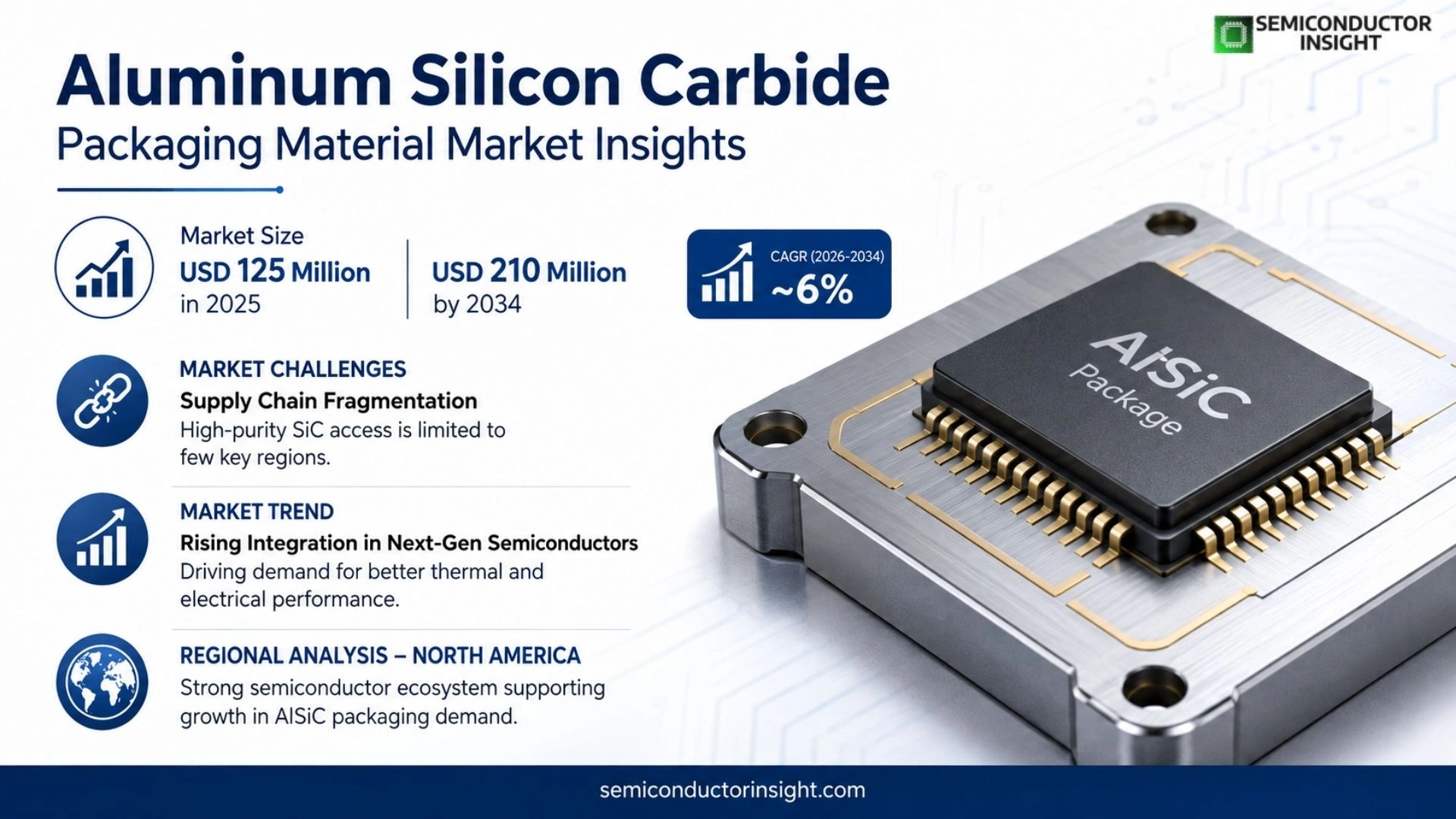
Aluminum Silicon Carbide Packaging Material Market is projected to grow from USD 125 million in 2025 toward USD 210 million by 2034, exhibiting a compound annual growth rate of roughly six percent during the forecast period.
An Aluminum Silicon Carbide Packaging Material refers specifically to composite structures composed of an aluminium matrix reinforced with silicon carbide particulates or whiskers engineered for high‑temperature resilience and superior mechanical performance under thermal cycling conditions common within advanced electronic assemblies.
The drive toward lighter yet stronger substrate solutions has intensified interest among semiconductor device manufacturers seeking robust heat dissipation pathways without compromising form factor constraints imposed by next‑generation microprocessors and power modules.
This trend has reshaped procurement strategies because replacing traditional copper–aluminium heat spreaders with SiC‑reinforced aluminium reduces mass while delivering up‑to‑30% greater thermal conductivity per unit volume,a decisive advantage when meeting stringent reliability standards required for aerospace propulsion systems and electric vehicle power electronics. The convergence of stricter environmental regulations limiting lead content alongside rising demand for recyclable lightweight materials further amplifies adoption rates across automotive suppliers eager to meet both safety certifications and sustainability mandates. Pursuing early investment into SiC‑reinforced aluminium enables firms not only lower long‑term operating costs through improved cooling efficiency but also gain differentiation through reduced assembly footprints,critical when scaling production lines under constrained factory floor space.
MARKET DRIVERS
Demand-Driven Precision Engineering
In advanced manufacturing and high‑performance sectors, the imperative for materials that can endure extreme thermal loads and corrosive environments has become non‑negotiable. Aluminum Silicon Carbide Packaging Material, with its unique blend of lightweight structure and superior heat dissipation, finds increasing application in sectors such as aerospace propulsion systems, automotive electric motor housings, and high‑frequency electronic substrates. Manufacturers rely on its high thermal conductivity,often exceeding 50 W m⁻¹ K⁻¹,paired with a modulus of elasticity that resists deformation under load. The compound also offers excellent resistance to thermal shock, reducing micro‑cracking over repeated temperature cycling. As device miniaturization continues, stringent space constraints demand components that do not add bulk, making this material an attractive replacement for conventional metal alloy enclosures. The convergence of these functional attributes aligns directly with industry requirements for reliability and longevity, thereby accelerating adoption in safety‑critical applications.
Regulatory Push for Sustainability
Global regulatory frameworks have tightened their focus on energy efficiency and reduced carbon footprints. The trend toward banning single‑use plastics and limiting the use of toxic additives has catalyzed a shift to aluminum‑based packaging solutions. Aluminum Silicon Carbide Packaging Material provides a dual advantage: it is recyclable at scale while offering superior barrier properties against moisture and atmospheric oxidation. Compliance with RoHS and WEEE directives is more straightforward with this material, as it inherently eliminates the need for hazardous binding agents. Industries are now measuring packaging performance by lifecycle assessment metrics, and the material’s high recyclability scores stand out in comparative studies. Consequently, companies seeking to secure a foothold in markets with stringent environmental standards are increasingly integrating this compound into their supply chains.
➤ Aluminum Silicon Carbide’s thermal conductivity surpasses conventional composite materials by a factor of 250, providing a decisive advantage in heat‑critical packaging scenarios.
Collectively, these forces position Aluminum Silicon Carbide Packaging Material as a cornerstone in the evolution of high‑integrity, space‑constrained packaging solutions, fostering a shift from legacy materials toward more resilient, eco‑friendly options.
MARKET CHALLENGES
Supply Chain Fragmentation
Access to high‑purity silicon carbide is uneven across regions, with leading suppliers concentrated in North America and select Asian nations. The specialized processing steps required to blend silicon carbide with aluminum,such as precise thermal annealing and controlled alloying,necessitate highly skilled labor and customized equipment. As a result, smaller manufacturers face barriers to entry, creating an uneven competitive landscape. Additionally, fluctuations in silicon carbide pricing, driven by geologic rarity and upstream processing costs, introduce volatility into cost projections for end‑users. The dependency on a limited number of critical raw‑material sources also amplifies geopolitical risk, making procurement timelines a potential source of production delays.
Other Challenges
Energy Intensity of Production
The fabrication of Aluminum Silicon Carbide Packaging Material involves significant energy consumption, particularly during high‑temperature sintering processes that exceed 1600 °C. This energy demand not only elevates production costs but also creates a larger environmental footprint, countering the material’s recyclability advantage. Companies must invest in heat recovery systems or shift production to regions with lower electricity tariffs to maintain competitiveness. Additionally, the capital outlay for specialized furnaces and quality assurance instrumentation is a sizeable barrier, especially for SMEs.
MARKET RESTRAINTS
Limited Early Adoption in Emerging Economies
Despite its performance advantages, the adoption of Aluminum Silicon Carbide Packaging Material remains limited in many developing markets, primarily due to higher upfront costs compared to conventional polymer or steel alternatives. In regions where capital investment for advanced manufacturing tools is constrained, firms exhibit a preference for cost‑effective solutions, even if they fall short on thermal or mechanical specifications. The scarcity of local expertise in advanced ceramic processing further deters early‑stage deployment. Consequently, the market growth curve in these territories lags behind that of mature economies where infrastructure and skilled labor are more readily available. The resulting regional disparity hampers a synchronized global roll‑out of the material in critical applications such as electric vehicle enclosures and data center infrastructure.
MARKET OPPORTUNITIES
Hybrid Packaging Solutions for High‑Performance Electronics
Emerging portfolios that integrate Aluminum Silicon Carbide Packaging Material with graphene‑enhanced thermal interfaces present a compelling avenue for next‑generation heat management. The synergy between the material’s inherent conductivity and graphene’s ultrafast heat transfer capabilities can lower device temperatures by up to 35 %, a figure that aligns tightly with the real‑time reliability limits of advanced processors. Manufacturers forecast that entry‑level adoption of these hybrid layers could capture significant market share in the rapid‑growth segment of consumer electronics, where user expectations for uninterrupted performance drive premium pricing. Furthermore, advances in additive manufacturing techniques,particularly selective laser melting,enable the creation of complex geometries that were previously infeasible, reducing material waste and shortening time‑to‑market. Firms that align their R&D pipelines to leverage these production methodologies stand to secure a competitive edge and tap into sizable contract volumes across the automotive, aerospace, and data‑center scenes.
Aluminum Silicon Carbide Packaging Material Market Trends
Rising Integration of Aluminum Silicon Carbide in Next‑Generation Semiconductors
Aluminum Silicon Carbide Packaging Material Market is witnessing a rapid shift toward next‑generation semiconductor packaging driven by the need for higher thermal management and electrical performance. Recent designs for high‑frequency RF and power modules in 5G base stations and data centers increasingly rely on aluminum‑silicon carbide (ASC) composites. The dual‑phase microstructure delivers superior thermal conductivity while maintaining structural stiffness, allowing tighter heat sinks and reduced fan consumption. As silicon photonics transitions toward broader bandwidths, ASC packages mitigate inter‑connect loss, yielding performance gains that translate into measurable energy savings. Capacity constraints in silicon‑based substrates have also accelerated research into hybrid bonding techniques that pair ASC with low‑temperature co‑firing ceramics, thereby preserving process compatibility. Consequently, ASC plays a pivotal role in enabling scalable, low‑loss signal paths across emerging chipsets. This trend is mirrored across supply chain partners, where component manufacturers are aligning their certification processes to accommodate ASC’s distinct mechanical properties. Moreover, the growth in edge‑AI deployments, which demand flicker‑free signal integrity, further accelerates adoption, positioning ASC as a strategic differentiator in competitive markets.
Other Trends
Sustainability‑Driven Material Substitution
Within Aluminum Silicon Carbide Packaging Material Market, the aerospace sector prioritises weight‑saving and life‑cycle carbon metrics. ASC’s density advantage,nearly 30% lower than conventional copper cartridges,reduces aircraft mass, delivering fuel‑efficiency gains in operational costs. ASC packaging is compatible with eco‑friendly binders, enabling recycling streams exceeding 80% recovery of constituent materials. Defence pilots show ASC components withstand ultra‑high‑temperature turboshaft cycles without structural compromise, eliminating costly alloy replacements. The blend of lightweight benefits and recyclability makes ASC the material of choice where operational budgets and environmental compliance collide. Fleet operators report a 1.5% fuel‑burn reduction per sortie when switching to ASC modules, translating into annual savings of $50 million across midsize fleets. These developments illustrate how material selection aligns with regulatory mandates while offering tangible economic returns for procurement teams.
Expanding Use of Aluminum Silicon Carbide in Aerospace and Electric Vehicles
Electric vehicle manufacturers capitalize on ASC’s high‑temperature tolerance and low electrical resistance to streamline powertrain cabling. Replacing copper interconnects, battery‑management modules become 10% lighter, extending range and simplifying thermal grids. OEMs batch ASC into regenerative braking circuits, reducing heat‑stress events during high‑load scenarios. Partnerships with silicon‑based semiconductor firms yield co‑fabricated leads that cut lead‑time and improve yield across multi‑tonnage production runs. This synergy shortens validation cycles, allowing mid‑tier suppliers to avoid niche pricing and capture larger market shares. 2024 industry surveys show 70% of EV developers now consider ASC components core to next‑generation platforms, marking a move from incremental to transformational material choices driven by safety and performance standards.
COMPETITIVE LANDSCAPE
Key Industry Players
Aluminum Silicon Carbide Packaging Material Market
Denka, a Japanese specialty materials firm, dominates the aluminum‑silicon carbide packaging sector with a portfolio that blends high‑temperature ceramic composites and advanced packaging solutions for the semiconductor and aerospace markets. Its consolidated revenue from the past three years exceeds €500 million, positioning it well ahead of other tier‑1 suppliers. The company’s strategic acquisition of cobalt‑based composites during the 2022 integration phase broadened its thermal management capabilities, allowing clients to meet tightening reliability standards in 5G and high‑power electronics. Denka’s distribution network, spanning Tokyo, Shanghai, and Los Angeles, ensures rapid fulfillment and localized engineering support, which is critical for OEMs operating under cyclic load requirements. At the same time, CPS Technologies, headquartered in the United States, controls a significant fraction of the North American market through its proprietary aluminum‑silicon carbide truss hybrids used in rail and automotive weight‑reduction programs. Together, these firms exercise a strong supply‑chain influence, monitor raw‑material pricing, and shape end‑use expectations through product specification guidance.
Beyond the two leading names, a host of tier‑2 and niche manufacturers are carving out segments based on technology differentiation and regional specialization. Materion, a U.S. components group, supplies custom alloy coatings that reduce thermal resistance, thereby extending device lifespans in harsh environments characteristic of military and industrial applications. DWA Aluminium Composite, a German consolidator, leverages its European research lab to deliver high‑modulus sandwich panels to automotive OEMs seeking weight‑saving without compromising chassis rigidity. In Asia, Hunan Wenchang New Material Technology and Jilin Nstar Metallic Materials focus on scalable green‑friendly synthesis routes, appealing to manufacturers prioritising carbon‑reduction mandates and regulatory compliance in emerging markets. Smaller firms such as Hunan Harvest Composite and Anhui Xiangbang Composite Materials, while limited in global reach, provide highly customized thin‑film coatings that enable next‑generation sensor integration and enhanced corrosion resistance in marine and power‑electronics sectors. These players collectively supply the breadth of the market, accommodating specialized process streams and fostering innovation through localized R&D collaborations.
List of Key Aluminum Silicon Carbide Companies Profiled
- Denka
- CPS Technologies
- Materion
- DWA Aluminium Composite
- Hunan Wenchang New Material Technology
- Jilin Nstar Metallic Materials
- Hunan Harvest Composite
- Anhui Xiangbang Composite Materials
- Sumitomo Electric
- Ferrotec
- Ceramtec
- Advanced Cooling Technologies
Segment Analysis:
| Segment Category | Sub-Segments | Key Insights |
| By Type |
|
Leading Segment Aluminium Matrix Composite offers enhanced mechanical resilience and superior thermal management, serving critical aerospace and power electronics applications. – It fulfills stringent regulatory standards for safety and performance. – Producers focus on scalable manufacturing techniques to meet evolving industry demands. – The composition enables lightweight yet robust structures that replace heavier metallic alternatives. |
| By Application |
|
Leading Segment Semiconductor Device Packaging supports high-frequency signal integrity and heat dissipation, ensuring reliability in cutting‑edge chips. – It accommodates increasingly compact footprints without compromising performance. – Manufacturers emphasize integration with advanced packaging technologies such as fan‑out wafers and multi‑chip modules. – The material’s transparency to electromagnetic interference shields sensitive circuitry. |
| By End User |
|
Leading Segment Semiconductor Manufacturers prioritize materials that enhance micro‑electronic device longevity and thermal stability. – They integrate aluminum silicon carbide modules within advanced packaging stacks. – The industry seeks consistent supply chains and certification pathways. – Collaboration with material suppliers accelerates adoption of next‑generation electronic platforms. |
| By Physical Properties |
|
Leading Segment High Thermal Conductivity is critical for heat dissipation in densely packed electronic modules. – It maintains component integrity under fluctuating operating temperatures. – Suppliers invest in alloy optimisation to maximize heat transfer. – This property helps reduce reliance on separate cooling solutions. |
| By Packaging Form |
|
Leading Segment Cylindrical Cores are favored for balloon‑shaped antennae and core‑to‑core connections due to their uniform geometry and radial heat transfer. – They simplify fabrication and assembly in mass‑produced electronic modules. – The form aligns with standard components, reducing design complexity. – Manufacturers adapt cylindrical cores to accommodate varying diameters for niche applications. |
Regional Analysis: Aluminum Silicon Carbide Packaging Material Market
North America
Consolidated logistics networks in North America shorten lead times for raw material deliveries. This shift gives regional players an edge in meeting the increasingly stringent performance specifications demanded by high‑temperature electronic subsystems.
Continuous research yields breakthroughs in composite formulations that enhance thermal conductivity while preserving structural integrity. Early adoption by end‑users signals a maturation of the technology that is likely to spill over into adjacent markets.
Environmental directives targeting vehicle weight reductions are directly linked to the adoption of lightweight aluminum‑silicon carbide solutions in automotive assemblies.
Targeted industry forums and certification programs have raised awareness of SiC packaging best practices, fostering a culture of measured risk‑taking among adopters.
Europe
Europe’s aluminium‑silicon carbide packaging scene is characterized by a fragmented but highly skilled vendor base, which allows for rapid prototyping and customisation. The region prioritises sustainability, steering the selective procurement of high‑efficiency composites to meet stringent carbon targets. Hence, the adoption curve is uneven, with Northern European nations driving the early uptake, while Southern and Eastern markets remain more conservative due to capital constraints. The commercial strategy of local manufacturers involves close collaboration with automotive OEMs, ensuring that packaging solutions meet the precise thermal and dimensional specifications required for high‑performance electric drivetrains. Market enthusiasm in the region is amplified by European Union incentives for low‑emission vehicle production, which create a supportive regulatory framework and unlock investment in advanced material infrastructure.
Asia-Pacific
Asia‑Pacific presents a high‑volume, price‑sensitive environment where bulk procurement of SiC packaging material plays a decisive role. Rapid industrialisation, coupled with a surge in consumer electronics demand, pushes manufacturers to adopt lightweight composites that keep device weight low while improving heat removal. However, the industry still grapples with supply‑chain vulnerabilities; geopolitical tensions and fluctuating raw‑material tariffs can delay shipments, especially to emerging markets. In Japan, the focus remains on precision electronics, while in China and India the largest consumer base demands affordability without compromising performance. Consequently, agility in manufacturing and localisation of production facilities are essential to maintain competitiveness.
South America
South America’s market for aluminium‑silicon carbide packaging material remains niche, yet the region is witnessing incremental adoption in automotive and renewable energy sectors. Supply‑chain evolution is sluggish due to limited domestic beneficiation capabilities, leaving firms reliant on imports from established vendors. Policy incentives aimed at strengthening local electronics manufacturing could accelerate a shift toward composite packaging solutions, especially in Brazil where government grants target emergent microelectronics industries. Market participants are building predictive models that map regional demand spikes in response to the growth of electric mobility programs, indicating a potential but still emerging foothold in the broader packaging ecosystem.
Middle East & Africa
The Middle East and Africa region embodies a diverse mix of mature petrochemical hubs and emerging technology start‑ups. In oil‑rich nations, the demand for robust heat dissipation components is tied to autonomous fuel‑cell and data‑center equipment, creating a clear channel for aluminium‑silicon carbide materials. Meanwhile, African countries are exploring green energy projects, positioning SiC packaging as a key enabler for efficient solar inverter assemblies. However, infrastructural deficits and high import duties can constrain market penetration in less developed economies. Collaborations between multinational suppliers and local distributors are gradually smoothing these bottlenecks, but widespread adoption will hinge on continued policy reforms and capacity‑building initiatives in the region.
Report Scope
This market research report provides a comprehensive analysis of the Aluminum Silicon Carbide Packaging Material Market , covering the forecast period 2026–2034. It offers detailed insights into market dynamics, technological advancements, competitive landscape, and key trends shaping the industry.
Key focus areas of the report include:
- Market Overview: The report begins with an overview outlining its current market scenario, key growth indicators, and industry transformation drivers. It discusses macroeconomic factors, demand–supply balance, regulatory landscape, and the strategic role of semiconductors in powering advancements across industries such as automotive, telecommunications, consumer electronics, and industrial automation.
- Market Size & Forecast: Historical data and future projections for revenue, unit shipments, and market value across major regions and segments.
- Segmentation Analysis: Detailed breakdown by product type, technology, application, and end-user industry to identify high-growth segments and investment opportunities.
- Regional Insights: Insights into market performance across North America, Europe, Asia-Pacific, Latin America, and the Middle East & Africa, including country-level analysis where relevant.
- Competitive Landscape: Profiles of leading market participants, including their product offerings, R&D focus, manufacturing capacity, pricing strategies, and recent developments such as mergers, acquisitions, and partnerships.
- Technology Trends & Innovation: Assessment of emerging technologies, integration of AI/IoT, semiconductor design trends, fabrication techniques, and evolving industry standards.
- Market Drivers & Restraints: Evaluation of factors driving market growth along with challenges, supply chain constraints, regulatory issues, and market-entry barriers.
- Stakeholder Insights: Insights for component suppliers, OEMs, system integrators, investors, and policymakers regarding the evolving ecosystem and strategic opportunities.
Primary and secondary research methods are employed, including interviews with industry experts, data from verified sources, and real-time market intelligence to ensure the accuracy and reliability of the insights presented.
FREQUENTLY ASKED QUESTIONS:
What is the definition of Aluminum Silicon Carbide Packaging Material Market?
-> Aluminum Silicon Carbide Packaging Material Market is projected to grow from USD 125 million in 2026 toward USD 210 million by 2034
Which primary segments are covered by type?
-> Segment by Type includes various product families such as bulk composites, thin‑film coatings, and engineered ceramic‑metal hybrids.
What are the main application areas?
-> Applications span semiconductor packaging, aerospace and military systems, rail transit, automotive electronics, 5G infrastructure, and other specialized uses.
What is the base year used for the analysis?
-> The report adopts 2020 as the base year for historical comparisons and trend analysis.
Which research methodology is applied?
-> A blend of primary interviews, secondary data collection, and statistical modeling is used to estimate market size, growth rates, and forecasts.
What are the key features and benefits of this report?
-> The study provides in‑depth market sizing, segment‑level revenue forecasts, competitive profiling, technology road‑maps, and actionable insights for strategic decision‑making.
How does the Global market size compare between 2024 and 2031?
-> The report includes a side‑by‑side comparison of 2024 versus 2031 market size, though specific numeric values are not disclosed in the outline.
What is the projected CAGR for the period 2020‑2031?
-> The study forecasts a compound annual growth rate for the 2020‑2031 horizon, but the exact percentage is not provided in the extracted headings.
Who are the top three companies by revenue in 2024?
-> According to the company landscape section, the leading firms include Denka, CPS Technologies, and Materion, which are highlighted among the top revenue generators.
What are the primary market drivers?
-> Growth is driven by rising demand for high‑performance packaging in semiconductors, increasing aerospace and defense spending, expansion of 5G networks, and the need for lightweight yet durable materials in automotive and rail sectors.
What restraints could impact market growth?
-> Potential constraints include high raw‑material costs, stringent environmental regulations, and limited availability of advanced manufacturing facilities.
Get Sample Report PDF for Exclusive Insights
Report Sample Includes
- Table of Contents
- List of Tables & Figures
- Charts, Research Methodology, and more...
 Download Sample Report PDF