Thermal Interface Material (TIM, Grease, Phase Change) Market Insights
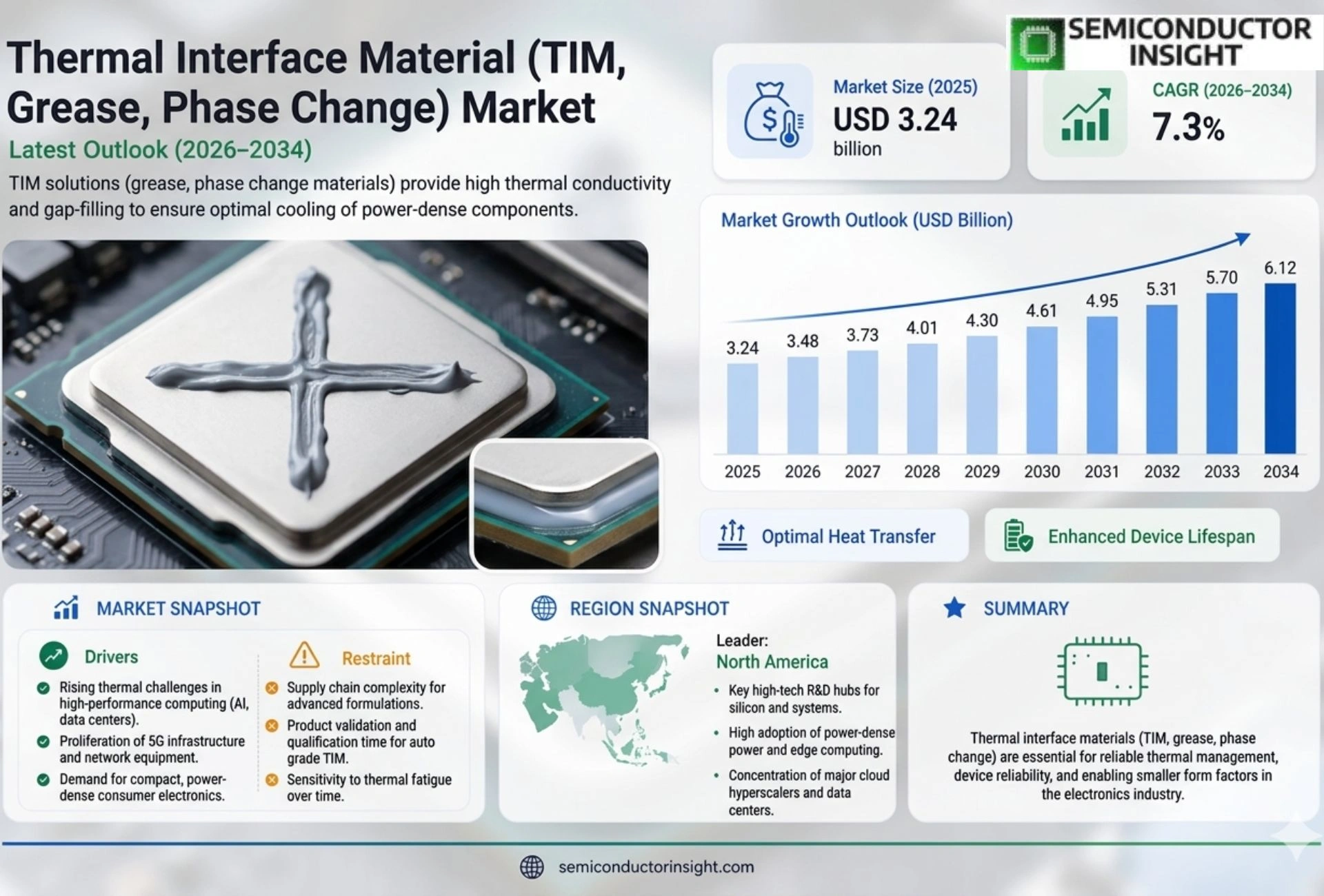
Global Thermal Interface Material (TIM, Grease, Phase Change) Market size was valued at USD 3.24 billion in 2025. The market is projected to grow from USD 3.48 billion in 2025 to USD 6.15 billion by 2034, exhibiting a CAGR of 7.3% during the forecast period.
Thermal Interface Materials encompass specialized substances designed to enhance thermal conductivity between two mating surfaces, thereby improving heat dissipation in electronic assemblies. These materials include thermal greases, phase change materials, gap fillers, adhesives, and tapes, each engineered to address specific thermal management challenges across diverse applications such as consumer electronics, automotive electronics, telecommunications equipment, and industrial machinery.
The market is experiencing robust expansion driven by escalating demand for miniaturized electronic devices with higher power densities, coupled with the proliferation of electric vehicles requiring sophisticated battery thermal management systems. Furthermore, the accelerating deployment of data centers and 5G infrastructure necessitates advanced cooling solutions because overheating remains a critical reliability concern. While silicone-based formulations currently dominate market share due to their proven performance characteristics and cost-effectiveness, emerging alternatives including graphite-based and metal-based TIMs are gaining traction particularly in high-performance computing applications where thermal resistance minimization is paramount.
MARKET DRIVERS
Growing Demand in Electronics Industry
Thermal Interface Material (TIM, Grease, Phase Change) Market is significantly propelled by the increasing miniaturization and power density of electronic devices. With devices such as smartphones, laptops, and data center servers generating substantial heat, there is an imperative need for efficient thermal management solutions to prevent overheating and ensure performance reliability. This trend is driving the adoption of advanced TIMs, including high-performance greases and phase change materials, which offer superior thermal conductivity and mechanical compliance.
Expansion in Automotive and Renewable Energy Sectors
The rise of automotive electronics, particularly in electric vehicles (EVs), alongside growth in renewable energy applications like solar inverters, is augmenting the demand for robust and durable thermal interface materials. These sectors require TIMs capable of operating under harsh environmental conditions while maintaining thermal efficiency, thereby pushing innovation and market expansion.
➤ Increasing integration of TIMs in emerging technologies is crucial for enhancing device longevity and operational safety.
Additionally, government regulations focusing on energy efficiency are accelerating the use of advanced TIMs across multiple industrial domains, ensuring faster heat dissipation and reducing energy wastage.
MARKET CHALLENGES
Technical and Application Challenges
Despite advancements, Thermal Interface Material (TIM, Grease, Phase Change) Market confronts several technical challenges such as material degradation over time and thermal cycling reliability. Selecting the appropriate TIM for different substrates and operational environments requires precise engineering, which can complicate widespread deployment. Some materials, like phase change TIMs, require specific temperature ranges to perform optimally, limiting their application scope.
Other Challenges
Material Compatibility
Ensuring compatibility between TIMs and varying electronic packaging materials remains challenging, as inappropriate selection can lead to adhesion loss or reduced thermal conductivity.
MARKET RESTRAINTS
Cost Sensitivity and Supply Chain Constraints
The cost-effectiveness of high-performance Thermal Interface Materials restricts their adoption in cost-sensitive segments, particularly in consumer electronics with tight profit margins. Additionally, the supply chain disruptions experienced globally have impacted raw material availability, delaying production timelines. Fluctuations in prices of key raw materials such as silicone and graphite exacerbate this restraint, affecting pricing strategies across the market.
MARKET OPPORTUNITIES
Advancements in Material Science and Emerging Applications
Continuous research leading to novel compositions, such as nano-enhanced TIMs with improved thermal conductivity and mechanical durability, presents significant growth opportunities. Furthermore, expanding applications in wearable electronics, 5G infrastructure, and artificial intelligence hardware offer fresh avenues for market expansion.
The increasing awareness regarding sustainable and eco-friendly thermal materials also encourages innovation in biodegradable and recyclable TIMs, aligning with global environmental goals. These trends collectively offer strategic opportunities for manufacturers to differentiate their portfolios and capture emerging market segments.
Trends
Rising Demand Driven by Miniaturization and Advanced Electronics
Thermal Interface Material (TIM, Grease, Phase Change) Market is witnessing substantial growth due to technological advancements in electronic devices that demand improved thermal management. The increasing miniaturization of electronic components with higher power densities has intensified the necessity for efficient heat dissipation solutions. This trend is prominently seen in consumer electronics, automotive systems, and telecommunication infrastructure where managing thermal resistance is critical to device reliability and longevity.
Other Trends
Emergence of Electric Vehicles and Battery Thermal Management
The rapid adoption of electric vehicles has become a significant growth engine for Thermal Interface Material (TIM, Grease, Phase Change) Market. The complex thermal management needs of EV battery systems require specialized TIMs that offer enhanced thermal conductivity and durability. As manufacturers strive to optimize battery life and safety, the market is seeing a shift towards materials with superior performance under variable thermal conditions.
Growth of Data Centers and 5G Infrastructure
Accelerating deployment of data centers and 5G networks is driving additional demand for reliable thermal interface materials. The increased heat generation from high-performance computing hardware necessitates advanced TIMs that can maintain low thermal resistance and ensure operational efficiency. This trend is encouraging innovation in new formulations, including emerging graphite-based and metal-based TIMs, which offer advantages over traditional silicone-based options in critical applications.
Shifts in Material Composition and Market Preferences
While silicone-based thermal interface materials continue to dominate the market due to their established efficacy and cost efficiency, there is a noticeable shift towards alternative compositions. Graphite-based and metal-based TIMs are gaining traction, particularly in environments requiring minimal thermal resistance. Their adoption reflects a broader market emphasis on high-performance solutions to meet the rigorous demands of next-generation electronic devices and industrial equipment.
COMPETITIVE LANDSCAPE
Key Industry Players
Competitive Dynamics in the Thermal Interface Material Market
Thermal Interface Material (TIM) market is characterized by a mix of established multinational corporations and specialized manufacturers, each contributing to the advancement of thermal management solutions. Leading companies such as Henkel AG & Co. KGaA hold a significant position due to their extensive product portfolio that includes thermal greases, phase change materials, and adhesives tailored for diverse industrial applications. The market structure is influenced by high demand from sectors including consumer electronics, automotive, and telecommunications, necessitating continual innovation and quality assurance. Silicone-based TIM products dominate the market segment, which favors manufacturers with strong R&D capabilities and global distribution networks.
Emerging niche players like Laird Performance Materials and II-VI Incorporated emphasize high-performance graphite-based and metal-based TIM products, targeting specialized arenas such as high-performance computing and electric vehicle battery management. Other notable manufacturers such as BERGQUIST and Shin-Etsu Chemical are advancing phase change materials and gap fillers, strengthening their footprint in precision thermal management. The competitive landscape is further shaped by a growing emphasis on sustainable and cost-effective solutions, fostering collaboration between technology developers and end-users to meet escalating thermal requirements in advanced electronics and 5G infrastructure deployments.
List of Key Thermal Interface Material Companies Profiled
- Henkel AG & Co. KGaA
- Laird Performance Materials
- II-VI Incorporated
- BERGQUIST
- Shin-Etsu Chemical Co., Ltd.
- ESS Technologies
- Panasonic Corporation
- 3M Company
- Honeywell International Inc.
- Kyocera Corporation
- Thermal Grizzly GmbH
- Fujipoly America Corporation
- DuPont de Nemours, Inc.
- Cold Chain Technologies, Inc.
- Saint-Gobain Performance Plastics
Segment Analysis:
| Segment Category | Sub-Segments | Key Insights |
| By Type |
|
Thermal Interface Material (TIM) remains central due to its versatile use in electronic cooling, offering excellent thermal conductivity and adaptability across various substrates. – Thermal Grease is favored for its pliability and ability to fill microscopic air gaps, enhancing heat transfer between components in compact electronics. – Phase Change Materials offer unique advantages by altering their physical state to optimize thermal conductivity during operation, making them ideal for applications demanding consistent thermal management through fluctuating temperatures. Together, these types address the critical need for efficient heat dissipation in increasingly miniaturized and high-power density electronic devices. |
| By Application |
|
Consumer Electronics drives demand due to the continuing trend of device miniaturization where efficient thermal management is essential for performance and reliability. – Automotive Electronics applications see increased integration of thermal interface materials especially in electric vehicle battery systems where temperature regulation is critical for safety and longevity. – Telecommunications Equipment benefits from advanced cooling solutions amidst rapid data center expansion and 5G network deployments, addressing the heightened thermal loads of high-speed processing units. – Industrial Machinery utilizes TIMs to enhance operational efficiency and equipment lifespan by mitigating overheating in heavy-duty applications. |
| By End User |
|
Original Equipment Manufacturers (OEMs) leverage TIMs extensively to integrate thermal management early in the product design phase, ensuring performance consistency and regulatory compliance. – Contract Manufacturers focus on flexibility and cost-effectiveness while maintaining thermal reliability across diverse products. – Aftermarket Users seek TIM solutions for maintenance and upgrades that optimize device longevity and thermal performance without complete system replacement. |
| By Material Base |
|
Silicone-Based Materials continue to dominate due to their cost efficiency and proven thermal performance in a wide range of standard applications. – Emerging Graphite-Based TIMs are gaining traction in high-performance scenarios by virtue of their superior thermal conductivity and lightweight nature. – Metal-Based TIMs offer specialized solutions in sectors demanding minimal thermal resistance and sustainable heat dissipation under extreme operating conditions. Overall, material innovation is a critical driver enhancing thermal management capabilities to meet evolving industry challenges. |
| By End-Use Industry |
|
Information Technology sector demands TIMs to manage heat in servers and high-performance computing systems where reliability is paramount. – Automotive applications increasingly require advanced thermal materials to support electric vehicle systems and in-car electronics. – Healthcare equipment benefits from TIM innovations that ensure efficient thermal management in sensitive diagnostic and treatment devices, enhancing safety and function. These industries drive focused innovation and adoption trends shaping the market’s future trajectory. |
Regional Analysis: North America Thermal Interface Material (TIM, Grease, Phase Change) Market
North America
The North American market leads in integrating cutting-edge TIM solutions, focusing on enhancing thermal conductivity and reducing interface resistance. Innovations such as nano-enhanced greases and advanced phase change materials cater to the high-demand sectors like aerospace and data centers, ensuring optimal heat dissipation in compact designs.
The growing use of consumer electronics, automotive electrification, and 5G deployment are major drivers. Rising investments in electric vehicles increase the need for efficient thermal management systems, positioning the Thermal Interface Material market for steady growth in this region.
North America benefits from established manufacturing ecosystems and a reliable supplier network for raw materials such as silicone and graphite. The proximity to end-use industries supports efficient logistics and faster time-to-market, critical for technology-driven sectors.
Stringent environmental regulations incentivize the development of eco-friendly and sustainable TIM products. North America’s regulatory framework encourages innovations that reduce environmental impact, simultaneously addressing thermal management and compliance challenges.
Europe
Europe’s Thermal Interface Material market is characterized by a strong focus on sustainability and energy efficiency, propelled by stringent environmental policies. The automotive and industrial sectors drive demand, particularly in countries like Germany and France where innovation in electric mobility and industrial automation is advancing. Collaborative efforts among manufacturers and research institutions foster the development of bio-based and high-performance TIM products, positioning Europe as a competitive and environmentally conscious market.
Asia-Pacific
Asia-Pacific dominates the global Thermal Interface Material market in volume due to the rapid expansion of consumer electronics manufacturing and growing adoption of electric vehicles across China, Japan, and South Korea. The region benefits from cost-effective manufacturing and a vast base of electronics production. Market demand here is shaped by high-performance TIM materials needed for compact, high-power devices and increasingly sophisticated thermal management requirements in telecommunications and computing sectors.
South America
South America’s Thermal Interface Material market remains nascent but is gradually gaining momentum driven by the growth in automotive electronics and increasing electronics consumption. Brazil and Argentina lead regional demand, supported by emerging investments in advanced manufacturing and infrastructure development. While challenges remain in supply chain logistics and raw material accessibility, there is a growing focus on adopting reliable TIM solutions for enhanced device performance.
Middle East & Africa
The Middle East and Africa Thermal Interface Material market is developing with rising technology adoption and infrastructure expansion efforts, notably in the UAE and South Africa. Initiatives to diversify economies and advance electronics industries are boosting demand for advanced thermal management materials. However, limited local manufacturing capacity necessitates reliance on imports, prompting market players to explore partnerships to strengthen presence and supply chain efficiency in the region.
Report Scope
This market research report provides a comprehensive analysis of the Thermal Interface Material (TIM, Grease, Phase Change) Market , covering the forecast period 2026–2034. It offers detailed insights into market dynamics, technological advancements, competitive landscape, and key trends shaping the industry.
Key focus areas of the report include:
- Market Overview: The report begins with an overview outlining its current market scenario, key growth indicators, and industry transformation drivers. It discusses macroeconomic factors, demand–supply balance, regulatory landscape, and the strategic role of semiconductors in powering advancements across industries such as automotive, telecommunications, consumer electronics, and industrial automation.
- Market Size & Forecast: Historical data and future projections for revenue, unit shipments, and market value across major regions and segments.
- Segmentation Analysis: Detailed breakdown by product type, technology, application, and end-user industry to identify high-growth segments and investment opportunities.
- Regional Insights: Insights into market performance across North America, Europe, Asia-Pacific, Latin America, and the Middle East & Africa, including country-level analysis where relevant.
- Competitive Landscape: Profiles of leading market participants, including their product offerings, R&D focus, manufacturing capacity, pricing strategies, and recent developments such as mergers, acquisitions, and partnerships.
- Technology Trends & Innovation: Assessment of emerging technologies, integration of AI/IoT, semiconductor design trends, fabrication techniques, and evolving industry standards.
- Market Drivers & Restraints: Evaluation of factors driving market growth along with challenges, supply chain constraints, regulatory issues, and market-entry barriers.
- Stakeholder Insights: Insights for component suppliers, OEMs, system integrators, investors, and policymakers regarding the evolving ecosystem and strategic opportunities.
Primary and secondary research methods are employed, including interviews with industry experts, data from verified sources, and real-time market intelligence to ensure the accuracy and reliability of the insights presented.
FREQUENTLY ASKED QUESTIONS:
What is the current market size of Thermal Interface Material (TIM, Grease, Phase Change) Market?
-> Thermal Interface Material (TIM, Grease, Phase Change) Market was valued at USD 3.24 billion in 2025 and is expected to reach USD 6.15 billion by 2034, exhibiting a CAGR of 7.3% during the forecast period.
Which key companies operate Thermal Interface Material (TIM, Grease, Phase Change) Market?
-> Key players include Axalta Coating Systems, AkzoNobel, BASF SE, PPG, Sherwin-Williams, and 3M, among others.
What are the key growth drivers?
-> Key growth drivers include increasing demand for miniaturized electronic devices with higher power densities, electric vehicle battery thermal management systems, and the growth of data centers and 5G infrastructure.
Which region dominates the market?
-> Asia-Pacific is the fastest-growing region due to its expansive electronics manufacturing base, while Europe remains a significant market driven by automotive electronics and industrial applications.
What are the emerging trends?
-> Emerging trends include silicone-based TIM dominance, growing adoption of graphite-based and metal-based thermal interface materials for high-performance computing, and advanced cooling solutions targeting thermal resistance minimization.

Get Sample Report PDF for Exclusive Insights
Report Sample Includes
- Table of Contents
- List of Tables & Figures
- Charts, Research Methodology, and more...
 Download Sample Report PDF