Switch Transistor Market Insights
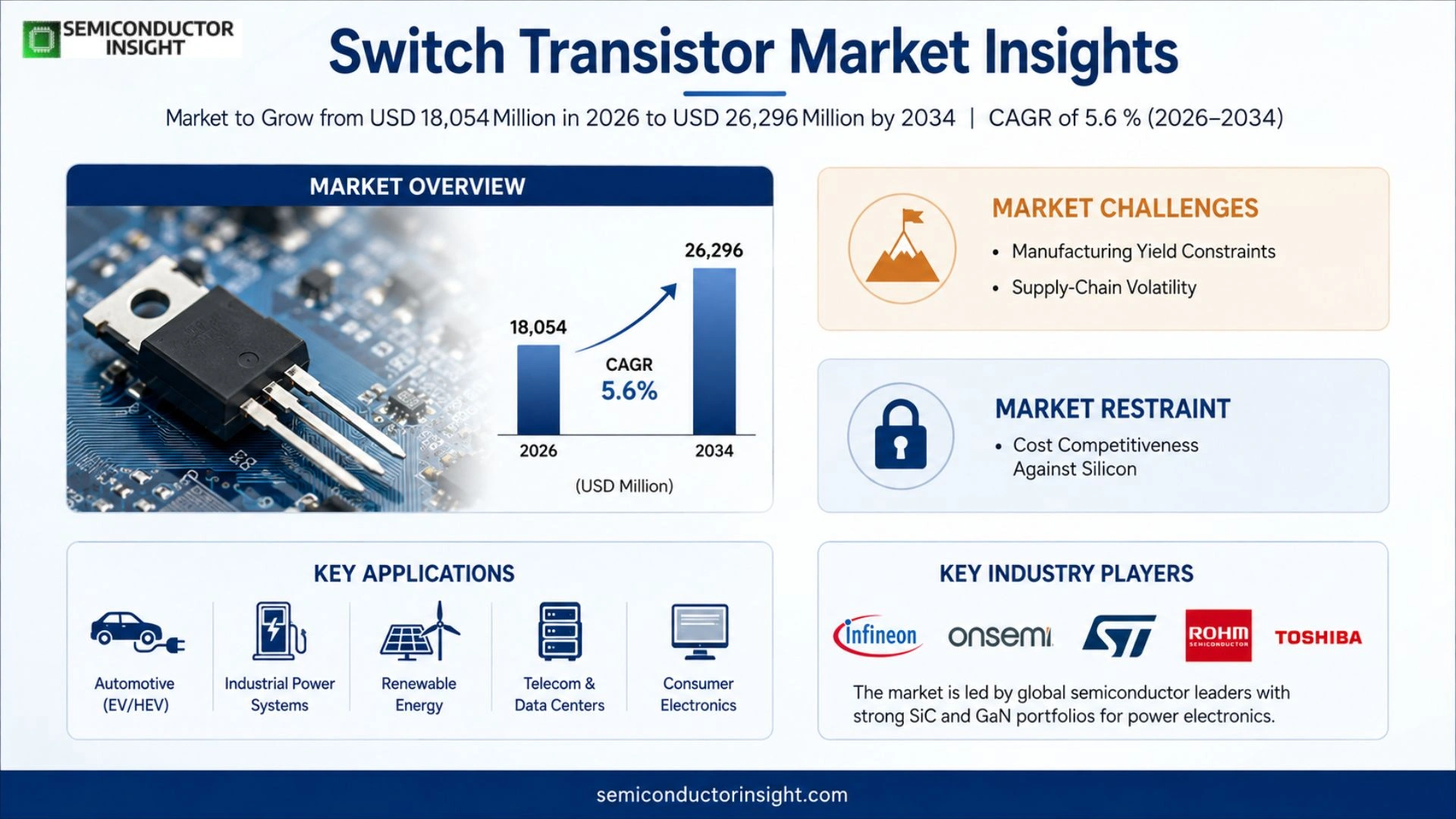
Global Switch Transistor market is projected to grow from USD 18,054 million in 2026 to USD 26,296 million by 2034, exhibiting a CAGR of 5.6 % during the forecast period.
A Switch Transistor is a solid‑state semiconductor device that functions as a variable current switch, precisely controlling the on‑off state of output current based on input voltage or current. Its core physical essence lies in using electrical signals to achieve high‑speed cutting and conduction of circuits. Unlike traditional mechanical switches that rely on physical contacts, Switch Transistor completes its switching action through the bias‑state transition of a PN junction, with laboratory switching speeds exceeding 100 GHz. Bipolar Switch Transistors are divided into PNP and NPN types, adjusting conduction between collector and emitter via base‑current control; Field‑Effect Switch Transistors modulate channel conductivity between source and drain through gate voltage.
The market is experiencing rapid expansion because electric‑vehicle electrification multiplies demand for power‑switching components such as drive‑inverters and battery‑management systems. Wide‑bandgap materials,silicon carbide and gallium nitride,enable operation at higher voltages, frequencies and temperatures, meeting urgent renewable‑energy conversion needs. Legislative pushes for energy efficiency and semiconductor supply‑chain localization further accelerate adoption across automotive, industrial automation and communications equipment sectors.
MARKET DRIVERS
Technology Adoption in Power Electronics
Switch Transistor Market is being reshaped by the migration of automotive and industrial designers toward silicon‑carbide (SiC) and gallium‑nitride (GaN) architectures. These materials lower conduction losses and enable higher switching frequencies, which translate into lighter, more compact power converters. OEMs are therefore incentivising component suppliers to deliver transistors that can sustain demanding thermal cycles while preserving efficiency.
Demand for Energy‑Efficient Systems
Regulatory pressure for reduced carbon footprints is prompting manufacturers of data‑center infrastructure and renewable‑energy converters to adopt devices that minimise idle power draw. The ability of modern switch transistors to achieve sub‑nanosecond transition times directly supports the design of ultra‑efficient inverters, which in turn drives procurement volumes across the supply chain.
➤ “Every 1 % improvement in transistor efficiency can shave several megawatts of waste heat in large‑scale installations,” a senior engineering director noted.
Beyond compliance, the cost advantage of fewer heat‑sink components and reduced cooling requirements is prompting end‑users to prioritize advanced switch transistors, reinforcing a virtuous cycle of higher adoption rates.
MARKET CHALLENGES
Manufacturing Yield Constraints
Fabricating SiC and GaN wafers at scale still encounters defect densities that exceed those of mature silicon processes. Yield shortfalls raise unit costs, making Switch Transistor Market less attractive for price‑sensitive segments such as consumer electronics. Suppliers are forced to invest heavily in clean‑room upgrades and advanced inspection tools to close the gap.
Other Challenges
Supply‑Chain Volatility
The reliance on specialty raw materials, coupled with geopolitical tensions, introduces lead‑time uncertainty. Procurement teams are therefore re‑evaluating inventory strategies, which can dampen short‑term order volumes.
MARKET RESTRAINTS
Cost Competitiveness Against Silicon
Despite performance gains, the premium price of SiC and GaN transistors remains a hurdle for widespread displacement of silicon‑based devices. Many manufacturers hesitate to commit capital until a clear total‑cost‑of‑ownership advantage materialises, especially in legacy product lines where redesign costs are non‑trivial.
Design‑Tool Ecosystem Gaps
Electronic design automation (EDA) packages have only recently integrated comprehensive models for wide‑bandgap transistors. The learning curve associated with new design rules slows adoption, as engineering teams allocate time to validate simulation accuracy before moving to production.
MARKET OPPORTUNITIES
Emerging Applications in Renewable Energy
Utility‑scale solar inverters and offshore wind converters demand converters that can operate at higher voltages with minimal losses. Switch Transistor Market stands to benefit from contracts that specify wide‑bandgap devices, as they enable lighter transformer‑less architectures and reduce balance‑of‑system costs.
Growth of Edge‑Computing Platforms
Edge devices require power modules that can sustain rapid on/off cycles while staying within tight thermal envelopes. The confluence of AI workloads at the edge and the need for compact power supplies creates a niche where advanced switch transistors can command a price premium.
Switch Transistor Market Trends
Electrification of Vehicles Fuels Demand Surge
The shift toward battery‑electric drivetrains has amplified the need for high‑performance switching components. Power‑train converters, battery‑management units and on‑board chargers each rely on devices capable of handling elevated voltages and currents while maintaining tight control loops. As automakers scale production, the cumulative count of transistors per vehicle has risen sharply, making them a pivotal element in overall vehicle efficiency. Suppliers that can guarantee low‑loss operation at frequencies above 200 kHz are seeing their designs adopted across multiple EV platforms, translating into a measurable uplift for the broader market.
Other Trends
Material Innovation Shifts
Silicon carbide and gallium nitride have entered mainstream designs, offering thermal resilience and reduced parasitic losses compared with traditional silicon devices. Although the unit price of these wide‑bandgap solutions remains higher, manufacturers are targeting premium segments where reliability and performance outweigh cost considerations. Early adopters report up to 30 % improvement in inverter efficiency, a figure that directly supports longer vehicle range targets. The ongoing refinement of epitaxial growth techniques is gradually narrowing the cost gap, hinting at broader acceptance in the mid‑tier market within the next few years.
Regional Production and Supply Dynamics
Asia‑Pacific continues to dominate both fabrication capacity and consumption, benefitting from a dense network of semiconductor foundries and a robust electronics manufacturing ecosystem. North America leverages its research institutions and leading EV manufacturers to drive high‑volume orders for next‑generation devices, reinforcing its role as an innovation hub. Europe, guided by energy‑efficiency regulations, has accelerated procurement of high‑reliability transistors for both automotive and renewable‑energy projects. Nevertheless, the concentration of wafer‑fab facilities in a limited number of locations creates exposure to geopolitical and material‑supply shocks, prompting several OEMs to diversify their supplier base. Companies that establish localized production lines or secure multi‑source agreements are better positioned to mitigate lead‑time volatility and sustain growth in the competitive landscape.
COMPETITIVE LANDSCAPE
Key Industry Players
Switch Transistor Market – Competitive Player Overview
Switch Transistor arena is dominated by a handful of multinational semiconductor firms that combine deep silicon‑carbide (SiC) and gallium‑nitride (GaN) portfolios with extensive automotive and power‑electronics pedigrees. Infineon (DE) leverages its SiC power‑device platform to secure large contracts with European EV makers, while ON Semiconductor (US) exploits a broad catalog of bipolar and MOSFET switches that feed North American automotive and industrial customers. Texas Instruments (US) sustains market share through aggressive pricing on mature silicon products and a robust design‑win program targeting consumer‑electronics OEMs. Vishay (US) differentiates with high‑voltage SiC modules tailored for renewable‑energy inverters, and STMicroelectronics (FR) capitalizes on its integrated driver‑IC ecosystem to embed Switch Transistors in automotive power‑train architectures. Collectively these leaders account for roughly half of global revenue, setting pricing benchmarks and driving standard‑setting initiatives across the supply chain.
Beyond the core conglomerates, a diverse set of niche players adds depth to the competitive field. Fuji Electric (JP) and Toshiba (JP) specialize in high‑frequency field‑effect devices for railway traction and data‑center power supplies, benefitting from strong domestic manufacturing ecosystems. Wolfspeed (US) commands the premium SiC segment with a focus on high‑power, high‑temperature modules for fast‑charging infrastructure. Rohm (JP) and Littelfuse (US) pursue mid‑range GaN switches for industrial automation, where size and thermal efficiency are paramount. MACOM (US) supplies RF‑optimized Switch Transistors for 5G base stations, while Chinese firms such as Sino‑MicroElectronics, JIEJIE MicroElectronics, and Silan (CN) accelerate market entry through aggressive cost structures and rapid capacity expansion, targeting emerging consumer‑electronics and EV‑charging niches. These companies intensify price competition and broaden the technology mix available to system designers.
List of Key Switch Transistor Companies Profiled
- Infineon
- ON Semiconductor
- Texas Instruments
- Vishay
- STMicroelectronics
- Fuji Electric
- Toshiba
- Wolfspeed
- Rohm
- Littelfuse
- MACOM
- Sino‑MicroElectronics
- JIEJIE MicroElectronics
- Silan
Segment Analysis:
| Segment Category | Sub-Segments | Key Insights |
| By Type |
|
Bipolar Junction Switch Transistor – prized for its robustness in high‑current power paths; ‑ Enables reliable operation in automotive power‑train modules where thermal endurance is critical; ‑ Preferred where legacy circuit designs demand proven bias‑current control mechanisms. |
| By Application |
|
Automotive Electronics – central to inverter and on‑board charger architectures; ‑ Drives efficiency gains in electric‑vehicle power conversion; ‑ Supports stringent reliability standards demanded by safety‑critical vehicular systems. |
| By End User |
|
Electric Vehicles – dictate the need for high‑frequency, high‑voltage switching; ‑ Accelerates adoption of wide‑bandgap devices for faster charge‑discharge cycles; ‑ Influences overall vehicle efficiency and range performance. |
| By Polarity |
|
NPN Switch Transistor – dominates legacy power‑stage designs; ‑ Offers straightforward drive requirements for discrete driver circuits; ‑ Remains the fallback choice where design simplicity outweighs performance extremes. |
| By Material |
|
Silicon Carbide Switch Transistor – enables operation at higher voltages and temperatures; ‑ Critical for next‑generation EV inverters and renewable‑energy converters; ‑ Drives system‑level efficiency improvements despite higher upfront cost considerations. |
Regional Analysis: Switch Transistor Market
North America
Silicon Valley and the Boston corridor serve as incubators for switch transistor breakthroughs, where startups leverage venture capital to explore gallium‑nitride and silicon‑carbide integrations that push switching speeds beyond conventional silicon limits.
Long‑term agreements between wafer fabs and assembly houses smooth the flow of critical substrates, allowing manufacturers to meet automotive and telecom demand spikes without resorting to rapid capacity expansions.
Federal initiatives promote energy‑efficiency standards that incentivize designers to adopt high‑performance switch transistors, creating a feedback loop between policy and product evolution.
Tier‑1 OEMs prioritize components that deliver lower on‑resistance and faster turn‑off times, accelerating the migration from legacy MOSFETs to next‑gen switch transistor families.
Europe
European manufacturers draw strength from a robust standards framework that aligns power‑electronics design across the automotive and renewable‑energy sectors. Germany’s emphasis on precision engineering dovetails with France’s focus on sustainable mobility, fostering collaborative projects that test switch transistor performance under stringent reliability criteria. The region’s financing mechanisms, such as Horizon Europe grants, nurture research into wide‑bandgap materials, enabling firms to address the latency demands of edge‑computing installations. While the market remains fragmented, cross‑border consortia are gradually harmonizing design tools, which reduces time‑to‑market for innovative transistor packs.
Asia‑Pacific
Asia‑Pacific exhibits a rapid scaling of production capacity, driven by dense manufacturing clusters in China, Taiwan, and South Korea. These hubs excel at cost‑efficient silicon processing, allowing local OEMs to incorporate switch transistors into consumer electronics and electric‑vehicle platforms at competitive price points. However, the region contends with intellectual‑property considerations that shape partnership strategies, prompting many firms to adopt joint‑development agreements with Western design houses. The growing emphasis on energy‑saving regulations in Japan and India further nudges designers toward higher‑efficiency switch transistor solutions.
South America
South American activity centers on adapting switch transistor technology to the region’s expanding renewable‑energy infrastructure, especially wind and solar farms in Brazil and Chile. Local utilities favor devices that can handle fluctuating grid conditions while minimizing thermal footprints. Limited domestic fab capacity leads to a reliance on imported wafers, but strategic alliances with North American suppliers are mitigating lead‑time concerns. Emerging policy incentives aimed at grid modernization are spurring demand for more sophisticated power‑conversion modules.
Middle East & Africa
In the Middle East and Africa, Switch Transistor Market is influenced by large‑scale desalination and oil‑field electrification projects that require robust, high‑temperature components. The United Arab Emirates’ focus on smart‑city initiatives encourages the integration of advanced power‑management chips, while African nations are beginning to explore off‑grid solar solutions that depend on efficient switching. Partnerships with global equipment providers are facilitating technology transfer, positioning the region to adopt next‑generation transistor designs as infrastructure projects mature.
Report Scope
This market research report provides a comprehensive analysis of the Switch Transistor Market , covering the forecast period 2026–2034. It offers detailed insights into market dynamics, technological advancements, competitive landscape, and key trends shaping the industry.
Key focus areas of the report include:
- Market Overview: The report begins with an overview outlining its current market scenario, key growth indicators, and industry transformation drivers. It discusses macroeconomic factors, demand–supply balance, regulatory landscape, and the strategic role of semiconductors in powering advancements across industries such as automotive, telecommunications, consumer electronics, and industrial automation.
- Market Size & Forecast: Historical data and future projections for revenue, unit shipments, and market value across major regions and segments.
- Segmentation Analysis: Detailed breakdown by product type, technology, application, and end-user industry to identify high-growth segments and investment opportunities.
- Regional Insights: Insights into market performance across North America, Europe, Asia-Pacific, Latin America, and the Middle East & Africa, including country-level analysis where relevant.
- Competitive Landscape: Profiles of leading market participants, including their product offerings, R&D focus, manufacturing capacity, pricing strategies, and recent developments such as mergers, acquisitions, and partnerships.
- Technology Trends & Innovation: Assessment of emerging technologies, integration of AI/IoT, semiconductor design trends, fabrication techniques, and evolving industry standards.
- Market Drivers & Restraints: Evaluation of factors driving market growth along with challenges, supply chain constraints, regulatory issues, and market-entry barriers.
- Stakeholder Insights: Insights for component suppliers, OEMs, system integrators, investors, and policymakers regarding the evolving ecosystem and strategic opportunities.
Primary and secondary research methods are employed, including interviews with industry experts, data from verified sources, and real-time market intelligence to ensure the accuracy and reliability of the insights presented.
FREQUENTLY ASKED QUESTIONS:
What is the current market size of Switch Transistor Market?
-> Switch Transistor market is projected to grow from USD 18,054 million in 2026 to USD 26,296 million by 2034, exhibiting a CAGR of 5.6 %
Which key companies operate in Switch Transistor Market?
-> Key players include Infineon (DE), ON Semiconductor (US), Texas Instruments (US), Vishay (US), Fuji Electric (JP), STMicroelectronics (FR), Toshiba (JP), Wolfspeed (US), Rohm (JP), Littelfuse (US), MACOM (US), Sino-MicroElectronics (CN), JIEJIE MicroElectronics (CN), Silan (CN).
What are the key growth drivers?
-> Key growth drivers include accelerating automotive electrification, increasing adoption of wide bandgap materials (SiC and GaN), renewable energy integration, and supportive energy‑efficiency legislation worldwide.
Which region dominates the market?
-> Asia-Pacific dominates Switch Transistor market, driven by the region’s extensive electronics manufacturing base, rapid electric‑vehicle production, and strong consumer‑electronics demand. North America and Europe remain important high‑end application hubs.
What are the emerging trends?
-> Emerging trends include wide‑bandgap semiconductor deployment, miniaturization for high‑frequency 5G base stations, fast‑charging solutions for consumer electronics, and advanced thermal‑management packaging technologies.

Get Sample Report PDF for Exclusive Insights
Report Sample Includes
- Table of Contents
- List of Tables & Figures
- Charts, Research Methodology, and more...
 Download Sample Report PDF