Solar Inverter Semiconductor Market Insights
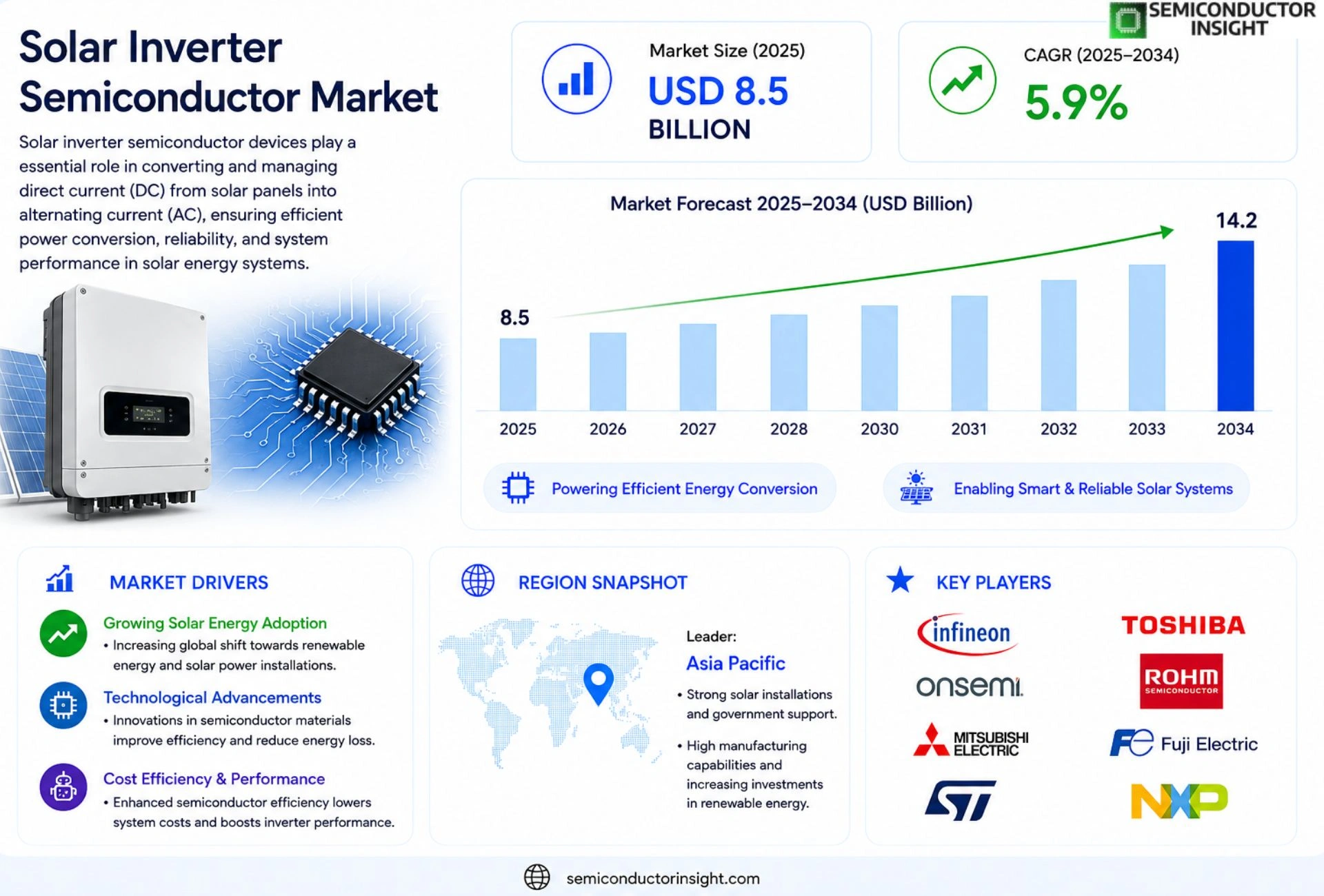
Global Solar Inverter Semiconductor Market size was valued at USD 8.5 billion in 2025. The market is projected to grow from USD 8.5 billion in 2025 to USD 14.2 billion by 2034, exhibiting a CAGR of 5.9% during the forecast period.
Solar inverter semiconductors comprise power‑electronic components such as IGBTs, MOSFETs, silicon‑carbide (SiC) and gallium‑nitride (GaN) devices that convert DC generated by photovoltaic panels into grid‑compatible AC power. These components are essential for maximizing conversion efficiency, ensuring reliability under diverse temperature conditions, and enabling advanced functions like maximum power point tracking (MPPT) and grid‑support services.
The market is experiencing rapid growth because renewable‑energy installations are expanding worldwide, government incentives remain strong, and wide‑bandgap semiconductor costs continue to decline. Furthermore, rising demand for higher‑efficiency inverters fuels adoption of SiC technology. Key players,including SMA Solar Technology, Huawei Technologies, ABB Ltd., and Schneider Electric,are investing heavily in R&D and strategic partnerships to broaden their product portfolios.
MARKET DRIVERS
Increasing Renewable Energy Adoption
Solar Inverter Semiconductor Market is being propelled by a surge in solar capacity installations worldwide. Between 2022 and 2024, global solar PV installations rose by roughly 18%, creating strong demand for high‑efficiency inverter semiconductors that can manage larger power flows.
Advancements in Silicon‑Carbide Technology
Silicon‑carbide (SiC) devices now deliver up to 30% lower conduction losses compared with traditional silicon solutions, enabling inverter manufacturers to offer more compact and reliable products. This technological leap has accelerated adoption in utility‑scale projects where efficiency gains directly improve project economics.
➤ In 2024, the adoption rate of solar inverters with integrated SiC semiconductors grew by 12% globally, driven by utility‑scale expansions and policy incentives.
Overall, the convergence of policy support, falling semiconductor costs, and performance improvements continues to fuel robust growth Solar Inverter Semiconductor Market.
MARKET CHALLENGES
Supply Chain Volatility
Geopolitical tensions and raw‑material shortages have introduced periodic disruptions in the supply of high‑purity silicon wafers. These bottlenecks can extend lead times by 15‑20% and elevate component costs, challenging manufacturers’ ability to meet tight project schedules.
Other Challenges
Cost Sensitivity
End‑users remain highly price‑conscious, especially in emerging economies where solar projects compete with conventional generation. Any increase in semiconductor pricing can erode the overall levelized cost of electricity (LCOE), slowing market penetration.
MARKET RESTRAINTS
Regulatory Uncertainty
In several key regions, evolving grid interconnection standards create uncertainty for inverter manufacturers. Delays in finalizing regulations on grid‑forming inverter functionalities can postpone product launches and dampen investment confidence.
Furthermore, inconsistent tariff structures for imported semiconductor components add a layer of cost unpredictability, particularly for manufacturers reliant on cross‑border supply chains.
These regulatory and fiscal ambiguities act as restraints, limiting the speed at which new semiconductor‑enhanced inverter designs reach the market.
MARKET OPPORTUNITIES
Emerging Markets in Southeast Asia
Rapid electrification programs across Indonesia, Vietnam, and the Philippines are generating a sizable pipeline of solar projects. The region’s projected solar capacity addition of 30 GW by 2027 presents a substantial opportunity for manufacturers of advanced inverter semiconductors.
Additionally, the integration of inverter semiconductor technology with battery energy storage systems is gaining traction, offering a dual‑benefit of grid stability and higher renewable penetration. Companies that can deliver optimized, hybrid inverter solutions are positioned to capture a growing share of this emerging market segment.
Solar Inverter Semiconductor Market Trends
Increasing Adoption of Wide‑Bandgap Technologies
Solar Inverter Semiconductor Market is witnessing a decisive shift toward wide‑bandgap materials such as silicon‑carbide (SiC) and gallium‑nitride (GaN). These technologies enable higher switching frequencies, lower conduction losses, and improved thermal performance, which together raise inverter efficiency above 98 percent in many installations. As utility‑scale solar farms pursue tighter performance margins and residential systems demand compact, high‑power density designs, manufacturers are accelerating SiC‑based module rollouts. The cost curve for SiC devices has flattened in recent years, making them economically viable for projects that previously relied on traditional silicon IGBTs. This transition supports grid‑support services, including rapid frequency response and voltage regulation, thereby enhancing overall system reliability.
Other Trends
Integration of Smart Grid Functions
Another prominent development Solar Inverter Semiconductor Market is the embedding of advanced communication and control capabilities directly into power‑electronic modules. Modern inverters now incorporate digital signal processors that execute real‑time maximum power point tracking (MPPT) algorithms, fault diagnostics, and remote firmware updates. These functions allow operators to participate in ancillary service markets, such as demand response and frequency control, without additional hardware. Consequently, inverter designs are becoming multi‑functional platforms that blend power conversion with intelligent grid interaction, a trend that is accelerating as regulatory frameworks incentivize distributed energy resources to provide grid stability.
Consolidation Among Key Industry Players
Strategic consolidation continues to reshape Solar Inverter Semiconductor Market. Leading firms are entering joint‑venture agreements and acquiring niche technology startups to broaden their product portfolios and capture emerging market segments. For instance, collaborations between traditional power‑electronics manufacturers and semiconductor innovators are fostering hybrid architectures that combine SiC switches with silicon‑based control circuitry, leveraging the strengths of each material class. This merger of expertise reduces development cycles and accelerates time‑to‑market for next‑generation inverter solutions. As the competitive landscape tightens, the emphasis on research and development intensifies, driving continuous improvements in reliability, efficiency, and cost structure across the sector.
COMPETITIVE LANDSCAPE
Key Industry Players
Navigating a Rapidly Evolving Solar Inverter Semiconductor Market Amid Intensifying Global Competition
Solar inverter semiconductor market is characterized by a moderately consolidated competitive landscape, with a handful of dominant multinational corporations commanding significant market share alongside a growing cohort of specialized regional players. Infineon Technologies AG stands out as a foremost leader in this space, offering a broad portfolio of IGBTs, MOSFETs, and silicon carbide (SiC) power modules purpose-built for photovoltaic inverter applications. The company’s consistent investment in wide-bandgap semiconductor R&D, combined with its established global distribution network, reinforces its competitive edge. Similarly, ON Semiconductor (onsemi) and STMicroelectronics have secured strong positions through the commercialization of advanced SiC and GaN device technologies, which are increasingly preferred by inverter manufacturers seeking higher conversion efficiencies and reduced thermal management requirements. Wolfspeed (formerly Cree) has emerged as a critical pure-play SiC supplier, particularly relevant as solar inverter OEMs such as SMA Solar Technology, Huawei Technologies, ABB Ltd., and Schneider Electric accelerate their transition to next-generation wide-bandgap platforms. The competitive intensity in this market is further amplified by aggressive capacity expansion strategies, vertical integration initiatives, and cross-industry partnerships aimed at securing stable supply chains for premium semiconductor materials.
Beyond the tier-one incumbents, a set of strategically significant niche players continues to reshape the solar inverter semiconductor competitive landscape. Mitsubishi Electric Corporation and Fuji Electric Co., Ltd. maintain robust positions in high-power IGBT modules widely deployed in utility-scale string and central inverters across Asia-Pacific and European markets. Rohm Semiconductor has steadily expanded its SiC MOSFET and diode lineup tailored explicitly for photovoltaic power conversion systems, while Vishay Intertechnology and Littelfuse provide complementary passive and protection semiconductor components integral to inverter circuit design. Additionally, Texas Instruments Incorporated supplies gate driver ICs and analog signal-chain components that serve as critical enablers of precise MPPT and grid-support functionality within modern solar inverters. Chinese manufacturers, notably BYD Semiconductor and Starpower Semiconductor, are gaining traction through cost-competitive IGBT and SiC offerings directed at the rapidly growing domestic and emerging-market solar installations, adding a new dimension of pricing pressure on established Western and Japanese suppliers.
List of Key Solar Inverter Semiconductor Companies Profiled
- Infineon Technologies AG
- ON Semiconductor (onsemi)
- STMicroelectronics
- Wolfspeed, Inc.
- Mitsubishi Electric Corporation
- Fuji Electric Co., Ltd.
- Rohm Semiconductor
- Vishay Intertechnology, Inc.
- Littelfuse, Inc.
- Texas Instruments Incorporated
- BYD Semiconductor Co., Ltd.
- Starpower Semiconductor Ltd.
- ABB Ltd.
- SMA Solar Technology AG
- Schneider Electric SE
Segment Analysis:
| Segment Category | Sub-Segments | Key Insights |
| By Type |
|
Silicon‑Carbide (SiC) devices
|
| By Application |
|
Utility‑scale solar farms
|
| By End User |
|
OEM manufacturers
|
| By Technology |
|
Wide‑bandgap technology
|
| By Functional Feature |
|
Grid‑support and ancillary services
|
Regional Analysis: North America
The residential segment dominates the Solar Inverter Semiconductor Market in the US, fueled by homeowner interest in reducing electricity bills and embracing clean energy. Growth is evident in the adoption of hybrid solar-battery systems, providing energy independence and resilience. Demand for string inverters and microinverters continues to rise, catering to diverse rooftop configurations.
The C&I sector is experiencing substantial expansion, driven by corporate sustainability goals and the desire to lower operational costs. Large-scale solar projects deployed on rooftops and ground-mounted systems are becoming increasingly common. The Solar Inverter Semiconductor Market is benefiting from the demand for high-power inverters with advanced monitoring and control capabilities.
Utility-scale solar projects continue to be a significant driver, contributing considerably to the overall demand for inverters. These large-scale installations are essential for meeting renewable energy targets and reducing carbon emissions. The Solar Inverter Semiconductor Market is witnessing a trend towards bifacial inverters to enhance energy yield.
Advancements in power electronics, particularly the adoption of SiC and GaN semiconductors, are reshaping the Solar Inverter Semiconductor Market. These new materials enable higher efficiency, smaller size, and improved reliability of inverters, further driving market growth.
Europe
Europe is positioned as a significant and evolving market for Solar Inverter Semiconductor Market, marked by ambitious renewable energy targets enshrined in various national policies. The region’s commitment to decarbonization, coupled with falling solar costs, is propelling adoption across diverse countries. Germany, the UK, Spain, and France are leading markets, with strong growth expected in the coming years. The European Union’s (EU) Green Deal provides a robust framework for sustainable energy investments, further encouraging the deployment of solar power. The Solar Inverter Semiconductor Market in Europe is increasingly focused on integrating smart inverter technologies with energy storage solutions to optimize energy consumption and grid stability. The rise of distributed solar generation, particularly in residential and commercial sectors, is creating opportunities for microinverters and hybrid inverters.
Asia-Pacific
Asia-Pacific represents the largest and fastest-growing market for the Solar Inverter Semiconductor Market. China, India, Japan, and South Korea are key contributors, with substantial investments in solar power infrastructure. China leads the global market in both solar module manufacturing and solar installation capacity. The growing demand for renewable energy in India, driven by government initiatives and energy security concerns, is fueling significant growth in the Solar Inverter Semiconductor Market. Japan is focusing on grid modernization and the integration of renewable energy sources, creating opportunities for advanced inverter technologies. South Korea is witnessing increasing adoption of solar power in residential and commercial sectors. The Solar Inverter Semiconductor Market in Asia-Pacific is characterized by intense competition among both domestic and international players, driving innovation and cost optimization.
South America
South America presents a promising, albeit developing, market for the Solar Inverter Semiconductor Market. Brazil, Chile, and Argentina are leading countries, with growing interest in solar power for both residential and utility-scale applications. Brazil benefits from abundant solar resources and supportive government policies, including auctions for renewable energy projects. Chile is gaining traction due to its high solar irradiance and increasing focus on clean energy. Argentina has the potential for significant growth, but faces economic challenges that can impact investment. The Solar Inverter Semiconductor Market in South America is witnessing a shift towards cost-effective inverter solutions to enhance affordability and competitiveness.
Middle East & Africa
The Middle East & Africa region offers significant untapped potential for the Solar Inverter Semiconductor Market. Countries like the UAE, Saudi Arabia, and Egypt are investing heavily in solar power projects as part of their diversification strategies and to reduce reliance on fossil fuels. The region’s abundant sunshine and large land areas are ideal for large-scale solar deployments. The Solar Inverter Semiconductor Market in the Middle East & Africa is expected to experience rapid growth in the coming years, driven by increasing energy demand and government support for renewable energy. Challenges include water scarcity and high upfront costs, but these are being addressed through technological advancements and innovative financing models.
Report Scope
This market research report provides a comprehensive analysis of the Solar Inverter Semiconductor Market , covering the forecast period 2026–2034. It offers detailed insights into market dynamics, technological advancements, competitive landscape, and key trends shaping the industry.
Key focus areas of the report include:
- Market Overview: The report begins with an overview outlining its current market scenario, key growth indicators, and industry transformation drivers. It discusses macroeconomic factors, demand–supply balance, regulatory landscape, and the strategic role of semiconductors in powering advancements across industries such as automotive, telecommunications, consumer electronics, and industrial automation.
- Market Size & Forecast: Historical data and future projections for revenue, unit shipments, and market value across major regions and segments.
- Segmentation Analysis: Detailed breakdown by product type, technology, application, and end-user industry to identify high-growth segments and investment opportunities.
- Regional Insights: Insights into market performance across North America, Europe, Asia-Pacific, Latin America, and the Middle East & Africa, including country-level analysis where relevant.
- Competitive Landscape: Profiles of leading market participants, including their product offerings, R&D focus, manufacturing capacity, pricing strategies, and recent developments such as mergers, acquisitions, and partnerships.
- Technology Trends & Innovation: Assessment of emerging technologies, integration of AI/IoT, semiconductor design trends, fabrication techniques, and evolving industry standards.
- Market Drivers & Restraints: Evaluation of factors driving market growth along with challenges, supply chain constraints, regulatory issues, and market-entry barriers.
- Stakeholder Insights: Insights for component suppliers, OEMs, system integrators, investors, and policymakers regarding the evolving ecosystem and strategic opportunities.
Primary and secondary research methods are employed, including interviews with industry experts, data from verified sources, and real-time market intelligence to ensure the accuracy and reliability of the insights presented.
FREQUENTLY ASKED QUESTIONS:
What is the current market size of Solar Inverter Semiconductor Market?
-> Solar Inverter Semiconductor Market was valued at USD 8.5 billion in 2025 and is projected to reach USD 14.2 billion by 2034, reflecting a CAGR of 5.9%.
Which key companies operate Solar Inverter Semiconductor Market?
-> Key players include SMA Solar Technology, Huawei Technologies, ABB Ltd., and Schneider Electric.
What are the key growth drivers?
-> Key growth drivers include expanding renewable‑energy installations, strong government incentives, declining costs of wide‑bandgap semiconductors, and rising demand for higher‑efficiency inverters driving SiC adoption.
Which region dominates the market?
-> The reference does not specify a single dominant region; market growth is reported globally.
What are the emerging trends?
-> Emerging trends include increased adoption of silicon‑carbide (SiC) and gallium‑nitride (GaN) devices, integration of advanced MPPT algorithms, and broader use of wide‑bandgap technologies to enhance efficiency and reliability.

Get Sample Report PDF for Exclusive Insights
Report Sample Includes
- Table of Contents
- List of Tables & Figures
- Charts, Research Methodology, and more...
 Download Sample Report PDF