Discrete Switch Market Insights
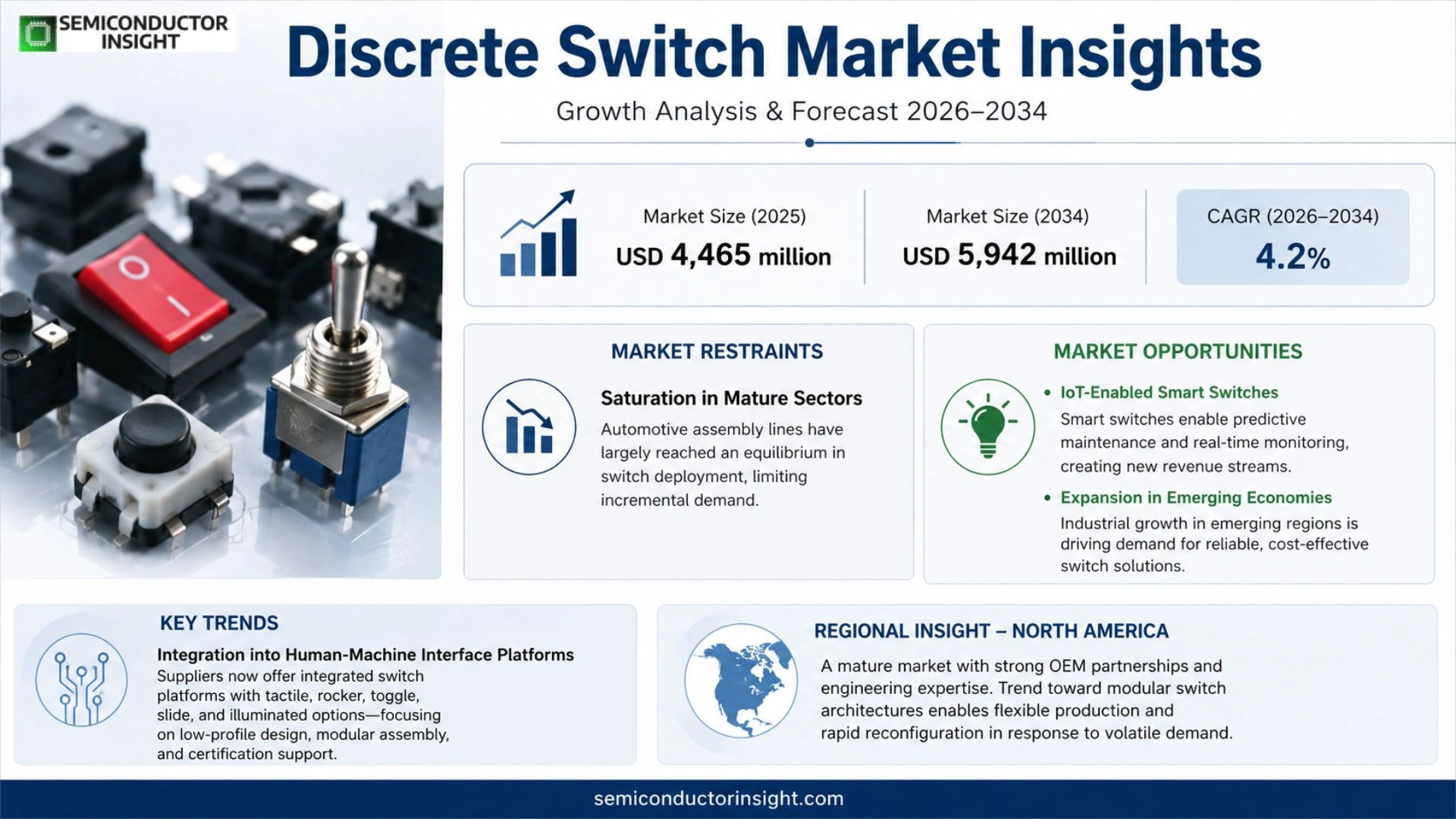
Discrete Switch market was valued at USD 4,465 million in 2025 and is projected to reach USD 5,942 million by 2034, exhibiting a CAGR of 4.2% during the forecast period.
The discrete switch industry comprises electromechanical control components such as tactile, push‑button, rocker, toggle, slide, rotary and DIP switches. These parts enable start‑stop control, mode selection, parameter setting and status indication across consumer electronics, automotive electronics, industrial automation, medical equipment and communications gear. Recent product releases emphasize sealed housings (IP67‑IP68), low‑profile designs and LED/RGB illumination, reflecting a shift from simple on/off devices toward integrated human‑machine interface nodes that deliver reliable actuation and assembly efficiency.
MARKET DRIVERS
Automation and Safety Regulations
Manufacturers are substituting mechanical interlocks with discrete switches to meet tighter safety standards. The shift reduces failure rates and simplifies compliance testing, making the Discrete Switch Market a preferred source for certified components.
Miniaturization of Electronic Systems
As devices shrink, designers demand switches with smaller footprints yet reliable contact ratings. These requirements push suppliers to innovate with low‑profile housings, directly expanding the addressable volume of the market.
➤ Engineered contact materials now deliver 15 % longer life cycles, lowering total cost of ownership for end users.
Industrial IoT deployments rely on discrete switches for deterministic signaling. Predictable on/off behavior under harsh conditions encourages equipment manufacturers to embed these parts in next‑generation controllers.
MARKET CHALLENGES
Supply Chain Volatility
Global shortages of copper and specialty plastics have intermittently constrained production runs. Manufacturers facing delayed deliveries often resort to higher‑priced alternatives, which can erode margin expectations.
Other Challenges
High‑temperature applications remain problematic for conventional polymer‑based switches. Thermal degradation can compromise contact integrity, limiting adoption in sectors such as aerospace where temperature extremes are routine.
Bullet Point Title
Standardization gaps across regional safety codes create additional engineering effort, forcing OEMs to carry multiple variant inventories.
MARKET RESTRAINTS
Saturation in Mature Sectors
Automotive assembly lines have largely reached an equilibrium in switch deployment, with most new vehicle platforms reusing legacy designs. Consequently, the incremental demand from this segment contributes modestly to overall volume growth.
MARKET OPPORTUNITIES
IoT‑Enabled Smart Switches
Embedding sensors and low‑power wireless modules into discrete switches opens a revenue stream tied to predictive maintenance services. Enterprises that adopt such “smart” switches can monitor actuation cycles in real time, creating a data‑driven value proposition that differentiates suppliers.
Expansion in Emerging Economies
Rapid industrialization across Southeast Asia and Africa is generating fresh demand for reliable electromechanical components. Local OEMs are seeking cost‑effective yet certified switches, offering a clear avenue for market entrants to capture share.
Discrete Switch Market Trends
Integration of Switches into Human‑Machine Interface Platforms
The industry has moved beyond treating tactile or push‑button parts as isolated components. Suppliers now bundle tactile, rocker, toggle, slide and illuminated families into coherent HMI platforms that deliver consistent feedback, sealing, and visual cues. This evolution reflects a shift in value creation: customers prize low‑profile design, modular assembly and certification support as much as electrical performance. As a result, competition is less about per‑unit cost and more about breadth of portfolio, rapid customization and system‑level engineering assistance. Vendors that can present a full suite of switch types, coupled with design‑for‑assembly tools, are positioned to capture mid‑range and premium projects across multiple sectors.
Other Trends
Automotive Electrification Boosts Control Node Count
The surge in electric vehicle production, surpassing 17 million units in 2024, translates into a higher density of control points per vehicle. Cabin interfaces, charging connectors and ancillary modules increasingly rely on miniature, IP‑rated switches that survive vibration and moisture. Manufacturers are therefore specifying switches with gold contacts, LED status indication and surface‑mount footprints to meet tighter packaging constraints. Parallel upgrades in advanced driver‑assist systems and infotainment units generate a steady demand for reliable actuation, reinforcing the market’s resilience even when consumer‑electronics cycles soften.
Regional Supply‑Chain Consolidation Elevates Reliability Standards
Japanese firms dominate high‑reliability, automotive‑grade offerings, while European and North American players focus on heavy‑duty and military‑spec switches. Taiwanese and Chinese producers expand through extensive catalogues and flexible low‑cost manufacturing, prompting a competitive landscape where differentiation hinges on certification depth and after‑sales engineering. Environmental directives such as EU RoHS tighten material compliance, prompting equipment owners in China to replace legacy panels that no longer meet the latest standards. This dual pressure of regulatory compliance and end‑user replacement cycles underpins a constructive outlook for the Discrete Switch Market, favoring suppliers that combine robust design with agile customization capabilities.
COMPETITIVE LANDSCAPE
Key Industry Players
Discrete Switch Market – Competitive Overview
The segment is dominated by a handful of firms that combine deep engineering capabilities with global supply chains. C&K, backed by its extensive tactile‑switch portfolio and a strong automotive certification record, commands the high‑volume tier and sets the benchmark for actuation consistency. TE Connectivity leverages its broad connector heritage to offer integrated switch‑connector modules that appeal to industrial equipment makers seeking system‑level simplification. Panasonic’s emphasis on miniature, sealed switches has entrenched it in consumer‑electronics and medical devices where space and reliability are paramount. Together these leaders shape a market structure where price competition is secondary to reliability, compliance and the ability to co‑engineer solutions with OEMs. Their scale also forces smaller suppliers to specialize, either by targeting niche form‑factors or by delivering rapid customization for low‑to‑mid volume programs.
Beyond the top tier, a vibrant cohort of niche manufacturers sustains the ecosystem. Carling Technologies and Grayhill focus on rugged, panel‑mount switches for heavy‑duty industrial and defense platforms, exploiting certifications that larger players do not always prioritize. OTTO Controls and Marquardt have built modular families that integrate LED or RGB illumination, meeting the aesthetic and functional demands of modern HMI designs. Asian players such as NKK Switches, NIDEC COMPONENTS, Diptronics and Switronic Industrial Corp. compete on breadth of catalog items and manufacturing efficiency, while ALPS Alpine and E‑Switch (Honeywell) differentiate through tactile feel and low‑force designs suited to portable electronics. This layered competitive set ensures that end‑users can source solutions that match precise performance, environmental and cost criteria.
List of Key Discrete Switch Companies Profiled
- C&K
- TE Connectivity
- Panasonic Industry
- OMRON
- ALPS Alpine
- E‑Switch
- Marquardt
- Carling Technologies
- Grayhill
- OTTO Controls
- NKK Switches
- NIDEC COMPONENTS
- Diptronics Manufacturing Inc.
- Switronic Industrial Corp.
- Eastern
Segment Analysis:
| Segment Category | Sub-Segments | Key Insights |
| By Type |
|
Leading Segment: Tactile Switch
|
| By Application |
|
Leading Segment: Automotive Control
|
| By End User |
|
Leading Segment: Automotive OEMs
|
| By Mounting Style |
|
Leading Segment: Surface‑Mount
|
| By Actuation Mechanism |
|
Leading Segment: Momentary Actuation
|
Regional Analysis: Discrete Switch Market
North America
Vehicle manufacturers are embedding discrete switches in advanced driver‑assistance systems, valuing the component’s reliability under temperature extremes. The push for electric powertrains intensifies demand for switches that can handle higher voltage tiers while maintaining compact footprints, prompting suppliers to refine sealing technologies.
Factories upgrading to collaborative robot cells rely on discrete switches for precise motion control. Engineers cite the tactile feedback and deterministic response as key differentiators that enable safe human‑machine interaction on the shop floor.
In aerospace, certification pathways demand components that can survive repeated pressure cycles. Discrete switches meeting these criteria are increasingly selected for avionics panels, where their proven track record reduces lifecycle risk for defense contractors.
Smart home devices incorporate miniature discrete switches to offer tactile user interfaces without sacrificing aesthetic minimalism. Designers appreciate the ability to source parts that balance low actuation force with long mechanical endurance.
Europe
European manufacturers are leveraging the region’s strong standards framework to differentiate their switch offerings. Compliance with the IEC 60947 series is not merely a checklist; it informs design choices that improve interoperability across cross‑border projects. Companies are also capitalising on the EU’s emphasis on circular economy principles, embedding recyclable polymers and designing for easy disassembly. These moves align product development cycles with policy incentives, granting market participants a competitive edge in both public‑sector contracts and private‑sector procurement.
Asia‑Pacific
In Asia‑Pacific, the Discrete Switch Market is shaped by an accelerating adoption of smart factory concepts, especially in China, Japan, and South Korea. Manufacturers are turning to switches that can integrate with IoT gateways, allowing real‑time diagnostics and predictive maintenance. Labor cost pressures have spurred investment in autonomous assembly lines where discrete switches act as critical safety interlocks, ensuring rapid shutdown capabilities without human intervention. The regional emphasis on cost efficiency coexists with a rising demand for higher reliability, compelling suppliers to balance price with robust performance.
South America
South American producers are navigating a landscape marked by infrastructure renewal and a gradual shift toward renewable energy integration. Discrete switches are increasingly specified for solar‑farm monitoring stations and wind‑turbine control panels, where they must endure harsh environmental exposure. Local OEMs value suppliers that can provide on‑time logistics across the continent’s vast geography, prompting a trend toward regional supply hubs that shorten lead times and mitigate import‑tariff volatility.
Middle East & Africa
The Middle East & Africa region presents a unique mix of high‑value oil‑and‑gas projects and emerging urban‑mobility initiatives. Discrete switches are integral to control systems that manage pipeline safety valves and to emerging metro networks where they support passenger‑information displays. Vendors that pair technical support with localized training programs are gaining traction, as customers seek assurance that switch installations meet both operational reliability and regional compliance standards.
Report Scope
This market research report provides a comprehensive analysis of the Discrete Switch Market , covering the forecast period 2026–2034. It offers detailed insights into market dynamics, technological advancements, competitive landscape, and key trends shaping the industry.
Key focus areas of the report include:
- Market Overview: The report begins with an overview outlining its current market scenario, key growth indicators, and industry transformation drivers. It discusses macroeconomic factors, demand–supply balance, regulatory landscape, and the strategic role of semiconductors in powering advancements across industries such as automotive, telecommunications, consumer electronics, and industrial automation.
- Market Size & Forecast: Historical data and future projections for revenue, unit shipments, and market value across major regions and segments.
- Segmentation Analysis: Detailed breakdown by product type, technology, application, and end-user industry to identify high-growth segments and investment opportunities.
- Regional Insights: Insights into market performance across North America, Europe, Asia-Pacific, Latin America, and the Middle East & Africa, including country-level analysis where relevant.
- Competitive Landscape: Profiles of leading market participants, including their product offerings, R&D focus, manufacturing capacity, pricing strategies, and recent developments such as mergers, acquisitions, and partnerships.
- Technology Trends & Innovation: Assessment of emerging technologies, integration of AI/IoT, semiconductor design trends, fabrication techniques, and evolving industry standards.
- Market Drivers & Restraints: Evaluation of factors driving market growth along with challenges, supply chain constraints, regulatory issues, and market-entry barriers.
- Stakeholder Insights: Insights for component suppliers, OEMs, system integrators, investors, and policymakers regarding the evolving ecosystem and strategic opportunities.
Primary and secondary research methods are employed, including interviews with industry experts, data from verified sources, and real-time market intelligence to ensure the accuracy and reliability of the insights presented.
FREQUENTLY ASKED QUESTIONS:
What is the current market size of Discrete Switch Market?
-> Discrete Switch market is projected to reach USD 5,942 million by 2034, exhibiting a CAGR of 4.2% during the forecast period.
Which key companies operate in Discrete Switch Market?
-> Key players include APEM, C&K, E‑Switch, EAO, Carling Technologies, Grayhill, OTTO Controls, Marquardt, TE Connectivity, OMRON, ALPS Alpine, Panasonic Industry, NKK Switches, NIDEC COMPONENTS, SM Switch, Eastern, Innocent Electronics, DAILYWELL ELECTRONICS CO., LTD., Salecom Electronics Co., Ltd., TAIWAY Electronics Components Co., Ltd., Diptronics Manufacturing Inc., SWITRONIC INDUSTRIAL CORP., HUA‑JIE (TAIWAN) CORP., Wenzhou Gangyuan Electronics Co., Ltd., Dongguan Hongju Electronic Hardware Products Co., Ltd., YueQing Daier Electron Co., Ltd., Dongguan Xunpu Electronic Technology Co., Ltd., Onpow Push Button Manufacture Co., Ltd., Yueqing Dahe Electric Co., Ltd., Suntan Technology Company Limited.
What are the key growth drivers?
-> Key growth drivers include electrification of vehicles, proliferation of industrial automation, increasing demand for reliable human‑machine interface components, and stringent reliability and certification requirements across automotive, medical and industrial sectors.
Which region dominates the market?
-> Asia-Pacific is the fastest‑growing region, while Europe remains a dominant market in terms of revenue share.
What are the emerging trends?
-> Emerging trends include integration of LED/RGB illumination, miniaturized surface‑mount designs, advanced sealing (IP67‑IP68) for harsh environments, and modular switch platforms offering customizable actuation and feedback.
Get Sample Report PDF for Exclusive Insights
Report Sample Includes
- Table of Contents
- List of Tables & Figures
- Charts, Research Methodology, and more...
 Download Sample Report PDF