Radio-frequency Power Semiconductor Devices Market Insights
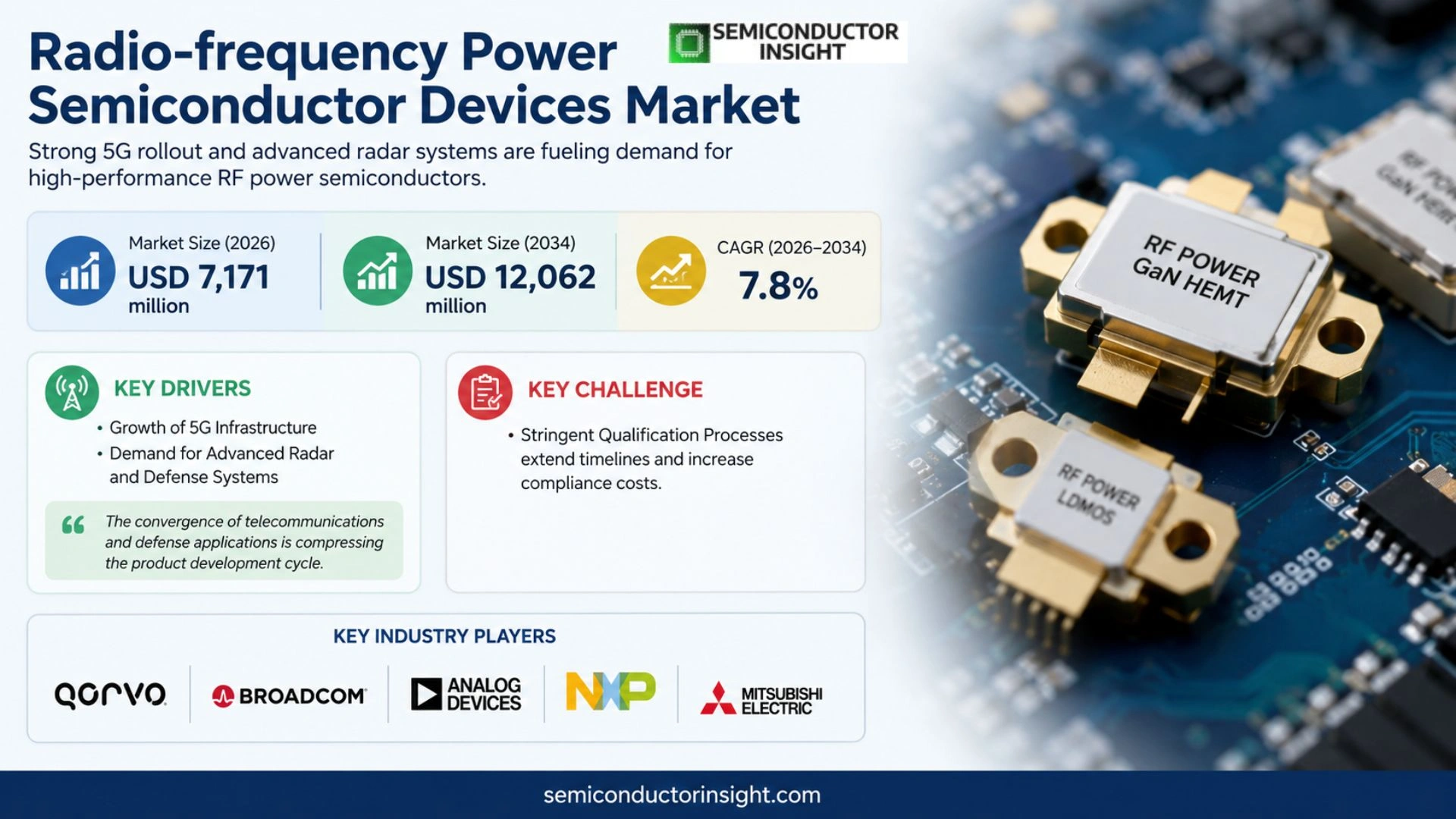
Global Radio-frequency Power Semiconductor Devices market is projected to grow from USD 7,171 million in 2026 to USD 12,062 million by 2034, exhibiting a CAGR of 7.8% during the forecast period.
Radio‑frequency Power Semiconductor Devices are semiconductor components used to generate, amplify, control or switch high‑power RF signals. They appear as discrete power transistors, bare dies, monolithic microwave integrated circuits or power‑amplifier modules and are built on silicon LDMOS, GaN HEMT,GaAs pHEMT/HBT or SiC platforms. The market is expanding because telecom operators are upgrading base‑station infrastructure while defense and satellite sectors demand higher efficiency and power density. Advances in GaN epitaxy and advanced packaging reduce thermal resistance, enabling new applications such as radar and industrial RF heating. Key players including Broadcom, Qorvo and Analog Devices are investing in reference designs and evaluation kits to shorten OEM development cycles.
MARKET DRIVERS
Growth of 5G Infrastructure
The rollout of 5G networks is creating a surge in demand for high‑frequency power components capable of handling wider bandwidths and higher power densities. Manufacturers of base‑station equipment are turning to Radio-frequency Power Semiconductor Devices to meet performance targets while keeping form‑factor constraints in check. This shift is not merely incremental; it reshapes supply‑chain priorities and invites new entrants focused on silicon‑carbide (SiC) and gallium‑nitride (GaN) technologies.
Demand for Advanced Radar and Defense Systems
Modern radar platforms, especially those deployed in autonomous vehicles and aerospace defense, require power amplifiers that sustain high peak powers without sacrificing linearity. The adoption of phased‑array architectures accelerates the need for semiconductor devices that can operate efficiently across a broad frequency spectrum. Consequently, defense contractors are allocating larger portions of R&D budgets to procure and qualify next‑generation RF power semiconductors.
➤ “The convergence of telecommunications and defense applications is compressing the product development cycle, prompting vendors to prioritize integrated SiC/GaN solutions.”
These dual‑market forces are compelling OEMs to revisit design philosophies, favoring modularity and thermal management innovations. Companies that can demonstrate reliability under stringent automotive and aerospace standards are likely to capture outsized market share as the ecosystem matures.
MARKET CHALLENGES
Stringent Qualification Processes
Regulatory scrutiny in aerospace and automotive sectors imposes multi‑year qualification timelines. Even when a device meets electrical specifications, it must survive rigorous environmental testing before volume production can commence. This lag hampers rapid adoption and can erode margin expectations for smaller suppliers lacking extensive compliance infrastructure.
Other Challenges
Supply‑Chain Volatility
Fluctuations in raw‑material availability, particularly for high‑purity silicon‑carbide wafers, create price instability. End‑users often face lead‑times that exceed six months, prompting them to stockpile inventory and negotiate long‑term contracts, which in turn reduces flexibility for innovators.
MARKET RESTRAINTS
High Capital Expenditure
Establishing production lines for SiC and GaN devices demands multi‑million‑dollar investments in epitaxy reactors, cleanroom facilities, and testing equipment. The upfront cost barrier discourages new entrants and limits the number of players able to achieve economies of scale, thereby constraining overall market expansion.
MARKET OPPORTUNITIES
Emergence of Satellite IoT Constellations
Low‑Earth‑orbit satellite constellations targeting Internet of Things connectivity rely on compact, high‑efficiency RF power modules to extend battery life and reduce thermal load. The niche yet rapidly scaling segment opens a pathway for semiconductor firms to tailor SiC‑based power amplifiers for space‑qualified, radiation‑hard environments, presenting a lucrative revenue stream beyond terrestrial applications.
Radio-frequency Power Semiconductor Devices Market Trends
Shift Toward System‑Level Integration
Manufacturers are moving beyond the traditional focus on individual transistor performance and are positioning entire RF power solutions as strategic differentiators. This shift is driven by the rising complexity of telecom base‑station architectures, radar payloads, and satellite transponders, where linearity, thermal efficiency, and footprint directly impact system cost. Companies that bundle discrete devices with reference designs, matching networks, and turnkey modules can influence downstream engineering decisions, shortening time‑to‑market for equipment makers. The trend also creates an incentive for semiconductor firms to deepen ties with original equipment manufacturers, offering co‑development resources that translate device specifications into real‑world performance gains. For investors, the ability to capture value at the system level often translates into higher margin opportunities than pure component sales.
Other Trends
Technology Platform Competition
The market now features a nuanced coexistence of silicon LDMOS and gallium‑nitride (GaN) platforms. LDMOS continues to dominate cost‑sensitive segments such as legacy broadcast and some cellular bands because of its mature manufacturing base and proven reliability. In contrast, GaN is gaining preference in high‑frequency, high‑power density applications like advanced radar, electronic warfare, and next‑generation satellite links, where its superior efficiency and bandwidth justify a premium price. This dual‑track environment forces vendors to allocate R&D spend carefully, balancing incremental improvements to LDMOS with aggressive scaling of GaN epitaxy and packaging. The competitive dynamics also heighten the importance of supply‑chain resilience, as each technology relies on distinct substrate sources and specialized fabrication equipment.
Evolving Customer Procurement Models
OEM purchasing behavior is shifting from a pure bill‑of‑materials approach to a partnership model that values application support, evaluation kits, and design‑in services. Buyers increasingly demand that semiconductor suppliers provide not only high‑performance devices but also simulation models, reliability data, and field‑service assurances that reduce overall system risk. This change is especially pronounced in defense and space sectors, where qualification cycles are lengthy and failure costs are prohibitive. Suppliers that can deliver integrated solutions,combining hardware, software, and engineering expertise,are better positioned to secure long‑term contracts and command pricing power. Consequently, the competitive landscape is evolving from a race on raw device specs to a broader contest over ecosystem ownership and customer enablement.
COMPETITIVE LANDSCAPE
Key Industry Players
Competitive Overview of RF Power Semiconductor Vendors
RF power semiconductor arena is dominated by a handful of global firms that command the majority of high‑frequency LDMOS and GaN product lines. Qorvo, Broadcom, and Analog Devices together supply roughly half of the total volume, leveraging deep wafer‑fab capacity, extensive IP portfolios, and long‑standing relationships with telecom equipment makers. Their breadth across discrete transistors, power‑amplifier modules, and reference designs creates a tiered value chain where OEMs can source both off‑the‑shelf parts and fully engineered solutions. This concentration forces smaller entrants to specialize in niche frequency bands, ultra‑high‑power density offerings, or application‑specific packaging to remain viable.
Beyond the dominant trio, a diverse set of specialists is reshaping the competitive picture. Skyworks and MACOM focus on premium GaN HEMT devices for radar and satellite payloads, while Ampleon and Mitsubishi Electric leverage mature silicon LDMOS platforms for broadcast and base‑station upgrades. Regional players such as Sumitomo Electric Industries, WIN Semi, and UMS provide localized supply chains that mitigate geopolitical risk and address medium‑power market segments in Asia‑Pacific. Emerging firms like RFHIC and Dynax Semiconductor inject innovative epitaxial processes and advanced thermal‑management techniques, positioning themselves as attractive partners for defense contractors seeking custom‑engineered RF blocks.
List of Key Radio-frequency Power Semiconductor Devices Companies Profiled
- Qorvo
- Broadcom
- Analog Devices
- NXP
- Skyworks
- MACOM
- Ampleon
- Mitsubishi Electric
- Sumitomo Electric Industries
- WIN Semi
- UMS
- RFHIC
- Dynax Semiconductor
Segment Analysis:
| Segment Category | Sub-Segments | Key Insights |
| By Type |
|
Power Amplifiers are the dominant type because they address the core requirement of delivering high RF output power with tight linearity constraints.
|
| By Application |
|
Wireless Communication continues to shape demand as networks evolve toward higher capacity and lower latency.
|
| By End User |
|
Telecom Operators remain the primary end‑user because of the massive scale of network roll‑out.
|
| By Technology Platform |
|
GaN HEMT is emerging as the technology of choice for high‑frequency, high‑power niches.
|
| By Market Trend |
|
System‑level Integration is redefining value creation across the RF semiconductor market.
|
Regional Analysis: Radio-frequency Power Semiconductor Devices Market
North America
The Silicon Valley corridor, along with research clusters in New York and Texas, acts as a crucible for advanced RF device concepts. Frequent cross‑industry workshops accelerate the translation of academic breakthroughs into manufacturable products, giving local firms a pipeline of differentiated technologies.
Proximity between wafer suppliers and assembly fabs mitigates logistical bottlenecks. This geographic alignment enables rapid design‑for‑manufacture cycles, a competitive advantage that smaller regions find difficult to replicate.
Federal incentives for high‑frequency electronics, coupled with streamlined export controls for trusted partners, create a regulatory backdrop that encourages both domestic expansion and selective overseas engagement.
Major infrastructure players, from telecom operators upgrading to 5G and beyond to defense agencies modernising radar suites, constitute a demanding clientele that drives specifications toward higher power density and thermal efficiency.
Europe
European nations exhibit a collaborative approach, leveraging EU‑wide research programmes to harmonise standards for RF power devices. Nations such as Germany and France host advanced fab facilities that specialise in wide‑band applications for aerospace and renewable‑energy inverters. Policy frameworks emphasise energy efficiency, prompting OEMs to adopt gallium‑nitride solutions that minimise loss. While the market lacks the sheer capital depth of North America, the emphasis on cross‑border projects and sustainability creates a niche where incremental innovation thrives, especially in automotive electrification and satellite communications.
Asia‑Pacific
Asia‑Pacific is characterised by rapid adoption cycles, driven primarily by dense urban deployments of mobile networks and a burgeoning IoT ecosystem. China’s manufacturing scale offers competitive pricing, yet Japan and South Korea lead in high‑precision device engineering, supplying premium‑grade components to global OEMs. The region’s industrial policy increasingly supports domestic semiconductor self‑sufficiency, encouraging joint ventures that blend low‑cost production with sophisticated design talent. This dynamic yields a market where volume growth is tempered by a parallel push toward higher performance, particularly in automotive radar and industrial automation.
South America
South America remains an emerging arena for RF power semiconductor adoption, with Brazil’s telecommunications upgrades and Argentina’s renewable‑energy projects acting as early catalysts. The market’s growth is moderated by fiscal constraints and limited local fab capacity, prompting reliance on imported devices. Nevertheless, regional alliances are forming to develop localized testing facilities, a step that could reduce entry barriers for niche manufacturers and attract foreign investment focused on cost‑effective solutions for broadband expansion.
Middle East & Africa
In the Middle East and Africa, demand is largely propelled by satellite communications, oil‑field telemetry, and the rollout of 5G in affluent Gulf states. The region’s investment patterns focus on importing high‑performance RF modules while nurturing local engineering talent through university‑industry partnerships. South Africa exhibits a modest but growing ecosystem, targeting defense and mining sectors that require rugged power devices. Although the overall market size is modest, the strategic importance of reliable high‑frequency components for critical infrastructure ensures a steady, albeit specialised, demand trajectory.
Report Scope
This market research report provides a comprehensive analysis of the Radio-frequency Power Semiconductor Devices Market , covering the forecast period 2026–2034. It offers detailed insights into market dynamics, technological advancements, competitive landscape, and key trends shaping the industry.
Key focus areas of the report include:
- Market Overview: The report begins with an overview outlining its current market scenario, key growth indicators, and industry transformation drivers. It discusses macroeconomic factors, demand–supply balance, regulatory landscape, and the strategic role of semiconductors in powering advancements across industries such as automotive, telecommunications, consumer electronics, and industrial automation.
- Market Size & Forecast: Historical data and future projections for revenue, unit shipments, and market value across major regions and segments.
- Segmentation Analysis: Detailed breakdown by product type, technology, application, and end-user industry to identify high-growth segments and investment opportunities.
- Regional Insights: Insights into market performance across North America, Europe, Asia-Pacific, Latin America, and the Middle East & Africa, including country-level analysis where relevant.
- Competitive Landscape: Profiles of leading market participants, including their product offerings, R&D focus, manufacturing capacity, pricing strategies, and recent developments such as mergers, acquisitions, and partnerships.
- Technology Trends & Innovation: Assessment of emerging technologies, integration of AI/IoT, semiconductor design trends, fabrication techniques, and evolving industry standards.
- Market Drivers & Restraints: Evaluation of factors driving market growth along with challenges, supply chain constraints, regulatory issues, and market-entry barriers.
- Stakeholder Insights: Insights for component suppliers, OEMs, system integrators, investors, and policymakers regarding the evolving ecosystem and strategic opportunities.
Primary and secondary research methods are employed, including interviews with industry experts, data from verified sources, and real-time market intelligence to ensure the accuracy and reliability of the insights presented.
FREQUENTLY ASKED QUESTIONS:
What is the current market size of Radio-frequency Power Semiconductor Devices Market?
-> Radio-frequency Power Semiconductor Devices market is projected to grow from USD 7,171 million in 2026 to USD 12,062 million by 2034, exhibiting a CAGR of 7.8%
Which key companies operate in Radio-frequency Power Semiconductor Devices Market?
-> Key players include Broadcom, Mitsubishi Electric, NXP, Analog Devices, Sumitomo Electric Industries, Skyworks, Qorvo, Microchip, MACOM, Ampleon, WIN Semi, UMS, RFHIC, Integra Technologies, Dynax Semiconductor, among others.
What are the key growth drivers?
-> Key growth drivers include the demand for higher efficiency, broader bandwidth, greater power density, improved thermal performance, telecom infrastructure upgrades, defense and satellite communications, industrial RF energy systems, and medical equipment requiring reliable high‑power RF solutions.
Which region dominates the market?
-> Asia is the fastest‑growing region, while North America remains a dominant market due to strong telecom and defense spending.
What are the emerging trends?
-> Emerging trends include increased adoption of GaN and SiC technologies, advanced packaging for higher power density, system‑level integration with AI/IoT, and the development of reference designs and modules to accelerate time‑to‑market for end‑users.
Get Sample Report PDF for Exclusive Insights
Report Sample Includes
- Table of Contents
- List of Tables & Figures
- Charts, Research Methodology, and more...
 Download Sample Report PDF