Silicon MOSFET Market Insights
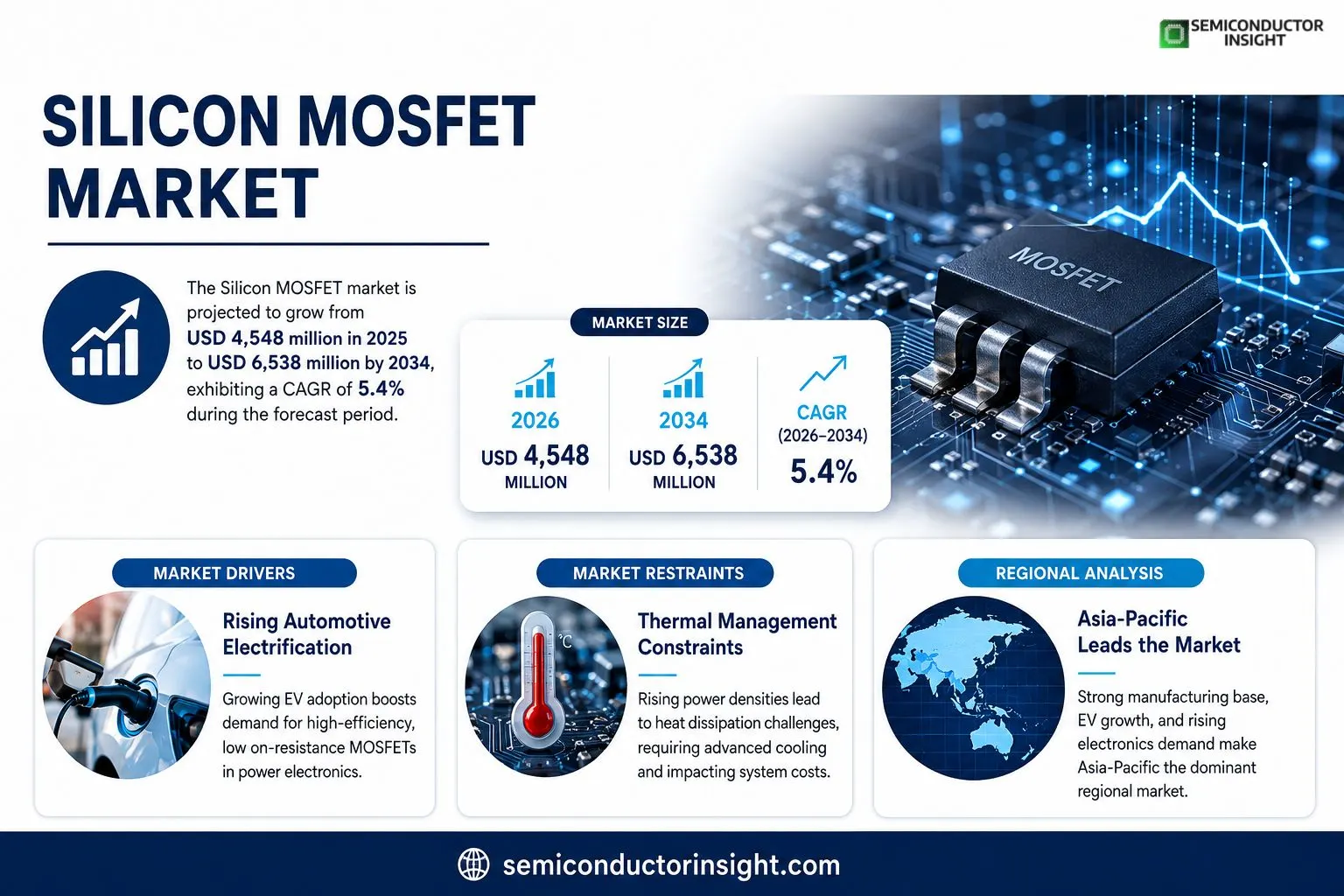
Silicon MOSFET market size was valued at USD 4,548 million in 2025 and will reach USD 6,538 million by 2034, reflecting a CAGR of 5.4% over the forecast period.
Silicon MOSFETs are fundamental power‑switching devices that enable efficient voltage regulation, current control and power conversion while minimizing both conduction and switching losses. They are therefore integral to switch‑mode power supplies, DC‑DC converters, server and telecom power systems, industrial motor drives, automotive electronics, on‑board chargers, lighting, home appliances and battery‑management modules.The upward trajectory is supported by expanding automotive electrification programs and the surge in AI‑focused data‑center deployments, which increase demand for low‑on‑resistance and high‑speed devices. Competition among leading suppliers now centres on reducing gate charge, widening safe operating area and improving thermal performance through advanced packaging such as LFPAK or TSON. Companies including Infineon Technologies AG, onsemi and ROHM Co., Ltd. continue to introduce trench‑and super‑junction architectures that address these efficiency targets.
MARKET DRIVERS
Rising Automotive Electrification
The shift toward electric drivetrains has markedly lifted Silicon MOSFET Market as original‑equipment manufacturers scramble for devices that can handle higher current densities while maintaining low on‑resistance. Engineers favour silicon MOSFETs for their mature manufacturing base, which translates into predictable yield and competitive pricingtwo criteria that speed up vehicle program timelines. Moreover, the ability to integrate MOSFETs into compact power modules supports the space‑constrained architecture of modern EVs.
Expansion of Renewable Energy Inverters
Utility‑scale solar and wind installations rely on inverter topologies where fast switching and high efficiency are paramount. Silicon MOSFETs, with their proven thermal resilience, have become the go‑to choice for many 400‑kW residential and 2‑MW commercial inverters. The cost advantage over emerging wide‑bandgap alternatives allows project developers to meet tight CAPEX targets without sacrificing performance.
➤ Manufacturers that prioritize fab capacity upgrades are better positioned to capture emerging volume.
Collectively, these drivers push supply chains to reinforce production lines, prompting strategic partnerships between semiconductor fabs and automotive power‑train specialists. Companies that anticipate the need for larger wafer throughput stand to enjoy stronger bargaining power with downstream assemblers.
MARKET CHALLENGES
Thermal Management Constraints
As power densities climb, dissipating heat becomes a decisive factor for device reliability. Silicon MOSFETs, while robust, still encounter junction temperature limits that force designers to incorporate larger heatsinks or advanced cooling techniques. This added mechanical complexity can erode the cost benefits that originally attracted customers to silicon solutions.
Other Challenges
Materials Competition
Wide‑bandgap semiconductors such as silicon carbide (SiC) and gallium nitride (GaN) are increasingly present in niche high‑efficiency applications. Their superior switching speeds and lower conduction losses tempt premium‑segment buyers, pressuring Silicon MOSFET Market to defend its share through price leadership and incremental performance tweaks.
MARKET RESTRAINTS
Supply‑Chain Volatility
Recent disruptions in silicon wafer availability, coupled with geopolitical constraints on equipment imports, have injected uncertainty into production schedules. When fab capacity is throttled, lead times lengthen and inventory buffers rise, which can deter OEMs from committing to large‑scale MOSFET orders until the supply outlook stabilizes.
MARKET OPPORTUNITIES
Smart‑Grid Integration
The rollout of intelligent distribution networks creates a fertile environment for silicon MOSFETs to excel in fast‑acting protective relays and modular converters. Their relatively low cost, combined with proven reliability, offers grid operators a pragmatic path to upgrade legacy infrastructure while preserving budgetary discipline. Companies that tailor MOSFET families to the specific voltage‑tier requirements of smart‑grid equipment are likely to capture a growing slice of this emerging demand.
Silicon MOSFET Market Trends
Efficiency‑Centric Device Evolution
Silicon MOSFET Market is seeing a pronounced shift toward minimizing both conduction and switching losses. Suppliers are now prioritizing ultra‑low on‑resistance (Rds(on)) and reduced gate charge as the primary levers for boosting system‑level efficiency. This focus matters because tighter efficiency targets directly translate into smaller heat sinks, lighter enclosures, and lower operating costs for end‑users. Consequently, manufacturers are investing in trench‑type and super‑junction architectures that can sustain high current densities while keeping the thermal envelope modest. The trend is evident in the rollout of LFPAK and TSON packages, which combine compact footprints with superior heat dissipation, enabling designers to pack more power into limited board space.
Other Trends
Automotive Electrification
Vehicle electrification is reshaping the demand profile for silicon MOSFETs. Modern electric and hybrid models rely on dozens of low‑ and mid‑voltage converters for functions ranging from on‑board charging to motor‑drive assistance. The industry response includes dedicated automotive qualification streamsAEC‑Q101, PPAP compliance, and copper‑clip packagingthat assure reliability under high‑temperature and vibration conditions. As a result, automotive‑grade discrete MOSFETs are gaining market share at the expense of legacy catalog parts, prompting suppliers to offer higher current capabilities and tighter safe‑operating‑area margins. This evolution not only secures a steady revenue stream for players with strong automotive pedigrees but also raises the entry barrier for newcomers lacking certified processes.
Data‑Center Power Evolution
Parallel to automotive growth, the expansion of AI‑focused servers and high‑density telecom gear is pressuring power‑conversion stages to operate at ever higher frequencies. Designers are turning to devices that combine sub‑nanosecond switching with low gate charge, thereby reducing the size of passive components in PFC and LLC converters. The ripple‑free power rails demanded by AI accelerators have spurred a wave of super‑junction MOSFETs capable of handling voltages above 400 V while delivering minimal losses. This shift reinforces Silicon MOSFET Market’s relevance in the compute arena and signals that vendors who master high‑frequency, high‑voltage solutions will capture premium pricing and long‑term service contracts.
COMPETITIVE LANDSCAPE
Key Industry Players
Silicon MOSFET Competitive Overview
Infineon Technologies dominates the high‑voltage, automotive‑qualified segment, leveraging its deep process expertise and a portfolio that spans planar to super‑junction architectures. Its ability to deliver low‑on‑resistance devices with rigorous AEC‑Q101 compliance gives it a distinct advantage in vehicle power modules and data‑center power supplies. The company’s extensive footprint, coupled with a strong application‑engineer network, translates into reliable supply chains that many OEMs consider indispensable. Parallel to Infineon, onsemi and STMicroelectronics sustain robust positions in the low‑to‑mid‑voltage space, each focusing on trench and split‑gate designs that meet aggressive switching‑speed targets while maintaining competitive pricing.Beyond the majors, a cohort of Asian manufacturers is reshaping the mid‑range market. Nexperia, Vishay, and ROHM have expanded their trench‑MOSFET lines to address growing demand in consumer electronics and industrial motor drives. Chinese players such as China Resources Microelectronics, Hangzhou Silan, and Jiangsu Jiejie are accelerating their product qualification programs, introducing automotive‑grade devices that challenge incumbent suppliers on cost and localized support. Korean outfit KEC and Taiwan‑based Alpha and Omega Semiconductor contribute niche innovations in shielded‑gate and super‑junction structures, positioning themselves as attractive partners for specialized applications like telecom power amplifiers. This diversified ecosystem creates a competitive pressure that pushes all participants toward tighter on‑resistance specifications, enhanced thermal performance, and broader packaging options.
List of Key Silicon MOSFET Companies Profiled
- Infineon Technologies AG
- onsemi
- STMicroelectronics N.V.
- Nexperia
- Vishay Intertechnology, Inc.
- Alpha and Omega Semiconductor
- Diodes Incorporated
- Microchip Technology Inc.
- Littelfuse, Inc.
- Renesas Electronics Corporation
- ROHM Co., Ltd.
- Toshiba Electronic Devices & Storage Corporation
- Shindengen Electric Manufacturing Co., Ltd.
- Fuji Electric Co., Ltd.
- China Resources Microelectronics Limited
- Hangzhou Silan Microelectronics Co., Ltd.
- Jiangsu Jiejie Microelectronics Co., Ltd.
- KEC Corporation
Segment Analysis:
| Segment Category | Sub-Segments | Key Insights |
| By Type |
|
Discrete MOSFETs
|
| By Application |
|
Automotive Power Electronics
|
| By End User |
|
Vehicle OEMs
|
| By Technology |
|
Super‑junction Technology
|
| By Packaging |
|
LFPAK Packaging
|
Regional Analysis: Silicon MOSFET Market
Asia-Pacific
Foundries across the peninsula operate at wafer scales that permit cost‑efficient batch runs, allowing OEMs to source MOSFETs with tighter tolerances. Process refinements such as trench‑gate structures and silicon‑on‑insulator platforms demonstrate the region’s commitment to pushing device performance while curbing thermal losses.
Electric vehicle platforms in China and Japan demand MOSFETs that can switch at higher frequencies, supporting regenerative braking systems and compact power converters. Tier‑1 suppliers respond by tailoring device footprints to meet vehicle packaging constraints, fostering a feedback loop between automakers and silicon designers.
Portable devices prioritize long battery life and rapid charging, nudging designers toward MOSFETs with low on‑resistance and superior thermal resilience. The surge in ultra‑thin laptops amplifies the need for components that occupy minimal board space while delivering reliable power conversion.
Regional policymakers channel grants into semiconductor research hubs, encouraging collaboration between universities and manufacturers. Such initiatives shorten development cycles for next‑generation MOSFET designs and attract foreign capital seeking stable production ecosystems.
North America
Silicon MOSFET Market in North America benefits from a strong emphasis on high‑performance applications within aerospace and defense sectors. Companies prioritize devices that can endure extreme temperature swings while sustaining fast switching, prompting local fabless firms to invest heavily in design‑win strategies. Parallel developments in data‑center infrastructure create a demand for MOSFETs that improve power‑supply efficiency, aligning with sustainability goals set by major technology firms. However, the region faces a talent bottleneck in advanced process engineering, urging manufacturers to forge partnerships with academic institutions to sustain innovation pipelines.
Europe
European stakeholders approach Silicon MOSFET Market with a focus on regulatory compliance and energy‑efficiency standards. The push for greener transportation networks drives automotive suppliers to adopt MOSFET‑based converters that reduce overall system losses. Meanwhile, the industrial automation arena seeks robust components capable of handling fluctuating load patterns in smart factories. Collaborative EU initiatives aim to harmonize design guidelines across member states, fostering cross‑border supply chains that can compete with Asian counterparts despite higher production costs.
South America
In South America, Silicon MOSFET Market is shaped by expanding renewable‑energy projects, particularly solar farms in Brazil and Chile. Power‑electronics firms tailor MOSFET solutions to accommodate large‑scale inverter installations, where reliability and low failure rates are paramount. Additionally, the region’s growing consumer base for affordable electronics spurs demand for cost‑effective MOSFETs that balance performance with price sensitivity. Infrastructure constraints, such as limited local fabrication capacity, keep the market reliant on imports, prompting regional distributors to secure diversified supplier portfolios.
Middle East & Africa
The Middle East & Africa segment witnesses Silicon MOSFET Market responding to infrastructure upgrades in oil‑and‑gas processing and emerging smart‑grid initiatives. Operators require MOSFETs that can withstand harsh environmental conditions while delivering precise control over power conversion equipment. Simultaneously, nascent automotive electrification efforts in the Gulf states encourage local assembly plants to source MOSFETs optimized for high‑temperature operation. Investment in technical training programs aims to build a skilled workforce capable of managing sophisticated power‑electronics designs, gradually reducing dependency on external expertise.
Report Scope
This market research report provides a comprehensive analysis of the Silicon MOSFET Market , covering the forecast period 2026–2034. It offers detailed insights into market dynamics, technological advancements, competitive landscape, and key trends shaping the industry.
Key focus areas of the report include:
- Market Overview: The report begins with an overview outlining its current market scenario, key growth indicators, and industry transformation drivers. It discusses macroeconomic factors, demand–supply balance, regulatory landscape, and the strategic role of semiconductors in powering advancements across industries such as automotive, telecommunications, consumer electronics, and industrial automation.
- Market Size & Forecast: Historical data and future projections for revenue, unit shipments, and market value across major regions and segments.
- Segmentation Analysis: Detailed breakdown by product type, technology, application, and end-user industry to identify high-growth segments and investment opportunities.
- Regional Insights: Insights into market performance across North America, Europe, Asia-Pacific, Latin America, and the Middle East & Africa, including country-level analysis where relevant.
- Competitive Landscape: Profiles of leading market participants, including their product offerings, R&D focus, manufacturing capacity, pricing strategies, and recent developments such as mergers, acquisitions, and partnerships.
- Technology Trends & Innovation: Assessment of emerging technologies, integration of AI/IoT, semiconductor design trends, fabrication techniques, and evolving industry standards.
- Market Drivers & Restraints: Evaluation of factors driving market growth along with challenges, supply chain constraints, regulatory issues, and market-entry barriers.
- Stakeholder Insights: Insights for component suppliers, OEMs, system integrators, investors, and policymakers regarding the evolving ecosystem and strategic opportunities.
Primary and secondary research methods are employed, including interviews with industry experts, data from verified sources, and real-time market intelligence to ensure the accuracy and reliability of the insights presented.
FREQUENTLY ASKED QUESTIONS:
What is the current market size of Silicon MOSFET Market?
-> Silicon MOSFET Market was valued at USD 4,548 million in 2025 and is expected to reach USD 6,538 million by 2034, growing at a CAGR of 5.4% during the forecast period.
Which key companies operate in Silicon MOSFET Market?
-> Key players include Infineon Technologies AG, onsemi, STMicroelectronics N.V., Nexperia, Vishay Intertechnology, Inc., Alpha and Omega Semiconductor, Diodes Incorporated, Microchip Technology Inc., Littelfuse, Inc., Renesas Electronics Corporation, ROHM Co., Ltd., Toshiba Electronic Devices & Storage Corporation, Shindengen Electric Manufacturing Co., Ltd., Fuji Electric Co., Ltd., Magnachip Semiconductor Corporation, KEC Corporation, China Resources Microelectronics Limited, among others.
What are the key growth drivers?
-> Key growth drivers include automotive electrification, increasing data‑center and AI‑server power demand, pursuit of higher efficiency power conversion, and technology advances such as low on‑resistance, high‑speed switching, and super‑junction MOSFET structures.
Which region dominates the market?
-> Asia‑Pacific holds the largest market share, propelled by strong automotive, industrial and consumer electronics demand, while Europe remains a major mature market with significant automotive and server‑power applications.
What are the emerging trends?
-> Emerging trends include super‑junction MOSFET architectures, advanced thermal packages such as LFPAK and TSON, automotive‑qualified low‑voltage MOSFETs, and expanding use in AI‑driven server power supplies and high‑efficiency power management solutions.
Get Sample Report PDF for Exclusive Insights
Report Sample Includes
- Table of Contents
- List of Tables & Figures
- Charts, Research Methodology, and more...
 Download Sample Report PDF