Bipolar Transistors Market Insights
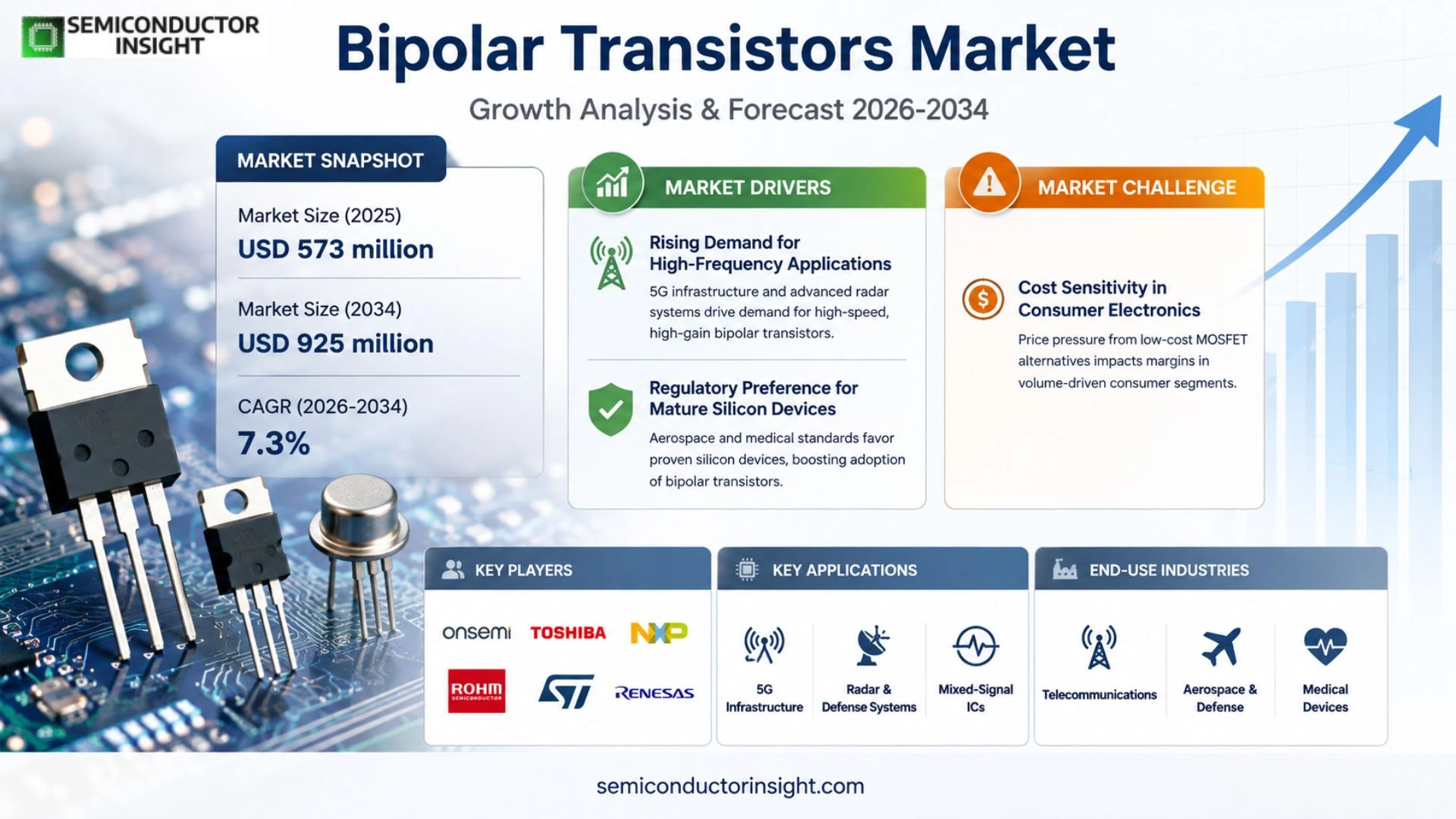
Global Bipolar Transistors market size was valued at USD 573 million in 2025. The market is expected to climb to USD 925 million by 2034, delivering a compound annual growth rate of 7.3 % over the forecast horizon.
A Bipolar Junction Transistor (BJT) is a three‑terminal active discrete device comprising an emitter, base and collector. It earns the “bipolar” label because both electrons and holes participate in conduction, and it is offered in NPN and PNP polarities. In practice, a modest base current or base‑emitter voltage controls a substantially larger collector current, making BJTs ideal for amplification and switching tasks across analog front‑ends, load‑switches, driver stages and gate‑drive support for power converters.
MARKET DRIVERS
Rising Demand for High‑Frequency Applications
The proliferation of 5G infrastructure and advanced radar systems forces designers to select components capable of switching at gigahertz rates. Bipolar Transistors Market benefits because the inherent high gain and fast transition times of bipolar devices meet the stringent latency requirements of these applications. Suppliers that can guarantee tight tolerance on ft and fmax are securing contracts with telecom OEMs.
Regulatory Preference for Mature Silicon Devices
Safety‑critical standards in aerospace and medical equipment still favor silicon‑based active devices, citing decades‑long reliability data. This regulatory bias nudges manufacturers toward bipolar solutions rather than newer, less‑tested compounds, expanding the addressable base for legacy‑type transistors. Companies that maintain robust qualification portfolios are positioning themselves as preferred vendors.
➤ Design houses that integrate bipolar transistors into mixed‑signal ASICs are reporting up to a 12% reduction in power‑budget while preserving linearity.
Overall, the convergence of ultra‑fast communication gear and conservative certification regimes creates a steady pull on component volumes, reinforcing the growth trajectory of Bipolar Transistors market.
MARKET CHALLENGES
Cost Sensitivity in Consumer Electronics
Smart‑phone and wearable manufacturers chase ultra‑low bill‑of‑materials, compelling them to evaluate cheaper MOSFET alternatives despite comparable performance. The price gap narrows profit margins for bipolar suppliers, especially in volume‑driven segments where unit cost dominates purchase decisions.
Other Challenges
Supply‑Chain Volatility
Fluctuations in silicon wafer availability and logistics bottlenecks increase lead times. End‑users facing uncertain delivery schedules are more likely to qualify secondary sources, diluting brand equity for established bipolar producers.
MARKET RESTRAINTS
Thermal Management Limits
Bipolar transistors generate higher base currents, which translate into greater junction temperatures under high‑power operation. Systems that cannot accommodate additional heatsinking face reliability concerns, prompting designers to shift toward low‑loss alternatives for power‑dense modules.
The need for complex thermal solutions adds bill‑of‑materials and design effort, deterring adoption in cost‑constrained markets such as IoT edge devices.
MARKET OPPORTUNITIES
Integration into Power‑Management Modules
Hybrid power‑ICs that combine DC‑DC conversion with precise analog control are increasingly incorporating bipolar transistors for their linear amplification capabilities. This architecture enables tighter voltage regulation without sacrificing efficiency, opening a niche for specialized device families.
Automotive electrification, particularly in advanced driver‑assistance systems, calls for components that can tolerate harsh temperature cycles while delivering fast switching. Bipolar transistors that meet automotive AEC‑Q100 standards are poised to capture a share of the expanding electric‑vehicle power‑train segment.
Bipolar Transistors Market Trends
Low‑VCE(sat) Families Gain Traction in Automotive Power‑train Modules
Automotive designers are prioritising BJTs that exhibit very low collector‑emitter saturation voltage because the resulting efficiency gain directly reduces fuel consumption in hybrid power‑train converters. Recent product introductions from Infineon and STMicroelectronics feature VCE(sat) values under 0.2 V while maintaining high current capability, enabling tighter thermal budgets in power‑stage driver circuits. This shift is reinforced by stricter emissions standards and the expanding electric‑vehicle portfolio, which together create a demand for components that can survive high‑temperature cycles without compromising switching speed. Manufacturers that can source such devices in automotive‑qualified packages stand to enlarge their share of a market that is increasingly defined by reliability rather than pure volume.
Other Trends
Pre‑biased and Resistor‑Equipped BJTs Simplify Bill‑of‑Materials
Design houses are integrating pre‑biased BJTs into signal‑conditioning blocks to eliminate discrete resistor networks. The approach cuts PCB real‑estate by up to 30 % and reduces assembly steps, a benefit that resonates strongly in consumer‑electronics where cost and time‑to‑market are paramount. Vendors such as Nexperia and Diodes Incorporated have released families that embed precise biasing resistors, offering predictable gain curves across temperature ranges. The move away from manual biasing improves yield in high‑volume production lines and aligns with the broader industry push toward component consolidation.
RF‑Optimised BJTs Support Emerging 5G Front‑Ends
High‑frequency BJTs tailored for low‑noise amplification are experiencing renewed interest as 5G infrastructure expands. These devices, typically fabricated in SiGe processes, provide superior noise figures compared to comparable MOSFETs at frequencies above 2 GHz, making them attractive for front‑end LNA stages in base‑station modules. The combination of modest power consumption and robust linearity enables network operators to meet density targets without incurring excessive cooling costs. As spectrum allocations broaden, manufacturers that diversify into RF‑optimised families can capture a niche that complements the traditional analog and power segments of Bipolar Transistors market.
Bipolar Transistors market
Key Industry Players
Bipolar Transistors Market: Competitive Overview
The segment is anchored by a handful of global semiconductor houses whose breadth of product families defines the market’s pricing power and distribution reach. Infineon Technologies AG, STMicroelectronics, onsemi and Nexperia each run multi‑generation BJT lines that cover everything from low‑VCE(sat) small‑signal devices to high‑voltage power Darlington arrays, and they retain deep automotive and industrial certifications. Their scale enables aggressive inventory policies, while continual portfolio refreshes,such as sub‑nanosecond switching families targeting electric‑vehicle power modules,create incremental demand among OEMs that still rely on discrete BJTs for gate‑drive and protection functions.
Beyond the tier‑one companies, a coalition of niche specialists supplies segments where performance nuance or regional compliance matters more than sheer volume. Vishay Intertechnology, Diodes Incorporated and Texas Instruments provide differentiated low‑noise or pre‑biased packages that simplify board design for consumer‑electronics and communication equipment. Analog Devices, Renesas Electronics, ROHM Co., Ltd., Toshiba Electronic Devices & Storage Corporation, Microchip Technology and NXP Semiconductors focus on high‑temperature, high‑reliability variants geared to automotive power‑train control and data‑center infrastructure. The presence of several Asian manufacturers,Sanken Electric, Fuji Electric and a host of China‑based firms,ensures that cost‑sensitive markets receive locally sourced alternatives, preserving a competitive pressure that moderates price erosion across the board.
List of Key Bipolar Transistors Companies Profiled
- Infineon Technologies AG
- STMicroelectronics
- onsemi
- Nexperia
- Vishay Intertechnology
- Diodes Incorporated
- Texas Instruments
- Analog Devices, Inc.
- Renesas Electronics
- ROHM Co., Ltd.
- Toshiba Electronic Devices & Storage Corporation
- Microchip Technology
- NXP Semiconductors
- Sanken Electric
- Fuji Electric
Segment Analysis:
| Segment Category | Sub-Segments | Key Insights |
| By Type |
|
Small‑signal BJTs
|
| By Application |
|
Switching and Driving
|
| By End User |
|
Automotive Electronics
|
| By Power Level |
|
High‑Voltage Power BJTs
|
| By Integration |
|
Multi‑Device Assemblies
|
Regional Analysis: Bipolar Transistors Market
Concentrated fabs in Taiwan and South Korea specialize in high‑voltage bipolar structures, delivering economies of scale that lower unit costs for global buyers. Their ability to run mixed‑size wafer lots adds flexibility for niche applications while preserving throughput efficiency.
Regional R&D centers focus on SiGe and SiC integration, pushing the performance envelope of bipolar devices for power‑dense modules. These advances translate into lighter, more reliable power‑management solutions for consumer electronics.
A dense distributor ecosystem across Hong Kong, Singapore and Japan shortens order‑to‑delivery cycles. Cross‑border logistics arrangements, reinforced after recent disruptions, keep inventory buffers thin yet responsive.
Government programmes that tie semiconductor subsidies to domestic content encourage local sourcing of raw silicon, reinforcing the region’s competitive edge without imposing protectionist barriers on foreign designers.
North America
North America remains a critical design nucleus for Bipolar Transistors market, where leading automotive and aerospace firms drive specifications that emphasize reliability under extreme conditions. While domestic fabs have contracted over the decade, the region compensates with intensive intellectual property creation and a robust ecosystem of test and validation services. End‑users increasingly expect customized transistor families that can be integrated into heterogeneous platforms, prompting foundry partnerships that blend offshore volume production with on‑shore engineering support. Trade policies that favor strategic material stockpiling have also nudged manufacturers to diversify sourcing beyond traditional Asian suppliers, adding a layer of risk mitigation for high‑value projects.
Europe
European stakeholders view bipolar technology as a cornerstone for precision instrumentation and renewable‑energy converters. Nations such as Germany and the Netherlands channel public research funds into low‑noise transistor architectures that serve medical imaging and smart‑grid applications. The regulatory environment, characterized by stringent environmental directives, pushes suppliers toward lead‑free processes and energy‑efficient manufacturing. Consequently, European OEMs often prioritize suppliers with verified sustainability credentials, a factor that shapes procurement strategies across the continent’s fragmented market landscape.
South America
In South America, emerging demand for telecom infrastructure and localized renewable‑energy projects fuels modest growth in bipolar component consumption. Countries like Brazil are investing in mixed‑signal foundry capabilities, yet the region still relies heavily on imported parts to meet quality standards. Market participants that can offer after‑sales technical assistance in Portuguese and Spanish gain a distinct advantage, as end‑users value on‑ground support for integration into harsh climatic conditions. Supply‑chain uncertainty, driven by fluctuating logistics costs, encourages buyers to lock in longer‑term contracts with trusted Asian exporters.
Middle East & Africa
The Middle East & Africa segment is gradually transitioning from a pure consumption zone to a modest design hub, driven by oil‑field automation and burgeoning data‑center construction. Investment in regional test labs enables local OEMs to qualify bipolar devices against harsh temperature cycles typical of desert environments. Although import dependency remains high, strategic partnerships with global manufacturers provide technology transfer opportunities that could seed a nascent ecosystem of niche‑focused fabs within the next decade.
Report Scope
This market research report provides a comprehensive analysis of the Bipolar Transistors Market , covering the forecast period 2026–2034. It offers detailed insights into market dynamics, technological advancements, competitive landscape, and key trends shaping the industry.
Key focus areas of the report include:
- Market Overview: The report begins with an overview outlining its current market scenario, key growth indicators, and industry transformation drivers. It discusses macroeconomic factors, demand–supply balance, regulatory landscape, and the strategic role of semiconductors in powering advancements across industries such as automotive, telecommunications, consumer electronics, and industrial automation.
- Market Size & Forecast: Historical data and future projections for revenue, unit shipments, and market value across major regions and segments.
- Segmentation Analysis: Detailed breakdown by product type, technology, application, and end-user industry to identify high-growth segments and investment opportunities.
- Regional Insights: Insights into market performance across North America, Europe, Asia-Pacific, Latin America, and the Middle East & Africa, including country-level analysis where relevant.
- Competitive Landscape: Profiles of leading market participants, including their product offerings, R&D focus, manufacturing capacity, pricing strategies, and recent developments such as mergers, acquisitions, and partnerships.
- Technology Trends & Innovation: Assessment of emerging technologies, integration of AI/IoT, semiconductor design trends, fabrication techniques, and evolving industry standards.
- Market Drivers & Restraints: Evaluation of factors driving market growth along with challenges, supply chain constraints, regulatory issues, and market-entry barriers.
- Stakeholder Insights: Insights for component suppliers, OEMs, system integrators, investors, and policymakers regarding the evolving ecosystem and strategic opportunities.
Primary and secondary research methods are employed, including interviews with industry experts, data from verified sources, and real-time market intelligence to ensure the accuracy and reliability of the insights presented.
FREQUENTLY ASKED QUESTIONS:
What is the current market size of Bipolar Transistors Market?
-> Bipolar Transistors market is expected to climb to USD 925 million by 2034, delivering a compound annual growth rate of 7.3 %
Which key companies operate in Bipolar Transistors Market?
-> Key players include Infineon Technologies AG, STMicroelectronics, onsemi, Nexperia, ROHM Co., Ltd., Toshiba Electronic Devices & Storage Corporation, Diodes Incorporated, Microchip Technology, Vishay Intertechnology, Texas Instruments, Analog Devices, Inc., NXP Semiconductors, and others.
What are the key growth drivers?
-> Key growth drivers include electrification of transportation (rising EV sales), expanding AI and data‑center power‑infrastructure demand, and increasing requirements for reliable switching and biasing components in automotive and industrial applications.
Which region dominates the market?
-> Asia‑Pacific dominates the market, driven by strong automotive and consumer‑electronics demand, while North America and Europe also show significant growth.
What are the emerging trends?
-> Emerging trends include low VCE(sat) and faster switching BJT families, tighter gain binning, pre‑biased/resistor‑equipped BJTs for BOM reduction, and multi‑device packages targeting automotive reliability and industrial automation.

Get Sample Report PDF for Exclusive Insights
Report Sample Includes
- Table of Contents
- List of Tables & Figures
- Charts, Research Methodology, and more...
 Download Sample Report PDF