Gallium Nitride (GaN) Power Transistor Market Insights
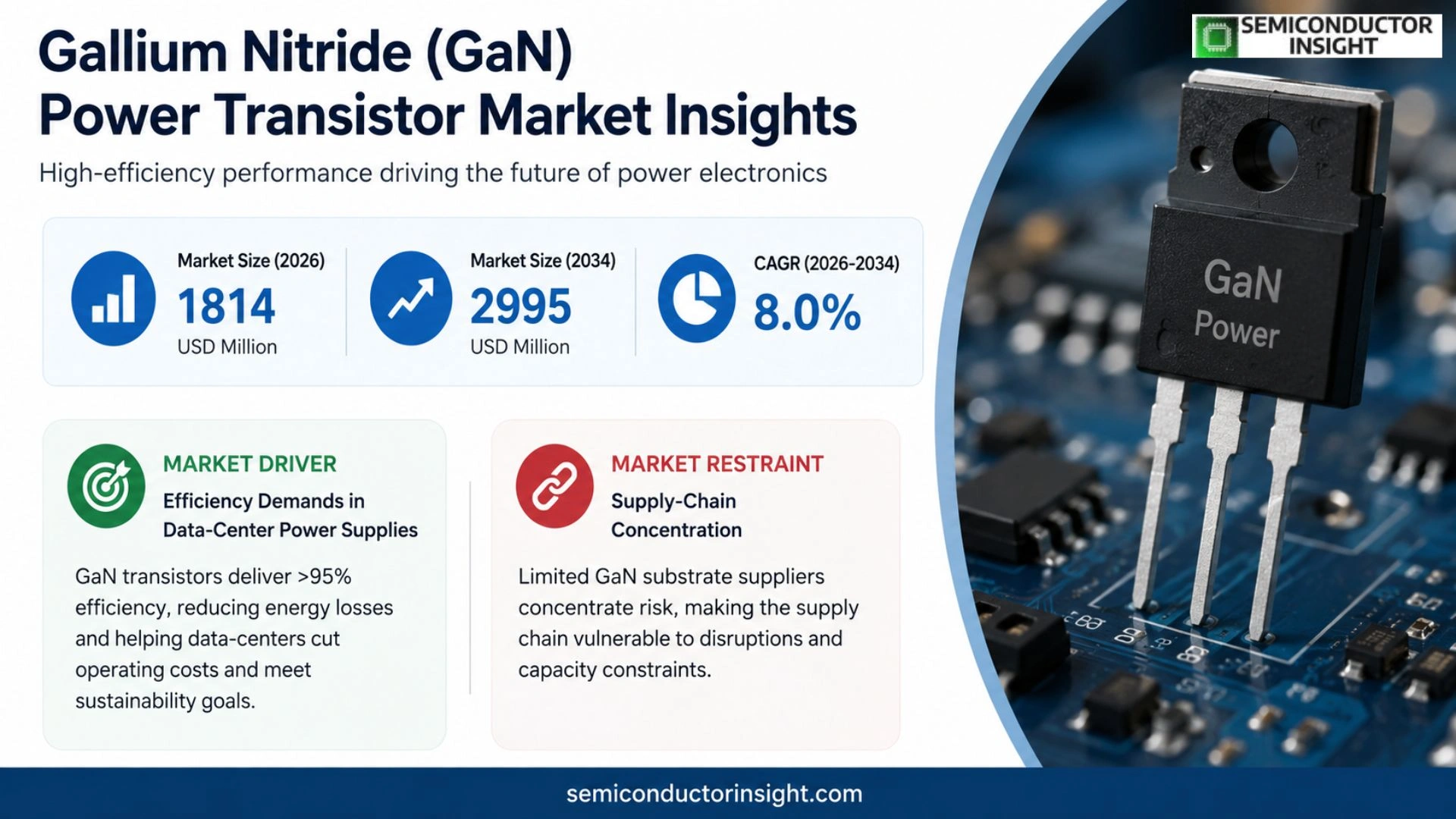
Gallium Nitride (GaN) Power Transistor market is projected to grow from USD 1814 million in 2026 to USD 2995 million by 2034, exhibiting a CAGR of 8.0% during the forecast period.
Gallium Nitride (GaN) power transistors are GaN‑based switching devices used for high‑efficiency power conversion. They are typically implemented as lateral GaN HEMTs on GaN‑on‑Si or GaN‑on‑SiC epitaxial platforms and target superior performance versus silicon MOSFETs across voltage classes such as 48 V‑class, 100–200 V‑class and 650 V‐class. Product forms include enhancement‑mode (E‑mode) normally‑off devices realized with p‑GaN gates, depletion‑mode (D‑mode) normally‐on devices and cascode configurations that pair D‑mode GaNs with low‑voltage Si MOSFETs.
The market gains momentum because higher efficiency and power density enable smaller magnetics and compact system designs across AI data centers, telecom infrastructure and automotive electrification. Recent capacity expansions,TI’s new GaN fab in Aizu Japan and Infineon’s progression toward 300 mm wafers,illustrate manufacturers’ push toward silicon‐fab‐like scaling and cost reduction per die. Integration trends such as combined driver/protection GaN power stages further lower design barriers for OEMs seeking robust solutions.
MARKET DRIVERS
Efficiency Demands in Data‑Center Power Supplies
Enterprises upgrading legacy silicon‑based converters are confronting ever‑higher energy‑cost pressures. Gallium Nitride (GaN) Power Transistor Market solutions deliver switching efficiencies above 95 %, trimming power‑loss budgets and enabling data‑centers to shave several megawatts of electricity consumption annually. This performance edge translates into lower operating expenditures and supports sustainability targets that many operators now treat as core business objectives.
Miniaturization Trends in Automotive Electrification
Vehicle architectures are shifting toward compact inverter modules to accommodate higher voltage battery packs. GaN devices, with their reduced parasitic capacitance, allow designers to pack more functionality into a smaller footprint, directly influencing vehicle weight and packaging constraints. Automotive OEMs that integrate these transistors can claim up to 15 % weight reduction in power‑train modules, a metric that improves range and handling characteristics.
➤ “Adoption of GaN power transistors is accelerating faster than any other wide‑bandgap technology, driven by tangible cost‑of‑ownership benefits.”
Beyond efficiency and size, the ability of GaN transistors to operate at higher temperatures reduces the need for extensive thermal management. Manufacturers can therefore eliminate bulky heat‑sinks, lower bill‑of‑materials, and shorten time‑to‑market for next‑generation power electronics, reinforcing the overall attractiveness of Gallium Nitride (GaN) Power Transistor Market.
MARKET CHALLENGES
Manufacturing Yield Volatility
The epitaxial growth processes required for high‑quality GaN layers remain sensitive to substrate defects, resulting in variable yields across production runs. Companies that cannot consistently achieve yields above 80 % face margin compression, which discourages large‑scale procurement and slows broader market penetration.
Other Challenges
Cost Parity with Silicon
While operating advantages are clear, the unit cost of GaN transistors remains roughly 1.5‑2 times that of mature silicon counterparts. End‑users often weigh upfront capital outlay against long‑term efficiency savings, creating a decision matrix that can delay adoption, especially in price‑sensitive segments such as consumer electronics.
MARKET RESTRAINTS
Supply‑Chain Concentration
Few suppliers dominate the GaN substrate market, concentrating risk in a limited number of production facilities. Any disruption,whether geopolitical, natural, or capacity‑related,quickly reverberates through the entire value chain, limiting the confidence of downstream manufacturers seeking reliable component streams.
Reliance on a narrow supplier base also hampers the ability of designers to negotiate volume discounts, reinforcing the cost gap highlighted in the challenges section and tempering broader market momentum.
MARKET OPPORTUNITIES
Emerging Applications in Renewable Energy Converters
Solar‑inverter manufacturers are exploring GaN transistors to boost the conversion efficiency of grid‑tie systems. Early pilots report efficiency lifts of 2‑3 % over silicon solutions, which can translate into net energy gains of several megawatt‑hours per megawatt of installed capacity. This differential creates a compelling value proposition for utilities aiming to maximize output from fixed‑area solar farms.
Additionally, the rapid rollout of offshore wind projects presents a niche where lightweight, high‑frequency converters can reduce platform weight and improve reliability, opening a specialized revenue stream for firms that can certify GaN devices for marine environments.
Gallium Nitride (GaN) Power Transistor Market Trends
Integration of Driver‑Protection Functions Within GaN Power Stages
System designers are increasingly favoring GaN power transistors that embed driver and protection capabilities directly on the die. By eliminating discrete MOSFET drivers, the solution cuts board‑level component count, reduces parasitic inductance, and shortens development cycles. This architectural shift is largely driven by the need for higher efficiency in data‑center converters and telecom power supplies, where every millivolt of loss translates into sizable operating‑cost savings. Moreover, the consolidated footprint eases thermal management, allowing tighter packaging in compact chargers and emerging automotive modules. Vendors that can deliver a reliable, normally‑off architecture while maintaining low gate‑threshold variation are gaining design‑win momentum, prompting OEMs to re‑evaluate bill‑of‑materials strategies.
Other Trends
Automotive Powertrain Adoption
Electrified drivetrains demand converters that sustain high voltage while occupying minimal space. GaN devices operating in the 600‑V class meet these criteria, delivering the power density required for on‑board chargers and traction‑inverter front‑ends. The automotive sector’s push toward higher voltage architectures amplifies the value of GaN’s fast switching, which reduces magnetic component size and improves overall system reliability. Suppliers that can certify their GaN products to stringent automotive reliability standards are positioning themselves as preferred partners for next‑generation EV platforms, creating a clear incentive for manufacturers to accelerate qualification programs.
Capacity Scaling and Wafer‑Size Expansion
Recent announcements from major semiconductor fabs signal a move toward “silicon‑fab‑like” production volumes for GaN. The establishment of dedicated GaN lines in Japan and the introduction of 300‑mm GaN wafers in Europe both aim to increase die‑per‑wafer counts and lower unit cost. Higher throughput enables lower‑priced GaN offerings, which erodes the cost barrier that previously limited adoption to premium segments. As capacity expands, the risk‑adjusted return on investment for new entrants improves, encouraging broader participation across the supply chain and fostering competitive pricing dynamics that benefit downstream integrators.
COMPETITIVE LANDSCAPE
Key Industry Players
Competitive Overview of GaN Power Transistor Suppliers
Texas Instruments dominates the high‑volume segment, leveraging its Aizu, Japan fab to supply E‑mode GaN FETs across 48 V to 650 V classes. Its broad portfolio and deep design‑win ecosystem give it a decisive edge in consumer chargers, data‑center adapters, and emerging automotive power modules. Infineon follows closely, advancing 300 mm wafer technology that squeezes more dies per wafer, thereby reducing unit cost and attracting telecom infrastructure OEMs seeking higher density converters. Onsemi complements the landscape with a strong presence in discrete D‑mode devices and cascode solutions, often paired with legacy silicon MOSFETs to ease transition for system integrators. The market structure therefore rests on a few large fabs that control volume and cost, while a parallel niche segment thrives on specialized architectures and integrated power‑stage IP.
Beyond the tier‑one manufacturers, a cluster of innovators is reshaping application‑specific value. Navitas Semiconductor and GaN Systems focus on high‑efficiency power stages for electric‑vehicle inverters, prioritizing thermal‑optimized packaging that tolerates aggressive di/dt. EPC (Efficient Power Conversion) leads in “plug‑and‑play” driver‑integrated modules, simplifying board‑level design for AI accelerator power supplies. Qorvo’s RF‑centric GaN portfolio is expanding into power‑dense 5G base‑station front‑ends, while STMicroelectronics offers silicon‑on‑insulator (SOI)‑compatible GaN devices that dovetail with its broader analog portfolio. These niche players, though smaller in revenue, generate meaningful differentiation through bespoke performance metrics, creating pockets of competition that larger firms must address through acquisitions or strategic alliances.
List of Key Gallium Nitride Power Transistor Companies Profiled
- Texas Instruments
- Infineon Technologies
- onsemi (ON Semiconductor)
- Navitas Semiconductor
- GaN Systems
- Efficient Power Conversion (EPC)
- Qorvo
- STMicroelectronics
- Wolfspeed (Cree)
- Analog Devices
- Renesas Electronics
- Mitsubishi Electric
- GeneSixt
Segment Analysis:
| Segment Category | Sub-Segments | Key Insights |
| By Type |
|
Enhancement‑mode GaN
|
| By Application |
|
Automotive Electrification
|
| By End User |
|
OEMs in High‑Speed Power Systems
|
| By Device Architecture |
|
Integrated Power Stages
|
| By Integration Form |
|
Co‑packaged Modules
|
Regional Analysis: Gallium Nitride (GaN) Power Transistor Market
Asia‑Pacific
Concentrations of wafer‑fab facilities in Taiwan, South Korea and China allow the region to achieve economies of scale, shortening lead times for GaN transistor volumes and lowering entry barriers for niche players.
Automotive electrification, 5G infrastructure and renewable‑energy converters dominate demand, with local automakers fast‑tracking GaN‑based inverters to meet stricter efficiency standards.
Several economies have introduced tax incentives for low‑carbon power solutions, indirectly encouraging adoption of GaN power transistors across industrial and consumer categories.
A tightly knit network of raw‑material suppliers and packaging specialists ensures resilience, while cross‑border collaborations reduce the risk of component shortages.
North America
North America remains a strong incubator for innovation in Gallium Nitride (GaN) Power Transistor Market, largely because leading research universities translate breakthroughs into commercial products within months. Venture capital flows continue to target start‑ups that demonstrate novel substrate‑integration techniques, giving the region a reputation for early‑stage technology leadership. However, the absence of large‑scale domestic wafer fabs forces many firms to source substrates from Asia‑Pacific, adding a logistical layer that can affect time‑to‑market. Companies are therefore adopting hybrid design‑for‑manufacturability strategies that balance performance with supply reliability. Regulatory scrutiny around electromagnetic compatibility also nudges designers toward GaN solutions that meet tighter emission standards, opening incremental market opportunities for high‑frequency applications.
Europe
European players approach Gallium Nitride (GaN) Power Transistor Market with a sustainability lens, integrating energy‑efficiency goals into long‑term product roadmaps. The region’s automotive clusters, especially in Germany and France, view GaN transistors as essential to achieving next‑generation electric‑drive efficiencies, prompting joint ventures between chipmakers and OEMs. Meanwhile, the EU’s emphasis on strategic autonomy for critical technologies has spurred public‑private partnerships aimed at establishing local substrate production capabilities. These initiatives mitigate reliance on external supply while positioning Europe as a responsible source of high‑performance power components. The cumulative effect is a market segment that values compliance, reliability and eco‑friendly performance over sheer volume.
South America
In South America, Gallium Nitride (GaN) Power Transistor Market is still emerging, with adoption chiefly driven by telecommunications upgrades and modest renewable‑energy projects. Local utilities are experimenting with GaN‑enabled converters to improve grid stability, especially in regions prone to intermittent solar generation. The primary barrier remains limited domestic manufacturing capacity, which forces firms to import finished devices, inflating costs. Nevertheless, regional trade agreements are easing tariff burdens, encouraging distributors to stock GaN solutions alongside traditional silicon components. This incremental shift suggests a budding market that could accelerate as cross‑border logistics improve.
Middle East & Africa
The Middle East & Africa sees Gallium Nitride (GaN) Power Transistor Market shaped by large‑scale infrastructure programs and a rising focus on data‑center expansion. Nations with ambitious smart‑city agendas view GaN transistors as a pathway to reduce power loss in urban lighting and HVAC systems, aligning with broader carbon‑reduction commitments. Although the region lacks indigenous semiconductor fabrication facilities, strategic partnerships with Asian manufacturers provide access to the latest device generations. Financial institutions in the Gulf are increasingly financing technology upgrades, creating a modest but steady demand pipeline for high‑efficiency power solutions across industrial and consumer sectors.
Report Scope
This market research report provides a comprehensive analysis of the Gallium Nitride (GaN) Power Transistor Market , covering the forecast period 2026–2034. It offers detailed insights into market dynamics, technological advancements, competitive landscape, and key trends shaping the industry.
Key focus areas of the report include:
- Market Overview: The report begins with an overview outlining its current market scenario, key growth indicators, and industry transformation drivers. It discusses macroeconomic factors, demand–supply balance, regulatory landscape, and the strategic role of semiconductors in powering advancements across industries such as automotive, telecommunications, consumer electronics, and industrial automation.
- Market Size & Forecast: Historical data and future projections for revenue, unit shipments, and market value across major regions and segments.
- Segmentation Analysis: Detailed breakdown by product type, technology, application, and end-user industry to identify high-growth segments and investment opportunities.
- Regional Insights: Insights into market performance across North America, Europe, Asia-Pacific, Latin America, and the Middle East & Africa, including country-level analysis where relevant.
- Competitive Landscape: Profiles of leading market participants, including their product offerings, R&D focus, manufacturing capacity, pricing strategies, and recent developments such as mergers, acquisitions, and partnerships.
- Technology Trends & Innovation: Assessment of emerging technologies, integration of AI/IoT, semiconductor design trends, fabrication techniques, and evolving industry standards.
- Market Drivers & Restraints: Evaluation of factors driving market growth along with challenges, supply chain constraints, regulatory issues, and market-entry barriers.
- Stakeholder Insights: Insights for component suppliers, OEMs, system integrators, investors, and policymakers regarding the evolving ecosystem and strategic opportunities.
Primary and secondary research methods are employed, including interviews with industry experts, data from verified sources, and real-time market intelligence to ensure the accuracy and reliability of the insights presented.
FREQUENTLY ASKED QUESTIONS:
What is the current market size of Gallium Nitride (GaN) Power Transistor Market?
-> Gallium Nitride (GaN) Power Transistor market is projected to grow from USD 1814 million in 2026 to USD 2995 million by 2034, exhibiting a CAGR of 8.0%
Which key companies operate in Gallium Nitride (GaN) Power Transistor Market?
-> Key players include Texas Instruments, Infineon Technologies, NXP Semiconductors, ON Semiconductor, and GaN Systems, among others.
What are the key growth drivers?
-> Key growth drivers include higher efficiency and power density, AI-driven and electrification-driven power‑system upgrades, and integrated GaN driver/protection solutions.
Which region dominates the market?
-> Asia-Pacific is the fastest‑growing region, while Europe remains a significant market.
What are the emerging trends?
-> Emerging trends include capacity internalization, wafer‑size scaling (e.g., 300 mm wafers), and integration of driver/protection in GaN power stages/modules.

Get Sample Report PDF for Exclusive Insights
Report Sample Includes
- Table of Contents
- List of Tables & Figures
- Charts, Research Methodology, and more...
 Download Sample Report PDF