Low Voltage Power MOSFETS Market Insights
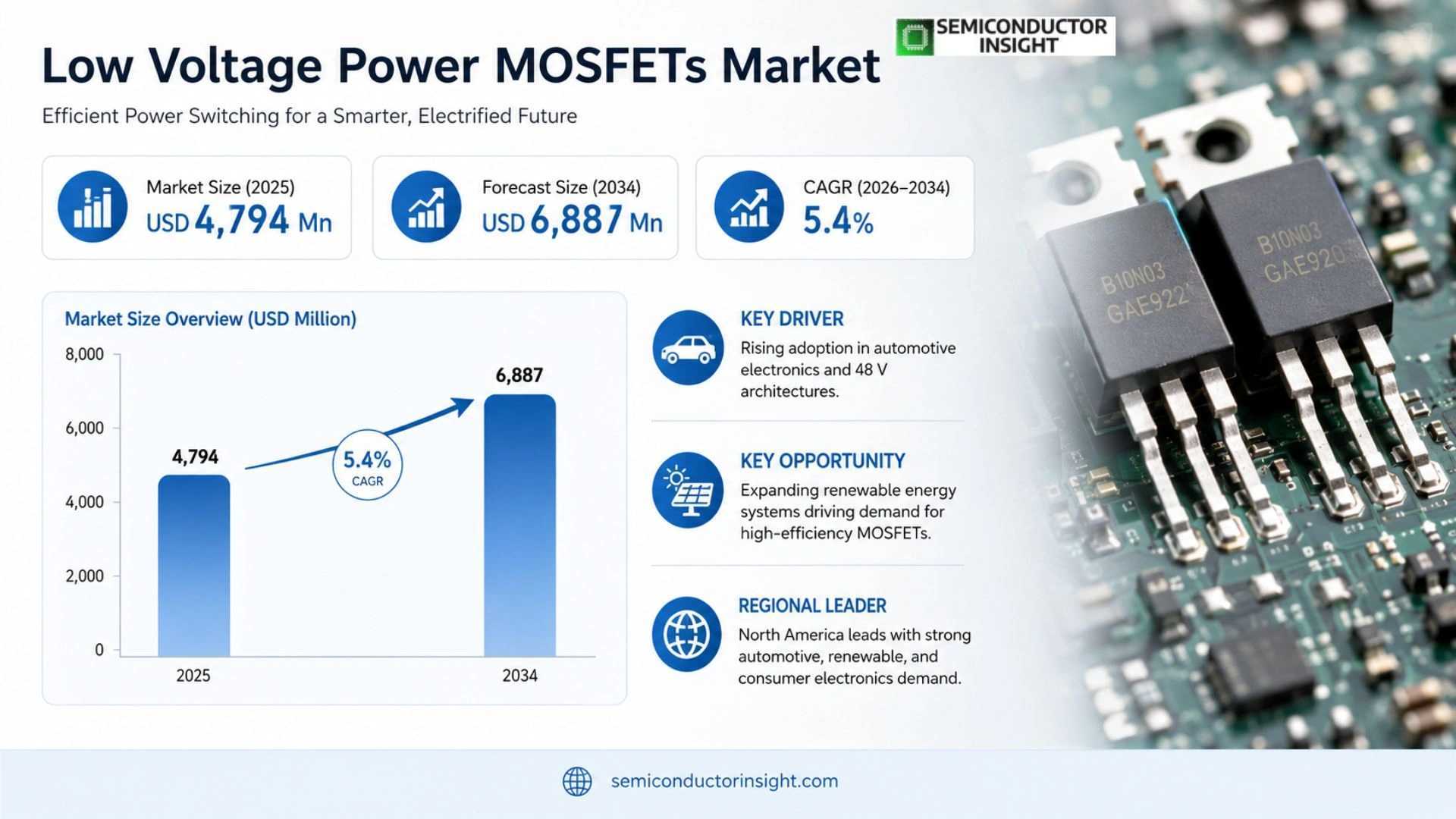
Low Voltage Power MOSFETs market was valued at USD 4,794 million in 2025 and is forecasted to climb to USD 6,887 million by 2034, reflecting a CAGR of 5.4 % over the forecast horizon.
Low‑voltage power MOSFETs are silicon‑based switching devices built on field‑effect transistor technology, typically rated at 100 V or below though some manufacturers extend coverage up to 150–200 V. They improve efficiency, power density and reliability in DC conversion, synchronous rectification, load switching, battery protection and motor‑drive applications by offering low on‑resistance, reduced gate charge and compact packaging. Common deployments include PoE modules, motherboard voltage regulators (VRM), adapters, chargers, server and telecom power supplies, lithium‑ion battery protection circuits and automotive auxiliary systems ranging from 12 V to 48 V.
The upward trajectory is supported by expanding demand across consumer electronics adapters, data‑center power modules , automotive low‑voltage architectures and industrial automation equipment . Companies such as Infineon Technologies, STMicroelectronics, ON Semiconductor, Nexperia, Toshiba Electronics and AOS are actively broadening their portfolios with dual‑MOSFET solutions , automotive‑grade qualifications (AEC‑Q101) and advanced packages like DFN , LFPAK and TOLL . Recent product launches emphasize lower RDS(on) , smaller Qg and wider safe operating area (SOA) , positioning these devices as integral components of modern power topologies rather than simple commodities .
MARKET DRIVERS
Increasing Adoption in Automotive Electronics
The proliferation of electric drivetrains and advanced driver‑assistance systems has raised the demand for compact, fast‑switching switches. Low Voltage Power MOSFETs Market participants are benefitting from the shift to 48 V architectures, where tighter voltage margins force designers to choose devices with lower on‑resistance and superior linearity. This transition is not merely a technical tweak; it reshapes bill‑of‑materials calculations and opens room for higher‑efficiency power‑train modules.
Shift Toward Energy‑Efficient Power Management
Industrial automation and IoT edge nodes increasingly rely on power supplies that can conserve energy without sacrificing response time. Modern converters employ synchronous rectification, a technique that leans heavily on low‑voltage MOSFETs to minimize conduction losses. As manufacturers tighten energy‑use thresholds to meet regulatory standards, the preference for devices that combine low gate charge with high thermal conductivity becomes a decisive factor.
➤ Design engineers now treat the MOSFET selection as a system‑level lever, balancing efficiency, footprint, and cost rather than a component‑by‑component choice.
Beyond technical advantages, the cost curve for silicon‑based MOSFETs has flattened thanks to mature fabs and incremental process refinements. This price stability encourages OEMs to incorporate higher‑spec parts earlier in the design cycle, further reinforcing the upward momentum of Low Voltage Power MOSFETs Market.
MARKET CHALLENGES
Thermal Management Constraints
Even as on‑resistance improves, power density in compact modules pushes junction temperatures close to limits. Engineers must allocate board space for heatsinks or adopt advanced package technologies, which can erode the cost benefits of low‑voltage devices. The trade‑off often forces a compromise between thermal safety margins and the aggressive form factors demanded by next‑generation equipment.
Other Challenges
Supply‑Chain Volatility
Fluctuations in silicon wafer availability and the concentration of specialty substrate suppliers create lead‑time uncertainties. When critical batches are delayed, manufacturers face schedule overruns, prompting some to keep higher inventory levels,an approach that diminishes the lean‑production advantage traditionally associated with MOSFETs.
MARKET RESTRAINTS
High Development Costs
Launching a new low‑voltage MOSFET series entails extensive design‑for‑reliability testing, electro‑static discharge qualification, and compliance verification across multiple standards. These activities demand significant engineering capital, which can deter smaller players from entering Low Voltage Power MOSFETs Market and limit competitive pressure.
Material Availability Constraints
Advanced gate‑oxide materials and high‑purity silicon substrates are subject to cyclical supply pressures. When raw material inventories tighten, manufacturers may resort to lower‑performance process windows, potentially compromising device reliability and raising warranty costs for end users.
Regulatory scrutiny over electromagnetic interference (EMI) also adds a layer of compliance testing that lengthens time‑to‑market, further restraining rapid portfolio expansion.
MARKET OPPORTUNITIES
Growth in Renewable Energy Systems
Solar inverters and grid‑tie converters increasingly operate at low voltages to improve safety and simplify isolation requirements. The push for higher conversion efficiency in these applications directly fuels demand for MOSFETs that can switch at high frequencies while maintaining minimal loss, positioning Low Voltage Power MOSFETs Market for notable capture of renewable‑energy spend.
Emergence of Wide‑Bandgap Integration
Hybrid designs that pair silicon MOSFETs with SiC or GaN devices are gaining traction, especially in high‑power, low‑voltage stages where cost‑effective silicon still dominates. Companies that develop seamless driver architectures for such mixed‑technology topologies can unlock new revenue streams and differentiate themselves in a crowded field.
Customization for Edge Computing
Edge servers embedded in factories and data centers require power modules that can adapt to fluctuating workloads without excess heat. Tailored MOSFET solutions offering programmable threshold voltages and integrated protection features meet this niche, creating a boutique market segment that rewards agile product development cycles.
Low Voltage Power MOSFETs Market Trends
Shift Toward Platform‑Based Competition
Low Voltage Power MOSFETs Market is moving beyond simple on‑resistance benchmarking. Manufacturers now bundle low RDS(on), reduced gate charge, and advanced packaging into cohesive device families. This approach allows OEMs to address efficiency, thermal density, and electromagnetic compatibility in a single selection step, rather than juggling discrete specifications. As a result, component procurement cycles are tightening, and design teams are favoring suppliers that can certify automotive‑grade reliability (AEC‑Q101) while delivering thin‑wafer, copper‑clip solutions. The net effect is a higher barrier to entry for pure‑price competitors and a premium placed on integrated performance metrics that align with system‑level cost targets.
Other Trends
Application Drivers Across Verticals
Demand is spilling over from traditional consumer adapters into data‑center power supplies, electric‑vehicle auxiliary systems, and industrial robotics. Server manufacturers cite lower loss in synchronous rectifiers as a decisive factor for selecting 100 V class MOSFETs, while automotive designers prioritize DFN and LFPAK packages for 48 V architectures. Simultaneously, the surge in lithium‑ion battery protection modules is prompting designers to adopt dual‑MOSFET configurations that balance reverse‑conductance and die‑size constraints. These concurrent growth vectors are reinforcing each other: higher data‑center density fuels cooler chassis designs, which in turn amplifies the need for compact, thermally robust MOSFETs.
Geographic Realignment of Supply and Demand
Production capacity remains clustered in East Asia, Europe, and the United States, but the bulk of new orders is migrating toward China and broader Asian electrification initiatives. Policy incentives for green data centers and vehicle electrification have accelerated order books for low‑voltage devices, especially in regions where 12 V to 48 V auxiliary power is becoming standard on commercial fleets. European automotive firms are increasingly qualifying Asian‑sourced MOSFETs that meet stringent reliability standards, while North American cloud operators are locking in multi‑year supply agreements with U.S. and Taiwanese manufacturers to mitigate geopolitical risk. This geographic shift suggests that Low Voltage Power MOSFETs Market will stay in a growth phase through the mid‑2020s, driven by a confluence of technological, regulatory, and supply‑chain dynamics.
COMPETITIVE LANDSCAPE
Key Industry Players
Low Voltage Power MOSFETs – Competitive Overview
The market is anchored by a handful of global semiconductor powerhouses that dominate revenue streams and secure the most demanding automotive and data‑center programmes. Infineon Technologies leverages its 150‑mm wafer line and extensive AEC‑Q101 portfolio to supply low‑on‑resistance devices across 12‑48 V vehicle subsystems, while STMicroelectronics exploits a broad DFN and PowerFLAT family to meet both consumer and industrial converters. ON Semiconductor, backed by a deep automotive supply chain in North America, differentiates through copper‑clip bonding and aggressive pricing on dual‑MOSFET modules. These firms command the bulk of high‑volume contracts because they couple mature silicon process technology with a global sales network that can guarantee long‑term component availability, a factor that end‑users in server and automotive OEMs weigh heavily. Collectively they capture roughly three‑quarters of worldwide shipments, creating a tiered competitive environment where niche entrants must either specialise in ultra‑low gate charge or target cost‑sensitive regional markets.
Beyond the tier‑one group, a vibrant set of specialists is reshaping the value chain by focusing on package innovation and voltage‑specific optimisation. Nexperia has expanded its LFPAK and SOT‑23 line‑up to deliver sub‑5 mΩ RDS(on) parts that appeal to compact notebook adapters, whereas Alpha and Omega Semiconductor pushes Split‑Gate‑Trench (SGT) devices for high‑frequency motor drives. KEC’s recent introduction of thin‑wafer DFN products positions it well for emerging 48 V automotive architectures, and SemiHow’s China‑based foundries enable rapid iteration on TOLL packages for local BMS manufacturers. China Resources Microelectronics leverages its vertical integration to offer competitive pricing on 20‑30 V series, while Renesas and Vishay retain niche footholds in industrial control and Power‑over‑Ethernet modules. The cumulative effect of these players is a diffusion of capability that forces the leading firms to continuously upgrade packaging and thermal solutions to preserve market share.
List of Key Low Voltage Power MOSFETs Companies Profiled
- Infineon Technologies AG
- STMicroelectronics
- ON Semiconductor
- Texas Instruments
- Nexperia
- Alpha and Omega Semiconductor Limited
- KEC Corporation
- SemiHow Co., Ltd.
- China Resources Microelectronics Limited
- Renesas Electronics
- Vishay Intertechnology
- Diodes Incorporated
Segment Analysis:
| Segment Category | Sub-Segments | Key Insights |
| By Type |
|
N‑Channel MOSFETs
|
| By Application |
|
Automotive Auxiliary Systems
|
| By End User |
|
OEM Power‑Supply Designers
|
| By Package |
|
DFN and PowerFLAT Packages
|
| By Qualification |
|
Automotive‑Grade (AEC‑Q101) Devices
|
Regional Analysis: Low Voltage Power MOSFETs Market
North America
The push for higher‑efficiency electric drivetrains has driven automakers to select MOSFETs with lower on‑resistance and faster switching capabilities. This preference accelerates adoption in power‑train modules, where thermal management and reliability are paramount, creating a virtuous cycle of design integration and volume growth.
Smart‑factory deployments rely on precise motor‑control and energy‑saving converters. Low‑voltage MOSFETs enable tighter control loops and reduced standby losses, making them a cornerstone component in robotics and CNC machinery across the United States and Canada.
Portable devices and wearables demand compact power stages. The region’s leading consumer‑electronics firms prioritize MOSFETs that combine high current density with minimal footprint, driving incremental upgrades in smartphones, tablets, and IoT gateways.
Domestic wafer fabs and a layered distribution network cushion North America from global shortages. This stability allows OEMs to lock in multi‑year supply agreements, reducing the need for costly inventory buffers.
Europe
European manufacturers are adapting to stringent energy‑efficiency directives that favor low‑loss semiconductor solutions. Automotive suppliers in Germany and France are co‑designing power modules that embed MOSFETs capable of handling higher thermal cycles, while the renewable‑energy sector in Scandinavia seeks devices that sustain long‑duration operation in offshore wind converters. Policy‑driven incentives for electric‑vehicle adoption also push component specifiers toward devices with tighter tolerance bands, fostering a niche for premium‑grade MOSFETs. Supply‑side dynamics are shaped by a blend of local fab capacity and a well‑established ecosystem of specialty distributors, ensuring that design cycles remain agile despite broader market volatility.
Asia‑Pacific
The Asia‑Pacific region presents a paradox of massive demand coupled with fragmented sourcing. Rapid urbanization in China, India, and Southeast Asia fuels an explosion of consumer‑electronics, yet the same markets are investing heavily in electric‑bus fleets and solar‑plus‑storage installations. Local manufacturers, many of which operate at scale, are pushing price‑competitive MOSFETs that meet baseline performance criteria, while tier‑1 global players focus on high‑performance niches such as advanced driver‑assistance systems. The regional trade environment, characterized by variable tariff regimes, forces OEMs to balance cost pressures against the reliability needed for mission‑critical applications.
South America
In South America, the market is shaped by emerging renewable‑energy projects and a growing automotive aftermarket. Countries like Brazil are expanding grid‑integration projects, prompting utilities to adopt low‑voltage power converters that rely on robust MOSFETs to manage fluctuating generation. Simultaneously, the region’s automotive sector is transitioning from legacy internal‑combustion platforms to hybrid powertrains, creating a modest but steady demand for devices that can tolerate harsher thermal environments. Limited local fab capability means most components are imported, placing emphasis on distributor reliability and after‑sales support.
Middle East & Africa
The Middle East & Africa region is witnessing incremental adoption of low‑voltage power modules in both data‑center expansion and oil‑field automation. Energy‑intensive industries are seeking MOSFETs that can operate under extreme ambient temperatures while maintaining efficiency, prompting a shift toward devices with enhanced thermal tolerance. Infrastructure projects, especially in the Gulf, integrate smart‑grid technologies that depend on reliable semiconductor switches. Import‑centric supply chains dominate, making strategic partnerships with global distributors essential for ensuring consistent product availability and technical assistance.
Report Scope
This market research report provides a comprehensive analysis of the Low Voltage Power MOSFETs Market , covering the forecast period 2026–2034. It offers detailed insights into market dynamics, technological advancements, competitive landscape, and key trends shaping the industry.
Key focus areas of the report include:
- Market Overview: The report begins with an overview outlining its current market scenario, key growth indicators, and industry transformation drivers. It discusses macroeconomic factors, demand–supply balance, regulatory landscape, and the strategic role of semiconductors in powering advancements across industries such as automotive, telecommunications, consumer electronics, and industrial automation.
- Market Size & Forecast: Historical data and future projections for revenue, unit shipments, and market value across major regions and segments.
- Segmentation Analysis: Detailed breakdown by product type, technology, application, and end-user industry to identify high-growth segments and investment opportunities.
- Regional Insights: Insights into market performance across North America, Europe, Asia-Pacific, Latin America, and the Middle East & Africa, including country-level analysis where relevant.
- Competitive Landscape: Profiles of leading market participants, including their product offerings, R&D focus, manufacturing capacity, pricing strategies, and recent developments such as mergers, acquisitions, and partnerships.
- Technology Trends & Innovation: Assessment of emerging technologies, integration of AI/IoT, semiconductor design trends, fabrication techniques, and evolving industry standards.
- Market Drivers & Restraints: Evaluation of factors driving market growth along with challenges, supply chain constraints, regulatory issues, and market-entry barriers.
- Stakeholder Insights: Insights for component suppliers, OEMs, system integrators, investors, and policymakers regarding the evolving ecosystem and strategic opportunities.
Primary and secondary research methods are employed, including interviews with industry experts, data from verified sources, and real-time market intelligence to ensure the accuracy and reliability of the insights presented.
FREQUENTLY ASKED QUESTIONS:
What is the current market size of Low Voltage Power MOSFETs Market?
-> Low Voltage Power MOSFETs market is forecasted to climb to USD 6,887 million by 2034, reflecting a CAGR of 5.4 % over the forecast horizon.
Which key companies operate in Low Voltage Power MOSFETs Market?
-> Key players include STMicroelectronics, Vishay, Infineon, ON Semiconductor, Texas Instruments, Nexperia, Toshiba, Rohm, Renesas Electronics, and KEC Corporation, among others.
What are the key growth drivers?
-> Key growth drivers include expansion of server power supplies, AI computing infrastructure, automotive low‑voltage electrical systems, robotics and industrial automation, battery management systems, and the push for greener data‑center and electric‑vehicle solutions.
Which region dominates the market?
-> Asia-Pacific is the fastest‑growing region, while Europe remains a dominant market in terms of mature applications and automotive electrification.
What are the emerging trends?
-> Emerging trends include platform‑based competition focusing on low RDS(on), low gate charge, advanced packaging formats such as DFN, LFPAK, PowerFLAT, and the shift toward automotive‑grade and dual‑MOSFET solutions that enhance system efficiency and reliability.

Get Sample Report PDF for Exclusive Insights
Report Sample Includes
- Table of Contents
- List of Tables & Figures
- Charts, Research Methodology, and more...
 Download Sample Report PDF