GaN FET Market Insights
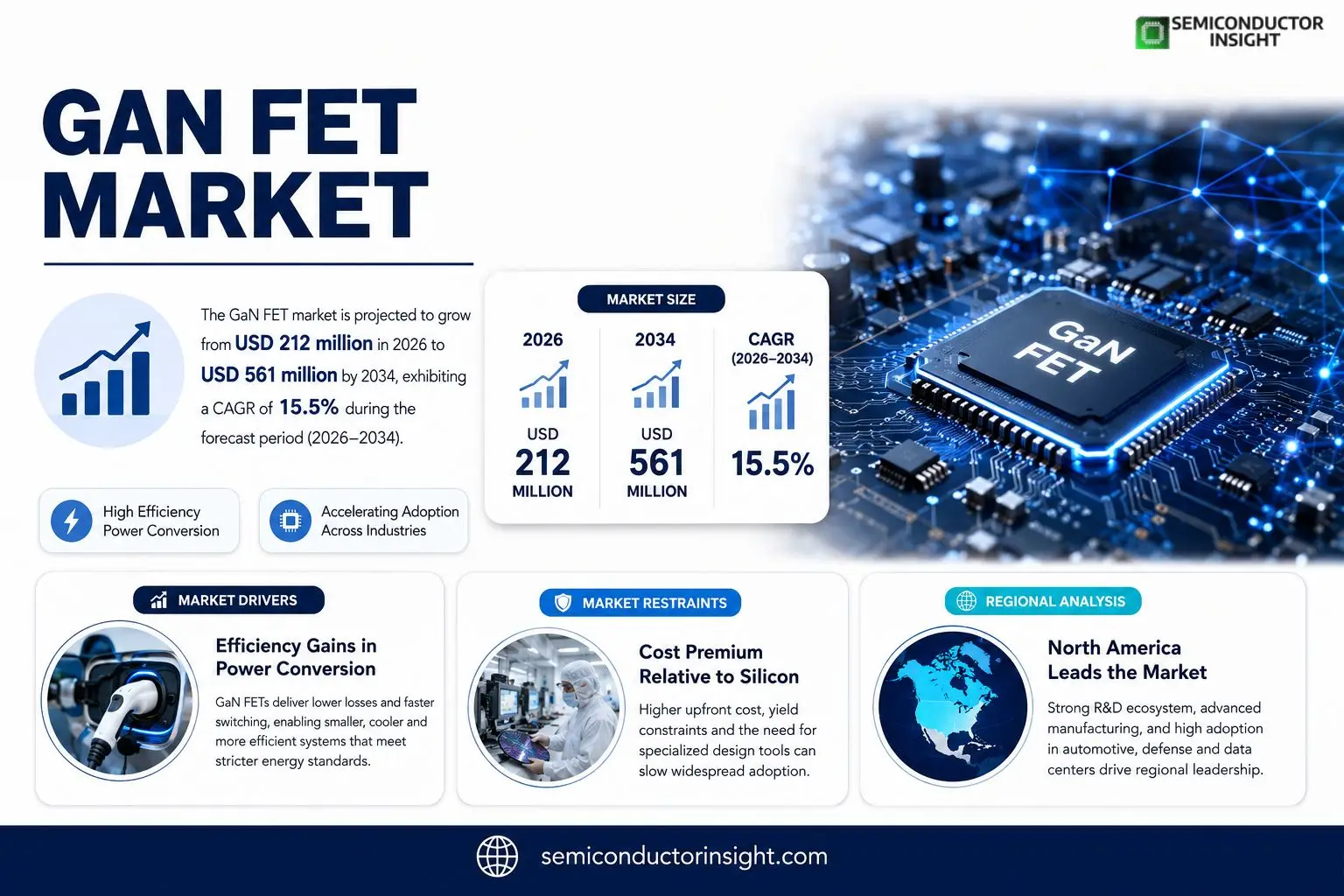
GaN FET market size was valued at USD 212 million in 2025. The market grows from USD 212 million in 2025 to USD 561 million by 2034, reflecting a compound annual growth rate of 15.5% during the forecast period.
GaN FETs (gallium nitride field‑effect transistors) are high‑performance power and RF semiconductor devices built on wide‑bandgap GaN material. They mitigate loss, size and thermal‑management constraints of conventional silicon devices when operating under high‑frequency switching, high‑efficiency power conversion, high power density and elevated temperature conditions.The expansion is fueled by adoption in fast chargers, data‑center power supplies, AI server architectures, industrial motor drives and automotive onboard chargers, where efficiency gains translate into smaller footprints and lower cooling costs.Key suppliers such as Infineon Technologies AG, Navitas Semiconductor Corporation and Efficient Power Conversion Corporation have broadened their portfolios from discrete HEMTs toward integrated power ICs with built‑in drivers and protection features, shifting competition toward platform capabilities rather than isolated device parameters.
MARKET DRIVERS
Efficiency Gains in Power Conversion
Design teams are increasingly turning to gallium nitride (GaN) transistors because they deliver lower on‑resistance and faster switching than conventional silicon devices. Those electrical advantages translate into smaller heat‑sink requirements and higher overall system efficiency, allowing OEMs to shrink form factors while meeting stricter energy‑use standards. Manufacturers that embed GaN FETs can differentiate their products on both performance and sustainability metrics.
Rise of Electrified Transportation
Electric vehicle (EV) powertrains demand converters that can handle high voltage spikes without excessive losses. GaN technology supplies the necessary bandwidth for regenerative braking and fast‑charge interfaces, giving vehicle makers a path to improve range without enlarging battery packs. The shift toward electrified public‑transport fleets further amplifies demand for compact, high‑power modules.
➤ Industry analysts note that every 10 % improvement in inverter efficiency can shave several hundred dollars off a midsize EV’s bill of materials.
Beyond transportation, data‑center power supplies are pressured by rising compute density. GaN FETs enable higher‑frequency operation, which reduces magnetic component size and improves thermal managementa compelling proposition for hyperscale operators seeking to lower floor‑space footprints.
MARKET CHALLENGES
Manufacturing Yield Constraints
GaN epitaxial growth remains a relatively niche process, and yield variability can drive up per‑watt costs. Foundries that lack mature production lines face longer lead times, prompting some customers to stay with legacy silicon solutions despite efficiency penalties.
Other Challenges
Supply‑Chain Volatility
The reliance on high‑purity substrates and specialized packaging materials introduces exposure to geopolitical fluctuations. When wafer shipments are delayed, downstream system integrators encounter bottlenecks that can stall product launches.
MARKET RESTRAINTS
Cost Premium Relative to Silicon
Even though total‑system savings are evident, the upfront price of a GaN FET often exceeds that of a comparable silicon MOSFET. Cost‑sensitive segments such as consumer appliances hesitate to adopt the technology until economies of scale materialize.
Furthermore, design engineers must invest in new simulation tools and validation workflows to fully exploit GaN’s fast switching capabilities. The learning curve can discourage early adoption in organizations with limited R&D budgets.
MARKET OPPORTUNITIES
Emerging 5G Infrastructure
The rollout of 5G base stations relies on high‑frequency power amplifiers where GaN transistors excel. Suppliers that can integrate GaN FETs into compact RF power modules stand to capture a sizable share of telecom capital‑expenditure budgets.In parallel, aerospace applications demand radiation‑hard components capable of operating under extreme thermal cycles. GaN’s wide bandgap properties make it a strong candidate for satellite power converters, opening a niche yet high‑margin market.Finally, the growing emphasis on renewable‑energy integrationparticularly in solar‑inverter and wind‑turbine converterscreates demand for devices that can tolerate high voltage transients while maintaining efficiency. Companies that align product roadmaps with these clean‑energy trends will likely see accelerated adoption.
GaN FET Market Trends
System‑Level Integration Accelerates Adoption
The transition from discrete switches to fully‑integrated power platforms marks the most visible shift in the GaN FET Market today. Manufacturers are bundling drivers, protection circuitry, and current‑sensing functions into single Si‑based packages, allowing design engineers to collapse bill‑of‑material counts and shorten time‑to‑market. In data‑center power supplies, this integration translates into 10‑15 % lower total harmonic distortion and a measurable reduction in rack‑space consumption, qualities that directly influence operating expense calculations. Automotive OEMs are increasingly specifying half‑bridge modules that embed gate‑drive logic, because the promised thermal headroom eases cooling system sizing on electric‑vehicle charging racks. The net effect is a redefinition of the value proposition: success is no longer judged solely by on‑resistance, but by the extent to which a component can be treated as a plug‑and‑play power block.
Other Trends
Expansion into High‑Power Infrastructures
Beyond consumer fast chargers, the GaN FET Market is finding traction in applications that demand several hundred volts and tens of kilowatts. Solar‑inverter manufacturers report that the high‑frequency capability of GaN devices enables transformer‑less topologies, cutting BOM weight by up to 30 %. In AI server architectures operating at 800 VDC, the ability to switch at tens of megahertz reduces magnetic component volume and improves overall efficiency, delivering tangible savings in cooling infrastructure. These high‑power use cases also raise the average revenue per unit, because system designers are willing to pay a premium for the combination of density and reliability that GaN delivers.
Supply‑Chain Consolidation Strengthens Market Confidence
Recent M&A activitymost notably Infineon’s acquisition of GaN Systems and Renesas’ purchase of Transphormhas reshaped the competitive landscape. The consolidation creates vertically integrated players capable of guaranteeing long‑term wafer capacity and providing coordinated design‑in support. Regional analysis shows that production capabilities are now spread across North America, Europe, and Asia, reducing reliance on any single fab. For end customers, this translates into more predictable lead times and warranty terms, which are critical for sectors such as defense radar and aerospace where lifecycle assurance is non‑negotiable. As the ecosystem matures, smaller fabless firms are increasingly partnering with these larger entities to leverage shared IP, reinforcing the trend toward a collaborative, albeit more concentrated, supply network.
COMPETITIVE LANDSCAPE
Key Industry Players
GaN FET Competitive Dynamics – 2024 Overview
Infineon Technologies, following its acquisition of GaN Systems, now anchors a sizeable share of the high‑voltage GaN FET segment and leverages a ID‑manufacturing footprint that spans Europe, the United States and Asia. Its portfolio combines discrete HEMTs, cascode devices and integrated power‑IC families, positioning the company as a one‑stop supplier for OEMs that demand both performance and volume assurance. Texas Instruments complements this structure with a strong analog‑power heritage; its GaN offerings are bundled with driver‑ICs and reference designs that accelerate time‑to‑market for data‑center adapters and automotive DC‑DC converters. Nexperia and STMicroelectronics reinforce the European contingent, each delivering cost‑effective, normally‑off GaN devices that suit fast‑charger and consumer‑electronics applications while retaining a robust supply chain. Collectively, these leaders dictate pricing tiers, set reliability benchmarks and shape the platform‑centric narrative that now defines the market’s evolution.Beyond the headline players, a cohort of specialist firms fuels innovation in niche and emerging segments. Navitas Semiconductor has become a preferred source for ultra‑compact chargers, thanks to its emphasis on low‑on‑resistance architectures and extensive design‑in support. Efficient Power Conversion focuses on high‑frequency, high‑current modules for industrial motor drives, where its half‑bridge solutions reduce external component count. Qorvo’s RF‑GaN portfolio serves 5G base stations and defense radar, illustrating the crossover between power and RF domains. Transphorm, recently integrated into Renesas, supplies high‑voltage devices that address AI‑server power‑supply requirements. Additional contributors such as Cambridge GaN Devices, MACOM, and Ampleon address niche markets ranging from aerospace to bidirectional converters, ensuring that the competitive arena remains diverse and technically vibrant.
List of Key GaN FET Companies Profiled
- Infineon Technologies AG
- Texas Instruments Incorporated
- Nexperia B.V.
- Qorvo, Inc.
- Navitas Semiconductor Corporation
- Efficient Power Conversion Corporation
- Transphorm (now part of Renesas)
- Cambridge GaN Devices Ltd.
- MACOM Technology Solutions Holdings, Inc.
- Ampleon Netherlands B.V.
- Wolfspeed, Inc.
- Microchip Technology Inc.
- STMicroelectronics
- Navitas Semiconductor
- Sumitomo Electric Industries, Ltd.
Segment Analysis:
| Segment Category | Sub-Segments | Key Insights |
| By Type |
|
Integrated Power ICs
|
| By Application |
|
Data Center Power Supplies
|
| By End User |
|
Power Module and Inverter Manufacturers
|
| By Voltage Class |
|
Mid Voltage
|
| By Delivery Form |
|
Integrated Power IC
|
Regional Analysis: GaN FET Market
North America
Domestic wafer production facilities have expanded their line‑up to accommodate larger diameters, delivering higher throughput for GaN FETs. This locally sourced output curtails shipping delays and allows niche players to iterate designs with minimal batch turnaround.
University‑industry consortia focus on epitaxial layer quality and thermal management, yielding devices that sustain higher voltage while maintaining compact form factors, a combination prized by power‑electronics integrators.
Vertical integration initiatives link design houses directly with packaging firms, creating a streamlined flow that reduces inventory buffers and improves forecast accuracy for system manufacturers.
Tier‑1 automotive OEMs are experimenting with GaN FETs in onboard chargers, seeking lighter weight and higher efficiency, while data‑center operators evaluate them for fast‑switching power supplies to cut energy consumption.
Europe
European stakeholders leverage stringent energy‑efficiency directives to embed GaN technology within industrial drives and rail electrification projects. Collaborative clusters in Germany and France align component manufacturers with system integrators, fostering rapid validation of low‑loss converters for renewable‑energy installations. The region’s emphasis on sustainability, coupled with a mature standards framework, pushes OEMs to replace legacy silicon solutions where lifecycle cost reductions become evident. Supply‑chain diversity remains a priority, prompting firms to source from both local and Asian fabs to mitigate geopolitical risk while retaining access to cutting‑edge process nodes.
Asia‑Pacific
In the Asia‑Pacific, burgeoning demand for consumer electronics and electric mobility fuels a pragmatic embrace of GaN FETs. Manufacturers in Japan, South Korea, and Taiwan integrate the devices into compact adapters and fast‑charging modules, capitalizing on the technology’s ability to deliver high power density within constrained footprints. Meanwhile, Chinese firms accelerate volume production through government‑backed semiconductor initiatives, positioning the region as a cost‑effective supplier for OEMs. The confluence of aggressive cost targets and scaling ambitions creates a competitive landscape where performance gains are quickly translated into market offerings.
South America
South American markets, while smaller in absolute terms, exhibit a growing appetite for energy‑efficient power conversion in mining and agricultural equipment. Local engineering firms partner with multinational chip providers to tailor GaN FET‑based solutions for harsh operating environments, emphasizing reliability under temperature extremes. Regulatory incentives aimed at reducing diesel fuel consumption encourage the adoption of electric auxiliary power units, where GaN’s superior switching characteristics deliver measurable fuel savings. The region’s focus on ruggedized applications differentiates its trajectory from the more consumer‑driven markets elsewhere.
Middle East & Africa
The Middle East and Africa are leveraging GaN FETs to modernize power infrastructure amid ambitious renewable‑energy rollouts. Solar‑farm developers in the UAE and South Africa experiment with GaN‑enabled inverters to improve conversion efficiency and lower balance‑of‑system costs. Concurrently, telecom operators upgrade base‑station power supplies, seeking compact, high‑efficiency components that reduce cooling requirements in desert climates. Although market size remains modest, strategic trials underscore a willingness to adopt advanced semiconductor solutions where they align with long‑term sustainability goals.
Report Scope
This market research report provides a comprehensive analysis of the GaN FET Market , covering the forecast period 2026–2034. It offers detailed insights into market dynamics, technological advancements, competitive landscape, and key trends shaping the industry.
Key focus areas of the report include:
- Market Overview: The report begins with an overview outlining its current market scenario, key growth indicators, and industry transformation drivers. It discusses macroeconomic factors, demand–supply balance, regulatory landscape, and the strategic role of semiconductors in powering advancements across industries such as automotive, telecommunications, consumer electronics, and industrial automation.
- Market Size & Forecast: Historical data and future projections for revenue, unit shipments, and market value across major regions and segments.
- Segmentation Analysis: Detailed breakdown by product type, technology, application, and end-user industry to identify high-growth segments and investment opportunities.
- Regional Insights: Insights into market performance across North America, Europe, Asia-Pacific, Latin America, and the Middle East & Africa, including country-level analysis where relevant.
- Competitive Landscape: Profiles of leading market participants, including their product offerings, R&D focus, manufacturing capacity, pricing strategies, and recent developments such as mergers, acquisitions, and partnerships.
- Technology Trends & Innovation: Assessment of emerging technologies, integration of AI/IoT, semiconductor design trends, fabrication techniques, and evolving industry standards.
- Market Drivers & Restraints: Evaluation of factors driving market growth along with challenges, supply chain constraints, regulatory issues, and market-entry barriers.
- Stakeholder Insights: Insights for component suppliers, OEMs, system integrators, investors, and policymakers regarding the evolving ecosystem and strategic opportunities.
Primary and secondary research methods are employed, including interviews with industry experts, data from verified sources, and real-time market intelligence to ensure the accuracy and reliability of the insights presented.
FREQUENTLY ASKED QUESTIONS:
What is the current market size of GaN FET Market?
-> GaN FET Market was valued at USD 212 million in 2025 and is expected to reach USD 561 million by 2034, growing at a CAGR of 15.5% over the forecast period.
Which key companies operate in GaN FET Market?
-> Key players include Nexperia B.V., Renesas Electronics Corporation, Texas Instruments Incorporated, Infineon Technologies AG, Toshiba Electronic Devices & Storage Corporation, Wolfspeed, Inc., Qorvo, Inc., Efficient Power Conversion Corporation, Navitas Semiconductor Corporation, STMicroelectronics, ROHM Co., Ltd., and Mitsubishi Electric Corporation, among others.
What are the key growth drivers?
-> Growth is driven by the need for higher efficiency power conversion, size reduction, and improved thermal management in high‑frequency switching applications; expanding demand from data‑center and AI server power supplies, industrial motor drives, solar‑energy and storage systems, automotive on‑board chargers and DC‑DC converters, and 5G communications infrastructure.
Which region dominates the market?
-> Asia‑Pacific is expected to hold the largest market share, supported by strong manufacturing capabilities in China, Japan, and South Korea, while North America and Europe remain important secondary markets.
What are the emerging trends?
-> Emerging trends include the integration of GaN devices into power‑ICs and system‑in‑package solutions, platform‑centric competition focused on driver integration and half‑bridge topologies, increased adoption in AI‑server power architectures, and expanding use of RF GaN for radar, satellite communications, and defence applications.
Get Sample Report PDF for Exclusive Insights
Report Sample Includes
- Table of Contents
- List of Tables & Figures
- Charts, Research Methodology, and more...
 Download Sample Report PDF