Radio Frequency Transistor Market Insights
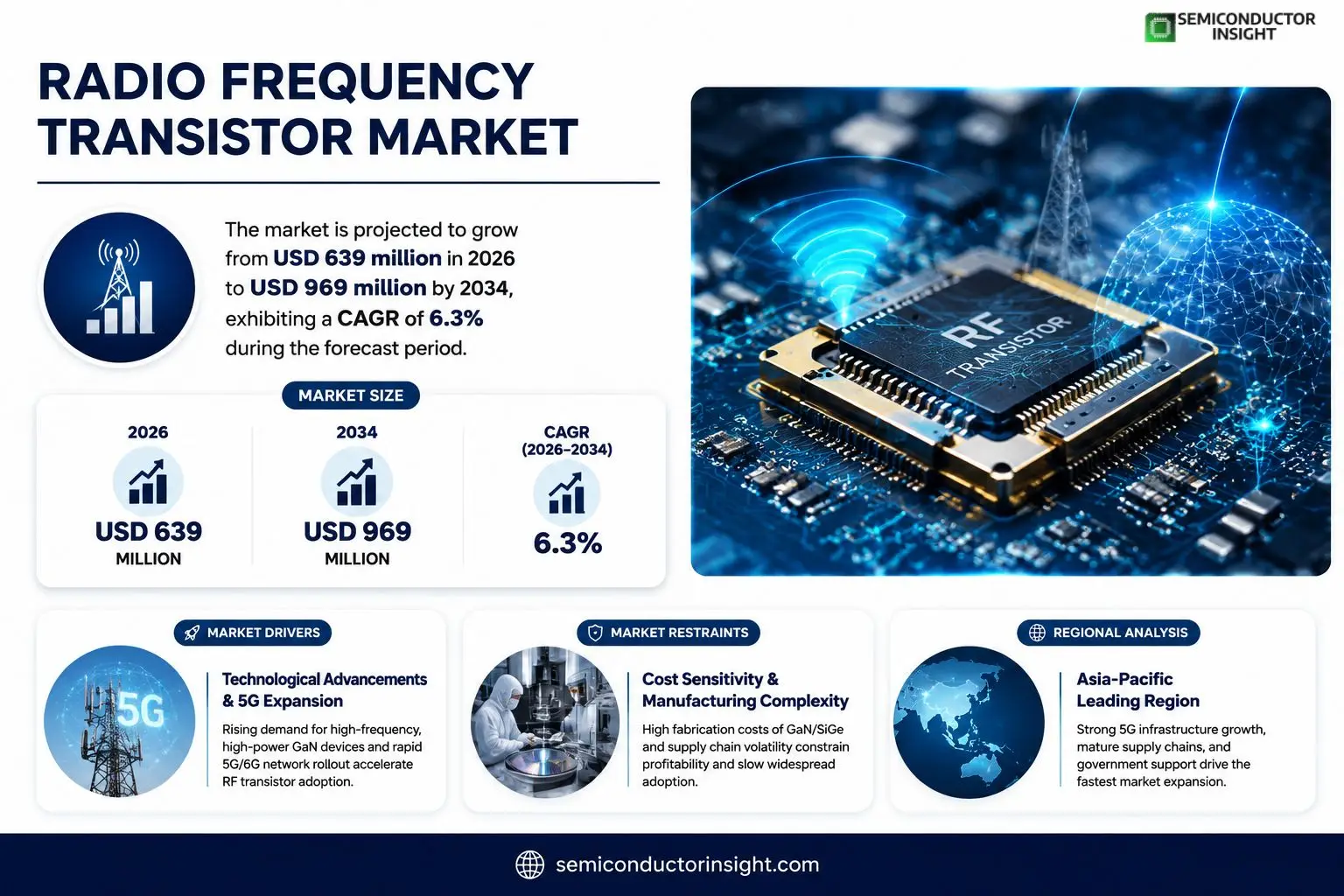
Radio Frequency Transistor market size was valued at USD 639 million in 2025. The market is expected to rise from USD 639 million in 2025 to USD 969 million by 2034, reflecting a CAGR of 6.3% over the forecast horizon.
A radio frequency transistor is a semiconductor device engineered for high‑frequency signal processing (typically 300 kHz‑300 GHz). In 2025 production reached roughly 8.7 million units, with an average selling price of about USD 80 per unit. These transistors serve as core amplification and switching elements in modern wireless communication, radar and satellite systems.The expansion is fueled by escalating demand for wireless connectivity, especially the rollout of 5G networks and early research into 6G, which drives adoption of high‑power GaN HEMTs for base‑station infrastructure. Meanwhile, mobile‑device front‑end modularization pushes silicon‑based CMOS and GaAs technologies toward heterogeneous integration via advanced packaging. Leading manufacturers such as STMicroelectronics, Onsemi, Infineon, and NXP Semiconductors are expanding capacity and investing in compound‑semiconductor processes to meet these trends.
MARKET DRIVERS
Technological Advancements in High‑Frequency Applications
The rollout of 5G infrastructure has pushed manufacturers to demand transistors that can operate beyond 6 GHz with minimal phase noise. In response, the Radio Frequency Transistor Market has seen a surge in silicon‑germanium (SiGe) and gallium‑nitride (GaN) technologies that deliver higher electron mobility and lower power loss. Companies that integrate these devices can achieve tighter signal integrity, a factor that directly influences equipment pricing and carrier rollout speed.
Shift Toward Miniaturized Power Amplifiers
Portable radar, autonomous‑vehicle radar, and IoT gateways all require compact power‑amplifier modules. The trend to shrink form factors forces designers to select transistors with higher gain‑bandwidth product per square millimeter. As a result, the Radio Frequency Transistor Market is channeling R&D spend into monolithic microwave‑integrated‑circuit (MMIC) designs that marry performance with space efficiency, enabling OEMs to launch slimmer products without compromising range.
➤ The convergence of 5G spectrum expansion and demand for edge‑computing hardware has turned transistor efficiency into a competitive differentiator.
End‑users now evaluate transistors not just on cost per piece but on total system‑level savingslower cooling requirements, reduced board real‑estate, and extended device lifecycles. This broader view of value is reshaping purchasing criteria across telecom, defense, and aerospace segments.
MARKET CHALLENGES
Cost Sensitivity and Manufacturing Complexity
While high‑performance devices command premium prices, the majority of buyers remain price‑conscious, especially in consumer‑grade equipment. Fabrication of GaN and SiGe transistors involves multiple epitaxial steps, driving unit costs upward. Consequently, many suppliers face pressure to balance yield improvements with aggressive pricing, a dilemma that slows the rollout of next‑gen solutions.
Other Challenges
Supply‑Chain Volatility
Geopolitical tensions and rare‑earth material scarcity have introduced unpredictability in wafer‑supply timelines. Manufacturers that lack diversified sourcing strategies risk production bottlenecks, which can erode market confidence and delay product launches.
MARKET RESTRAINTS
Regulatory Constraints on Emission Standards
telecom authorities continue to tighten out‑of‑band emission limits to curb interference between adjacent bands. Compliance often requires additional filtering or redesign of transistor bias networks, adding engineering overhead and extending time‑to‑market. For manufacturers with legacy process lines, retrofitting to meet newer standards can be cost‑prohibitive, limiting their ability to compete in regions with stricter rules.
MARKET OPPORTUNITIES
Emerging Use‑Cases in Space Telemetry
Satellite constellations targeting broadband internet are increasing demand for radiation‑hard RF transistors capable of withstanding harsh orbital environments. The Radio Frequency Transistor Market can capture this niche by offering devices with enhanced latch‑up immunity and extended temperature ranges. Early adopters that secure supply agreements stand to gain sizable margins as launch frequencies climb.
Radio Frequency Transistor Market Trends
Shift Toward Wide‑Bandgap Materials
The latest production figures show roughly 8.7 million units sold at an average price of $80 each, generating a market value near $639 million in 2025. A noticeable portion of that revenue now stems from gallium‑nitride (GaN) high‑electron‑mobility transistors, whose efficiency advantage is reshaping base‑station architecture. As operators expand 5G deployments and lay groundwork for 6G, the need for higher output power and lower losses pushes suppliers toward GaN and, to a lesser extent, silicon‑carbide solutions. This material shift reduces the bill of materials for high‑frequency amplifiers while opening new revenue streams in automotive radar and satellite broadband. Analysts observe that the emerging preference for wide‑bandgap devices is already influencing supplier roadmaps and capital allocation decisions.
Other Trends
Manufacturing Process Convergence
Silicon‑based RF CMOS continues to benefit from the economies of scale inherent in digital chip fabs, where advanced photolithography trims gate length and lifts cutoff frequencies. In parallel, GaN HEMT production relies on epitaxial growth on silicon‑carbide or silicon substrates, followed by electron‑beam lithography to craft T‑shaped gates that curb resistance and parasitics. The coexistence of these pathways forces foundries to maintain dual‑track capabilities, but also encourages heterogeneous integration strategies that embed silicon, GaAs, and GaN dies within a single package. Such integration targets the RF front‑end modularization trend, allowing designers to shrink footprints and cut power budgets without compromising performance.
Modular RF Front‑End Evolution
Customer demand for compact, low‑loss RF front‑ends drives a move away from discrete component chains toward consolidated modules. By leveraging advanced packagingsuch as system‑in‑package and wafer‑level integrationmanufacturers can combine amplifiers, filters, and switches on a shared substrate. This approach meets the constraints of mobile handsets and IoT devices, where board space and energy consumption are at a premium. For the Radio Frequency Transistor Market, modularization translates into higher volume orders for multi‑function blocks and stimulates competition among vendors that can deliver tightly coupled silicon, GaAs, and GaN technologies. Companies that master these packaging techniques are positioned to capture a larger share of the evolving ecosystem.
COMPETITIVE LANDSCAPEKey Industry Players
Radio Frequency Transistor Market – Competitive Overview
The RF transistor arena remains tightly clustered around a handful of multinational fabs that dominate volume and pricing power. STMicroelectronics and Onsemi anchor the silicon‑based segment, leveraging deep‑submicron CMOS lines that feed both consumer front‑ends and infrastructure equipment. Their ability to shrink gate lengths translates into higher fT and lower unit costs, reinforcing a barrier to entry for smaller outfits. In parallel, Infineon and NXP, with strong automotive and industrial portfolios, capture a growing share of GaN‑HEMT production for base‑station power amplifiers, a segment where efficiency gains command premium pricing. The concentration of R&D spend in the United States, Europe and Japan sustains a competitive hierarchy in which scale‑driven cost advantages dictate market share, while regional policy support for high‑frequency communications amplifies demand for these high‑performance devices.Beyond the tier‑one giants, a diverse set of specialists injects innovation and niche market reach. MACOM and Qorvo excel in GaAs and heterojunction bipolar technologies, supplying radar and defense contracts that require ultra‑low noise figures. European‑based Ampleon and the UK’s TT Electronics focus on power‑optimized modules for 5G and emerging 6G deployments, often partnering with system integrators for heterogeneous integration. Asian challengers such as Chengdu Haiwei Huaxin Technology and Central Semiconductor are scaling up GaN epitaxy capabilities on silicon carbide, positioning themselves to serve the fast‑growing automotive radar segment. Meanwhile, legacy players like Toshiba, Renesas, and Diodes Incorporated maintain relevance through legacy BJT and MOSFET lines that support legacy telecom gear, ensuring a stable revenue stream while they pivot toward next‑generation architectures.
List of Key Radio Frequency Transistor Companies Profiled
- STMicroelectronics
- ON Semiconductor (Onsemi)
- Infineon Technologies
- NXP Semiconductors
- Qorvo
- MACOM
- Ampleon
- TT Electronics
- Chengdu Haiwei Huaxin Technology
- Central Semiconductor
- Renesas Electronics
- Diodes Incorporated
- Microchip Technology
Segment Analysis:
| Segment Category | Sub-Segments | Key Insights |
| By Type |
|
HEMT
|
| By Application |
|
Commercial
|
| By End User |
|
Telecommunications infrastructure
|
| By Frequency |
|
High Frequency
|
| By Material |
|
Gallium Nitride
|
Regional Analysis: Radio Frequency Transistor Market
Asia‑Pacific
Several semiconductor parks in China, Taiwan, and South Korea host tier‑1 fabs that specialize in RF transistor epitaxy. Their proximity to component assemblers shortens logistics chains, yielding lower unit costs and quicker design iterations for end‑users.
Regional research institutes collaborate with chip makers on novel high‑electron‑mobility transistor (HEMT) structures, pushing frequency ceilings beyond 100 GHz and opening new radar and satellite‑communication niches.
A diversified network of raw‑material providers, from silicon wafers to rare‑earth dopants, mitigates the impact of geopolitical tensions, ensuring steady feedstock for volume production.
Harmonised spectrum allocations across ASEAN and the Indo‑Pacific lessen redesign overhead for manufacturers, allowing a single device platform to serve multiple national standards.
North America
The United States and Canada present a market shaped by defense procurement and sophisticated communication‑infrastructure projects. Here, the emphasis lies on reliability and performance under stringent thermal conditions, prompting customers to favour silicon‑carbide solutions despite higher price points. Domestic fab capacity is modest, so most firms import wafers, yet the region compensates with a robust ecosystem of design houses that specialise in custom RF front‑ends for aerospace and autonomous‑vehicle applications. Partnerships between semiconductor giants and university labs nurture niche breakthroughs, particularly in low‑noise amplifier (LNA) architectures that serve next‑generation satellite constellations.
Europe
European activity centers on automotive radars, industrial IoT, and renewable‑energy monitoring. Regulatory pressure to curb emissions has spurred automakers to integrate advanced driver‑assistance systems, which rely on compact, high‑frequency transistors. While local fabs are limited, the continent excels in system‑level integration, with firms offering turnkey RF modules that combine transistors, matching networks, and digital control. Collaborative research programmes funded by the EU aim to standardise 77‑GHz and 79‑GHz bands, reducing fragmentation and encouraging cross‑border supply‑chain coordination.
South America
Growth in Brazil, Argentina, and Chile is anchored to expanding mobile broadband penetration and government‑led smart‑city initiatives. The market remains import‑heavy, but regional distributors have built strong relationships with Asian manufacturers, ensuring timely access to mid‑range RF components. Emerging demand for low‑cost connectivity in agricultural telemetry drives interest in power‑efficient transistor designs, prompting local OEMs to adopt design‑for‑manufacturability practices that minimise bill‑of‑materials while meeting performance thresholds.
Middle East & Africa
The Middle East benefits from extensive oil‑field telemetry and burgeoning defense spending, whereas African nations focus on extending coverage to remote communities. In the Gulf Cooperation Council, high‑frequency satellite backhaul projects require rugged transistors that can operate under extreme temperature swings. African telecom operators, meanwhile, prioritize affordability, steering them toward older SiGe platforms that balance cost with acceptable gain. Both sub‑regions are witnessing early‑stage joint ventures that aim to localise assembly, a step that could gradually reduce dependence on distant supply lines.
Report Scope
This market research report provides a comprehensive analysis of the Radio Frequency Transistor Market , covering the forecast period 2026–2034. It offers detailed insights into market dynamics, technological advancements, competitive landscape, and key trends shaping the industry.
Key focus areas of the report include:
- Market Overview: The report begins with an overview outlining its current market scenario, key growth indicators, and industry transformation drivers. It discusses macroeconomic factors, demand–supply balance, regulatory landscape, and the strategic role of semiconductors in powering advancements across industries such as automotive, telecommunications, consumer electronics, and industrial automation.
- Market Size & Forecast: Historical data and future projections for revenue, unit shipments, and market value across major regions and segments.
- Segmentation Analysis: Detailed breakdown by product type, technology, application, and end-user industry to identify high-growth segments and investment opportunities.
- Regional Insights: Insights into market performance across North America, Europe, Asia-Pacific, Latin America, and the Middle East & Africa, including country-level analysis where relevant.
- Competitive Landscape: Profiles of leading market participants, including their product offerings, R&D focus, manufacturing capacity, pricing strategies, and recent developments such as mergers, acquisitions, and partnerships.
- Technology Trends & Innovation: Assessment of emerging technologies, integration of AI/IoT, semiconductor design trends, fabrication techniques, and evolving industry standards.
- Market Drivers & Restraints: Evaluation of factors driving market growth along with challenges, supply chain constraints, regulatory issues, and market-entry barriers.
- Stakeholder Insights: Insights for component suppliers, OEMs, system integrators, investors, and policymakers regarding the evolving ecosystem and strategic opportunities.
Primary and secondary research methods are employed, including interviews with industry experts, data from verified sources, and real-time market intelligence to ensure the accuracy and reliability of the insights presented.
FREQUENTLY ASKED QUESTIONS:
What is the current market size of Radio Frequency Transistor Market?
-> Radio Frequency Transistor Market was valued at USD 639 million in 2025 and is expected to reach USD 969 million by 2034, at a CAGR of 6.3% during the forecast period.
Which key companies operate in Radio Frequency Transistor Market?
-> Key players include STMicroelectronics, Onsemi, Infineon, NXP Semiconductors, Toshiba, Microchip, MACOM, Renesas Electronics, Diodes Incorporated, Qorvo, Central Semiconductor, Ampleon, TT Electronics, ASI Semiconductor, Chengdu Haiwei Huaxin Technology.
What are the key growth drivers?
-> Key growth drivers include the rapid expansion of 5G and emerging 6G networks, increasing demand for high‑frequency, high‑power GaN devices in base stations, RF front‑end modularization in mobile terminals, and the broader push for wireless connectivity across automotive, radar, and satellite communication sectors.
Which region dominates the market?
-> Europe and North America hold the largest market share owing to mature semiconductor ecosystems and major manufacturers, while Asia‑Pacific is the fastest‑growing region driven by strong demand for 5G infrastructure and automotive radar applications.
What are the emerging trends?
-> Emerging trends include wide‑bandgap semiconductor adoption (especially GaN), heterogeneous integration of high‑speed materials such as InP on silicon, advanced packaging for RF front‑end modules, and exploration of millimeter‑wave and terahertz frequencies for ultra‑high‑speed communications.
Get Sample Report PDF for Exclusive Insights
Report Sample Includes
- Table of Contents
- List of Tables & Figures
- Charts, Research Methodology, and more...
 Download Sample Report PDF