Silicon Carbide Power Modules Market Insights
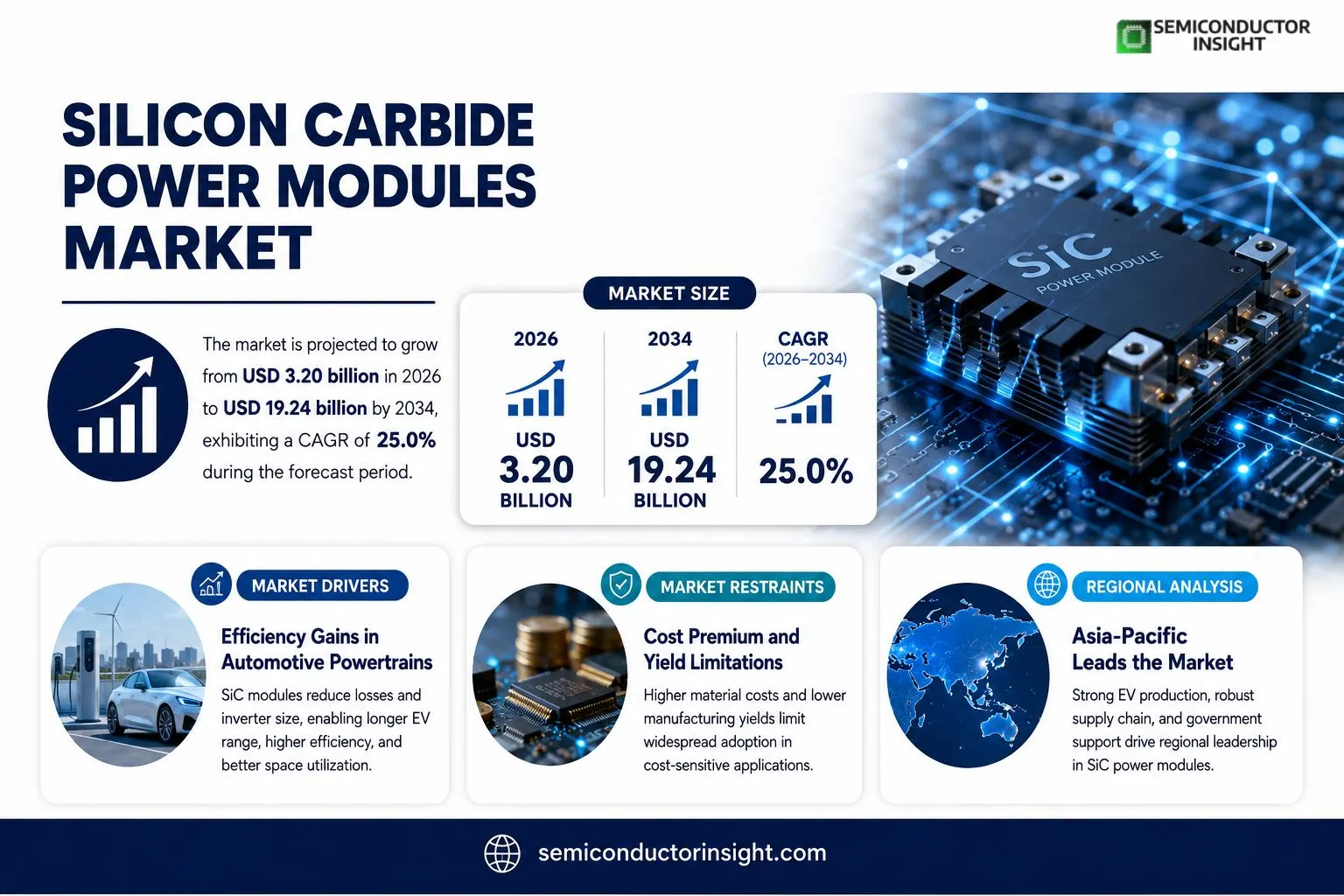
Silicon Carbide Power Modules Market size was valued at USD 2 550 million in 2025. The Market will increase from USD 3 200 million in 2026 to USD 19 240 million by 2034, exhibiting a compounded annual growth rate of approximately 25 percent over the period.
Silicon carbide power modules are semiconductor devices that employ silicon carbide as the primary material for high‑voltage and high‑power switching applications.
Their superior thermal conductivity and breakdown voltage enable more efficient power conversion compared with traditional silicon‑based solutions.The automotive segment holds the largest share because demand from China, Europe, Japan and other regions fuels electrified‑
Market DRIVERS
Efficiency Gains in Automotive Powertrains
The adoption of Silicon Carbide Power Modules Market solutions is reshaping electric‑vehicle architectures. By cutting conduction losses, these modules allow designers to reduce inverter size, which in turn frees up packaging volume for batteries and cabin space. The resulting improvement in vehicle range directly addresses consumer expectations for longer trips between charges.
Thermal Management Benefits for Data‑Center Converters
Data‑center operators are under pressure to lower PUE (Power Usage Effectiveness). SiC modules sustain higher switching frequencies while staying within safe temperature limits, enabling compact converters that dissipate less heat. This translates into lower cooling loads and a measurable reduction in operational expenditure.
➤ Analysts note that every 1 % improvement in conversion efficiency can offset roughly 0.15 % of total system cost over a ten‑year lifecycle.
Beyond these two pillars, the broader push toward electrification across transportation, renewable‑energy integration, and industrial motor drives creates a consistent demand stream for high‑performance SiC solutions.
Market CHALLENGES
Cost Premium Relative to Conventional Silicon Devices
Although SiC modules deliver superior performance, their price per watt remains higher than that of mature silicon counterparts. Manufacturers must balance the upfront expense against long‑term efficiency savings, a calculation that can stall adoption in cost‑sensitive segments such as mass‑Market consumer electronics.
Other Challenges
Supply‑Chain Bottlenecks
The limited number of wafer‑fab facilities capable of producing high‑quality SiC substrates creates a fragile supply chain. Any disruptionwhether from raw‑material scarcity or equipment downtimeripples through the entire ecosystem, prompting OEMs to maintain higher inventory buffers.
Market RESTRAINTS
Manufacturing Yield Limitations
Current SiC wafer processing still yields a lower proportion of defect‑free dies compared with silicon. This inefficiency inflates unit costs and discourages smaller players from entering the Market, reinforcing a concentration of supply among a handful of large manufacturers.
Market OPPORTUNITIES
Renewable‑Energy Inverter Expansion
As solar‑farm developers and wind‑turbine manufacturers scale up capacity, the need for high‑efficiency, high‑voltage conversion becomes paramount. SiC power modules enable inverter designs that handle tighter voltage margins while delivering lower loss profiles, positioning them as a compelling choice for next‑generation renewable installations.
Silicon Carbide Power Modules Market Trends
Electric‑Vehicle Momentum Elevates Module Adoption
The accelerating rollout of electric drivetrains has reshaped component demand curves, and silicon‑based power converters sit at the core of that shift. High‑efficiency, high‑temperature tolerance of SiC devices lets automotive designs trim cooling infrastructure while preserving voltage‑headroom for fast‑charge operations. As manufacturers chase longer range and lower pack weight, they increasingly specify SiC power modules for on‑board chargers and traction inverters. This transition is not merely a technical preference; it creates a cost‑recovery pathway through reduced ancillary hardware and lower total‑ownership expenses, prompting OEMs to embed SiC solutions early in vehicle platforms.
Other Trends
China’s Regional Dominance and Supply‑Chain Consolidation
China accounts for roughly two‑thirds of global new‑energy vehicle deliveries, a share that translates into the largest single Market for SiC power modules. Government incentives for domestic battery production and a robust network of tier‑1 automotive suppliers have accelerated local sourcing of semiconductor components. The concentration of fab capacity near major automotive hubs shortens lead times and enables iterative co‑development cycles, reinforcing China’s position as both a consumption and manufacturing nucleus for the Silicon Carbide Power Modules Market.
Shift Toward Higher Voltage Ratings Across Industries
Beyond automotive, industrial drives, data‑center UPS systems, and rail traction are gravitating toward modules rated above 1,200 V. The push for higher voltage stems from the desire to lower conduction losses and improve system compactness, especially in applications where power density directly influences equipment footprint. Suppliers that broaden their product portfolios to include 1,700 V and 3,300 V families gain entry into multi‑gigawatt projects, where traditional silicon solutions would require parallel architectures that inflate both cost and complexity. This voltage‑uptrend signals divergent growth avenues for the Silicon Carbide Power Modules Market, rewarding manufacturers that can align design cycles with the evolving specifications of energy‑intensive sectors.
COMPETITIVE LANDSCAPE
Key Industry Players
Silicon Carbide Power Modules: Competitive Outlook and Market Positioning
The silicon‑carbide power‑module arena is dominated by a handful of technologically deep firms that have leveraged long‑standing semiconductor expertise to capture the bulk of automotive‑inverter orders. STMicroelectronics remains the most diversified, pairing high‑voltage SiC devices with a global application engineering network that enables rapid qualification for electric‑drive OEMs. Infineon’s strength lies in its extensive power‑electronics portfolio and its ability to bundle SiC modules with intelligent driver ICs, a combination that resonates with tier‑one automotive integrators seeking system‑level simplicity. Wolfspeed (Cree) distinguishes itself through a vertically integrated supply chain, from SiC wafer production to module assembly, which translates into competitive pricing and tight control of defect densitya critical factor for high‑current traction applications. ROHM and onsemi complete the top tier, each offering niche voltage ranges (700 V‑900 V for ROHM, 1200 V‑1700 V for onsemi) that align with emerging charger and train‑inverter specifications. Collectively, these leaders account for the majority of revenue in 2024, set product roadmaps that influence substrate‑size standards, and shape procurement strategies across the automotive, industrial‑drive, and UPS segments.Beyond the marquee manufacturers, a cohort of specialized players is expanding the competitive field by targeting high‑growth verticals and regional niches. BYD Semiconductor, bolstered by its parent’s electric‑vehicle volume, translates mass‑production insights into cost‑effective modules for mainland‑China EV platforms. Microchip (Microsemi) leverages its heritage in high‑reliability power solutions to serve aerospace and defense customers demanding extreme temperature tolerance. Mitsubishi Electric’s Vincotech division focuses on rail‑traction and heavy‑induction‑motor Markets, where the 1700 V‑3300 V envelope meets stringent efficiency mandates. Semikron Danfoss, Fuji Electric, and Toshiba each bring deep industrial‑drive pedigrees, offering modular families that simplify integration for factory automation and renewable‑energy converters. Smaller innovators such as CETC 55, BASiC Semiconductor, and SemiQ are advancing SiC‑on‑silicon (SoS) architectures, which could lower barrier‑entry costs for midsize OEMs. This breadth of providers generates a competitive dynamic where differentiation hinges on voltage‑range optimization, thermal‑management patents, and the ability to co‑develop with vehicle manufacturers.
List of Key Silicon Carbide Power Modules Companies Profiled
- STMicroelectronics
- Infineon Technologies
- Wolfspeed (Cree)
- ROHM Semiconductor
- onsemi
- BYD Semiconductor
- Microchip (Microsemi)
- Mitsubishi Electric (Vincotech)
- Semikron Danfoss
- Fuji Electric
- Toshiba
- CETC 55
- BASiC Semiconductor
- SemiQ
- SanRex
Segment Analysis:
| Segment Category | Sub-Segments | Key Insights |
| By Type |
|
High‑Voltage Modules
|
| By Application |
|
Electric‑Vehicle Inverter Segment
|
| By End User |
|
Automotive OEMs
|
| By Voltage Rating |
|
Mid‑Voltage Segment
|
| By Emerging Use‑Case |
|
Grid‑Scale Energy Storage
|
Regional Analysis: Silicon Carbide Power Modules Market
Asia-Pacific
Vehicle manufacturers in the region are integrating SiC power modules to minimize inverter mass, thereby extending driving range without sacrificing performance. This design shift stems from tighter fleet‑wide CO₂ benchmarks that demand lower‑loss power conversion across an expanding electric‑vehicle portfolio.
Factories upgrading to high‑efficiency motor drives are favoring SiC modules for their ability to tolerate higher temperatures, which reduces cooling infrastructure costs and aligns with sustainability programs targeting reduced operational footprints.
Grid operators are deploying SiC‑based converters to manage the intermittency of solar and wind farms. The modules’ fast switching capabilities enable tighter control loops, improving power quality and facilitating higher penetration of clean energy sources.
A growing cluster of silicon‑carbide wafer fabs in Taiwan and Singapore has shortened component lead times, allowing system integrators to accelerate product cycles and respond swiftly to shifting customer specifications.
North America
In North America, the Silicon Carbide Power Modules Market is shaped by a regulatory environment that emphasizes grid resilience and automotive electrification. Federal incentives for low‑emission vehicles have encouraged major auto assemblers to qualify SiC modules for high‑volume production, while utilities prioritize reliability upgrades that benefit from the devices’ superior thermal performance. The presence of several leading semiconductor manufacturers provides a stable supply base, but intense competition forces firms to differentiate through advanced packaging and robust qualification processes. Consequently, customers in this region are increasingly evaluating total cost of ownership rather than upfront price, a shift that influences procurement strategies across both transportation and energy sectors.
Europe
European stakeholders view SiC power modules through the lens of stringent emissions standards and a strong push toward offshore wind expansion. Nations such as Germany and the Netherlands have introduced performance‑based benchmarks that compel power‑electronics designers to adopt low‑loss solutions. Moreover, the EU’s emphasis on circular‑economy principles drives manufacturers to explore recyclable module architectures, creating opportunities for niche players specializing in sustainable design. Collaborative research programs funded by the European Union further accelerate technology transfer, ensuring that regional OEMs remain at the forefront of efficiency‑driven innovation.
South America
In South America, burgeoning renewable‑energy projects and a gradual transition toward electrified public transport shape Market dynamics. Governments are implementing pilot programs that integrate SiC‑based converters into solar‑farm inverters, seeking to improve overall plant efficiency without requiring extensive infrastructure upgrades. While the region’s manufacturing footprint is modest, partnerships with Asian suppliers are enabling local system integrators to acquire proven modules, fostering a nascent ecosystem that balances cost considerations with performance aspirations.
Middle East & Africa
The Middle East & Africa region presents a unique blend of extreme climatic conditions and expanding industrial activity, prompting a focus on heat‑tolerant power solutions. SiC modules are gaining traction in oil‑field automation and in data‑center deployments that must operate reliably under high ambient temperatures. Additionally, emerging renewable‑energy initiatives in the United Arab Emirates and South Africa are testing SiC converters to lower losses in grid‑intertie applications. Although Market penetration remains early, strategic investments by multinational vendors aim to establish a foothold by tailoring module designs to the region’s specific thermal and reliability challenges.
Report Scope
This Market research report provides a comprehensive analysis of the Silicon Carbide Power Modules Market , covering the forecast period 2026–2034. It offers detailed insights into Market dynamics, technological advancements, competitive landscape, and key trends shaping the industry.
Key focus areas of the report include:
- Market Overview: The report begins with an overview outlining its current Market scenario, key growth indicators, and industry transformation drivers. It discusses macroeconomic factors, demand–supply balance, regulatory landscape, and the strategic role of semiconductors in powering advancements across industries such as automotive, telecommunications, consumer electronics, and industrial automation.
- Market Size & Forecast: Historical data and future projections for revenue, unit shipments, and Market value across major regions and segments.
- Segmentation Analysis: Detailed breakdown by product type, technology, application, and end-user industry to identify high-growth segments and investment opportunities.
- Regional Insights: Insights into Market performance across North America, Europe, Asia-Pacific, Latin America, and the Middle East & Africa, including country-level analysis where relevant.
- Competitive Landscape: Profiles of leading Market participants, including their product offerings, R&D focus, manufacturing capacity, pricing strategies, and recent developments such as mergers, acquisitions, and partnerships.
- Technology Trends & Innovation: Assessment of emerging technologies, integration of AI/IoT, semiconductor design trends, fabrication techniques, and evolving industry standards.
- Market Drivers & Restraints: Evaluation of factors driving Market growth along with challenges, supply chain constraints, regulatory issues, and Market-entry barriers.
- Stakeholder Insights: Insights for component suppliers, OEMs, system integrators, investors, and policymakers regarding the evolving ecosystem and strategic opportunities.
Primary and secondary research methods are employed, including interviews with industry experts, data from verified sources, and real-time Market intelligence to ensure the accuracy and reliability of the insights presented.
FREQUENTLY ASKED QUESTIONS:
What is the current Market size of Silicon Carbide Power Modules Market?
-> Silicon Carbide Power Modules Market was valued at USD 2,040 million in 2024 and is projected to reach USD 9,833 million by 2031, growing at a CAGR of 25.8% during the forecast period.
Which key companies operate in Silicon Carbide Power Modules Market?
-> Key players include STMicroelectronics, Infineon, Wolfspeed, Rohm, onsemi, BYD Semiconductor, Microchip (Microsemi), Mitsubishi Electric (Vincotech), Semikron Danfoss, Fuji Electric, Toshiba, CETC 55, BASiC Semiconductor, SemiQ, SanRex, Bosch, GE Aerospace, Zhuzhou CRRC Times Electric, StarPower, Guangdong AccoPower Semiconductor, Cissoid, United Nova Technology, Hebei Sinopack Electronic Technology, InventChip Technology, ANHI Semiconductor, HAIMOSIC (SHANGHAI), Shenzhen AST Science Technology, Hangzhou Silan Microelectronics, Wuxi Leapers Semiconductor, WeEn Semiconductors, Denso.
What are the key growth drivers?
-> Key growth drivers include rapid adoption of electric vehicles, increasing demand for high‑efficiency power conversion in automotive, industrial drives, and renewable energy systems, and the superior performance of silicon carbide material in high‑voltage and high‑temperature applications.
Which region dominates the Market?
-> Asia-Pacific dominates the Silicon Carbide Power Modules Market, driven primarily by China’s accelerating electric‑vehicle production and strong demand in Japan, South Korea, and Southeast Asia.
What are the emerging trends?
-> Emerging trends include development of higher‑voltage (1700V‑3300V) SiC modules, integration of SiC modules into traction inverters for electric trains, and expanding use of SiC technology in grid‑level renewable energy converters.

Get Sample Report PDF for Exclusive Insights
Report Sample Includes
- Table of Contents
- List of Tables & Figures
- Charts, Research Methodology, and more...
 Download Sample Report PDF