Key Statistics
Key Takeaways
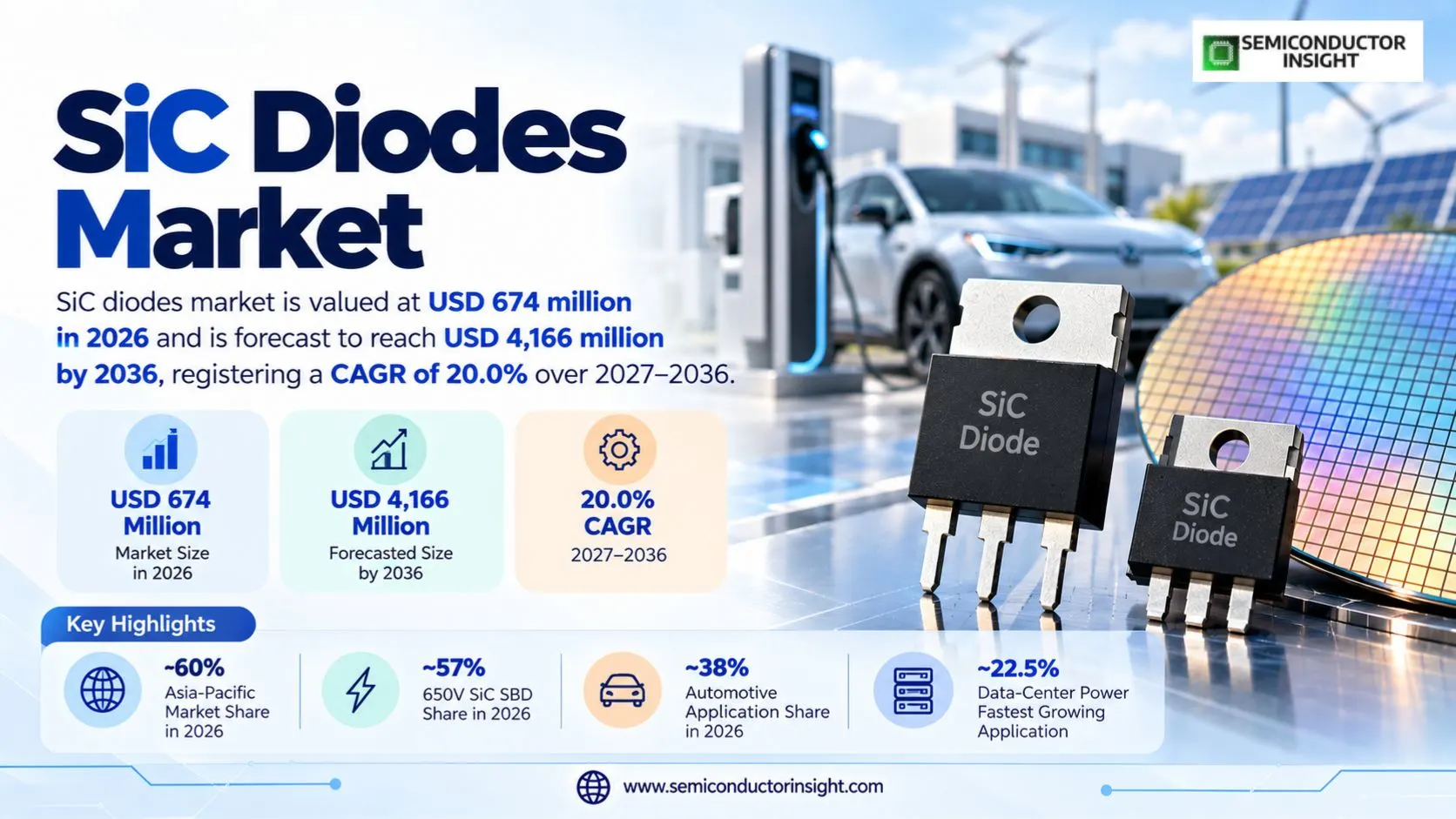
- Market trajectory: The global SiC diodes market represents USD 674 million in 2026 and is forecast to reach USD 4,166 million in 2036, with a 20.0% compound annual growth rate across the 2027–2036 period; conversion efficiency, automotive electrification and high-frequency power design are the main demand vectors.
- 650V Schottky diodes: The 650V SiC SBD class leads type revenue at an estimated ~57% in 2026, benefiting from established power-factor correction and onboard-charger sockets, while 1200V devices at ~38% serve higher-voltage power trains and industrial converters.
- Automotive and EV/HEV: Automotive power electronics constitute the largest application at an estimated ~38% of 2026 sales, with dedicated charging equipment contributing another ~18%; vehicle-related opportunities require stringent surge, temperature and qualification evidence.
- Asia-Pacific concentration: Asia-Pacific accounts for about ~60% of 2026 demand, supported by China’s vehicle-electronics ecosystem and Japanese and Korean device manufacturing; North America at ~24% and Europe at ~14% have distinct supply-chain and qualification requirements.
- Voltage and fabrication: Low and medium voltage diodes rated up to 1200V contribute an estimated ~96% of market value, while planar Schottky structures retain a ~48% technology share; trench and junction-barrier designs address loss and surge trade-offs.
- Competitive priorities: STMicroelectronics, Infineon, Wolfspeed and ROHM compete through wafer quality, device ruggedness and automotive programs; Microchip, onsemi, GeneSiC/Navitas and regional manufacturers broaden customer choice in 650V and 1200V products.
SiC Diodes Market Overview
SiC diodes market is valued at USD 674 million in 2026 and is forecast to reach USD 4,166 million by 2036, registering a CAGR of 20.0% over 2027–2036. Asia-Pacific is the largest market at an estimated ~60% share, while 650V SiC Schottky barrier diodes account for an estimated ~57% of type revenue. Customers select these devices where high-frequency switching, temperature endurance and reverse-recovery behavior justify a premium over silicon rectifiers.
Silicon carbide Schottky barrier diodes conduct through majority carriers, so the reverse-recovery charge characteristic of conventional silicon pn-junction rectifiers is largely avoided. This distinction matters in fast power-factor-correction stages, resonant power supplies and DC conversion, where each switching transition otherwise dissipates energy and raises semiconductor temperature. Device selection still depends on forward voltage, reverse leakage, surge tolerance, package parasitics and thermal resistance rather than on switching speed alone.
The market boundary includes packaged SiC Schottky barrier diodes and SiC diode bare die sold for rectification and freewheel functions, across the published 650V, 1200V and other voltage families. It includes planar, trench and junction-barrier Schottky structures as product technology variants. Revenue for separately priced wafers, SiC MOSFETs, complete power modules, finished chargers and inverters is excluded, avoiding the double counting that occurs when downstream assembly values are mixed with diode component sales.
The demand mix is not identical to the broader SiC power-semiconductor industry. MOSFETs are increasingly specified for the main switching position in traction inverters, whereas Schottky diodes are important in auxiliary rectification, onboard chargers, DC/DC stages, photovoltaic conversion and server power-factor correction. A power supply can use several diode positions of different ratings, so component volumes depend on topology and current rating rather than solely on the number of vehicles or renewable-energy installations.
Infineon markets CoolSiC Schottky families at 650V and 1200V, STMicroelectronics supplies automotive-qualified rectifiers in both classes, ROHM lists discrete and bare-die SBDs, and Wolfspeed provides 1200V bare die. These catalogs demonstrate a commercially established component range, but the availability of a part number does not by itself establish shipments, regional revenue or a dated product launch. Device datasheets instead provide a basis for analyzing voltage classes, reliability specifications and likely use cases.
Commercial growth depends on the spread between the higher purchase price of SiC devices and the total converter savings from smaller magnetics, reduced switching losses and easier cooling. Higher-frequency PFC and DC/DC stages can recover component cost through smaller inductors and heat sinks; price-sensitive low-power designs may continue to favor silicon. This economic separation explains why automotive qualification, server efficiency requirements and high-utilization energy systems offer stronger adoption incentives than basic low-frequency rectification.
The supply chain links SiC crystal growth, epitaxial wafer deposition, Schottky-device fabrication, die screening and final package testing. Defect density and wafer utilization influence die cost, while automotive customers require traceability and long-duration reliability evidence. Regional production and regional demand are not the same measure: wafers may be processed in one country, packaged in another and incorporated into a converter sold elsewhere, making geographic revenue attribution sensitive to the final component buyer.
Segment Analysis: By Type
The SiC diode type mix separates 650V SiC SBD, 1200V SiC SBD and other voltage-rated products. The 650V category holds an estimated ~57% of 2026 revenue and grows near ~18.3% annually; 1200V products contribute ~38% and expand near ~22.3% as vehicle chargers, industrial supplies and renewable converters shift toward higher bus voltages. Other ratings account for the remaining ~5% and serve specialized power conversion requirements.
| Type | Electrical and system role | 2026 position |
|---|---|---|
| 650V SiC SBD | Devices in this family are commonly evaluated for continuous-conduction PFC, high-frequency rectification and DC/DC stages where a 400V-class bus, surge margin and thermal characteristics determine the choice. Automotive-qualified and industrial packages coexist. | Largest type, estimated ~57% share; modeled ~18.3% annual growth. |
| 1200V SiC SBD | Higher-voltage diodes serve converter designs that must tolerate 800V-class batteries, elevated DC-link conditions or industrial power conversion. Bare-die offerings also allow system integrators to optimize thermal paths and module configurations. | Second-largest, estimated ~38% share; modeled ~22.3% annual growth. |
| Others | Other voltage and specialized rectifier configurations support demanding industrial and high-voltage applications, with economics shaped by lower production volumes, package constraints and the need for tailored surge and leakage performance. | Specialized category, estimated ~5% share; modeled ~19.3% annual growth. |
650V SiC Schottky Barrier Diodes
The 650V segment has an estimated ~57% market share in 2026 because mainstream power-factor-correction and auxiliary conversion designs often operate below 650V while requiring efficient high-frequency rectification. Infineon CoolSiC 650V product families and ST automotive-qualified 650V parts illustrate the range of forward-current and package options. The purchasing decision is influenced by diode capacitance, conduction loss and the reliability margin needed for repetitive mains and load transients.
Within automotive power supplies, a 650V Schottky diode is not automatically interchangeable with a 1200V part: the bus architecture, voltage overshoot, operating temperature and certification requirements determine the acceptable blocking margin. In high-volume charging electronics, even a modest reduction in rectifier heat can change enclosure design and cooling cost. Suppliers therefore compete through verified switching behavior and delivered system efficiency, not simply through the lowest nominal forward voltage.
1200V SiC Schottky Barrier Diodes
The 1200V category accounts for an estimated ~38% of 2026 market value and is modeled to grow at ~22.3% as charging and industrial power stages adopt higher voltage ratings. ST lists automotive 1200V rectifiers, while ROHM and Wolfspeed offer 1200V SiC SBD bare die for tailored power assemblies. The key qualification variables include surge current, high-temperature reverse leakage, package isolation and the effect of switching-frequency increases on EMI.
Other SiC Diode Ratings
Specialty devices outside the two principal voltage classes contribute an estimated ~5% of revenue. They address converter configurations where blocking voltage, current density or package form factor falls outside common catalog selections, and procurement is often tied to a specific industrial project. Lower volume can raise unit cost, but tailored reliability, thermal performance and supply assurance may justify the premium in long-life installations and high-voltage conversion equipment.
Segment Analysis: By Application
Applications are divided into automotive and EV/HEV, charging equipment, industrial drives, renewable energy, UPS and data-center power, rail, and other systems. Automotive is the largest use at an estimated ~38% of 2026 sales, followed by EV charging at ~18%; the remaining segments are more diverse in switching topology and qualification. Server and data-center power is modeled to expand at ~22.5% annually, reflecting efficiency pressure in high-utilization supplies.
| Application | Demand characteristics |
|---|---|
| Automotive & EV/HEV | Estimated ~38% of 2026 sales, ~20.5% annual growth. Automotive programs qualify SiC rectifiers for onboard charging, auxiliary converters and selected freewheel paths. OEM and Tier-1 buyers emphasize temperature cycling, AEC-Q101 evidence, surge resilience and stable supply over a long vehicle life, while traction inverters increasingly use SiC MOSFET switching stages. |
| EV Charging | Estimated ~18% of 2026 sales, ~21.5% annual growth. Charging stations use high-efficiency AC/DC and DC/DC power conversion, where 650V or 1200V rectifier choice follows grid interface, power level and bus voltage. The number of charging modules and their service duty cycle matter more than the charger count alone. |
| Industrial Motor/Drive | Estimated ~13% of 2026 sales, ~16.5% annual growth. Industrial drives and automation power supplies use SiC diodes where switching losses, switching frequency and cooling volume materially affect cabinet design. The market remains selective because silicon rectifiers still perform adequately in many low-frequency and price-sensitive motor systems. |
| PV, Energy Storage, Wind Power | Estimated ~16% of 2026 sales, ~19.5% annual growth. Renewable-energy inverters and storage converters increasingly prioritize high efficiency under varying load and thermal conditions. SiC Schottky devices can reduce recovery losses in relevant rectifier and boost stages, though complete power-train adoption depends on topology and system-level economics. |
| UPS, Data Center & Server | Estimated ~9% of 2026 sales, ~22.5% annual growth. Server power-factor correction and UPS conversion demand dense, reliable rectification at high duty cycles. SiC devices offer lower switching penalties in selected architectures, while data-center purchasing requires rigorous qualification and power-loss comparisons against established silicon and gallium nitride alternatives. |
| Rail Transport | Estimated ~3% of 2026 sales, ~14.5% annual growth. Railway auxiliary power and traction-related converters impose high surge and thermal requirements, with long approval cycles and conservative maintenance expectations. Diode orders are project-based and favor manufacturers that can provide documentation, traceability and sustained replacement availability. |
| Others | Estimated ~3% of 2026 sales, ~13.5% annual growth. Aerospace power, specialized laboratory systems and telecom rectifiers form a smaller group of applications. Qualification is fragmented, and each program weighs high-temperature behavior, electrical margins and lifecycle availability differently, limiting economies of scale but supporting higher-value components. |
Application allocation must be interpreted as diode-component revenue rather than the value of finished equipment. A single onboard charger may contain rectifiers at several stages, while an industrial inverter can use diode die embedded within a power assembly. The modeled ~38% automotive share reflects the large vehicle-electronics purchasing base, but component content varies with voltage class, topology and the number of parallel conversion channels.
The fastest design wins are likely to come from platforms where reduced heat and passive-component size can be valued explicitly. In contrast, rail systems and specialized industrial equipment move through longer qualification cycles, so shipment growth can lag engineering adoption. Customers commonly benchmark at 650V and 1200V before migrating to alternate voltage classes, because component availability and certification support shape engineering schedules.
Regional Analysis
Regional demand is led by Asia-Pacific at an estimated ~60% of 2026 revenue, followed by North America at ~24%, Europe at ~14%, and Middle East & Africa and South America at ~1% each. These shares describe component-market purchasing, not wafer-fabrication capacity. Asia-Pacific is modeled to grow near ~21.2% annually, with automotive charging and industrial power supply activity supporting broad product demand.
Which regions set the pace for SiC diode adoption and sourcing?
Geographic segmentation captures where diode components are bought for integration into converters and electronic assemblies. The same component may be designed in Europe, fabricated in Asia, packaged elsewhere and installed in a North American vehicle. Consequently, the share estimates emphasize the purchasing ecosystem and customer mix rather than treating fabrication output as a substitute for sales. The 2026 regional allocations sum to 100%, with the three major regions anchored by the publisher’s geographic positioning.
Asia-Pacific offers scale and manufacturing proximity; North America emphasizes high-value engineering and supply resilience; Europe concentrates on automotive qualification and industrial efficiency. Smaller regions are more dependent on distributors and project-led purchases, particularly in renewable-energy conversion. These differences affect the choice between 650V and 1200V devices, documentation expectations and the speed at which a successful prototype becomes repeat production.
| Region | Position | Growth outlook | Demand profile | What decides supplier selection |
|---|---|---|---|---|
| Asia-Pacific | ~60% of 2026 | ~21.2% CAGR | High-volume OEMs | Voltage-class availability, traceability, converter efficiency and reliable regional support |
| North America | ~24% of 2026 | ~18.2% CAGR | Qualification-led | Voltage-class availability, traceability, converter efficiency and reliable regional support |
| Europe | ~14% of 2026 | ~17.2% CAGR | Qualification-led | Voltage-class availability, traceability, converter efficiency and reliable regional support |
| Middle East & Africa | ~1% of 2026 | ~19.2% CAGR | Project-led | Voltage-class availability, traceability, converter efficiency and reliable regional support |
| South America | ~1% of 2026 | ~18.2% CAGR | Project-led | Voltage-class availability, traceability, converter efficiency and reliable regional support |
Leading SiC Diode Manufacturers and Competitive Landscape
Competition in SiC diodes is defined by validated electrical behavior, fabrication yield and access to automotive or industrial qualification programs. The principal supplier group includes STMicroelectronics, Infineon, Wolfspeed and ROHM, with Microchip, onsemi, GeneSiC/Navitas and other manufacturers competing across discrete and bare-die portfolios. The largest manufacturers have integrated or closely coordinated wafer supply, device processing and package qualification, creating an advantage in long-term cost and reliability assurance.
ST supplies automotive-qualified 650V and 1200V Schottky devices, Infineon markets multiple CoolSiC generations, ROHM provides packaged and bare-die offerings, and Wolfspeed offers high-voltage Schottky bare die. These public portfolios demonstrate real commercial participation without establishing individual supplier market shares. Buyer shortlists differ across onboard charging, industrial power supplies and renewable-energy conversion because voltage rating, available packages, thermal impedance and service support vary by manufacturer.
The engineering battle centers on forward-voltage drop at operating current, reverse leakage at elevated temperature, capacitive switching loss, surge current and package reliability. A supplier with a strong room-temperature specification may lose an automotive program if it cannot demonstrate stable performance after temperature cycling or if it lacks traceable production processes. The strongest manufacturers provide application notes, simulation models and failure-analysis support alongside the diode itself.
Automotive and industrial customers commonly qualify a second source where the package footprint and electrical envelope permit it, but a diode substitution is not always a drop-in change. Parasitic capacitance and recovery behavior affect EMI, while thermal resistance and surge characteristics change protective circuitry requirements. Component makers can differentiate through process control and quality documentation even when nominal voltage and current ratings appear identical in a distributor catalog.
Company lists in the wider SiC ecosystem contain device makers, wafer suppliers and former business names. A semiconductor company is not automatically a direct diode supplier merely because it produces SiC MOSFETs or substrates. For market participation, the relevant evidence is a diode or Schottky barrier product portfolio, a documented device platform, or an explicitly stated commercial offering rather than unrelated corporate revenue.
Tier structure
| Tier | Companies | Basis of competition |
|---|---|---|
| Integrated and broad-line | STMicroelectronics; Infineon Technologies; Wolfspeed; ROHM Semiconductor | Extensive device and qualification portfolios with wafer, design and automotive application support. |
| Diversified power suppliers | Microchip Technology; onsemi; Fuji Electric; Toshiba Electronic Devices & Storage | Power-electronics breadth and application engineering across industrial, automotive and infrastructure buyers. |
| Specialists and regional entrants | Navitas/GeneSiC; SemiQ; WeEn Semiconductors; BASiC Semiconductor; Diodes Incorporated | Targeted diode families, channel coverage and voltage/package differentiation. |
Key companies profiled
- STMicroelectronics
- Infineon Technologies
- Wolfspeed
- ROHM Semiconductor
- Microchip Technology
- onsemi
- Fuji Electric
- Navitas Semiconductor (GeneSiC)
- Toshiba Electronic Devices & Storage
- WeEn Semiconductors
- SemiQ
- BASiC Semiconductor
- Diodes Incorporated
SiC Diode Manufacturing Capacity and Production Economics
Commercial capacity for SiC rectifiers depends on usable substrate area, epitaxial quality, Schottky junction process control, metal deposition and final package screening. A rise in nominal wafer starts does not translate one-for-one into saleable diodes because yield, die size, voltage rating and test criteria vary. The transition toward 200mm materials can improve the long-term economics of 650V and 1200V devices, but qualification and defect management remain essential before larger wafers support sustained customer shipments.
Upstream SiC substrates and epitaxial wafers set a significant part of the cost base. Crystal defects, epitaxial thickness control and surface quality influence leakage current and yield, especially as blocking-voltage requirements rise. Producers must balance wafer area utilization against process complexity, and customer demand for lower forward losses may require changes in cell design or metallization that affect manufacturing throughput. The most useful capacity metric is qualified output at the required voltage and reliability grade.
Packaging and test can be as important as the wafer process for automotive and high-utilization power supplies. A diode may meet its electrical specifications on the wafer but require additional thermal-cycling, surge and leakage screening before it can enter a vehicle program. Bare-die products require downstream assembly partners to control die attach, bond integrity and heat spreading. These constraints create commercial value for suppliers that can coordinate device fabrication with application-specific package validation.
Capacity additions also change competitive behavior by making standard 650V products more available and pushing suppliers toward cost and quality differentiation. High-voltage or specialized devices are less likely to enjoy the same volume economies, so pricing remains sensitive to qualification batches and package options. The Wolfspeed 200mm materials milestone and Infineon 200mm SiC production announcements demonstrate the direction of the upstream ecosystem, not an automatic expansion of SiC diode revenue.
SiC Diodes Market Dynamics: Growth Drivers, Restraints and Opportunities
Market growth reflects a combination of automotive charging electronics, industrial efficiency upgrades, renewable conversion and higher-density server power supplies. The economic case is strongest where reverse-recovery losses would otherwise drive heat, switching penalties or oversized passive components. Cost premiums, substrate quality, customer qualification and silicon competition constrain the speed of substitution. The impact tables separate positive and negative contributions to the modeled growth path across three forecast windows.
MARKET DRIVERS
Drivers Impact Analysis*
| Market Drivers | Impact Rank | CAGR Contribution (%) | 2027–2029 | 2030–2032 | 2033–2036 |
|---|---|---|---|---|---|
| EV onboard charging and auxiliary conversion | High | +9.10% | High | High | Medium |
| Industrial PFC and high-frequency supplies | High | +5.60% | High | High | High |
| Renewable-energy and storage converters | Medium-High | +4.70% | Medium | High | High |
| Data-center and UPS efficiency redesign | Medium | +3.80% | Medium | High | High |
| Higher-voltage 1200V device adoption | Low-Medium | +2.50% | Medium | Medium | High |
| Others (rail, aerospace and specialized power) | Low | +1.20% | Low | Medium | Medium |
Automotive conversion moves beyond traction switching
Onboard chargers and auxiliary DC/DC converters contain rectification positions where SiC Schottky devices can reduce high-frequency losses and thermal burden. As vehicle electrical systems migrate toward higher bus voltages, designers review 650V and 1200V component ratings, current derating and surge margin. The commercial opportunity depends on qualified content per vehicle and platform production, not simply on the number of electric vehicles sold in a given year.
Power-factor correction rewards low-recovery rectifiers
High-efficiency industrial supplies and server power systems use power-factor correction to meet input-current and energy-performance requirements. SiC Schottky diodes avoid the large reverse-recovery penalty of conventional silicon junction rectifiers, allowing designers to consider higher switching frequencies and smaller magnetics. A successful design must still manage capacitive losses, electromagnetic interference and conduction losses at real operating temperatures before the component premium can be justified.
Renewable converters broaden the voltage envelope
Solar, battery-storage and wind conversion stages face variable loading and extended operating hours, making energy loss and thermal management commercially important. SiC diode families at 650V and 1200V can serve selected boost and auxiliary rectification paths, although the actual socket count depends on inverter topology. Higher-voltage designs demand careful attention to creepage, insulation and transient conditions, favoring suppliers with documented ruggedness and reliable long-term availability.
Data-center power density creates additional sockets
The pressure to deliver more electrical power within constrained rack space encourages higher-frequency, efficient power stages and solid-state conversion. Microchip’s May 2026 3.3kV module announcement included configurations with anti-parallel Schottky diodes, illustrating how diode functions can appear inside advanced assemblies. The standalone diode opportunity remains distinct from module sales, but both show the importance of switching loss, isolation and cooling performance in demanding data-center power architectures.
MARKET RESTRAINTS
Restraints Impact Analysis*
| Market Restraints | Impact Rank | CAGR Contribution (%) | 2027–2029 | 2030–2032 | 2033–2036 |
|---|---|---|---|---|---|
| SiC substrate and diode processing premium | High | -2.50% | High | Medium | Medium |
| Qualification, surge and reliability burden | Medium-High | -1.70% | High | High | Medium |
| Silicon and GaN design alternatives | Medium | -1.70% | Medium | Medium | High |
| Others (wafer yield and channel inventory) | Low | -1.00% | Medium | Medium | Low |
Component cost must be justified at system level
SiC rectifiers typically carry a purchase-price premium over silicon alternatives of comparable nominal rating. The buyer must recover that premium through efficiency, lower cooling requirements or smaller passive components, and not every converter runs at the duty cycle needed to earn the benefit. Low-frequency and price-sensitive power supplies therefore retain silicon solutions, especially when thermal margins are generous and the engineering cost of redesign is high.
Automotive reliability programs delay volume conversion
A diode selected for an automotive prototype is not yet an approved production part. Buyers test high-temperature leakage, surge tolerance, thermal cycling, package integrity and traceability before committing to long-lived vehicle platforms. Differences in capacitance and package thermal resistance can force board changes during second-source qualification. These steps protect field reliability but extend commercialization timelines and concentrate demand among manufacturers able to sustain engineering support and stable production control.
Alternative semiconductors compete for converter sockets
Silicon fast-recovery rectifiers remain economical in many established circuits, while gallium nitride and synchronous rectification can change the preferred topology in selected high-frequency power supplies. A SiC Schottky diode therefore competes against an architecture, not only another diode. Engineers compare switching behavior, controller complexity, EMI and cooling requirements under real operating conditions; the winning design can vary across 650V and 1200V classes and by converter power level.
MARKET OPPORTUNITIES
Higher-value 1200V rectifier portfolios
Manufacturers can target 1200V applications where higher bus voltage and sustained power throughput make loss reduction more valuable than in basic low-voltage supplies. Automotive charging, industrial drives and renewable-energy conversion each require different surge and package characteristics, creating room for tailored products. Suppliers with verified bare-die and packaged options can support both discrete component buyers and module integrators while retaining a clear distinction between the two revenue categories.
Advanced Schottky and junction-barrier structures
Trench and junction-barrier Schottky designs provide avenues for balancing forward drop, leakage and surge performance. Their appeal is strongest when conventional planar structures encounter trade-offs at higher current density or temperature. Production success requires stable process windows and evidence that performance improvements survive automotive and industrial stress testing, so differentiation depends on reproducible manufacturing rather than isolated laboratory measurements.
Regional sourcing and qualification services
Customers increasingly value alternate qualified sources, reliable distributor inventory and application engineering support. A manufacturer that can document wafer provenance, package assembly and long-term supply may win programs even without the lowest component price. Smaller regional buyers often require design assistance for 650V and 1200V selection, making reference designs and failure-analysis support useful commercial tools alongside the physical diode.
SiC Diodes Supply Chain: From Crystal Growth to Power Conversion
The SiC diode supply chain begins with crystal growth and epitaxial deposition, proceeds through Schottky-device fabrication and package assembly, and ends with power-converter qualification. Each step influences the forward-loss, leakage, thermal and reliability profile seen by the customer. Device manufacturers can purchase wafers or use vertically integrated capacity, but both models depend on consistent materials, stable process control and effective application engineering to turn nominal wafer output into qualified 650V and 1200V rectifier shipments.
Materials. Substrate defect density, wafer flatness and epitaxial uniformity influence both leakage behavior and usable die yield. For higher-voltage rectifiers, the epitaxial layer must support the required electric field without compromising manufacturing economics. Suppliers pursuing larger wafers still need stable process transfer and qualification, because a nominal increase in wafer diameter does not prove equivalent performance at the final diode package level.
Device fabrication. Schottky metal selection, junction geometry and edge termination determine key electrical trade-offs, including forward voltage and reverse blocking. Manufacturers must test wafers and finished die for leakage, current capability and temperature sensitivity before allocating output to automotive or industrial channels. Trench and junction-barrier variants add process choices that can improve certain characteristics while increasing manufacturing complexity and process-control requirements.
Distribution. Discrete packages and bare die follow different qualification paths: packaged parts are screened for thermal resistance and solderability, while bare die transfer more assembly responsibility to downstream integrators. Authorized distributors and application engineers help customers interpret datasheet ratings, select 650V versus 1200V parts and plan second-source strategies. Stock availability and traceability can decide a purchase when converter production schedules are fixed.
End use. Converter manufacturers value the diode only through system-level outcomes such as efficiency, size, thermal margin and service reliability. Automotive OEMs, industrial equipment makers and energy-infrastructure suppliers apply different test cycles, warranty expectations and cost targets. A supplier that offers robust surge behavior and reproducible leakage at elevated temperature can create meaningful value even where nominal diode voltage ratings match those of lower-priced alternatives.
Recent Developments Affecting the SiC Diodes Market
- 8 June 2026 Collaboration
Infineon and Siemens announced cooperation on semiconductor circuit breakers using 1200V CoolSiC power modules in the SENTRON 3QD2 platform. The announcement concerns a neighboring power-module application rather than a discrete diode launch, but it illustrates how efficient SiC switching and protection are moving into data-center and factory electrical distribution. For diode suppliers, the relevant implication is demand for rugged power-conversion and protective functions across increasingly electrified facilities. Source - 2 June 2026 Technology
Infineon introduced 750V CoolSiC bidirectional switches using a dual-die common-drain structure for efficient high-frequency conversion. This is a switch technology milestone, not a Schottky diode product introduction. Its significance for the diode market lies in the changing converter topologies that determine when discrete rectifiers are retained, integrated or displaced, and in the rising importance of fast transitions, thermal performance and reliable power-system design. Source - 26 May 2026 Product
Microchip launched 3.3kV HV-D3 mSiC modules for solid-state transformers in data-center power systems, offering configurations with and without anti-parallel Schottky diodes. This is direct evidence of diode functions inside a higher-voltage integrated assembly, although the reported product is a module and its revenue is outside the discrete-diode boundary. It demonstrates how system designers trade isolation, package thermal behavior and switching efficiency in advanced power conversion. Source - 11 May 2026 Product
Infineon expanded its XHP 2 CoolSiC power-module range with 2300V MOSFET variants intended for high-voltage energy systems. The announcement does not establish a new Schottky diode family, but it provides dated evidence that renewable and storage converters are moving toward higher-voltage SiC architectures. Such architectures influence the specification of auxiliary rectifiers, protection paths and power-supply components even when the main switch uses a different SiC device. Source - 9 February 2026 Adoption
Infineon disclosed that Toyota selected CoolSiC MOSFETs for the onboard charger and DC/DC converter in the bZ4X vehicle. The disclosed components are MOSFETs rather than Schottky diodes, so the event is adjacent demand evidence rather than diode revenue. It confirms that automotive power-conversion stages are active areas for SiC qualification, with system-level efficiency, heat management and supply assurance shaping the surrounding rectifier opportunity. Source - 10 September 2025 Materials
Wolfspeed announced commercial availability of its 200mm SiC materials portfolio, extending the upstream wafer platform for power-semiconductor fabrication. This materials milestone is not a dated SiC diode launch and does not directly quantify diode sales. It matters because wafer area, substrate quality and production scale influence long-term device costs, particularly in 650V and 1200V families where pricing and qualification are central to customer adoption. Source - 24 September 2024 Technology
STMicroelectronics unveiled its fourth-generation SiC MOSFET technology for automotive traction-inverter applications, with planned production expansion in subsequent years. This is a MOSFET technology milestone rather than a diode launch, but it shows how SiC device design and manufacturing platforms are advancing in vehicle electronics. Discrete Schottky rectifier demand must be assessed separately through charging, auxiliary and selected conversion sockets rather than inferred from MOSFET adoption alone. Source
REPORT SCOPE & SEGMENTATION
| Attribute | Details |
|---|---|
| Study Period | 2021–2036 |
| Base Year | 2026 |
| Estimated Year | 2027 |
| Forecast Period | 2027–2036 |
| Historical Period | 2021–2025 |
| Market Size 2026 | USD 674 million |
| Market Size 2027 | USD 809 million |
| Market Size 2036 | USD 4,166 million |
| Growth Rate | CAGR of 20.0% from 2027–2036 |
| Unit | Revenue (USD million); volume in units where reported |
| Segmentation | By Type, By Application, By End User, By Voltage Class, By Manufacturing Technology and By Region |
| By Type | 650V SiC SBD · 1200V SiC SBD · Others |
| By Application | Automotive & EV/HEV · EV Charging · Industrial Motor/Drive · PV, Energy Storage, Wind Power · UPS, Data Center & Server · Rail Transport · Others |
| By End User | Automotive OEMs & Tier-1 Suppliers · Industrial Equipment Manufacturers · Power & Energy Infrastructure Providers |
| By Voltage Class | Low & Medium Voltage (Up to 1200V) · High Voltage (Above 1200V) |
| By Manufacturing Technology | Planar Schottky Barrier Diodes · Trench Schottky Barrier Diodes · Junction Barrier Schottky (JBS) Diodes |
| By Region | Each region examined by diode voltage class, application, manufacturing technology and purchasing country. North AmericaUnited States, Canada, Mexico EuropeGermany, France, Italy, United Kingdom, other European markets Asia-PacificChina, Japan, South Korea, India, Southeast Asia and others South AmericaBrazil, Chile, Argentina and other countries Middle East & AfricaSaudi Arabia, United Arab Emirates, South Africa and other countries |
| Key Companies Profiled | STMicroelectronics, Infineon Technologies, Wolfspeed, ROHM Semiconductor, onsemi, Microchip Technology, Fuji Electric, Navitas Semiconductor (GeneSiC), Toshiba Electronic Devices & Storage, WeEn Semiconductors, SemiQ, BASiC Semiconductor, Diodes Incorporated |
| Customization Scope | Country, voltage-class, diode-architecture, package and converter-application scope can be tailored to the buyer’s commercial requirements. |
Frequently Asked Questions
What is the size of the global SiC diodes market?
The global SiC diodes market is valued at USD 674 million in 2026 and is projected to reach USD 4,166 million by 2036, with a 20.0% CAGR during 2027–2036. The opportunity comprises Schottky barrier diode components and bare die rather than complete inverters, and growth is linked to charging electronics, industrial power-factor correction, renewable conversion and efficient server supplies.
Which region has the largest SiC diode market?
Asia-Pacific leads with an estimated ~60% share of 2026 component sales, supported by electric-vehicle manufacturing and a broad electronics supply chain in China, Japan and South Korea. North America contributes ~24%, Europe ~14%, and smaller regions the balance. Regional share describes the diode purchasing ecosystem rather than wafer production, which can occur in a different country from final converter assembly.
Which SiC diode voltage type leads sales?
The 650V SiC Schottky barrier diode class is the largest, accounting for an estimated ~57% of 2026 revenue, with 1200V devices representing ~38% and other types ~5%. The leading class benefits from PFC and auxiliary power designs, while 1200V devices are increasingly important in higher-voltage chargers and industrial converters. Surge behavior, leakage and package selection remain important within each voltage rating.
What are the largest applications for SiC diodes?
Automotive and EV/HEV systems are modeled at ~38% of 2026 diode sales, followed by EV charging at ~18%, renewable-energy conversion at ~16%, industrial motor and drive at ~13%, UPS and data-center power at ~9%, rail at ~3%, and other applications at ~3%. The actual diode content per system depends on converter topology and must not be equated with the entire value of a power module or inverter.
Which manufacturers compete in SiC Schottky rectifiers?
Direct participants include STMicroelectronics, Infineon, Wolfspeed and ROHM, with additional offerings from Microchip and specialist suppliers. These manufacturers compete on forward voltage, high-temperature leakage, surge tolerance, thermal resistance, automotive qualification and distribution availability. A company’s total silicon carbide semiconductor revenue is not a valid proxy for its discrete Schottky diode sales, because portfolios may contain MOSFETs, substrates or modules.
Why do SiC diodes improve converter efficiency?
SiC Schottky barrier devices largely avoid the minority-carrier reverse-recovery losses of silicon pn-junction rectifiers, reducing switching energy in appropriate topologies. This can allow higher frequency operation and smaller passive components, but the result depends on conduction loss, junction capacitance, temperature and layout. Engineers evaluate total converter performance rather than assuming every SiC diode delivers the same efficiency gain.
How does the move toward 1200V products affect demand?
Higher bus voltages in vehicle chargers, energy systems and industrial converters expand opportunities for 1200V SiC rectifiers. The 1200V category is modeled at ~38% of 2026 revenue with faster growth than 650V devices, but the voltage rating alone does not establish suitability. Surge current, transient overshoot, insulation, package layout and thermal derating all influence qualification and can alter the device count within a converter.
What manufacturing technologies are included?
The market includes planar Schottky barrier diodes, trench Schottky barrier diodes and junction-barrier Schottky structures. Planar devices retain an estimated ~48% share, while trench and JBS structures offer ways to improve the balance of forward loss, leakage and surge robustness. These technologies are not interchangeable descriptions of package size; they refer to junction and device architectures that require different process controls and qualification evidence.
What limits SiC diode adoption?
The main restraints are higher device cost than conventional silicon rectifiers, specialized SiC wafer processing, qualification time and competition from alternative power-conversion topologies. Price-sensitive low-frequency applications may not recover the component premium, while automotive programs require extensive stress testing and traceability. Supply assurance and second-source qualification are important because a nominally identical 650V or 1200V rating does not guarantee electrical or thermal equivalence.
What does the SiC diode market study cover?
The study uses 2026 as the base year, 2027 as the estimate year and 2027–2036 as the forecast period, with historical context from 2021–2025. It evaluates diode type, application, end user, voltage class and manufacturing technology across five world regions. Revenue includes packaged Schottky rectifiers and diode bare die while excluding standalone substrates, complete power modules and downstream equipment value.
Research Sources & Evidence Base
Get Sample Report PDF for Exclusive Insights
Report Sample Includes
- Table of Contents
- List of Tables & Figures
- Charts, Research Methodology, and more...
 Download Sample Report PDF