Schottky Diodes Market Insights
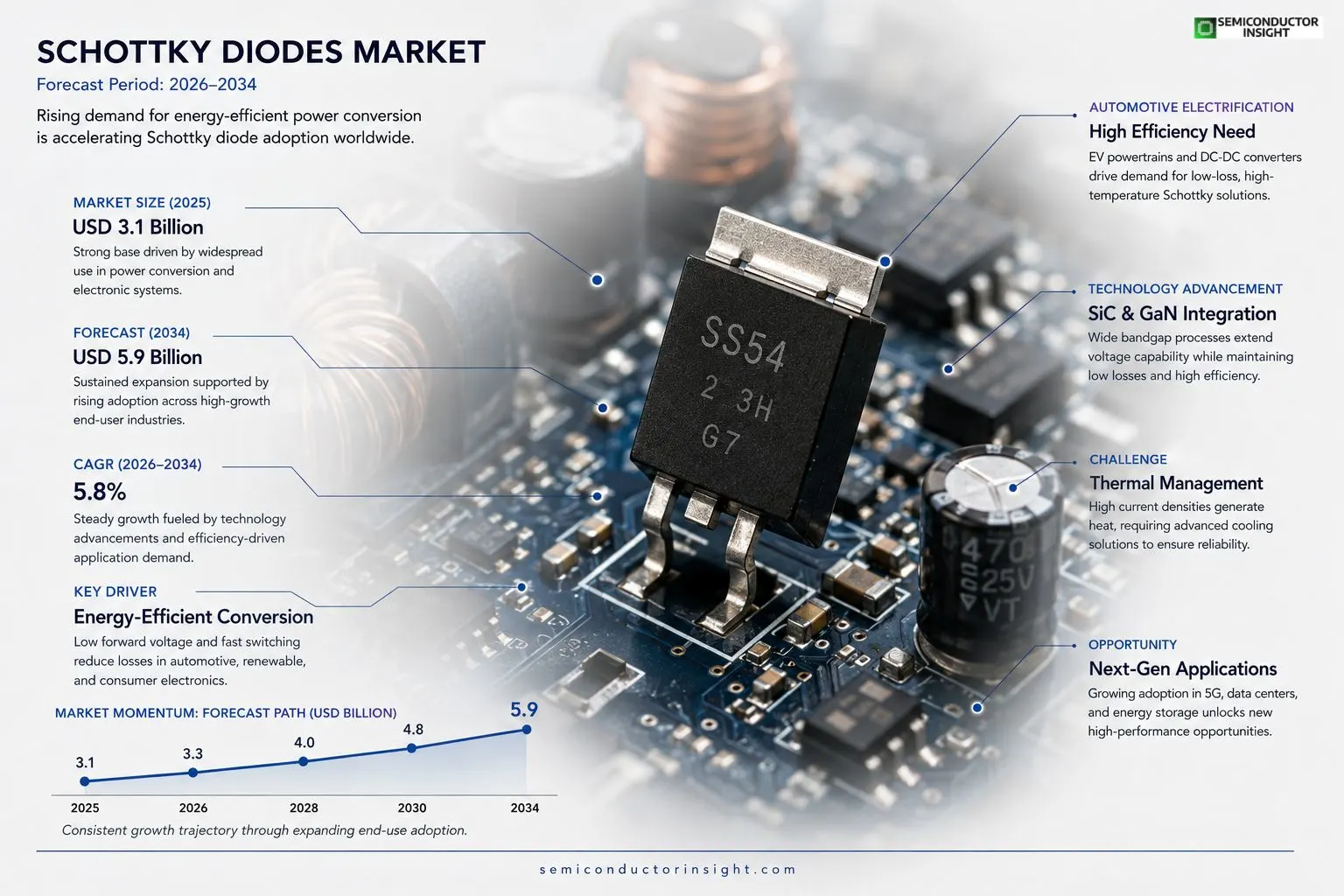
Schottky diodes market size was valued at USD 3.1 billion in 2025. The market is projected to grow from USD 3.3 billion in 2026 to USD 5.9 billion by 2034, exhibiting a CAGR of 5.8% during the forecast period.
Schottky diodes are semiconductor devices that combine a metal‑semiconductor junction with a low forward voltage drop and fast switching speed, making them ideal for power rectification, voltage clamping, and RF applications. Their construction typically involves a metal such as platinum or titanium on an n‑type silicon or silicon‑carbide substrate, which enables high efficiency and reduced heat dissipation.The market is experiencing robust expansion because rising demand for energy‑efficient power converters in automotive electrification, renewable energy systems, and consumer electronics drives adoption of Schottky technology. Furthermore, advancements in silicon‑carbide (SiC) and gallium‑nitride (GaN) processes are unlocking higher voltage capabilities while maintaining low losses. Key players,including Vishay Intertechnology, ON Semiconductor (onsemi), STMicroelectronics, Infineon Technologies, and NXP Semiconductors,are investing heavily in R&D and have launched next‑generation low‑loss packages throughout 2023‑2024 to capture emerging opportunities.
MARKET DRIVERS
Rising Demand for Energy‑Efficient Power Conversion
Schottky Diodes Market is being propelled by the expanding need for low‑loss rectification in power‑supply architectures. Manufacturers of data‑center servers and renewable‑energy inverters are specifying Schottky devices because they reduce forward voltage drop, thereby lowering overall system power consumption.
Growth in Automotive Electrification
Electrified vehicle platforms require fast‑recovery diodes for high‑frequency DC‑DC converters and traction‑inverter protection. The shift toward plug‑in hybrids and battery‑electric cars directly fuels demand for diode technologies that can operate at elevated temperatures while maintaining high efficiency.
➤ “Schottky solutions are now standard in high‑density power modules, delivering up to 30 % efficiency improvement over traditional silicon diodes.”
In addition, the rollout of 5G infrastructure drives compact, high‑performance power modules, where the low‑capacitance characteristics of Schottky diodes streamline thermal management and support higher data‑rate equipment.
MARKET CHALLENGES
Thermal Management Constraints at High Current Densities
Despite efficiency gains, Schottky devices generate significant heat when operated near their peak current limits. Designing adequate heat‑dissipation paths without inflating bill‑of‑materials remains a critical engineering hurdle for OEMs.
Other Challenges
Manufacturing Yield Variability
The thin‑film fabrication process can lead to inconsistencies in barrier height, affecting forward voltage uniformity and increasing reject rates in high‑volume production.
MARKET RESTRAINTS
Limited Reverse Voltage Capability Compared with Silicon Carbide
Schottky diodes typically max out at reverse voltages below 100 V, restricting their applicability in industrial motor‑drive and grid‑link systems where silicon‑carbide alternatives can handle higher stress levels.Regulatory compliance for automotive safety standards further narrows the pool of qualifying parts, as manufacturers must certify each diode variant against rigorous crash‑worthiness tests.
MARKET OPPORTUNITIES
Emergence of Wide‑Bandgap Integration
Hybrid solutions that combine Schottky diodes with wide‑bandgap materials such as GaN and SiC present a pathway to overcome reverse‑voltage limits while retaining low forward‑drop benefits. Early adopters in telecom and aerospace are piloting such architectures.The ongoing miniaturization of wearable medical devices creates a niche where ultra‑low leakage currents and compact footprints of Schottky diodes can be leveraged to extend battery life.Finally, advances in barrier‑metal engineering are expected to push reverse‑breakdown thresholds higher, opening new segments like high‑power lighting and next‑generation electric‑train propulsion.
Schottky Diodes Market Trends
Energy‑Efficient Power Conversion
Schottky Diodes Market is witnessing a clear shift toward energy‑efficient power conversion. Rising adoption of high‑efficiency power converters in automotive electrification, renewable‑energy interfacing, and consumer‑electronics devices is driving demand for the low forward voltage drop and rapid switching characteristics that Schottky technology offers. Manufacturers are prioritising designs that reduce heat dissipation, which aligns with stricter energy‑consumption regulations worldwide. Consequently, system integrators are specifying Schottky‑based rectifiers and clamping solutions to improve overall power‑train efficiency while maintaining compact form factors. This trend is reinforced by incremental cost reductions in metal‑semiconductor junction processing, making the technology increasingly attractive across volume‑production segments. In parallel, the proliferation of fast‑charging infrastructure for portable devices is prompting designers to opt for Schottky diodes in power‑supply front‑ends, where reduced turn‑on losses translate directly into higher charger efficiency and smaller thermal footprints.
Other Trends
Automotive Electrification
Automotive electrification represents a pivotal sub‑segment within Schottky Diodes Market. Hybrid‑electric and battery‑electric powertrains depend on efficient DC‑DC conversion, where Schottky diodes provide minimal conduction loss and fast recovery times. The vehicle manufacturers are integrating these devices into on‑board chargers, motor‑controller interfaces, and regenerative‑braking modules to boost range and reduce thermal management complexity. The move toward higher voltage architectures, often exceeding 800 V, has encouraged suppliers to qualify Schottky solutions on silicon‑carbide substrates, which sustain higher temperatures without compromising performance. As a result, OEMs are reporting measurable improvements in overall vehicle efficiency, directly supporting stricter emissions standards and consumer expectations for longer driving ranges. Furthermore, the integration of vehicle‑to‑grid (V2G) capabilities relies on bidirectional converters where Schottky diodes contribute to reliable energy flow control, reinforcing their role in future smart‑mobility ecosystems.
Advanced SiC and GaN Integration
Advanced semiconductor processes are shaping the next wave of growth for Schottky Diodes Market. Early‑stage integration of silicon‑carbide (SiC) and gallium‑nitride (GaN) technologies is enabling higher voltage ratings while preserving the low‑loss characteristics intrinsic to Schottky junctions. Leading suppliers such as Vishay, ON Semiconductor, STMicroelectronics, Infineon, and NXP have introduced ultra‑low‑inductance packages that target high‑frequency power modules and RF front‑ends. These innovations reduce board‑level parasitics and support higher switching frequencies, which are essential for modern power‑density demands in data‑center converters and wireless infrastructure. Market observers anticipate that continued R&D investment will broaden the application envelope, extending Schottky adoption into emerging sectors like grid‑scale energy storage and aerospace power systems. Additional benefits include improved reliability under high‑temperature cycling, which is critical for aerospace missions where maintenance intervals are limited. These attributes collectively reinforce the strategic importance of Schottky diode solutions in next‑generation high‑performance power architectures.
COMPETITIVE LANDSCAPEKey Industry Players
Schottky Diodes Market Competitive Overview
Schottky Diodes Market is dominated by a handful of vertically integrated semiconductor firms that leverage large‑scale manufacturing and deep R&D pipelines to capture the bulk of demand. Vishay Intertechnology leads the segment with a portfolio that spans low‑voltage power rectifiers to high‑frequency RF devices, benefiting from its extensive silicon‑carbide (SiC) and gallium‑nitride (GaN) process capabilities. ON Semiconductor (onsemi) follows closely, differentiating itself through cost‑optimized automotive‑grade Schottky solutions that address the electrification wave. Infineon Technologies and STMicroelectronics complement the leadership core by delivering high‑efficiency, low‑loss packages for renewable‑energy converters and consumer power supplies. Together, these firms command the majority of revenue, drive standards for forward voltage drop and switching speed, and invest heavily in next‑generation device architectures that support the projected CAGR of 5.8 % through 2034.Beyond the primary tier, a vibrant mid‑size cohort enriches the competitive landscape with niche innovations and regional strengths. NXP Semiconductors focuses on mixed‑signal Schottky diodes for automotive safety and connectivity, while ROHM Semiconductor supplies compact, high‑current devices for portable electronics. Texas Instruments, Diodes Incorporated, and Skyworks Solutions each target specific market slices such as power‑management IC integration, discrete packaging, and RF front‑end applications. Microchip Technology and Renesas Electronics leverage their broad microcontroller ecosystems to bundle Schottky diodes into system‑on‑chip solutions, whereas TDK Corporation exploits its material science expertise to improve thermal performance in high‑voltage devices. These players collectively enhance product diversity, accentuate supply‑chain resilience, and pressure the market leaders toward continual performance upgrades.
List of Key Schottky Diodes Companies Profiled
- Vishay Intertechnology
- ON Semiconductor (onsemi)
- Infineon Technologies
- STMicroelectronics
- NXP Semiconductors
- Texas Instruments
- ROHM Semiconductor
- Diodes Incorporated
- Skyworks Solutions
- Microchip Technology
- Renesas Electronics
- TDK Corporation
Segment Analysis:
| Segment Category | Sub-Segments | Key Insights |
| By Type |
|
Silicon Schottky
|
| By Application |
|
Power Rectifiers
|
| By End User |
|
Automotive Electronics
|
| By Technology |
|
Low‑Voltage Low‑Drive
|
| By Voltage Rating |
|
100 V‑600 V
|
Regional Analysis: North America
United States
The automotive industry’s transition towards electric and hybrid vehicles is a primary driver for Schottky diodes in the US. These diodes play a crucial role in power inverters, battery management systems, and on-board chargers, contributing to improved efficiency and performance.
The increasing complexity of electronic devices necessitates sophisticated power management solutions. Schottky diodes are integral components in DC-DC converters and other power regulation circuits, enhancing energy efficiency and system reliability across various applications.
Schottky diodes are utilized in various consumer electronics like mobile phones, laptops, and televisions for power regulation, voltage clamping, and signal rectification. The demand in this segment is influenced by the continuous evolution of electronic devices and the pursuit of smaller, more power-efficient designs.
The industrial sector employs Schottky diodes in power supplies, motor control systems, and other equipment requiring efficient power conversion. The reliability and high-switching speeds of these diodes are particularly valuable in demanding industrial environments.
Europe
The European Schottky diodes market exhibits steady growth, driven by stringent energy efficiency regulations and the expanding electric vehicle sector. Countries like Germany, France, and the UK are key contributors to this market. Emphasis on sustainable technologies and smart grid infrastructure further boosts the demand for these diodes. The automotive industry in Europe is actively incorporating Schottky diodes to enhance the performance of EV powertrains. Furthermore, increasing adoption in renewable energy systems contributes to market expansion.
Asia-Pacific
Asia-Pacific is emerging as the fastest-growing market for Schottky diodes. China, Japan, and South Korea are the dominant players, fueled by robust manufacturing industries and increasing domestic demand. The electronics manufacturing hub in Asia-Pacific significantly contributes to the consumption of Schottky diodes across various applications. The growth in the electric vehicle market in China presents a particularly significant opportunity. Government initiatives promoting technology innovation and industrial development further support market expansion.
South America
Schottky Diodes Market in South America is relatively nascent but holds potential for future growth. Brazil and Argentina are the primary markets, with increasing demand from the automotive, industrial, and consumer electronics sectors. The expansion of the automotive industry and the growing adoption of renewable energy technologies are key drivers. However, economic uncertainties and fluctuating currency values pose challenges to market development.
Middle East & Africa
The Middle East and Africa represent a smaller but growing market for Schottky diodes. The increasing investments in infrastructure development and the expansion of the automotive sector in countries like Saudi Arabia and South Africa are driving demand. The growing focus on renewable energy projects also contributes to market growth. However, limited local manufacturing capabilities and economic constraints restrict the overall market size.
Report Scope
This market research report provides a comprehensive analysis of the Schottky Diodes Market , covering the forecast period 2026–2034. It offers detailed insights into market dynamics, technological advancements, competitive landscape, and key trends shaping the industry.
Key focus areas of the report include:
- ✅ Market Overview: The report begins with an overview outlining its current market scenario, key growth indicators, and industry transformation drivers. It discusses macroeconomic factors, demand–supply balance, regulatory landscape, and the strategic role of semiconductors in powering advancements across industries such as automotive, telecommunications, consumer electronics, and industrial automation.
- ✅ Market Size & Forecast: Historical data and future projections for revenue, unit shipments, and market value across major regions and segments.
- ✅ Segmentation Analysis: Detailed breakdown by product type, technology, application, and end-user industry to identify high-growth segments and investment opportunities.
- ✅ Regional Insights: Insights into market performance across North America, Europe, Asia-Pacific, Latin America, and the Middle East & Africa, including country-level analysis where relevant.
- ✅ Competitive Landscape: Profiles of leading market participants, including their product offerings, R&D focus, manufacturing capacity, pricing strategies, and recent developments such as mergers, acquisitions, and partnerships.
- ✅ Technology Trends & Innovation: Assessment of emerging technologies, integration of AI/IoT, semiconductor design trends, fabrication techniques, and evolving industry standards.
- ✅ Market Drivers & Restraints: Evaluation of factors driving market growth along with challenges, supply chain constraints, regulatory issues, and market-entry barriers.
- ✅ Stakeholder Insights: Insights for component suppliers, OEMs, system integrators, investors, and policymakers regarding the evolving ecosystem and strategic opportunities.
Primary and secondary research methods are employed, including interviews with industry experts, data from verified sources, and real-time market intelligence to ensure the accuracy and reliability of the insights presented.
FREQUENTLY ASKED QUESTIONS:
What is the current market size of Schottky Diodes Market?
-> Schottky Diodes Market was valued at USD 3.1 billion in 2025 and is expected to reach USD 5.9 billion by 2034, reflecting a robust growth trajectory.
Which key companies operate in Schottky Diodes Market?
-> Key players include Vishay Intertechnology, ON Semiconductor (onsemi), STMicroelectronics, Infineon Technologies, and NXP Semiconductors, among others.
What are the key growth drivers?
-> Growth is driven by rising demand for energy‑efficient power converters in automotive electrification, renewable energy systems, and consumer electronics, as well as advancements in silicon‑carbide (SiC) and gallium‑nitride (GaN) technologies that enable higher voltage capabilities with low losses.
Which region dominates the market?
-> The reference does not specify a single dominant region; the market is ly distributed with significant activity across major regions.
What are the emerging trends?
-> Emerging trends include the integration of SiC and GaN processes for higher voltage performance, development of low‑loss Schottky packages launched in 2023‑2024, and ongoing R&D efforts to improve efficiency and thermal management.

Get Sample Report PDF for Exclusive Insights
Report Sample Includes
- Table of Contents
- List of Tables & Figures
- Charts, Research Methodology, and more...
 Download Sample Report PDF