
Key Statistics
Key Takeaways
- Market size: The market is valued at USD 736.7 million in 2025 and is projected to reach USD 1.28 billion by 2034, representing a 6.3% CAGR during 2026–2034.
- Imaging and spectrophotometry are the largest value applications, while light-position sensing remains an important industrial and scientific use case.
- North America holds the strongest 2025 market position through medical, scientific and industrial sensing demand, while Asia Pacific is the fastest manufacturing-growth region.
- Silicon arrays dominate visible and near-infrared applications, while InGaAs arrays serve higher-value SWIR and optical-communications needs.
- Integration with amplifiers and readout electronics is increasing, allowing 64–256-channel modules and more compact sensing systems with lower downstream analog-design burden.
Micro-Photodiode Arrays Market Overview
Mcro-photodiode arrays market is valued at USD 736.7 million in 2025 and is projected to reach USD 1.28 billion by 2034, expanding at a 6.3% CAGR during 2026–2034. The 2026 market level is USD 783.2 million. North America holds the strongest current market position, while Asia Pacific provides the fastest manufacturing and application growth. Micro-photodiode arrays serve light-position detection, imaging, spectroscopy, medical instrumentation and industrial sensing, with product value increasingly shifting toward integrated amplifier and readout solutions.
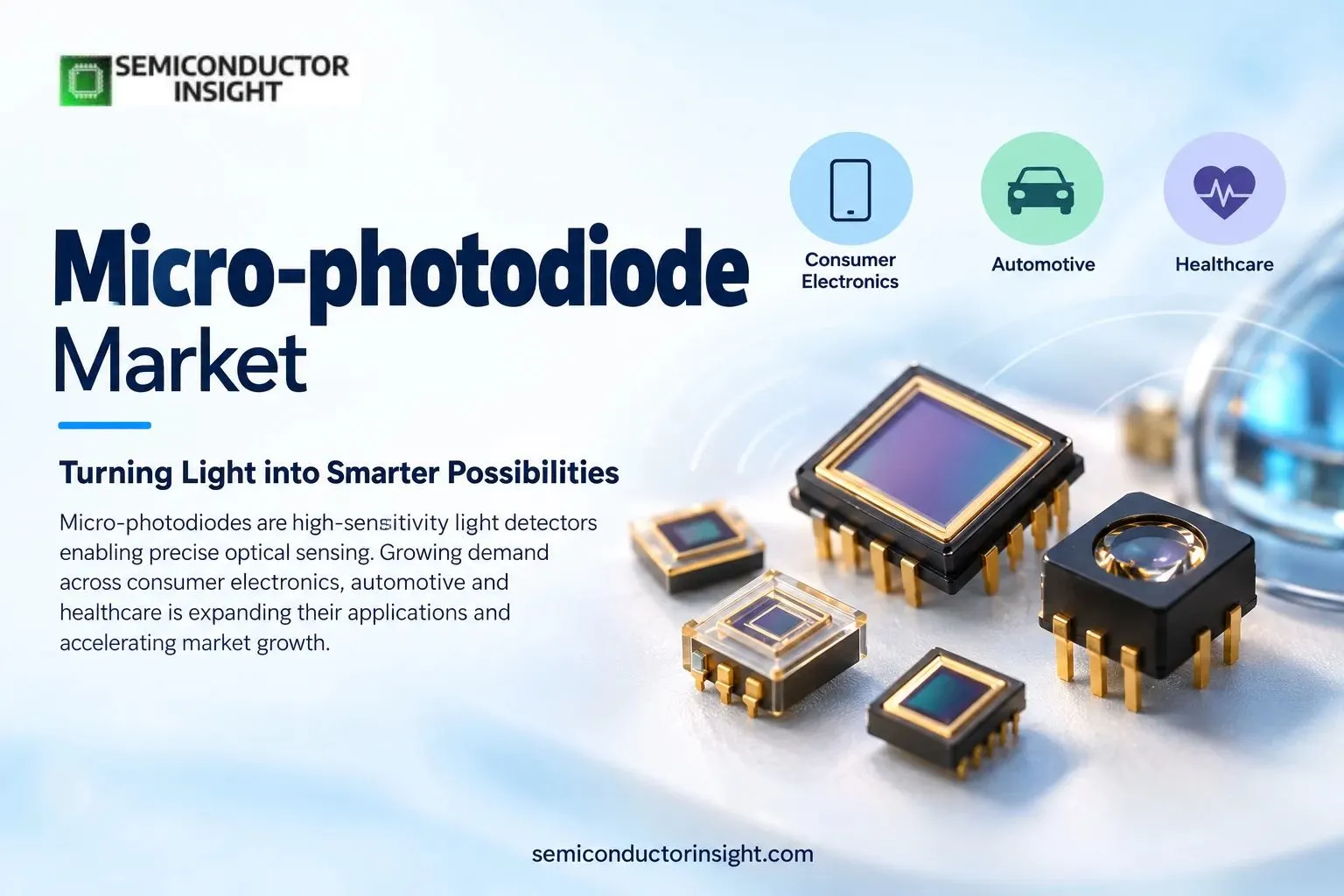
Micro-photodiode arrays combine multiple photodiodes in one package to detect light intensity across spatial positions or channels. Silicon arrays are widely used from ultraviolet through near-infrared wavelengths, while InGaAs and other materials extend sensitivity into short-wave infrared. Key performance parameters include responsivity, dark current, junction capacitance, channel pitch, crosstalk, spectral response and uniformity across the array.
Hamamatsu offers silicon photodiode arrays for light-position detection, imaging and spectrophotometry, as well as integrated array-plus-amplifier products with 64 to 256 channels. This integration trend reduces external analog complexity and supports denser instruments. At the same time, strip detectors and segmented arrays extend the technology into high-energy particle detection and precision measurement applications.
Commercial value depends on channel count, active area, pitch, material and packaging. Scientific and medical customers often buy lower volumes but require tight calibration and long product lifecycles, while industrial imaging can scale into higher unit demand. Custom arrays can carry premium pricing because photodiode geometry, spectral coatings and readout electronics are frequently tailored to the optical system.
Segment Analysis: By Type
By type, the market is segmented into 4-channel, 8-channel, 12-channel, 16-channel and other array formats. Lower channel counts serve simple position and intensity measurement, while higher channel counts enable more detailed imaging and spectroscopy. Commercial products also extend far beyond 16 channels, particularly when amplifiers or readout electronics are integrated.
| Type | Commercial role |
|---|---|
| 4 Channels | Compact position sensing and simple multi-channel light measurement. |
| 8 Channels | Intermediate channel density for industrial and analytical instruments. |
| 12 Channels | Specialized optical measurement and position-detection configurations. |
| 16 Channels | Higher-resolution linear or segmented sensing with manageable analog complexity. |
| Others | 64–256 channel and custom arrays for imaging, spectroscopy and advanced sensing. |
Additional Segmentation: By Detector Material
Detector material defines spectral range and cost. Silicon dominates visible and near-infrared sensing because it offers low dark current, mature manufacturing and attractive pricing. InGaAs serves short-wave infrared and telecom wavelengths, while other semiconductor materials are used for specialized ultraviolet, particle or narrow-band detection where silicon cannot provide adequate responsivity.
| Detector Material | Demand characteristics |
|---|---|
| Silicon | Visible, UV and near-infrared sensing with mature manufacturing and broad availability. |
| InGaAs | Short-wave infrared, optical communication and spectroscopy applications. |
| Other Semiconductor Materials | Specialty UV, particle, high-energy and application-specific detection. |
Segment Analysis: By Application
By application, imaging and spectrophotometry represent the largest value opportunities, while light-position detection remains important in industrial and scientific systems. Arrays can replace mechanical scanning by measuring multiple positions or wavelengths at once, improving speed and compactness. Other applications include particle detection, optical communications and specialized instrumentation. For commercial decisions in the Micro-Photodiode Arrays market, buyers also weigh qualification evidence, integration effort, operating reliability, lifecycle support, supply continuity and measurable system-level value rather than a single specification.
| Application | Demand characteristics |
|---|---|
| Light Position Detection | Alignment, displacement, motion and beam-position measurement. |
| Imaging | Industrial, medical, scientific and security imaging. |
| Spectrophotometry | Wavelength-resolved optical measurement in laboratory and process instruments. |
| Others | Particle detection, optical communication, LiDAR and specialty sensors. |
Additional Segmentation: By Integration Level
Products range from discrete diode arrays to sensors with integrated amplifiers or readout ICs and complete custom modules. More integration reduces board area and analog design effort, while discrete arrays provide maximum flexibility for specialized research or instrumentation. The market is gradually shifting toward integrated modules where noise, gain and calibration are controlled at the sensor level.
| Integration Level | Commercial relevance |
|---|---|
| Discrete Array | Photodiode elements in one package with external readout electronics. |
| Array with Amplifier / ROIC | Photodiodes combined with signal-processing ICs for lower system complexity. |
| Custom Sensor Module | Application-specific array, optics, electronics and calibrated module integration. |
Regional Analysis
North America holds the strongest current market position through medical devices, scientific instruments, aerospace and industrial sensing. Asia Pacific is the fastest growth region because Japan and China combine photonics manufacturing, electronics production and expanding industrial automation. Europe remains a strategic precision-instrumentation market. For commercial decisions in the Micro-Photodiode Arrays market, buyers also weigh qualification evidence, integration effort, operating reliability, lifecycle support, supply continuity and measurable system-level value rather than a single specification.
Why does regional demand differ across the Micro-Photodiode Arrays market?
Regional demand reflects both instrument production and end-user research or industrial activity. North America generates premium medical and scientific demand, Asia Pacific combines manufacturing scale with advanced sensor suppliers, and Europe contributes spectroscopy and industrial metrology. Customers value long product continuity because a detector change can force optical recalibration of the complete instrument.
| Region | Position | Demand profile | Supplier-selection factor |
|---|---|---|---|
| North America | Largest | Medical, scientific, industrial | High-value instrumentation |
| Asia Pacific | Fastest growth | Electronics, imaging, manufacturing | Sensor production scale |
| Europe | Strategic | Industrial, spectroscopy, research | Precision and lifecycle |
| South America | Emerging | Medical and industrial | Imported instrumentation |
| Middle East & Africa | Emerging | Medical, scientific, security | Institutional procurement |
Competitive Landscape
Hamamatsu Photonics, First Sensor, Laser Components, Optoi Microelectronics, OSI Optoelectronics, Excelitas, TT Electronics, Detection Technology, HORIBA and Kyoto Semiconductor compete through detector material, channel count, noise performance, packaging and custom design. The market is fragmented because applications range from simple position sensing to calibrated scientific imaging. For commercial decisions in the Micro-Photodiode Arrays market, buyers also weigh qualification evidence, integration effort, operating reliability, lifecycle support, supply continuity and measurable system-level value rather than a single specification.
Hamamatsu is a key technology benchmark with silicon arrays, segmented photodiodes, strip detectors and array-plus-amplifier products. Suppliers differentiate through low dark current, spectral coatings, channel uniformity, active-area geometry and the ability to integrate amplifiers or scintillators for specific measurement systems. For commercial decisions in the Micro-Photodiode Arrays market, buyers also weigh qualification evidence, integration effort, operating reliability, lifecycle support, supply continuity and measurable system-level value rather than a single specification.
InGaAs and other specialty arrays add a premium segment beyond mainstream silicon. These products serve SWIR spectroscopy, optical communications and industrial imaging, where detector material cost is higher but the wavelength range creates clear system value that cannot be achieved with conventional silicon. For commercial decisions in the Micro-Photodiode Arrays market, buyers also weigh qualification evidence, integration effort, operating reliability, lifecycle support, supply continuity and measurable system-level value rather than a single specification.
| Competitive tier | Representative companies | Primary differentiation |
|---|---|---|
| Global photodetector leaders | Hamamatsu, Excelitas, OSI Optoelectronics | Broad silicon and specialty arrays, custom packaging and instrumentation relationships. |
| Industrial / specialty sensor suppliers | First Sensor, Laser Components, TT Electronics | Application-specific arrays and industrial channels. |
| Scientific / imaging specialists | Detection Technology, HORIBA, Kyoto Semiconductor | Integrated arrays, imaging and analytical-instrument applications. |
Key companies profiled
Hamamatsu Photonics, First Sensor, Laser Components, Optoi Microelectronics, Renishaw, OSI Optoelectronics, Excelitas Technologies, TT Electronics, Detection Technology, HORIBA and Kyoto Semiconductor are included in the competitive scope. Products vary widely in channel count, spectral range, package and integration level, so direct share comparisons should be made by application category. For commercial decisions in the Micro-Photodiode Arrays market, buyers also weigh qualification evidence, integration effort, operating reliability, lifecycle support, supply continuity and measurable system-level value rather than a single specification.
Production Capacity Analysis
Capacity depends on semiconductor wafer fabrication, photodiode processing, passivation, dicing, wire bonding, package assembly and optical or electrical test. Multi-channel arrays require good element-to-element uniformity, so yield is constrained not only by individual diode defects but by whether the entire array meets specification. For commercial decisions in the Micro-Photodiode Arrays market, buyers also weigh qualification evidence, integration effort, operating reliability, lifecycle support, supply continuity and measurable system-level value rather than a single specification.
Integrated arrays add amplifier or readout IC assembly, calibration and sometimes scintillators or optics. This increases value per unit but also makes test more complex. Custom products can use lower-volume production lines, so application engineering and test automation are important capacity constraints. For commercial decisions in the Micro-Photodiode Arrays market, buyers also weigh qualification evidence, integration effort, operating reliability, lifecycle support, supply continuity and measurable system-level value rather than a single specification.
Market Dynamics
The market grows with medical imaging, spectroscopy, industrial automation, optical communications and position sensing. Miniaturization and integrated readout electronics increase value, while high manufacturing cost and noise optimization remain technical constraints. The largest opportunities lie in integrated modules, SWIR arrays and high-speed sensing. For commercial decisions in the Micro-Photodiode Arrays market, buyers also weigh qualification evidence, integration effort, operating reliability, lifecycle support, supply continuity and measurable system-level value rather than a single specification.
Market Drivers
| Driver | Impact | Commercial mechanism |
|---|---|---|
| Medical and scientific imaging | High | More instruments require compact multi-channel optical detection. |
| Industrial automation | High | Machine systems need fast position and light measurement. |
| Spectroscopy | Medium-High | Compact spectrometers use linear arrays for wavelength-resolved detection. |
| Optical communication / SWIR | Medium | InGaAs arrays serve wavelengths beyond silicon sensitivity. |
Medical and scientific imaging
Diagnostic, analytical and research systems use arrays to capture spatial or spectral information without mechanical scanning. Demand grows with instrument installations and with higher channel counts that improve throughput. For commercial decisions in the Micro-Photodiode Arrays market, buyers also weigh qualification evidence, integration effort, operating reliability, lifecycle support, supply continuity and measurable system-level value rather than a single specification.
Industrial automation
Photodiode arrays can detect beam position, alignment and process variation at high speed with simpler data paths than full image sensors. Factory automation therefore supports steady industrial demand. For commercial decisions in the Micro-Photodiode Arrays market, buyers also weigh qualification evidence, integration effort, operating reliability, lifecycle support, supply continuity and measurable system-level value rather than a single specification.
Spectroscopy
A linear array placed behind a diffraction grating can measure many wavelength bins simultaneously. Integrated amplifier arrays reduce analog design burden and enable smaller portable instruments. For commercial decisions in the Micro-Photodiode Arrays market, buyers also weigh qualification evidence, integration effort, operating reliability, lifecycle support, supply continuity and measurable system-level value rather than a single specification.
Optical communication / SWIR
SWIR detectors support telecom monitoring, spectroscopy and specialized imaging. Higher device cost is justified where silicon cannot provide adequate responsivity. For commercial decisions in the Micro-Photodiode Arrays market, buyers also weigh qualification evidence, integration effort, operating reliability, lifecycle support, supply continuity and measurable system-level value rather than a single specification.
Market Restraints
| Restraint | Impact | Commercial consequence |
|---|---|---|
| High production cost | High | Precision arrays need uniform semiconductor processing and test. |
| Noise and crosstalk | Medium-High | Small signals require low dark current and electrical isolation. |
| Application fragmentation | Medium | Customers require many channel counts and geometries. |
| Competition from image sensors | Medium | CMOS image sensors can replace arrays in some imaging tasks. |
High production cost
A single defective or noisy element can reduce the yield of the full array, especially at higher channel counts. Custom geometries and spectral coatings also reduce manufacturing scale relative to commodity image sensors. For commercial decisions in the Micro-Photodiode Arrays market, buyers also weigh qualification evidence, integration effort, operating reliability, lifecycle support, supply continuity and measurable system-level value rather than a single specification.
Noise and crosstalk
High sensitivity can be limited by leakage, amplifier noise or optical and electrical crosstalk between channels. System designers need careful biasing, shielding and calibration, increasing engineering complexity. For commercial decisions in the Micro-Photodiode Arrays market, buyers also weigh qualification evidence, integration effort, operating reliability, lifecycle support, supply continuity and measurable system-level value rather than a single specification.
Application fragmentation
The market spans spectroscopy, imaging, position sensing and particle detection. Product variety reduces economies of scale and forces suppliers to maintain many package and active-area configurations. For commercial decisions in the Micro-Photodiode Arrays market, buyers also weigh qualification evidence, integration effort, operating reliability, lifecycle support, supply continuity and measurable system-level value rather than a single specification.
Competition from image sensors
Where two-dimensional imaging and integrated processing are needed, CMOS sensors may provide better economics. Photodiode arrays retain an advantage in analog linearity, spectral flexibility and specialized detector materials. For commercial decisions in the Micro-Photodiode Arrays market, buyers also weigh qualification evidence, integration effort, operating reliability, lifecycle support, supply continuity and measurable system-level value rather than a single specification.
Market Opportunities
Integrated amplifier arrays
Combining photodiodes and signal-processing ICs can reduce noise and board space, making arrays easier to adopt in compact analytical and medical instruments. For commercial decisions in the Micro-Photodiode Arrays market, buyers also weigh qualification evidence, integration effort, operating reliability, lifecycle support, supply continuity and measurable system-level value rather than a single specification.
SWIR and InGaAs arrays
Short-wave infrared spectroscopy and optical communications create premium demand beyond the silicon spectral range. For commercial decisions in the Micro-Photodiode Arrays market, buyers also weigh qualification evidence, integration effort, operating reliability, lifecycle support, supply continuity and measurable system-level value rather than a single specification. For commercial decisions in the Micro-Photodiode Arrays market, buyers also weigh qualification evidence, integration effort, operating reliability, lifecycle support, supply continuity and measurable system-level value rather than a single specification.
Automotive and LiDAR sensing
Multi-channel fast detectors can support position, ranging and optical monitoring functions where low latency matters. For commercial decisions in the Micro-Photodiode Arrays market, buyers also weigh qualification evidence, integration effort, operating reliability, lifecycle support, supply continuity and measurable system-level value rather than a single specification. For commercial decisions in the Micro-Photodiode Arrays market, buyers also weigh qualification evidence, integration effort, operating reliability, lifecycle support, supply continuity and measurable system-level value rather than a single specification.
Quantum and particle detection
Specialized arrays and strip detectors can address research, high-energy physics and emerging photonic-computing instrumentation. For commercial decisions in the Micro-Photodiode Arrays market, buyers also weigh qualification evidence, integration effort, operating reliability, lifecycle support, supply continuity and measurable system-level value rather than a single specification. For commercial decisions in the Micro-Photodiode Arrays market, buyers also weigh qualification evidence, integration effort, operating reliability, lifecycle support, supply continuity and measurable system-level value rather than a single specification.
Supply Chain Analysis
Materials. Silicon, InGaAs and other detector materials are selected according to wavelength range and noise requirements. Wafer purity and junction quality determine dark current, responsivity and long-term stability. For commercial decisions in the Micro-Photodiode Arrays market, buyers also weigh qualification evidence, integration effort, operating reliability, lifecycle support, supply continuity and measurable system-level value rather than a single specification.
Fabrication. Multiple photodiode elements are formed on one die with controlled pitch, isolation and active area. Higher channel count increases the chance that one defective element reduces array yield, making uniformity an important manufacturing metric. For commercial decisions in the Micro-Photodiode Arrays market, buyers also weigh qualification evidence, integration effort, operating reliability, lifecycle support, supply continuity and measurable system-level value rather than a single specification.
Integration. Arrays are packaged and may be combined with amplifiers, readout ICs, scintillators or optical filters. Calibration aligns channel response and can materially improve instrument accuracy. For commercial decisions in the Micro-Photodiode Arrays market, buyers also weigh qualification evidence, integration effort, operating reliability, lifecycle support, supply continuity and measurable system-level value rather than a single specification.
Deployment. Instrument makers integrate the sensor with optics, analog electronics and software. Long qualification cycles are common because changing a detector may require recalibration of the complete optical system. For commercial decisions in the Micro-Photodiode Arrays market, buyers also weigh qualification evidence, integration effort, operating reliability, lifecycle support, supply continuity and measurable system-level value rather than a single specification.
Recent Developments in the Micro-Photodiode Arrays Market
Developments tracked through September 2026 and limited to events that materially affect technology, capacity, adoption or competition.
- 2026 Product Portfolio
Hamamatsu continued offering silicon photodiode arrays for light-position detection, imaging and spectrophotometry, including array-plus-amplifier products spanning 64 to 256 channels. Source - 2025–2026 Integration Trend
Commercial photodiode-array portfolios increasingly combine detector arrays with signal-processing ICs, reducing external analog circuitry and improving implementation in compact analytical instruments. Source - 2025–2026 Specialty Detection
Silicon strip detectors with photosensitive widths from several micrometers to several tens of micrometers remain available for micron-level particle-position detection, extending array technology into scientific instrumentation. Source
Report Scope & Segmentation
| Attribute | Scope |
|---|---|
| Base year | 2025 |
| Estimated year | 2026 |
| Forecast period | 2026–2034 |
| 2025 market size | USD 736.7 million |
| 2026 estimated size | USD 783.2 million |
| 2034 projected size | USD 1.28 billion |
| CAGR (2026–2034) | 6.3% |
| Largest market in 2025 | North America |
| By Type | 4 Channels; 8 Channels; 12 Channels; 16 Channels; Others |
| By Application | Light Position Detection; Imaging; Spectrophotometry; Others |
| By Detector Material | Silicon; InGaAs; Other Semiconductor Materials |
| By Integration Level | Discrete Array; Array with Amplifier/ROIC; Custom Sensor Module |
| Companies profiled | Hamamatsu; First Sensor; Laser Components; Optoi Microelectronics; OSI Optoelectronics; Excelitas; TT Electronics; Detection Technology; HORIBA; Kyoto Semiconductor |
Frequently Asked Questions
What is the micro-photodiode arrays market size in 2025?
The global market is valued at USD 736.7 million in 2025 across silicon, InGaAs and other multi-channel photodetector applications.
What is the market forecast for 2034?
The market is projected to reach USD 1.28 billion by 2034, representing a 6.3% CAGR during 2026–2034. The 2026 market level is USD 783.2 million.
Which region leads the market?
North America holds the strongest current market position through medical, scientific and industrial sensing demand, while Asia Pacific is the fastest growth region.
What are micro-photodiode arrays used for?
They are used for light-position detection, imaging, spectrophotometry, optical communication, particle detection and specialized sensing.
Which materials are used?
Silicon is the dominant material for visible and near-infrared detection, while InGaAs extends sensitivity into short-wave infrared.
Why integrate amplifiers with the array?
Integrated amplifiers reduce external analog design, lower noise and simplify high-channel-count instruments.
Which channel counts are common?
The source segmentation includes 4, 8, 12 and 16 channels, while commercial products also extend to 64–256 channels and custom formats.
Who are the major suppliers?
Hamamatsu, First Sensor, OSI Optoelectronics, Excelitas, TT Electronics, HORIBA and other photodetector specialists participate.
What limits market growth?
Production cost, noise, crosstalk, product fragmentation and competition from CMOS image sensors are the main constraints.
What will drive growth through 2034?
Medical imaging, spectroscopy, automation, SWIR detection, integrated readout and specialized scientific sensing will support market growth.
Research Sources & Evidence Base
View research sources used in this market overview
- Hamamatsu Photonics — Si Photodiode Arrays. Applications, array-plus-amplifier products and strip-detector evidence.
Get Sample Report PDF for Exclusive Insights
Report Sample Includes
- Table of Contents
- List of Tables & Figures
- Charts, Research Methodology, and more...



