Key Statistics
Key Takeaways
- Flex PCB remains a core commercial segment because it is already embedded in established system architectures and benefits from a broad installed base.
- High-Density Interconnect (HDI) PCB carries the strongest technology-led growth profile as customers prioritize higher density, efficiency or throughput and accept greater qualification complexity.
- Monitoring Devices is a key growth application because it translates end-market technology shifts directly into higher electronic content and more demanding component specifications.
- North America is the largest regional market in 2025, while Asia Pacific has the strongest structural growth momentum through the forecast window.
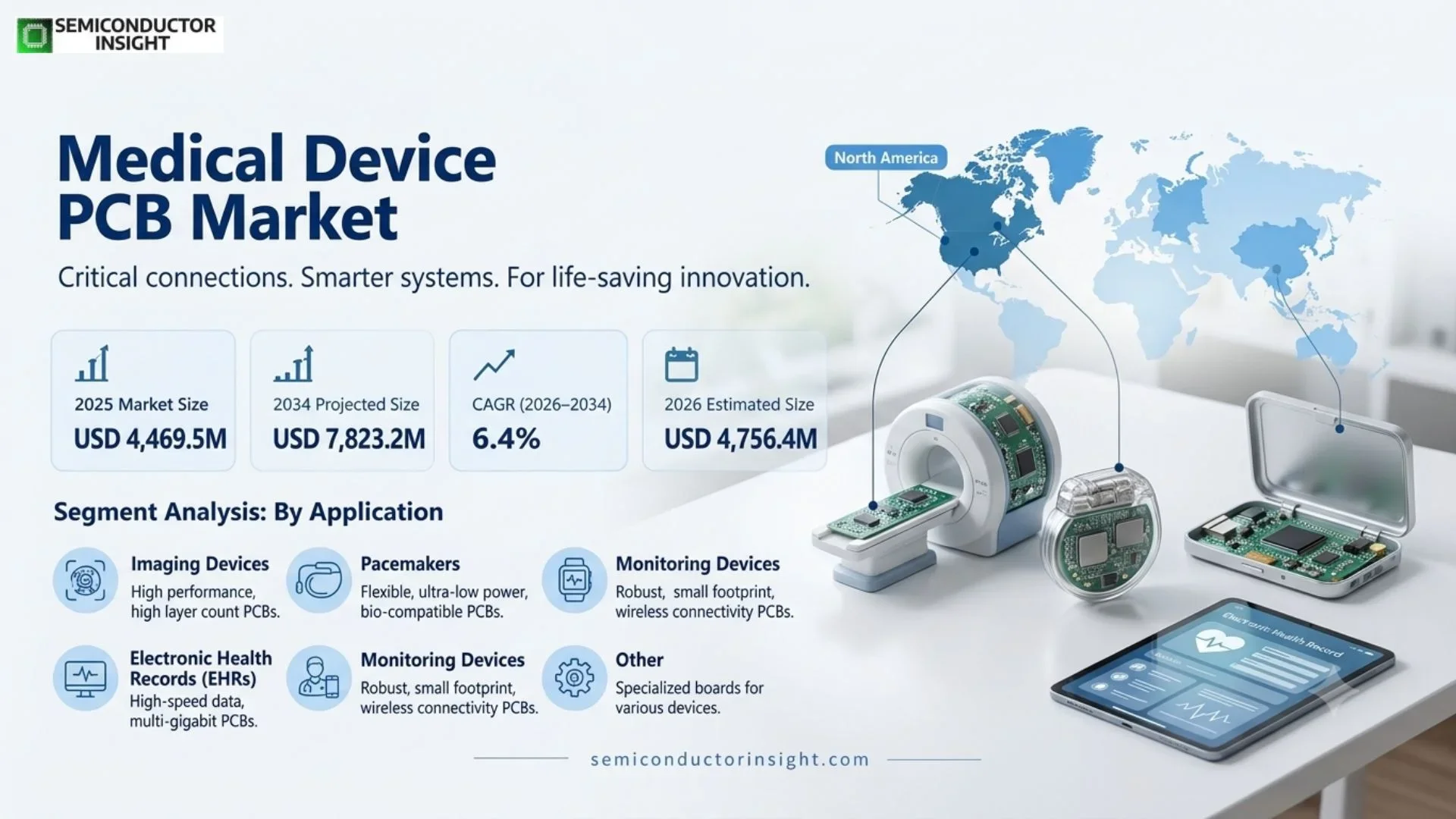
- The market expands from USD 4,469.5 million in 2025 to USD 7,823.2 million in 2034, corresponding to a 6.4% CAGR for 2026–2034.
- Supplier advantage increasingly depends on qualification depth, manufacturing scale, engineering support and lifecycle assurance rather than on nominal component specifications alone.
Medical Device PCB Market Overview
Medical Device PCB Market is valued at USD 4,469.5 million in 2025 and is projected to reach USD 7,823.2 million by 2034, representing a 6.4% CAGR during 2026–2034. North America is the largest market in 2025. The 2026 estimated market size is USD 4,756.4 million, consistent with the growth path implied by the published value anchors.
Medical device PCBs are rigid, flexible and high-density interconnect printed circuit boards engineered for diagnostic, monitoring, implantable and other regulated healthcare electronics. The market is shaped by reliability, traceability, miniaturization and validation requirements that are more demanding than general-purpose electronics because a board defect can affect device performance, clinical workflow or patient safety.
The market is not defined by a single component specification. It is an ecosystem of design choices, manufacturing capability, qualification requirements and downstream system economics. For medical device pcb, the purchasing decision shifts toward suppliers that can demonstrate predictable performance across production lots, long-term availability and application support. That makes design wins sticky but also raises the cost of entering programs already served by qualified incumbents.
The current transition is being driven by end markets that require more capability per unit of power, volume or installed system cost. This favors technologies that solve a system bottleneck rather than simply offering a higher nominal specification. The commercial result is a market where premium products can grow faster than unit volume, while mature categories remain important because they anchor installed-base replacement and cost-sensitive applications.
Segment Analysis: By Type
By type, the medical device pcb market is segmented into Flex PCB, Rigid PCB and High-Density Interconnect (HDI) PCB. The segments differ in architecture, qualification burden and system-level value. The commercial mix therefore changes as customers move from mature solutions toward products that deliver higher density, efficiency, integration or performance within the same equipment footprint.
| Type | Technology and use profile | Market position and commercial implication |
|---|---|---|
| Flex PCB | Flexible printed circuits support compact, lightweight and moving medical assemblies where rigid interconnects would consume too much space or introduce mechanical complexity. Wearables, catheters, compact sensors and other body-adjacent devices are natural use cases. Commercial value comes from materials control, bend reliability, fine-line capability and traceable manufacturing rather than from simple board area. | Flex PCB competes on measurable system value rather than a single datasheet parameter. Buyers compare qualification history, total implementation cost, availability and engineering support. As end markets adopt more demanding architectures, suppliers that combine product performance with stable manufacturing and reference designs are positioned to capture higher-value design wins and reduce customer switching risk. |
| Rigid PCB | Rigid boards remain the workhorse for imaging equipment, monitoring systems, laboratory instruments and many stationary medical products. Their manufacturing ecosystem is mature, but medical programs impose tighter documentation, change control and reliability requirements than general industrial production. Suppliers compete on process discipline, multilayer capability, test coverage and the ability to support long product lifecycles. | Rigid PCB competes on measurable system value rather than a single datasheet parameter. Buyers compare qualification history, total implementation cost, availability and engineering support. As end markets adopt more demanding architectures, suppliers that combine product performance with stable manufacturing and reference designs are positioned to capture higher-value design wins and reduce customer switching risk. |
| High-Density Interconnect (HDI) PCB | HDI boards enable smaller devices by using microvias, finer lines and denser routing. They are particularly relevant as medical electronics add processors, wireless connectivity, sensors and power-management functions without increasing enclosure size. The segment captures higher value because microvia reliability, registration, materials and sequential lamination require tighter process capability and more intensive qualification. | High-Density Interconnect (HDI) PCB competes on measurable system value rather than a single datasheet parameter. Buyers compare qualification history, total implementation cost, availability and engineering support. As end markets adopt more demanding architectures, suppliers that combine product performance with stable manufacturing and reference designs are positioned to capture higher-value design wins and reduce customer switching risk. |
Pricing and qualification by type
Price realization across medical device pcb segments reflects process complexity, performance class, packaging or board construction, qualification effort and purchase volume. Mature products generally face stronger price competition, while newer high-performance categories can sustain premiums when they reduce system cost, size, power or validation burden. This creates a two-speed market in which technology migration raises average value even as legacy products continue to ship in volume.
Segment Analysis: By Application
By application, the market covers Imaging Devices, Pacemakers, Electronic Health Records (EHRs), Monitoring Devices and Other. Application demand is shaped by the purchasing trigger inside the end system: performance, reliability, size, power, connectivity, compliance or lifecycle cost. The strongest growth occurs where component choice directly unlocks a new system architecture rather than merely replacing an equivalent incumbent part.
| Application | Demand characteristics and buying trigger |
|---|---|
| Imaging Devices | Imaging platforms such as ultrasound, X-ray and other diagnostic systems require multilayer boards for high-speed signal processing, power distribution and system control. These products tend to have long service lives and high reliability requirements, so board suppliers benefit from stable programs once qualified. The trade-off is extensive validation and strict control over materials and process changes. |
| Pacemakers | Pacemaker electronics demand extreme miniaturization, reliability and traceability because implanted devices must operate for long periods without service. Flexible and HDI technologies can support dense circuitry in constrained form factors, while material and process changes require rigorous review. The commercial market is therefore small in board area but high in qualification intensity and value per board. |
| Electronic Health Records (EHRs) | The report includes EHRs as an application category, which in hardware terms is expressed through terminals, gateways and connected clinical equipment that capture and exchange patient information. The PCB demand is less implant-specific and more comparable to secure medical computing, with emphasis on connectivity, reliability and compliance across devices installed in hospitals and clinics. |
| Monitoring Devices | Patient monitors, wearable health devices and remote-monitoring systems create recurring demand for compact PCBs that combine sensing, wireless communication, power management and local processing. The move toward home healthcare increases the need for portable, low-power and durable designs. Flexible and HDI boards are especially relevant where size and ergonomics determine whether a device can be worn continuously. |
| Other | Other applications include laboratory instruments, therapeutic systems and specialized medical electronics that do not fit the main categories. The common requirement is controlled, documented manufacturing with device-specific electrical and reliability testing. This diversity favors suppliers able to handle lower-volume, high-mix programs while maintaining quality systems suitable for regulated medical-device customers. |
Secondary segmentation: By end user
| End user | Commercial profile |
|---|---|
| Hospitals and Clinics | Hospitals and Clinics represents a distinct purchasing environment within the medical device pcb value chain. Procurement priorities vary by scale, compliance burden, service model and system criticality, but qualification continuity and lifecycle support remain common themes. Suppliers that adapt documentation, logistics and engineering support to the end user’s operating model can defend share even when the underlying hardware specification is widely available. |
| Diagnostic Centers | Diagnostic Centers represents a distinct purchasing environment within the medical device pcb value chain. Procurement priorities vary by scale, compliance burden, service model and system criticality, but qualification continuity and lifecycle support remain common themes. Suppliers that adapt documentation, logistics and engineering support to the end user’s operating model can defend share even when the underlying hardware specification is widely available. |
| Ambulatory Surgical Centers | Ambulatory Surgical Centers represents a distinct purchasing environment within the medical device pcb value chain. Procurement priorities vary by scale, compliance burden, service model and system criticality, but qualification continuity and lifecycle support remain common themes. Suppliers that adapt documentation, logistics and engineering support to the end user’s operating model can defend share even when the underlying hardware specification is widely available. |
| Home Healthcare | Home Healthcare represents a distinct purchasing environment within the medical device pcb value chain. Procurement priorities vary by scale, compliance burden, service model and system criticality, but qualification continuity and lifecycle support remain common themes. Suppliers that adapt documentation, logistics and engineering support to the end user’s operating model can defend share even when the underlying hardware specification is widely available. |
| Research Laboratories | Research Laboratories represents a distinct purchasing environment within the medical device pcb value chain. Procurement priorities vary by scale, compliance burden, service model and system criticality, but qualification continuity and lifecycle support remain common themes. Suppliers that adapt documentation, logistics and engineering support to the end user’s operating model can defend share even when the underlying hardware specification is widely available. |
| Other End-Users | Other End-Users represents a distinct purchasing environment within the medical device pcb value chain. Procurement priorities vary by scale, compliance burden, service model and system criticality, but qualification continuity and lifecycle support remain common themes. Suppliers that adapt documentation, logistics and engineering support to the end user’s operating model can defend share even when the underlying hardware specification is widely available. |
Regional Analysis
North America leads the medical device pcb market in 2025, while Asia Pacific carries the strongest structural growth momentum. Regional demand differs because manufacturing concentration, end-market investment, qualification ecosystems and channel structures are not evenly distributed. The most attractive region for a supplier therefore depends on whether it competes through local production, design influence, application engineering, system integration or distribution reach.
How does regional demand differ across the medical device pcb market?
Regional analysis is most useful when it distinguishes why customers buy. North America has the deepest current demand pool, but other regions can offer faster incremental growth in selected applications. North America is often innovation and design-led, Europe is qualification and efficiency-led, Asia Pacific combines manufacturing scale with expanding consumption, while South America and Middle East & Africa are more project and import dependent.
| Region | Position | Growth outlook | Demand profile | What decides supplier selection |
|---|---|---|---|---|
| Asia Pacific | Fastest-growing | High | Manufacturing, design and end-market mix vary by region. | Asia Pacific is the fastest-growing region because electronics manufacturing depth, PCB fabrication capacity and expanding healthcare-device production create a broad supply and demand base. China, Taiwan, South Korea and Southeast Asia provide manufacturing scale, while Japan adds high-reliability medical electronics. Growth depends on suppliers moving from general electronics toward medically qualified, traceable production systems. |
| North America | Largest | Moderate | Manufacturing, design and end-market mix vary by region. | North America is the largest demand center in this analysis because the United States combines a large regulated medical-device market, significant diagnostic and monitoring equipment development, and stringent FDA quality requirements. PCB suppliers serving these programs compete on traceability, documentation and engineering support. The region is demand-led rather than defined by the lowest fabrication cost. |
| Europe | Established / emerging | Moderate | Manufacturing, design and end-market mix vary by region. | Europe has a strong medical-device engineering base and a regulatory environment that rewards documented quality systems and stable supplier relationships. Germany, Switzerland and other manufacturing centers support advanced diagnostic and therapeutic equipment. PCB demand is therefore concentrated in qualified programs where material consistency, change control and compliance matter more than short-term spot pricing. |
| South & Central America | Established / emerging | Moderate | Manufacturing, design and end-market mix vary by region. | South and Central America are smaller demand centers, with Brazil and other larger healthcare markets accounting for the majority of regional opportunity. Many sophisticated devices are imported, while local assembly and service create selective PCB demand. Growth is connected to healthcare infrastructure and diagnostic investment, but suppliers must manage lower volumes and longer qualification cycles. |
| Middle East & Africa | Established / emerging | Moderate | Manufacturing, design and end-market mix vary by region. | Middle East and Africa demand is driven by hospital investment, diagnostic equipment deployment and growing use of connected medical systems. Much of the sophisticated equipment is imported, limiting local bare-board fabrication demand. Opportunity therefore appears through global OEM supply chains and regional service ecosystems rather than large domestic PCB manufacturing clusters. |
Competitive Landscape
Competition in the medical device pcb market is shaped by qualification, platform depth, manufacturing scale and customer engineering support. The profiled company set includes PCBgogo, Sierra Circuits, Epec Engineered Technologies, MCL and 19 additional companies. The strongest positions are typically built through repeated design wins and lifecycle execution rather than short-term price moves.
Large suppliers compete by offering product roadmaps that allow customers to move across performance tiers without redesigning the entire system. That advantage is reinforced by applications engineering, reference platforms, validation data and global supply. Smaller specialists can still win where customization, fast-turn engineering or niche process capability matters more than breadth, but they face higher customer-acquisition and qualification costs.
Customer concentration differs by application. High-volume platforms can create very large sockets, but they also give buyers pricing leverage and require suppliers to commit capacity years in advance. Lower-volume industrial and specialized applications generate smaller unit demand but can support longer lifecycles and more stable pricing. A balanced customer mix therefore reduces dependence on a single end-market investment cycle.
| Competitive tier | Positioning |
|---|---|
| Tier 1: scaled platform suppliers | PCBgogo, Sierra Circuits, Epec Engineered Technologies, MCL. These companies compete on manufacturing scale, technology roadmaps, global application support and the ability to sustain multi-generation customer programs. Their advantage is strongest where qualification is expensive and customers want a long-term supplier rather than a one-product transaction. |
| Tier 2: focused specialists | PCBCart, Twisted Traces, EMSG Inc., MOKO Technology. These vendors compete through focused engineering, regional responsiveness, specialized technology or attractive economics. They can win niches that are not large enough for every global supplier, but they must prove long-term supply and quality consistency to move into mission-critical programs. |
| Emerging and regional participants | NCAB Group, PCB Connect, Valtronic, EBICS. These companies expand the competitive set in cost-sensitive or locally sourced applications. Their path to higher-value business depends on certification, reference customers, process maturity and ecosystem compatibility rather than price alone. |
Companies profiled in the report
The report profiles the following companies in its stated scope: PCBgogo, Sierra Circuits, Epec Engineered Technologies, MCL, PCBCart, Twisted Traces, EMSG Inc., MOKO Technology, NCAB Group, PCB Connect, Valtronic, EBICS, PCBWay, Bittele Electronics, TTM Technologies, Pramura, Altek Electronics, Rayming, Printed Circuits LLC, VSE, SFI Circuits, GS Swiss PCB AG, Micro Systems Technologies Management. The list is preserved from the source page for scope consistency. Competitive interpretation in this overview focuses on defensible supplier roles and does not assign unsupported revenue shares or rankings beyond leadership positions that are directly evidenced.
Production Capacity Analysis
Production capacity for medical device pcb is constrained by the manufacturing steps that require the most specialized equipment, process control and qualification. Capacity is not interchangeable across products: a nominally available fab, PCB line or advanced packaging resource may not be qualified for the required materials, geometry, voltage, signal integrity or medical reliability class. The practical supply base is therefore smaller than headline industry capacity suggests.
Capacity expansion creates value only after yields, reliability and customer qualification reach production targets. Suppliers with control over critical upstream steps can respond faster to shortages and technology transitions, while fabless or outsourced models can be more capital efficient but depend on foundry, substrate, packaging or fabrication partners. This trade-off shapes margins, lead times and the speed at which new architectures reach volume.
Medical PCB capacity is defined by qualified process capability rather than raw panel throughput. IPC’s medical addendum and rigid-board specifications highlight requirements that matter for high-reliability boards, including microvia structures, dielectric spacing and plated features. Lines that can meet these controls with traceability and repeatable documentation are more relevant to the medical market than commodity board capacity alone.
Market Dynamics
The medical device pcb market is expanding because downstream systems demand more performance, efficiency, density, connectivity or reliability from the same physical and power envelope. Growth is balanced by qualification cost, manufacturing complexity and incumbent alternatives. The result is not uniform adoption: premium applications migrate first, while mature segments persist where total system economics do not justify a technology change.
Market Drivers
| Driver | Directional impact |
|---|---|
| Miniaturization of connected medical devices | High — the mechanism directly increases design activity, electronic content or addressable system value without assuming an unsupported percentage contribution to CAGR. |
| Remote monitoring and home healthcare | High — the mechanism directly increases design activity, electronic content or addressable system value without assuming an unsupported percentage contribution to CAGR. |
| Regulatory emphasis on quality systems | High — the mechanism directly increases design activity, electronic content or addressable system value without assuming an unsupported percentage contribution to CAGR. |
| Growth in diagnostic and monitoring equipment | High — the mechanism directly increases design activity, electronic content or addressable system value without assuming an unsupported percentage contribution to CAGR. |
Miniaturization of connected medical devices
Medical devices are integrating sensing, processing, wireless communication and power management into smaller enclosures. That architecture raises routing density and increases demand for flex and HDI boards. The market implication is a shift in value from board area toward process capability, microvia reliability and controlled materials, which supports higher-value suppliers that can meet medical qualification requirements.
Remote monitoring and home healthcare
Wearable and remote patient-monitoring products require lightweight, low-power electronics that can operate reliably outside controlled hospital environments. Their PCBs must support wireless data transfer, compact batteries and sensor interfaces while maintaining mechanical robustness. This expands the addressable market beyond traditional capital equipment and increases demand for flexible circuits and dense multilayer designs.
Regulatory emphasis on quality systems
The FDA’s Quality Management System Regulation became effective on February 2, 2026 and incorporates ISO 13485:2016 by reference. While the regulation applies to finished-device manufacturers, it increases attention to supplier controls, records and risk management across the supply chain. PCB vendors with disciplined documentation and audit-ready processes become more attractive to regulated customers.
Growth in diagnostic and monitoring equipment
Aging populations, chronic disease management and broader access to diagnostics support sustained demand for imaging, monitoring and laboratory equipment. These products use multiple boards across sensing, processing, power and communications. Long device lifecycles create durable qualified programs, but suppliers must support extended product availability and controlled component or material changes.
Market Restraints
| Restraint | Directional impact |
|---|---|
| Cost of qualification and documentation | Medium to High — the factor can delay qualification, reduce addressable applications or pressure supplier economics, but its magnitude varies by segment and customer architecture. |
| Complex regulatory environment | Medium to High — the factor can delay qualification, reduce addressable applications or pressure supplier economics, but its magnitude varies by segment and customer architecture. |
| High reliability expectations | Medium to High — the factor can delay qualification, reduce addressable applications or pressure supplier economics, but its magnitude varies by segment and customer architecture. |
| Supply-chain continuity requirements | Medium to High — the factor can delay qualification, reduce addressable applications or pressure supplier economics, but its magnitude varies by segment and customer architecture. |
Cost of qualification and documentation
Medical programs require more than electrical functionality. Customers may demand lot traceability, process validation, material records, test documentation and strict engineering-change control. These activities add overhead that is difficult for low-volume suppliers to absorb. The result is a higher barrier to entry and a stronger preference for vendors that already operate mature quality systems.
Complex regulatory environment
Medical-device manufacturers must satisfy jurisdiction-specific requirements covering safety, quality, cybersecurity and performance. PCB suppliers are not always the regulated finished-device manufacturer, but their design and manufacturing records can become part of the device’s risk and quality documentation. Frequent regulatory change therefore increases coordination costs and can slow redesigns or supplier transfers.
High reliability expectations
Defects that might be tolerable in consumer electronics can be unacceptable in medical equipment. Microvia integrity, cleanliness, solderability, material stability and long-term electrical performance must be managed tightly. This pushes suppliers toward more inspection and testing, which raises cost and lengthens production lead time, especially for complex HDI and flex constructions.
Supply-chain continuity requirements
Medical devices often remain in production for many years, so customers value continuity of laminates, copper, finishes and fabrication processes. Short-notice material substitutions can trigger engineering review or requalification. Suppliers must therefore carry more disciplined material-control practices than commodity PCB production, and shortages can be harder to work around without affecting device documentation.
Market Opportunities
Medical-specific PCB standards
IPC’s medical applications addendum to the rigid-board performance specification creates a recognized framework for higher-reliability medical electronics. Suppliers that can demonstrate capability against medical-focused requirements can differentiate from general-purpose board houses and reduce qualification friction with device OEMs, especially in imaging, monitoring and implantable electronics.
Cybersecure connected devices
FDA cybersecurity requirements for connected medical devices increase the importance of secure architectures, trusted components and controlled manufacturing. PCBs support the hardware root of those systems through processors, secure elements, wireless interfaces and physical layout. Board suppliers that collaborate early with device engineers can capture more design-for-manufacturability and lifecycle value.
Wearables and portable diagnostics
Healthcare is moving toward devices used in homes, clinics and continuous-monitoring settings. These products favor flex circuits, rigid-flex designs and HDI boards that reduce size and weight. Growth in portable form factors widens the customer base beyond large diagnostic systems and creates recurring opportunities for suppliers with fine-line, flex and assembly integration capability.
Regionalization of qualified supply
Medical OEMs increasingly value resilient supply chains and secondary sources, but transferring a qualified PCB is not trivial because process variation can affect device validation. Suppliers with facilities across multiple regions can offer continuity while preserving common quality systems. This creates an opportunity for larger qualified PCB groups to win multi-site programs and long-term agreements.
Supply Chain Analysis
Materials and foundational technology
The upstream stage supplies the materials, process technology, fabrication equipment and intellectual property that determine what medical device pcb products can be manufactured economically. Bottlenecks here can propagate through the chain because downstream suppliers cannot substitute materials or processes freely once a customer platform is qualified. Strategic sourcing and multi-year capacity planning therefore influence both availability and cost.
Component / board manufacturing
Manufacturing converts upstream inputs into qualified products through fabrication, assembly, testing or printed-board processing. Value capture rises with process complexity and yield sensitivity. Suppliers that own differentiated process know-how or have secure access to advanced manufacturing can defend margins, while commodity capacity competes more directly on utilization, yield and purchasing scale.
System integration and qualification
System integrators turn components into usable equipment and carry much of the qualification burden. They validate performance across temperature, power, signal integrity, software, regulatory or reliability conditions depending on the market. Because redesign is expensive, a successful design win can persist for multiple product generations, giving qualified suppliers strong lifecycle value even when unit prices decline.
Deployment, service and lifecycle
Deployment and service create the final feedback loop. Field reliability, software behavior, maintenance requirements and customer support influence whether a supplier remains on the approved list for the next platform. Long-lived applications reward continuity and documentation, while fast-moving data-center or consumer architectures reward roadmap speed. Suppliers that balance both needs can broaden their addressable customer base.
Recent Developments
The FDA’s Quality Management System Regulation became effective, replacing the prior Quality System Regulation framework and incorporating ISO 13485:2016 by reference. For medical electronics supply chains, the change reinforces documented supplier controls, auditability and risk-based quality systems, increasing the commercial value of PCB partners with mature traceability and change-management practices.
The FDA issued updated final guidance on cybersecurity in medical devices, reflecting the growing importance of connected and software-enabled healthcare systems. PCB architectures increasingly carry secure processors, wireless interfaces and trusted hardware elements, so cybersecurity requirements influence board-level design choices even when the bare PCB itself is not the regulated finished device.
IPC published IPC-6012F as the current base qualification and performance specification for rigid printed boards, while medical applications continue to be addressed through the medical addendum framework. The standards emphasize reliability factors such as microvia structures, dielectric spacing and internal plated layers that are directly relevant to dense medical electronics.
Report Scope & Segmentation
| Attribute | Scope |
|---|---|
| Market | Medical Device PCB |
| 2025 market size | USD 4,469.5 million |
| 2026 estimated size | USD 4,756.4 million |
| 2034 projected size | USD 7,823.2 million |
| CAGR | 6.4% during 2026–2034 |
| Largest market in 2025 | North America |
| By Type | Flex PCB, Rigid PCB, High-Density Interconnect (HDI) PCB |
| By Application | Imaging Devices, Pacemakers, Electronic Health Records (EHRs), Monitoring Devices, Other |
| By End User | Hospitals and Clinics, Diagnostic Centers, Ambulatory Surgical Centers, Home Healthcare, Research Laboratories, Other End-Users |
| Regions | Asia Pacific, North America, Europe, South & Central America, Middle East & Africa |
| Companies profiled | PCBgogo, Sierra Circuits, Epec Engineered Technologies, MCL, PCBCart, Twisted Traces, EMSG Inc., MOKO Technology, NCAB Group, PCB Connect, Valtronic, EBICS, PCBWay, Bittele Electronics, TTM Technologies, Pramura, Altek Electronics, Rayming, Printed Circuits LLC, VSE, SFI Circuits, GS Swiss PCB AG, Micro Systems Technologies Management |
Frequently Asked Questions
What is the Medical Device PCB market size in 2025?
The global medical device pcb market is valued at USD 4,469.5 million in 2025. The figure is the rebased base-year point derived from the published market-size anchors on the source report page. It provides the common starting point for the 2026–2034 forecast window and is used consistently throughout the Key Statistics, Market Overview and Report Scope sections.
What is the projected Medical Device PCB market size by 2034?
The market is projected to reach USD 7,823.2 million by 2034. This endpoint follows the annual growth factor implied by the source page’s published value anchors rather than relying on a CAGR label when the label and anchors differ. The resulting series keeps the 2025 base, 2026 estimate and 2034 endpoint mathematically consistent.
What CAGR is expected during 2026–2034?
The medical device pcb market is expected to expand at a 6.4% CAGR during 2026–2034. This rate is the compound growth factor that reconciles the 2025 market size of USD 4,469.5 million with the 2034 projected size of USD 7,823.2 million. It is therefore internally consistent with the monetary values used across the full overview.
Which region is the largest Medical Device PCB market in 2025?
North America is the largest regional market in 2025 in this analysis. Its position reflects the region’s combination of end-market demand, manufacturing or design concentration and supplier ecosystem relevant to medical device pcb. The overview avoids assigning a regional share unless a reliable quantitative figure is directly supported by a defensible source.
Which region is growing fastest?
Asia Pacific has the strongest structural growth outlook. The region benefits from a favorable combination of new capacity, downstream investment, infrastructure expansion or manufacturing scale depending on the market. Growth is not assumed to be uniform across countries, so supplier opportunity depends on local qualification, channel access and customer-platform exposure.
What are the main product types in the market?
The report segments the market by type into Flex PCB, Rigid PCB, High-Density Interconnect (HDI) PCB. These categories are retained from the source page rather than being renamed or expanded. Their commercial profiles differ because each type addresses a different balance of performance, integration, qualification complexity and cost, which leads to distinct adoption curves across applications.
What are the main applications for medical device pcb?
The application scope includes Imaging Devices, Pacemakers, Electronic Health Records (EHRs), Monitoring Devices, Other. Each application has a different purchasing trigger, ranging from efficiency and power density to reliability, throughput, connectivity or miniaturization. The fastest-growing opportunity is typically where the component enables a new system architecture rather than serving as a direct replacement for a mature incumbent solution.
Who are the key companies profiled?
The source report profiles PCBgogo, Sierra Circuits, Epec Engineered Technologies, MCL, PCBCart, Twisted Traces, EMSG Inc., MOKO Technology, NCAB Group, PCB Connect, Valtronic, EBICS, PCBWay, Bittele Electronics, TTM Technologies, Pramura, Altek Electronics, Rayming, Printed Circuits LLC, VSE, SFI Circuits, GS Swiss PCB AG, Micro Systems Technologies Management. The list is preserved for scope consistency. Competitive strength varies by technology and region, so the overview does not assign unsupported market shares to individual companies. Supplier positioning is instead assessed through manufacturing scale, technology roadmap, qualification depth, engineering support and lifecycle execution.
What are the main market drivers?
The main drivers are miniaturization of connected medical devices, remote monitoring and home healthcare, regulatory emphasis on quality systems, growth in diagnostic and monitoring equipment. These mechanisms increase demand because they raise the value of performance, efficiency, reliability, density or connectivity inside downstream systems. Their commercial impact depends on whether customers can capture enough system-level benefit to justify qualification cost and any component price premium.
What are the principal restraints on market growth?
Growth is restrained by cost of qualification and documentation, complex regulatory environment, high reliability expectations, supply-chain continuity requirements. These factors slow adoption by increasing cost, qualification time, supply risk or customer switching barriers. They do not remove the long-term demand trend, but they determine how quickly newer solutions penetrate price-sensitive and highly regulated applications.
Research Sources & Evidence Base
View research sources used for this overview.
- U.S. Food and Drug Administration. Quality Management System Regulation (QMSR), QMSR effective February 2, 2026 and incorporation of ISO 13485:2016.
- U.S. Food and Drug Administration. Cybersecurity in medical devices, Connected-device cybersecurity requirements and 2025 final guidance.
- IPC International. Medical Applications Addendum to IPC-6012E, Medical-specific printed-board reliability requirements.
- World Health Organization. Medical devices, Global scope of medical devices and device categories.
- Official company or regulator source. Development source, 2024.
Get Sample Report PDF for Exclusive Insights
Report Sample Includes
- Table of Contents
- List of Tables & Figures
- Charts, Research Methodology, and more...
 Download Sample Report PDF