Key Statistics
Key Takeaways
- Asia Pacific is the largest regional market, combining the world’s deepest electronics manufacturing base with major LED, sensor, display, optical-module, and semiconductor supply chains across China, Japan, South Korea, and Taiwan.
- Aerospace and defense remains a high-value application because surveillance, targeting, night vision, secure communications, and space payloads require qualified photodetectors, emitters, infrared devices, and electro-optical assemblies with unusually demanding reliability specifications.
- Automotive optoelectronics is expanding rapidly as vehicles add camera systems, interior sensing, display backlighting, adaptive lighting, driver monitoring, and increasingly sophisticated optical sensing for advanced driver-assistance functions.
- AI infrastructure is changing the product mix toward higher-speed optical interfaces, integrated photonics, laser drivers, photodiodes, and advanced optical packaging as data-center networks move from 800G toward 1.6T and beyond.
- Manufacturing complexity remains the principal structural restraint because compound-semiconductor epitaxy, optical alignment, thermal control, and electro-optical test can create yield losses that do not occur in conventional digital IC assembly.
- Technology differentiation is shifting from the discrete device to the integrated optical system, increasing the value of packaging, calibration, driver electronics, optical coupling, and application-specific qualification alongside the underlying emitter or detector.
Optoelectronics Market Overview
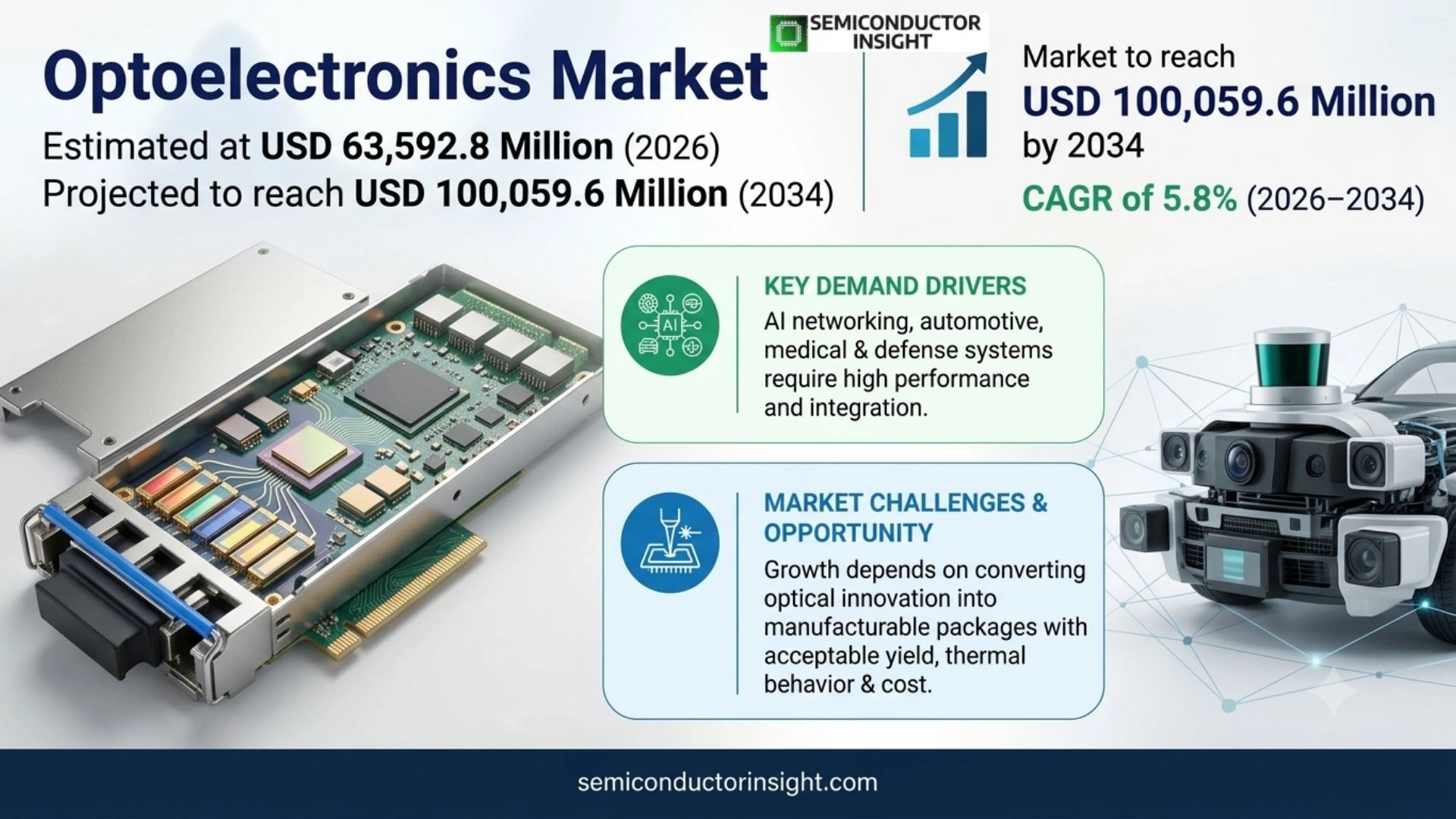
Optoelectronics Market was valued at USD 60,089.9 million in 2025, is estimated at USD 63,592.8 million in 2026, and is projected to reach USD 100,059.6 million by 2034, representing a CAGR of 5.8% during 2026–2034. Asia Pacific is the largest regional market in 2025, while the commercial growth mechanism is increasingly shaped by AI data-center optical links, automotive sensing, precision photodetection, medical imaging, and higher-efficiency lighting.
Optoelectronics covers semiconductor devices and assemblies that convert electrical energy into light, detect light and convert it into electrical signals, or control optical signals within an electronic system. The commercial category spans emitters such as LEDs and laser diodes, detectors such as photodiodes and photomultiplier technologies, optocouplers, sensing components, image-related devices, and integrated optical functions used in communications, vehicles, industrial equipment, healthcare systems, consumer electronics, and defense platforms.
The market is moving away from a simple volume story built around lighting and consumer devices. AI clusters require substantially more optical bandwidth between compute nodes; vehicles are incorporating more cameras, optical sensors and high-brightness displays; medical systems rely on precise light generation and detection; and industrial automation is adopting optical inspection and sensing at greater density. These requirements raise the value of wavelength control, sensitivity, bandwidth, reliability, and package-level integration.
Demand is therefore increasingly split between high-volume devices optimized for cost and tightly qualified components where performance, lifetime, spectral response, radiation tolerance, temperature range, or optical power determines supplier selection. This split supports a broad competitive landscape: scale manufacturers win consumer and lighting programs, specialist detector companies defend scientific and medical niches, and semiconductor vendors with strong networking portfolios capture the growing value associated with data-center optical connectivity.
Segment Analysis: By Type
By type, the market includes optoelectronic oscillators, photodiodes, photomultiplier tubes, photodetectors, optocouplers, and other optoelectronic devices. Photodiodes and broader photodetectors benefit from exceptionally wide deployment across sensing and communications, while optoelectronic oscillators gain strategic importance where low-noise microwave and optical signal generation supports communications, radar, and defense systems.
| Type | Technical role | Market position |
|---|---|---|
| Optoelectronic Oscillator | Combines optical and electronic feedback to generate exceptionally stable microwave or radio-frequency signals. The architecture is valuable where phase noise, timing precision, and frequency stability materially affect system performance, including radar, advanced communications, instrumentation, and defense electronics. | A smaller but technically differentiated segment. Purchasing decisions are qualification intensive, and commercial value is concentrated in applications where conventional oscillators cannot meet noise or stability targets. Integration with photonic components can reduce size and improve repeatability, but manufacturing complexity keeps the segment specialized. |
| Photodiodes | Semiconductor junction devices convert incident light into electrical current and are used from simple ambient-light detection to high-speed optical receivers. Device design varies by wavelength, speed, active area, sensitivity, and noise performance, with silicon, InGaAs and other materials serving different spectral windows. | One of the broadest installed demand pools in optoelectronics. Data communications, industrial sensing, medical equipment, safety systems, encoders, and consumer devices provide diversified volume. Higher-speed and lower-noise devices command stronger pricing than commodity visible-light parts because receiver performance is directly tied to detector characteristics. |
| Photomultiplier Tube | Vacuum-based detectors multiply photoelectrons through a dynode chain to provide extremely high sensitivity for low-light measurements. They remain important where single-photon sensitivity, broad active area, or established instrumentation designs outweigh the size, voltage, and ruggedness advantages of solid-state alternatives. | A mature but defensible specialist segment serving nuclear medicine, scientific instrumentation, analytical equipment, and certain high-energy physics applications. Solid-state photomultipliers continue to take share in compact systems, yet installed equipment, large-area detection requirements, and proven sensitivity sustain replacement and application-specific demand. |
| Photodetector | The broader detector category includes devices engineered for visible, infrared, ultraviolet, or specialized spectral response. Performance is determined by responsivity, noise, bandwidth, detectivity, active area, temperature behavior, and package design, making detector selection application specific rather than interchangeable. | A strategically important growth area because sensing intensity is rising in vehicles, factories, medical systems, defense platforms, and optical networks. Infrared and high-speed detectors carry higher value, while commodity detectors face stronger price competition. Qualification, calibration and package design increasingly differentiate suppliers. |
| Optocouplers | Optocouplers transfer signals across an electrical isolation barrier using an internal light emitter and detector. They protect control electronics from high-voltage domains and are widely used in industrial power supplies, motor drives, inverters, appliances, and automotive electronics where galvanic isolation is required. | Stable, high-volume demand is supported by power-electronics growth and installed industrial systems. Competition is intense in standard parts, while automotive and industrial qualification, high common-mode transient immunity, temperature range, and long operating life support premium positions in safety-critical designs. |
| Others | This category covers additional light-emitting, sensing and integrated optical devices that do not fit the principal groups, including application-specific emitters, specialized optical sensors and hybrid modules. Their technical roles vary substantially, so procurement is driven by the needs of the end system rather than a common specification. | Commercial performance depends on the pace of innovation in emerging applications. Specialized products can scale quickly after a design win, but the addressable market may remain narrow. Suppliers with strong application engineering and packaging capability are better placed to convert laboratory-level photonic performance into repeatable production. |
How are materials changing product economics?
Silicon remains central because it benefits from mature fabrication infrastructure, broad visible and near-infrared use, and attractive cost at volume. Compound semiconductors such as gallium arsenide and gallium nitride become necessary when wavelength, optical power, efficiency, switching speed, or temperature performance exceeds silicon’s practical range. Organic semiconductors and emerging materials add new form factors, but commercialization depends on lifetime, process control, encapsulation, and the ability to integrate them economically with established electronics manufacturing.
Segment Analysis: By Application
By application, demand spans aerospace and defense, medical and biotechnology, industrial systems, consumer electronics, automotive, and other uses. Aerospace and defense carries a particularly high value per device because qualification and performance requirements are stringent, while automotive is one of the fastest-moving areas as optical sensing, lighting, displays, and driver-monitoring functions expand within each vehicle platform.
| Application | Demand characteristics |
|---|---|
| Aerospace and Defense | Surveillance, targeting, electro-optical/infrared imaging, secure communications, navigation, space payloads, night vision and missile warning systems require components that can operate under severe thermal, vibration and radiation conditions. Long qualification cycles limit supplier substitution after design-in, making reliability history, traceability and specialized detector capability more important than unit price. |
| Medical and Biotechnology | Pulse oximetry, imaging, spectroscopy, diagnostics, DNA sequencing, fluorescence detection and minimally invasive surgical systems depend on controlled light sources and precise photodetection. Purchasing favors stable spectral performance, low noise, repeatable calibration and long product availability because equipment platforms often remain in service for many years and must meet medical-device quality requirements. |
| Industrial | Factories use optical encoders, safety light curtains, machine-vision illumination, spectroscopic sensors, optical inspection, flame detection and process-monitoring devices. Automation increases the number of optical sensing points, while harsh environments raise demand for rugged packages and stable performance across temperature, dust, vibration and electrical noise. |
| Consumer Electronics | Smartphones, wearables, displays, appliances and smart-home products consume large volumes of ambient-light sensors, proximity sensors, emitters, optical isolation devices and display-related components. Programs are highly price sensitive and concentrate volume rapidly, so suppliers compete on miniaturization, power consumption, integration, package thickness and the ability to support short product cycles. |
| Automotive | Vehicles increasingly combine camera sensing, driver monitoring, ambient and interior lighting, headlamps, display backlights, optical communication links and advanced driver-assistance sensors. Automotive qualification, lifetime requirements and wide temperature ranges raise entry barriers, while the transition toward software-defined and increasingly automated vehicles expands optical content per platform. |
| Others | Telecommunications infrastructure, scientific instruments, energy systems, environmental monitoring and security applications create specialized demand outside the largest end-use groups. These programs frequently value wavelength accuracy, detector sensitivity, low noise or radiation tolerance more than volume economics, supporting profitable niches for suppliers with application-specific engineering capability. |
Why does AI infrastructure matter to an optoelectronics supplier?
AI clusters move enormous data volumes between accelerators, switches and storage, making electrical interconnect power and reach increasingly difficult at higher lane rates. The transition toward 1.6T optical modules, higher-speed PAM-4 links, co-packaged optics and eventually 400G-per-lane optical interfaces increases demand for lasers, photodiodes, driver electronics, optical engines and precision packaging. This shifts growth toward suppliers that can deliver bandwidth density and lower power per bit rather than simply higher unit volumes.
Regional Analysis
Asia Pacific leads the optoelectronics market because semiconductor fabrication, LED production, display manufacturing, consumer-electronics assembly and automotive electronics are deeply concentrated across the region. North America retains strong positions in high-value networking, defense and sensing technologies, while Europe remains important in automotive, industrial, scientific and photonics research applications.
What makes regional demand structurally different in optoelectronics?
Regional purchasing reflects the industries that specify the component. Asia Pacific buys at manufacturing scale and therefore emphasizes cost, capacity and rapid qualification. North America concentrates more value in networking, defense, data centers and specialist sensing, where performance and intellectual property matter more. Europe is strongly influenced by automotive, industrial automation, photonics research and regulatory requirements. South America remains more import dependent, while Middle East and Africa demand is more project led through telecom, defense, energy and smart-city investment.
| Region | Position | Growth outlook | Demand profile | What decides supplier selection |
|---|---|---|---|---|
| Asia Pacific | Largest | Above market average | Manufacturing and design-in led | Scale, local technical support, automotive and consumer qualification, supply continuity |
| North America | High-value technology market | Steady to strong | AI networking, defense, medical and industrial sensing | Performance, interoperability, export controls, qualification and IP |
| Europe | Established specialist market | Moderate | Automotive, industrial, medical and photonics research | Reliability, functional safety, compliance, energy efficiency and lifecycle support |
| South America | Smaller installed base | Selective growth | Telecom, industrial automation, automotive and medical imports | Landed cost, distributor support, currency exposure and local service |
| Middle East & Africa | Project-driven emerging market | Uneven but positive | Telecom, defense, energy, security and smart-city systems | Project qualification, ruggedization, supply assurance and systems integration |
Competitive Landscape
Competition spans high-volume LED and sensor suppliers, specialist detector manufacturers, networking semiconductor companies, imaging-system vendors, and aerospace contractors. Winning positions are determined less by a single device category than by control of application-specific performance, packaging, qualification and customer design relationships.
Hamamatsu Photonics competes through deep detector and light-source expertise for scientific, medical and industrial applications, where sensitivity, noise performance and long product support are critical. Broadcom and ON Semiconductor participate from a semiconductor platform perspective, combining optical components with connectivity or sensing electronics. Seoul Semiconductor and LG Innotek bring high-volume manufacturing and application strength in displays, lighting, consumer electronics and automotive systems.
Defense-oriented suppliers such as Teledyne FLIR, Lockheed Martin, Northrop Grumman, Thales and Rafael Advanced Defense Systems compete at the system and subsystem level, where electro-optical performance is combined with ruggedization, image processing, targeting and platform integration. These markets have lower unit volumes but much higher qualification barriers and longer program lives, creating a different margin structure from consumer optoelectronics.
The most important competitive shift is the growing value of integration. High-speed optical links require coordinated lasers, photodetectors, modulators, DSPs, drivers, thermal solutions and packaging; automotive modules combine emitters, detectors and signal processing; and medical instruments require calibrated optical engines rather than isolated parts. Suppliers that can solve the system-level problem capture more of the design value and are harder to substitute after qualification.
| Competitive tier | Representative companies | Commercial basis |
|---|---|---|
| Diversified technology leaders | Hamamatsu Photonics, Broadcom, ON Semiconductor, LG Innotek, Seoul Semiconductor | Scale manufacturing, broad portfolios, strong customer engineering, established quality systems and access to high-volume consumer, automotive, industrial or networking programs. |
| Imaging and defense specialists | Teledyne FLIR, Lockheed Martin, Northrop Grumman, Thales, Rafael Advanced Defense Systems | High-value electro-optical systems, defense qualification, rugged imaging, infrared capability, platform integration and long program lifecycles. |
| Specialist and niche photonics suppliers | Oewaves, Resonon, Opto Diode, Excelitas Technologies, Beijing Minguang Technology | Application-specific detectors, hyperspectral imaging, oscillators, emitters and optical subsystems serving technical niches where specialization can outweigh production scale. |
Key Market Participants
Beijing Minguang Technology, LG Innoteck, Hamamatsu Photonics, Oewaves, Teledyne FLIR, ON Semiconductor, Broadcom, Lockheed Martin, Northrop Grumman, Resonon Inc., Opto Diode, Seoul Semiconductor, Thales, Rafael Advanced Defense Systems, Excelitas Technologies.
Production Capacity Analysis
Optoelectronics capacity is not a single fabrication pool. It is distributed across substrate and epitaxy preparation, semiconductor device fabrication, optical packaging and alignment, and final electro-optical test. The commercial bottleneck depends on the product: commodity LEDs are scale intensive, high-speed photonics are packaging intensive, and scientific or defense detectors are often constrained by specialized materials and low-volume process capability.
Emitter and detector performance is established early in the process through material quality and epitaxial control. Compound-semiconductor devices may require GaAs, GaN, InP or other specialized materials, with defect density, layer thickness and composition directly affecting efficiency and wavelength performance. Because these processes are less standardized than mainstream silicon logic, yield learning and supplier know-how can create durable capacity advantages.
Device fabrication converts the epitaxial structure into functional emitters, detectors or optical control elements. This stage requires lithography, etch, implantation, metallization and passivation adapted to the optical material system. Capacity cannot always be shifted quickly between product families because process recipes, contamination rules and device geometries differ, which limits the usefulness of headline wafer-start capacity as a measure of market supply.
Packaging is increasingly the highest-value constraint. Optical devices must be aligned to fibers, lenses or waveguides while controlling temperature, stress and contamination. At higher data rates and tighter form factors, micrometer-scale placement and thermal behavior materially affect yield. Automated optical alignment, wafer-level optics and co-packaged architectures therefore become competitive capabilities rather than routine back-end steps.
| Capacity layer | Where it concentrates | Commercial constraint |
|---|---|---|
| Materials & epitaxy | Japan, Taiwan, South Korea, China, United States and specialist European clusters | Material purity, epitaxial defect control, wavelength consistency and access to gallium, indium and compound-semiconductor substrates. |
| Device fabrication | Asia Pacific dominates volume; North America, Japan and Europe retain specialist lines | Process-specific equipment, yield learning, contamination control and the limited interchangeability of optical semiconductor processes. |
| Optical packaging & alignment | China, Taiwan, South Korea, Southeast Asia, United States and specialist European providers | Precision alignment, thermal management, coupling efficiency, fiber attach, automation and package qualification. |
| Final test & qualification | Close to assembly centers and end-customer engineering hubs | Specialized optical metrology, burn-in, environmental qualification and application-specific calibration can limit throughput for premium products. |
Market Dynamics
The market is being pulled in two directions: volume applications continue to demand lower cost per optical function, while AI networking, automotive, medical and defense systems require more performance and integration per component. Growth therefore depends on converting optical innovation into manufacturable packages with acceptable yield, thermal behavior and qualification cost.
Market Drivers
| Factor | Directional impact | Why it matters |
|---|---|---|
| AI and high-speed optical connectivity | High | Higher accelerator density raises east-west data traffic and increases the need for faster optical links, supporting lasers, detectors, optical DSP interfaces and advanced packaging. |
| Automotive sensing and lighting | High | ADAS, driver monitoring, camera systems, displays and adaptive lighting increase optical content per vehicle and favor long-lived qualified components. |
| Industrial and medical sensing | Medium-High | Automation, diagnostics and imaging use more precise optical measurement, supporting detectors and emitters with strong noise, stability and wavelength specifications. |
| Energy-efficient solid-state lighting | Medium | LED replacement and connected lighting sustain large-volume emitter demand even as mature categories experience price pressure and slower unit growth. |
AI infrastructure raises optical bandwidth density
Electrical interconnects become less attractive as lane speed, distance and rack-scale traffic increase. AI data centers therefore shift more links to optics, and each generation requires higher modulation speed, tighter optical budgets and lower power per transmitted bit. This creates demand not only for transceiver modules but also for lasers, photodiodes, optical drivers, modulators, coupling structures and precision package assembly.
Vehicles add more qualified optical functions
Automotive electronics are adding sensing and display functions faster than many other end markets. Cameras, driver monitoring, interior sensing, Mini LED displays, headlamps and emerging LiDAR architectures require optical components that can survive temperature cycling, vibration and long operating lives. Once a component is qualified into a vehicle platform, the design can generate multi-year demand with relatively high switching costs.
Medical and industrial systems reward detector performance
Medical diagnostics and industrial automation increasingly depend on optical measurement because it is non-contact, fast and compatible with spectroscopy, imaging and machine vision. These systems often value signal-to-noise ratio, wavelength stability and calibration consistency more than component price. Suppliers with strong detector physics and application engineering can therefore defend margins in niches that are small compared with consumer electronics but technically demanding.
Efficiency and controls sustain LED deployment
Solid-state lighting is already mature in many countries, yet efficiency regulation, commercial retrofits and connected controls continue to create replacement demand. The opportunity increasingly moves from the LED die alone toward integrated light engines, sensors and controls that adjust illumination to occupancy, daylight and application conditions, supporting optoelectronic content even where basic lamp volumes grow slowly.
Market Restraints
| Factor | Directional impact | Why it matters |
|---|---|---|
| Compound-semiconductor yield complexity | High | Epitaxy and fabrication defects can reduce optical efficiency and create wide device variation, limiting rapid scale-up for advanced materials. |
| Thermal management at higher power density | Medium-High | Lasers, high-brightness LEDs and dense optical engines generate heat that can degrade lifetime, wavelength stability and output performance. |
| Specialized materials and geopolitical exposure | Medium | Gallium, indium and other inputs have concentrated supply chains, exposing manufacturers to price, trade and availability risk. |
| Precision packaging and test cost | Medium-High | Optical alignment, coupling and calibration add capital intensity and can become the dominant yield constraint as integration density rises. |
Yield learning limits immediate capacity response
Unlike standardized digital logic, advanced optoelectronic devices often depend on material systems with narrower process windows and more device-to-device variation. Increasing wafer starts does not automatically create usable output if epitaxial defects, wavelength variation or optical efficiency remain unstable. New entrants therefore face long process-development cycles before they can compete with established suppliers on both performance and cost.
Heat constrains optical power and lifetime
Higher optical output and denser packaging concentrate heat near active junctions. Temperature shifts emission characteristics, accelerates degradation and can reduce receiver sensitivity or laser reliability.System designers must add thermal paths, control circuitry and conservative operating margins, which raises package cost and can limit how aggressively a device can be miniaturized.
Material concentration creates supply risk
Several optoelectronic technologies depend on gallium, indium and other specialized inputs whose refining and substrate supply are geographically concentrated. Trade restrictions or shortages can affect lead times even when device demand is healthy. Manufacturers respond through longer-term procurement, recycling, alternative material systems and geographic diversification, but each mitigation adds qualification effort.
Optical assembly remains harder to automate
A digital IC package can tolerate placement error that would severely reduce coupling efficiency in an optical package. Fiber attach, lens alignment, waveguide coupling and calibration therefore require tighter control and specialized equipment. At high data rates, electrical signal integrity must also be managed beside the optical path, making advanced packaging a multidisciplinary bottleneck.
Market Opportunities
1.6T and 3.2T data-center optics
AI networks are moving toward higher aggregate transceiver speeds and higher lane rates. Suppliers that reduce power per bit while improving laser efficiency, detector bandwidth and optical coupling can capture disproportionate value because network architecture is increasingly constrained by power and thermal budgets rather than raw switching capacity alone.
Automotive optical sensing and displays
The number of optical functions per vehicle continues to rise through cameras, driver monitoring, ambient lighting, high-resolution displays and advanced sensing. Automotive qualification creates a defensible revenue pool for suppliers that can combine consumer-scale manufacturing economics with long lifetime, wide temperature range and stable optical performance.
Biophotonics and point-of-care diagnostics
Portable diagnostics, spectroscopy, wearable health monitoring and minimally invasive medical systems require compact light sources and sensitive detectors. Integration can reduce instrument size and power consumption while preserving measurement quality, opening opportunities for specialized emitters, photodiodes and optical modules designed jointly with medical-system manufacturers.
Integrated photonics and quantum systems
Photonic integrated circuits combine multiple optical functions on a smaller footprint and can improve reliability by reducing discrete interconnects. Quantum communications and sensing add demand for single-photon detection, stable lasers and specialized optical control. Commercial volumes remain smaller than mainstream electronics, but performance requirements support high value per component.
Supply Chain Analysis
Materials & Epitaxy. Value capture begins with control of optical material quality. Substrate defects and epitaxial uniformity can determine wavelength, efficiency and lifetime before later manufacturing steps begin. Suppliers with stable compound-semiconductor processes can therefore support premium products and reduce downstream screening costs, while material concentration creates procurement and geopolitical risk.
Device Fabrication. Fabrication economics depend on achieving repeatable electro-optical performance across the wafer. High-volume LED and sensor lines emphasize cost per good die, while specialist infrared and scientific detectors prioritize performance and traceability. The inability to freely substitute one fab process for another makes qualified capacity more valuable than nominal capacity.
Packaging & Integration. Packaging converts a good optical die into a system-ready component. Alignment tolerances, thermal expansion, contamination, fiber attach and electrical parasitics all influence final performance. As bandwidth and integration increase, packaging captures more engineering value and can become the primary determinant of yield, lead time and supplier differentiation.
Test & Distribution. Final optical test measures output power, spectral characteristics, responsivity, noise, bandwidth and reliability under application conditions. Distributors remain important for standard devices, but automotive, medical, defense and data-center programs are increasingly supported through direct engineering relationships because qualification data and system integration matter as much as availability.
Recent Developments in the Optoelectronics Market
Developments tracked to September 2026. Entries are dated to the official publication date where available.
- 11 March 2026 Product
Broadcom introduced its Taurus BCM83640 400G-per-lane optical PAM-4 DSP for 1.6T transceivers, using a 3 nm architecture and positioning the technology as a foundation for future 3.2T optical connectivity. The launch illustrates how AI networks are raising the bandwidth and power-efficiency requirements imposed on the complete optical link. Source - 22 July 2026 Results
Teledyne reported strong organic growth in Digital Imaging, highlighting increased demand for infrared detectors and systems used in space, airborne, marine unmanned and counter-unmanned applications. The performance reinforces the role of defense and space as high-value markets for advanced electro-optical sensing rather than purely volume-driven component demand. Source - 2 July 2025 Automotive
Seoul Semiconductor announced global automotive supply of WICOP Mini LED technology, extending its no-wire LED architecture into vehicle displays. The development shows how automotive interiors are becoming a meaningful outlet for high-brightness, thin-package optoelectronics that must also meet durability and long-lifecycle requirements. Source - 3 June 2025 Industry data
WSTS projected a mixed 2025 environment for semiconductor product categories, with optoelectronics weaker than the fastest-growing logic and memory segments. The divergence is commercially important because AI-related optical-networking opportunities coexist with slower mature demand pools such as conventional lighting and consumer optoelectronics. Source - 29 November 2024 Infrastructure
The UAE allocated 600 MHz and 6 GHz bands for International Mobile Telecommunications, with operation expected during 2025–2026. Denser mobile infrastructure and future 6G preparation increase the long-term requirement for optical backhaul, data-center interconnects and photonic components that connect radio sites to high-capacity networks. Source
Report Scope & Segmentation
| Attribute | Coverage |
|---|---|
| Report title | Optoelectronics Market, Emerging Trends, Technological Advancements, and Business Strategies 2025-2032 |
| Base / estimate / forecast | 2025 base year; 2026 estimated year; 2034 forecast end year; CAGR measured for 2026–2034. |
| By Type | Optoelectronic Oscillator; Photodiodes; Photomultiplier Tube; Photodetector; Optocouplers; Others |
| By Application | Aerospace and Defense; Medical and Biotechnology; Industrial; Consumer Electronics; Automotive; Others |
| By Material | Silicon-based; Gallium Nitride; Gallium Arsenide; Organic Semiconductors; Others |
| By End User | Industrial; Commercial; Residential; Government and Defense; Healthcare |
| Regions | North America, Europe, Asia-Pacific, South America, and Middle East & Africa, with country-level analysis across the principal national markets. |
| Companies | Beijing Minguang Technology, LG Innoteck, Hamamatsu Photonics, Oewaves, Teledyne FLIR, ON Semiconductor, Broadcom, Lockheed Martin, Northrop Grumman, Resonon Inc., Opto Diode, Seoul Semiconductor, Thales, Rafael Advanced Defense Systems, Excelitas Technologies |
| Customization Scope | Free report customization (equivalent to up to 4 analyst working days) with purchase. Addition or alteration to country, regional and segment scope. |
Frequently Asked Questions
What is the size of the optoelectronics market?
The global optoelectronics market is valued at approximately USD 60,089.9 million in 2025, is estimated at USD 63,592.8 million in 2026, and is projected to reach about USD 100,059.6 million by 2034, representing a 5.8% CAGR during 2026–2034. Growth is increasingly supported by high-speed optical connectivity, automotive sensing, medical imaging and industrial photodetection.
Which region leads the optoelectronics market?
Asia Pacific is the largest regional market because it combines high-volume electronics assembly with major LED, display, semiconductor, sensor and optical-component manufacturing clusters. China supplies scale, Japan contributes precision detector and imaging capability, South Korea is strong in displays and lighting, and Taiwan provides semiconductor and packaging infrastructure that supports regional design-to-volume execution.
What are the main types of optoelectronic devices in this market?
The market is segmented into optoelectronic oscillators, photodiodes, photomultiplier tubes, photodetectors, optocouplers and other devices. Their economics differ substantially: photodiodes and optocouplers serve broad volume applications, photomultiplier tubes defend specialized scientific niches, and optoelectronic oscillators target high-performance communications and defense systems where signal stability justifies higher value.
Which application is most important for optoelectronics?
Aerospace and defense is a high-value leading application because surveillance, targeting, night vision, secure communications and space systems require qualified electro-optical components. Automotive demand is also expanding rapidly as vehicles add cameras, driver monitoring, advanced displays, lighting and optical sensing, creating longer-lifecycle opportunities for suppliers that can meet stringent reliability and temperature specifications.
Why is AI infrastructure increasing optoelectronics demand?
AI clusters generate extremely high east-west data traffic between accelerators and switches. As lane speeds and distances rise, optical links become necessary to control signal loss and power consumption. The shift toward 1.6T and future 3.2T connectivity supports demand for lasers, photodiodes, optical engines, DSP interfaces, coupling structures and precision packaging designed to reduce power per transmitted bit.
What materials are used in optoelectronic devices?
The market includes silicon-based, gallium nitride, gallium arsenide, organic semiconductor and other material systems. Silicon benefits from mature manufacturing and attractive cost, while compound semiconductors are selected when wavelength, optical power, efficiency or high-frequency performance exceed silicon’s practical range. Material choice therefore follows the optical requirement rather than a single industry-wide cost curve.
What is the biggest manufacturing challenge in optoelectronics?
Manufacturing must control both semiconductor yield and optical alignment. Compound-semiconductor epitaxy can introduce wavelength and efficiency variation, while packaging requires precise coupling to fibers, lenses or waveguides. Thermal behavior further affects output and lifetime. These constraints mean additional wafer capacity does not automatically translate into usable supply unless yield, alignment and electro-optical test also scale.
How is automotive demand changing the competitive landscape?
Automotive programs reward suppliers that combine scale with qualification discipline. Components must survive wide temperature ranges, vibration and long service lives while meeting strict optical performance. Once designed into a vehicle platform, a supplier can benefit from multi-year production and high switching costs, encouraging LED, sensor, imaging and module companies to invest more heavily in automotive-specific products and quality systems.
Who are the major companies in the optoelectronics market?
The competitive landscape includes Hamamatsu Photonics, LG Innotek, Teledyne FLIR, ON Semiconductor, Broadcom, Seoul Semiconductor, Lockheed Martin, Northrop Grumman, Thales, Rafael Advanced Defense Systems, Excelitas Technologies, Oewaves, Resonon and Opto Diode. Their positions differ by application, ranging from high-volume components and networking semiconductors to specialist detectors and defense electro-optical systems.
Where are the strongest future opportunities in optoelectronics?
The strongest opportunities are concentrated in high-speed AI data-center optics, automotive sensing and displays, biophotonics, integrated photonics and quantum technologies. These areas reward improved optical efficiency, sensitivity, bandwidth and package-level integration. Suppliers that can turn device performance into reliable system-ready modules are positioned to capture more value than vendors competing only on discrete component price.
Research Sources & Evidence Base
Get Sample Report PDF for Exclusive Insights
Report Sample Includes
- Table of Contents
- List of Tables & Figures
- Charts, Research Methodology, and more...