Key Statistics
Key Takeaways
- Electrical co-packaged optics is the leading type in the source segmentation because it offers a transitional path from established switch-ASIC and driver architectures toward optical I/O without requiring every part of the photonic stack to be redesigned at once.
- Data center interconnect is the largest application as AI clusters push switch bandwidth beyond the practical reach of long electrical traces; CPO shortens electrical paths, reduces retiming requirements and moves optical conversion closer to the switching silicon.
- North America leads current commercialization through hyperscale AI infrastructure, switch-ASIC vendors and system developers, while Asia Pacific is the fastest-growing production ecosystem because advanced packaging, photonics assembly and server manufacturing are concentrated across Taiwan, China, Japan and South Korea.
- 102.4 Tb/s switching has moved CPO from demonstration toward deployment: Broadcom shipped Tomahawk 6 with CPO support in June 2025 and later shipped a third-generation 102.4 Tb/s CPO switch, while NVIDIA announced its Spectrum-X photonics family and moved it into production in 2026.
- Standardization and serviceability remain the structural gates. OIF’s co-packaging agreements define interoperable module concepts, but customers still evaluate laser placement, fiber attach, thermal design, field replacement and the operational consequences of integrating optics with expensive switch silicon.
Co-Packaged Optics (CPO) Market Overview
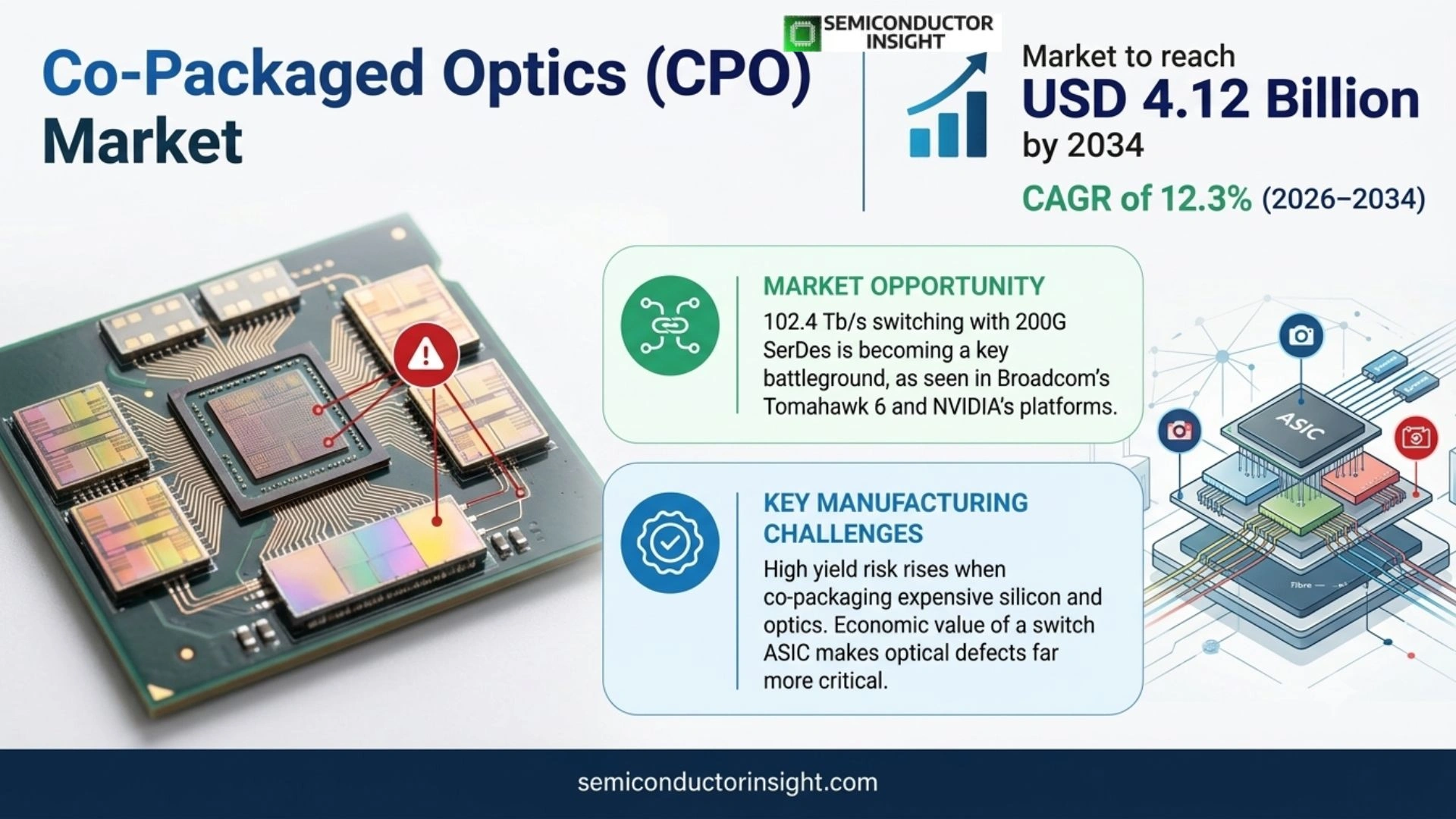
Co-packaged optics market is valued at USD 1.45 billion in 2025, rises to an estimated USD 1.63 billion in 2026, and is projected to reach USD 4.12 billion by 2034. The two published size anchors imply a 12.3% CAGR during 2026–2034. North America is treated as the largest 2025 market because the source page’s FAQ identifies it as dominant and current commercialization is concentrated around U.S.-headquartered AI-networking and switching platforms, while Asia Pacific is the fastest-growing manufacturing and deployment ecosystem.
Co-packaged optics changes the location of the optical-electrical boundary inside a network switch. Instead of sending extremely high-speed electrical signals across a printed-circuit board to pluggable transceivers at the front panel, optical engines are placed close to the switch ASIC. The shorter electrical reach reduces insertion loss, lowers the need for power-hungry retimers and makes higher aggregate bandwidth practical as SerDes speeds move from 100G toward 200G per lane.
The commercial logic is strongest in AI scale-out and scale-up networks where bandwidth grows faster than acceptable power per bit. Broadcom’s 102.4 Tb/s Tomahawk 6 supports 100G and 200G SerDes and CPO, while NVIDIA’s photonics switches use 200G SerDes and integrate optics with switching silicon. These platforms show that CPO is becoming a system-level architecture rather than an isolated optical component category, drawing in switch vendors, photonics suppliers, laser makers, packaging firms and server manufacturers.
Deployment decisions still involve a trade-off between efficiency and field serviceability. A pluggable optical module can be replaced independently of the switch ASIC, whereas co-packaging brings high-value electronic and optical functions into a tighter assembly. External-laser architectures, removable fiber interfaces, modular optical engines and standardized co-packaged modules therefore matter commercially because they determine whether the power savings of CPO can be achieved without creating unacceptable maintenance and yield risk.
Segment Analysis: By Type
By type, the source page segments the market into Electrical Co-Packaged Optics and Photonic Integrated Co-Packaged Optics. Electrical CPO currently provides the more accessible migration route because vendors can pair established switch ASICs and electrical drivers with nearby optical engines, while deeper photonic integration offers greater long-term density and efficiency but requires more demanding packaging, thermal and manufacturing control.
| Type | Technical / commercial role | Market position |
|---|---|---|
| Electrical Co-Packaged Optics | This architecture moves optical engines close to the switch or compute ASIC while retaining a clear division between electronic switching silicon and photonic functions. The design can reuse proven electrical-driver ecosystems, standardized host interfaces and external lasers, reducing the redesign burden for system vendors while still shortening lossy high-speed board traces and reducing retimer power. | Leading transitional segment. It is attractive for first commercial deployments because it balances efficiency gains with manufacturing familiarity. Vendors can scale bandwidth using known switch silicon and optical-engine building blocks while gradually improving fiber attach, laser delivery and thermal design, which lowers adoption risk compared with fully integrated photonic architectures. |
| Photonic Integrated Co-Packaged Optics | Photonic integrated CPO places more optical functionality into tightly integrated photonic circuits co-located with switching or accelerator silicon. This architecture can reduce electrical reach further and improve bandwidth density, but it introduces stronger dependencies among photonic yield, ASIC packaging, thermal behavior, optical coupling and test. Heterogeneous integration and wafer-level processes become central technical capabilities. | Strategic high-performance segment. Its value increases as 200G SerDes and multi-terabit optical engines make board-level electrical transport less attractive. Growth depends on the maturity of silicon photonics, external-laser ecosystems, advanced packaging and repair strategies that prevent one optical defect from compromising a very expensive switch or compute package. |
Why does CPO adoption accelerate as SerDes speed rises?
Electrical loss rises sharply as lane speeds increase and board traces become longer, so the system must spend more power on equalization, retiming and signal conditioning. CPO attacks that problem by moving optical conversion within centimeters or millimeters of the ASIC. The benefit becomes more valuable at 200G SerDes and beyond because every avoided retimer and shortened copper path reduces power, thermal load and signal-integrity margin consumed by the network.
Segment Analysis: By Application
By application, the source page segments demand into Data Center Interconnect, Telecom Transport, High-Performance Computing, and Others. Data center interconnect dominates because AI clusters and hyperscale cloud fabrics are already moving toward 800G and 1.6T links, where switch-level power and port density become binding design constraints. High-performance computing is closely related, while telecom adoption is more selective because carrier systems prioritize long lifecycle, standards and serviceability.
| Application | Demand characteristics |
|---|---|
| Data Center Interconnect | The purchasing trigger is the need to move more data among GPUs, accelerators and servers without allowing network power to consume an increasing share of rack and facility budgets. CPO allows high-radix switches to expose optical connectivity with shorter electrical paths, enabling denser 800G and 1.6T fabrics. Hyperscalers value energy efficiency, reduced retimer count, link stability and the ability to scale AI clusters beyond the reach of conventional board-level electrical signaling. |
| Telecom Transport | Carrier networks value optical density and power reduction but demand long field lifetimes, standards compatibility and straightforward maintenance. CPO can support metro, edge and transport systems where front-panel density and high-speed interfaces become restrictive, yet the service model is less forgiving than inside a hyperscale data center. Adoption therefore depends on standardized optical interfaces, laser architectures and operational processes that allow failures to be isolated without replacing an entire switching system. |
| High-Performance Computing | Scientific computing and AI training clusters require low-latency, high-bandwidth interconnects across dense accelerator topologies. CPO can reduce electrical distance and retiming while enabling many optical lanes directly from the switch package. The market opportunity is strongest where workload completion time has high economic value, because lower network power and improved reliability translate into more usable compute hours and better utilization of expensive GPUs or custom accelerators. |
| Others | Edge computing, specialized networking, research systems and future scale-up interconnects create smaller but strategically important demand. These applications can adopt CPO where space, power or electromagnetic constraints make front-panel pluggables difficult. Volumes are lower and architectures are less standardized, so suppliers must provide flexible packaging, fiber routing and laser options rather than rely solely on hyperscale switch designs. |
Regional Analysis
North America is the leading commercial market because the most visible CPO switch programs and AI-networking deployments are driven by U.S.-headquartered semiconductor and system companies, while Asia Pacific is the fastest-growing manufacturing and deployment region due to advanced packaging, photonics assembly and server-system production. Europe contributes standards, photonics research and telecom demand, while other regions remain primarily downstream deployment markets.
How do regional roles differ across the CPO ecosystem?
The CPO value chain is geographically split between architecture ownership, component technology and manufacturing. North America concentrates switch silicon, AI platforms and hyperscale demand. Asia Pacific concentrates semiconductor packaging, server assembly and a growing photonics manufacturing base. Europe contributes optical-system engineering, standards participation and advanced photonics research. South America and Middle East & Africa are mainly deployment markets, so their adoption follows data-center investment rather than local component manufacturing.
| Region | Position | Growth outlook | Demand profile | What decides supplier selection |
|---|---|---|---|---|
| North America | Largest | High | AI infrastructure and switch-platform led | System qualification, power efficiency, serviceability and supply assurance |
| Asia Pacific | Fastest growing | Highest | Manufacturing, packaging and hyperscale expansion | Advanced packaging scale, photonics yield, cost and local ecosystem |
| Europe | Technology-focused | Moderate to high | Photonics R&D, telecom and standards-led | Interoperability, reliability, sustainability and carrier lifecycle |
| South America | Emerging | Moderate from small base | Cloud and data-center deployment-led | System availability, vendor support and total operating cost |
| Middle East & Africa | Emerging | High in selected hubs | AI data-center and sovereign-cloud led | Deployment support, power efficiency and proven system platforms |
Competitive Landscape
Competition is organized around ecosystems rather than a single component. Switch-ASIC companies, networking-system vendors, silicon-photonics specialists, laser suppliers and advanced-packaging partners must cooperate because no vendor can supply every layer of a reliable CPO platform alone. The source page profiles Intel, Broadcom, Cisco, Lumentum, II-VI, Ciena, Juniper Networks, ADVA, Fujitsu, Nokia, Huawei, Marvell, Inphi and Mellanox/NVIDIA.
Broadcom is a central merchant-silicon competitor because its CPO roadmap is attached directly to high-radix Ethernet switching. The company shipped Tomahawk 6 at 102.4 Tb/s with CPO support and later announced a third-generation CPO version using 200G SerDes. NVIDIA approaches the market as an integrated AI-infrastructure platform, combining switching, photonics, software and system qualification. This creates a competitive model in which optical architecture influences the economics of the entire AI factory.
Networking-system suppliers such as Cisco, Ciena, Juniper, Nokia, Fujitsu and ADVA bring carrier and enterprise relationships, while optical component suppliers such as Lumentum and Coherent contribute lasers, optical engines and packaging expertise. Marvell brings high-speed interconnect silicon and the former Inphi portfolio. The commercial position of each company depends on where it can control interface definitions and guarantee multi-year supply rather than simply on whether it can demonstrate an optical engine.
Manufacturing yield is a powerful competitive separator. Integrating optics next to an expensive switch ASIC raises the economic cost of defects, so known-good-die strategies, wafer-level testing, fiber attach, laser reliability and thermal management all affect gross margin. Companies that can modularize the optical portion, use external lasers and isolate replaceable elements can offer customers a more credible operating model and may accelerate adoption even when their nominal optical performance is similar to competitors.
| Competitive tier | Companies | Why they matter |
|---|---|---|
| Switch and platform leaders | Broadcom; NVIDIA/Mellanox; Intel; Cisco | These companies can define switch architectures, SerDes roadmaps and system interfaces, which gives them disproportionate influence over how CPO is implemented. Their advantage is the ability to connect optical integration directly to AI or network-platform economics, customer qualification and software support rather than selling a stand-alone photonic component. |
| Optical technology suppliers | Lumentum; II-VI/Coherent; Marvell/Inphi | These suppliers provide lasers, optical components, photonic integration and high-speed interconnect silicon that are critical to the CPO bill of materials. Their opportunity grows as optical engines become more standardized, but they must meet stringent yield, coupling, thermal and reliability requirements because CPO defects can affect entire switch assemblies. |
| Network-system vendors | Ciena; Juniper Networks; ADVA; Fujitsu; Nokia; Huawei | These companies can introduce CPO through carrier, metro and enterprise systems where operational reliability and service processes determine adoption. They are important demand aggregators even when they do not manufacture every optical component themselves, because their system specifications shape interoperability, module form factors and supplier qualification. |
Companies profiled in the report
The source page profiles Intel, Broadcom, Cisco, Lumentum, II-VI Incorporated, Ciena, Juniper Networks, ADVA Optical Networking, Fujitsu, Nokia, Huawei, Marvell Technology, Inphi as part of Marvell, and Mellanox as part of NVIDIA. Acacia Communications is also discussed within Cisco’s optical portfolio. The report scope retains the named companies while the competitive analysis distinguishes switch-platform control, optical component supply and network-system integration.
Production Capacity Analysis
CPO production capacity is constrained by integration capability rather than any single wafer-fab metric. A commercial system requires advanced switch ASICs, silicon-photonic dies or optical engines, lasers, fiber attach, high-density packaging, thermal management and extensive optical-electrical test. Capacity therefore sits across multiple specialized supply chains, and the limiting step can shift from ASIC availability to optical-engine yield, packaging throughput or qualified laser supply as volumes ramp.
Advanced packaging is central because the electrical and optical elements must be placed close enough to deliver the signal-integrity benefit without compromising cooling or assembly yield. The package must route high-speed electrical lanes, optical fibers, control interfaces and power while protecting delicate photonic structures. Production economics improve when optical engines can be tested before final assembly and when failed optical components can be isolated from the high-value switch ASIC.
Laser architecture affects both capacity and field reliability. Many CPO designs use external lasers so heat and service risk are separated from the switch package. OIF’s external-laser small-form-factor pluggable work and co-packaging implementation agreements illustrate the industry effort to create reusable interfaces. Standardized laser and optical-module concepts can broaden the supplier base, simplify second sourcing and prevent every platform from requiring a proprietary manufacturing flow.
System qualification remains a practical capacity bottleneck. Hyperscale operators need long-duration optical reliability, fiber-connector robustness, stable thermal performance and network-management visibility before they deploy CPO at scale. NVIDIA’s move from announcement in March 2025 to production in 2026 demonstrates that commercialization requires coordinated supply across photonics, packaging and system manufacturing rather than only successful silicon development.
Market Dynamics
CPO growth is driven by the physics and economics of AI networking: electrical reach becomes more expensive as lane rates and switch bandwidth rise, while power per bit must fall. The market is restrained by packaging yield, optical serviceability and standards maturity. Commercial success therefore depends on balancing bandwidth density and energy efficiency against the operational simplicity that made pluggable transceivers attractive for decades.
Market Drivers
| Driver | Directional impact* | Commercial mechanism |
|---|---|---|
| AI network bandwidth | High | AI clusters require rapidly increasing east-west traffic among accelerators. Moving optics next to the switch ASIC shortens electrical paths and allows higher-radix switching without a proportional increase in retimer power, making CPO increasingly attractive as 800G and 1.6T links proliferate. |
| 200G SerDes transition | High | At 200G per electrical lane, board loss and equalization become more difficult. CPO reduces the distance those signals must travel electrically, allowing system designers to spend less power and margin on retimers and long printed-circuit-board traces. |
| Power and cooling constraints | High | Data centers increasingly treat network power as a facility-level constraint. CPO removes or reduces DSP retiming and can lower network energy per bit, which converts directly into more power available for GPUs and lower cooling demand. |
| Platform commercialization | Medium to High | Broadcom and NVIDIA have moved high-bandwidth CPO switches into shipping or production roadmaps. Commercial products reduce technology uncertainty and allow hyperscalers to evaluate lifecycle cost, reliability and service procedures with deployable systems rather than lab prototypes. |
AI factories require optical bandwidth closer to the ASIC
Large GPU clusters create network traffic patterns that push switch bandwidth and radix upward faster than traditional front-panel architectures can comfortably support. CPO shortens the highest-speed electrical path and converts data to optics close to the switch silicon. The commercial consequence is not only higher bandwidth: operators can preserve scarce facility power for compute and reduce the number of active retiming components that can fail inside the network.
The 200G SerDes generation changes the electrical-loss budget
Broadcom and NVIDIA are building new CPO products around 200G SerDes, demonstrating that higher lane rates are a direct technology trigger. At these speeds, long copper traces require more equalization and often additional retimers. Placing optical engines next to the ASIC changes the interconnect budget, allowing designers to trade complex board-level signal conditioning for photonic packaging and fiber routing.
Energy efficiency has become an AI infrastructure purchasing criterion
Hyperscale AI operators evaluate networking by power per delivered bit and by the effect of network downtime on expensive accelerators. NVIDIA states that its CPO architecture can materially improve power efficiency and resiliency compared with traditional pluggable designs. Even when vendor claims differ by system boundary, the direction is commercially important because a small percentage of network-energy savings can translate into megawatts at large AI campuses.
Standards reduce ecosystem risk
OIF’s 3.2T co-packaged module agreement and external-laser work create common reference points for optical engines, lasers and packaging interfaces. CPO will scale faster if switch vendors can qualify multiple component suppliers and if customers are not locked into one proprietary service model. Standardization therefore turns technical interoperability into a commercial driver by broadening supply and improving lifecycle confidence.
Market Restraints
| Restraint | Directional impact* | Commercial mechanism |
|---|---|---|
| Packaging and yield complexity | High | A defect in optics, fiber attach or packaging can compromise a high-value switch assembly. Suppliers need known-good-die testing, modular optical engines and robust assembly processes to prevent CPO economics from being undermined by yield loss. |
| Serviceability concerns | High | Pluggable optics can be replaced independently in the field. CPO integrates optics more tightly with the switch, so customers need credible strategies for external lasers, replaceable fiber interfaces, fault isolation and maintenance before large-scale adoption. |
| Standards fragmentation | Medium | Interfaces for optical engines, external lasers, management and service are still evolving. Proprietary designs can accelerate early products but may increase customer lock-in and second-source risk, slowing broad ecosystem adoption. |
| Thermal management | Medium to High | Switch ASICs dissipate substantial heat while lasers and photonics have their own temperature sensitivities. Co-locating these elements requires careful package and cooling design, especially in liquid-cooled AI systems. |
Yield risk rises when expensive silicon and optics share a package
The economic value of a 102.4 Tb/s switch ASIC is much higher than that of an individual pluggable transceiver. If optical defects are discovered only after final assembly, one failure can affect a far more expensive system. CPO manufacturing therefore depends on known-good photonic dies, high-coverage optical test and modularity. Until these processes reach mature yields, the cost advantage from lower power can be offset by manufacturing scrap and complex rework.
Field replacement is less intuitive than with front-panel pluggables
Data-center operators are accustomed to diagnosing and replacing individual optical transceivers without disturbing the switch. CPO changes that maintenance boundary. External lasers and replaceable fiber assemblies can reduce risk, but customers still need clear procedures for isolating optical-engine failures. If a fault forces replacement of an entire high-value switch, lifecycle cost and spare-parts requirements could slow adoption despite attractive energy efficiency.
Thermal design couples optical and electronic reliability
High-radix switch ASICs produce significant heat, while optical engines and lasers can be sensitive to temperature. Integrating the technologies in a confined package makes cooling architecture a first-order design problem. Liquid cooling can help in AI systems, but it also changes rack infrastructure and maintenance. Vendors must prove that temperature cycling and long-term optical alignment remain stable under realistic workload conditions.
Interoperability is still developing
Early CPO platforms can use proprietary optical engines, fiber interfaces and management approaches. This allows rapid optimization but creates second-source and vendor-lock-in concerns for hyperscalers that expect long equipment lifecycles. OIF standards reduce this risk, yet the market still needs broader adoption of common interfaces before customers can treat CPO components with the supply flexibility associated with mature pluggable ecosystems.
Market Opportunities
102.4 Tb/s and 200G SerDes switching
Broadcom’s Tomahawk 6 generation and NVIDIA’s photonics platforms show that the 102.4 Tb/s class is becoming a commercial battleground. Suppliers of optical engines, lasers, fiber attach and packaging can build products around a known bandwidth target instead of speculative future requirements. The opportunity is strongest for vendors that can demonstrate low power per bit, stable 200G-lane operation and a service model acceptable to hyperscale operators.
AI scale-up and scale-across fabrics
CPO is not limited to traditional Ethernet leaf-spine networking. AI systems increasingly need scale-up and scale-across connections among accelerators, racks and data centers. These topologies create new opportunities for tightly integrated photonics because electrical reach is short but bandwidth density is extreme. Vendors that can adapt CPO technology across Ethernet, InfiniBand and proprietary accelerator fabrics can address a larger share of AI interconnect spending.
External laser and standardized optical-engine ecosystems
Separating lasers from the co-packaged switch can improve thermal management and field serviceability. OIF’s external-laser and co-packaged module standards create room for specialist suppliers to offer interoperable components rather than complete switches. A mature ecosystem could allow hyperscalers to second-source lasers, fibers and optical engines, reducing platform risk and expanding the addressable market for component companies.
Manufacturing partnerships in Asia Pacific
CPO requires advanced packaging, precision optics, fiber connectivity and server-system integration, capabilities that are already concentrated in Asia Pacific. Partnerships among U.S. switch vendors and Asian foundry, packaging and system manufacturers can accelerate volume scaling. Suppliers that establish qualified manufacturing flows in Taiwan, Japan, South Korea and China can participate in growth even if switch architecture remains controlled by North American platform companies.
Supply Chain Analysis
Switch ASIC and SerDes silicon
Photonic engines and lasers
Advanced packaging and fiber attach
System integration and hyperscale deployment
Switch ASIC and SerDes silicon
The value chain begins with high-radix Ethernet, InfiniBand or proprietary switching silicon. SerDes speed determines how difficult board-level electrical signaling becomes and therefore how strong the CPO incentive is. ASIC suppliers control package interfaces, lane count, thermal design and software, making them the architectural anchor around which optical engines and lasers must be qualified.
Photonic engines and lasers
Silicon-photonic or other optical engines convert electrical lanes into optical signals close to the switch ASIC. Lasers may be integrated or external, and component suppliers must deliver stable wavelength, coupling efficiency, low optical loss and long reliability. This stage captures growing value because photonic yield and laser serviceability directly influence whether CPO can outperform pluggable architectures economically.
Advanced packaging and fiber attach
Optical engines, ASICs, fibers, connectors and thermal structures must be assembled with micron-scale control and high electrical integrity. Packaging houses and photonics specialists create value by testing known-good components, managing warpage and heat, and attaching fibers at volume. Yield at this stage can determine the profitability of the entire CPO product, especially when the central switch ASIC is expensive.
System integration and hyperscale deployment
Switch vendors and data-center operators validate complete systems for network performance, fault handling, software management, cooling and service procedures. This stage determines real market adoption because laboratory optical efficiency has little value if operations teams cannot deploy and maintain the network. The largest customers can influence standards and supplier selection by demanding dual sourcing, modular repair and long-term support.
Recent Developments
Recent developments show a rapid transition from CPO concept validation to commercial AI-networking platforms. The most important signals are shipping 102.4 Tb/s switch silicon, production of integrated photonics switches and standards that define reusable co-packaging building blocks, because these developments reduce the technical and supply-chain uncertainty that previously limited deployment.
May 31, 2026 — NVIDIA Vera Rubin moves Spectrum-X Ethernet Photonics into production
NVIDIA announced that Vera Rubin systems were ramping into full production and stated that Spectrum-X Ethernet Photonics, using co-packaged optics and 200G SerDes, was in production for million-GPU AI factories. The move matters because it converts CPO from a future roadmap item into a qualified system architecture supported by server manufacturers and a broad manufacturing ecosystem.
October 8, 2025 — Broadcom ships third-generation 102.4 Tb/s CPO switch
Broadcom announced Tomahawk 6 Davisson, a 102.4 Tb/s CPO Ethernet switch with 200G SerDes and described it as the company’s third-generation CPO platform. Commercially, a third-generation product implies cumulative learning in photonic integration, system design and customer deployment, while doubling optical switching bandwidth strengthens the case for CPO in AI scale-up and scale-out networks.
June 3, 2025 — Broadcom begins shipping Tomahawk 6 with CPO support
Broadcom announced shipments of the 102.4 Tb/s Tomahawk 6 switch family with support for 100G and 200G SerDes and co-packaged optics. The platform doubles prior merchant-switch bandwidth and targets AI clusters exceeding one million accelerators, creating a concrete demand target for optical engines, lasers and packaging technologies that can match 200G-lane electrical interfaces.
March 18, 2025 — NVIDIA announces Spectrum-X and Quantum-X photonics switches
NVIDIA introduced co-packaged silicon-photonics networking switches with 1.6 Tb/s per port and announced collaboration with TSMC, Coherent, Corning, Foxconn, Lumentum and SENKO. The ecosystem structure is important because it demonstrates that CPO commercialization requires coordinated foundry, optics, fiber, connector and system-manufacturing capacity rather than a single semiconductor supplier acting alone.
April 5, 2023 — OIF establishes an industry co-packaging module agreement
OIF published an implementation agreement for a 3.2 Tb/s co-packaged module targeting Ethernet switching and 100G electrical lanes. Although newer CPO platforms operate at higher aggregate bandwidth, the agreement remains important because standardized module concepts and interface definitions reduce ecosystem fragmentation and provide a foundation for multi-vendor lasers, optical engines and packaging supply.
Report Scope & Segmentation
| Attribute | Coverage |
|---|---|
| Market | Co-Packaged Optics (CPO) |
| Base Year | 2025 |
| Estimated Year | 2026 |
| Forecast Period | 2026–2034 |
| 2025 Market Size | USD 1.45 billion |
| 2034 Forecast Size | USD 4.12 billion |
| CAGR | 12.3% (2026–2034) |
| Largest Market in 2025 | North America |
| By Type | Electrical Co-Packaged Optics; Photonic Integrated Co-Packaged Optics |
| By Application | Data Center Interconnect; Telecom Transport; High-Performance Computing; Others |
| Additional Segmentation | End User: Hyperscale Cloud Providers; Telecom Service Providers; Enterprise Data Centers. Integration Architecture: Monolithic Integration; Hybrid Integration; Modular Integration. Performance Tier: 400 Gbps and above; 200–400 Gbps; Below 200 Gbps. |
| Regions | North America; Europe; Asia Pacific; South America; Middle East & Africa |
| Companies Profiled | Intel; Broadcom; Cisco; Lumentum; II-VI Incorporated; Ciena; Juniper Networks; ADVA Optical Networking; Fujitsu; Nokia; Huawei; Marvell Technology; Inphi (part of Marvell); Mellanox (NVIDIA) |
Frequently Asked Questions
What is the Co-Packaged Optics market size in 2025?
The source page publishes a 2025 market size of USD 1.45 billion. Because 2025 is already the target base year, that value is kept unchanged under the rebasing rule. Using the source page’s 2034 endpoint of USD 4.12 billion, the anchor-derived series produces an estimated 2026 value of approximately USD 1.63 billion and a mathematically consistent CAGR of 12.3% for 2026–2034.
What is the projected CPO market size by 2034?
The 2034 projected market size is USD 4.12 billion, which is the endpoint already published on the source page and therefore remains unchanged. The article does not reverse-calculate the endpoint from the page’s printed CAGR. Instead, the 2025 and 2034 size anchors determine the annual growth factor used throughout the Key Statistics, Market Overview, Scope table and FAQ.
What CAGR is used for 2026–2034?
The CAGR used in this article is 12.3%, derived from the published 2025 size of USD 1.45 billion and 2034 size of USD 4.12 billion. The source page states 11.2% and separately gives a 2026 value of USD 1.55 billion, but those figures are not mathematically consistent with the two endpoint anchors. Under the specified workflow, the endpoint values control.
Which CPO type is the largest segment?
The source page identifies Electrical Co-Packaged Optics as the leading type because it uses established driver-ASIC and electrical architectures to create a lower-risk transition from front-panel pluggable optics. It shortens high-speed electrical paths and improves power efficiency without requiring every optical and electronic function to be monolithically integrated, which supports earlier commercialization than deeper photonic integration.
Which application dominates the market?
Data Center Interconnect is the dominant application in the source segmentation. AI and hyperscale networks require rapidly rising switch bandwidth and port density while power per bit must fall. CPO is commercially attractive in this environment because it brings optical conversion close to the switching ASIC, reducing electrical reach, retimer requirements and signal-loss penalties as networks migrate toward 800G and 1.6T links.
Which region is the largest CPO market?
North America is used as the largest 2025 market. The source page’s FAQ describes North America as dominant and current commercial platforms are concentrated around U.S.-headquartered switch, AI-networking and cloud companies. The page’s longer regional prose contains unrelated optical-component application text, so the article does not repeat those unsupported regional details. Asia Pacific is treated as the fastest-growing manufacturing and deployment ecosystem.
Why is CPO important for AI data centers?
AI clusters require many high-speed connections among GPUs and switches, and network power can become a material part of facility consumption. CPO reduces the distance traveled by 100G and 200G electrical lanes before conversion to optics, lowering retimer and equalization requirements. The result can be better bandwidth density, lower power per bit and improved signal integrity at the scale required by million-accelerator network architectures.
What are the main restraints on CPO adoption?
The principal restraints are packaging yield, field serviceability, thermal integration and incomplete interface standardization. A pluggable optical module is easy to replace independently, whereas CPO combines optics more tightly with expensive switching silicon. Customers therefore need modular optical engines, reliable external-laser strategies, fault isolation and proven maintenance procedures before the energy and density advantages justify broad replacement of established pluggable systems.
Who are the major companies profiled in the CPO report?
The source page profiles Intel, Broadcom, Cisco, Lumentum, II-VI Incorporated, Ciena, Juniper Networks, ADVA Optical Networking, Fujitsu, Nokia, Huawei, Marvell Technology, Inphi as part of Marvell, and Mellanox as part of NVIDIA. Acacia Communications is also discussed within Cisco’s optical portfolio. Their roles span switch silicon, photonic components, lasers and complete networking systems.
What is the most important strategic shift through 2034?
The key strategic shift is the move from laboratory co-packaging demonstrations to platform-level commercialization around 102.4 Tb/s switching, 200G SerDes and AI-network production. As products ship, competitive advantage moves toward manufacturing yield, optical-engine modularity, external-laser serviceability and ecosystem standards. Suppliers that can deliver qualified components within multi-vendor CPO architectures may capture value even without controlling the switch ASIC.

Get Sample Report PDF for Exclusive Insights
Report Sample Includes
- Table of Contents
- List of Tables & Figures
- Charts, Research Methodology, and more...
 Download Sample Report PDF