Infrared (IR) Sensor Market Insights
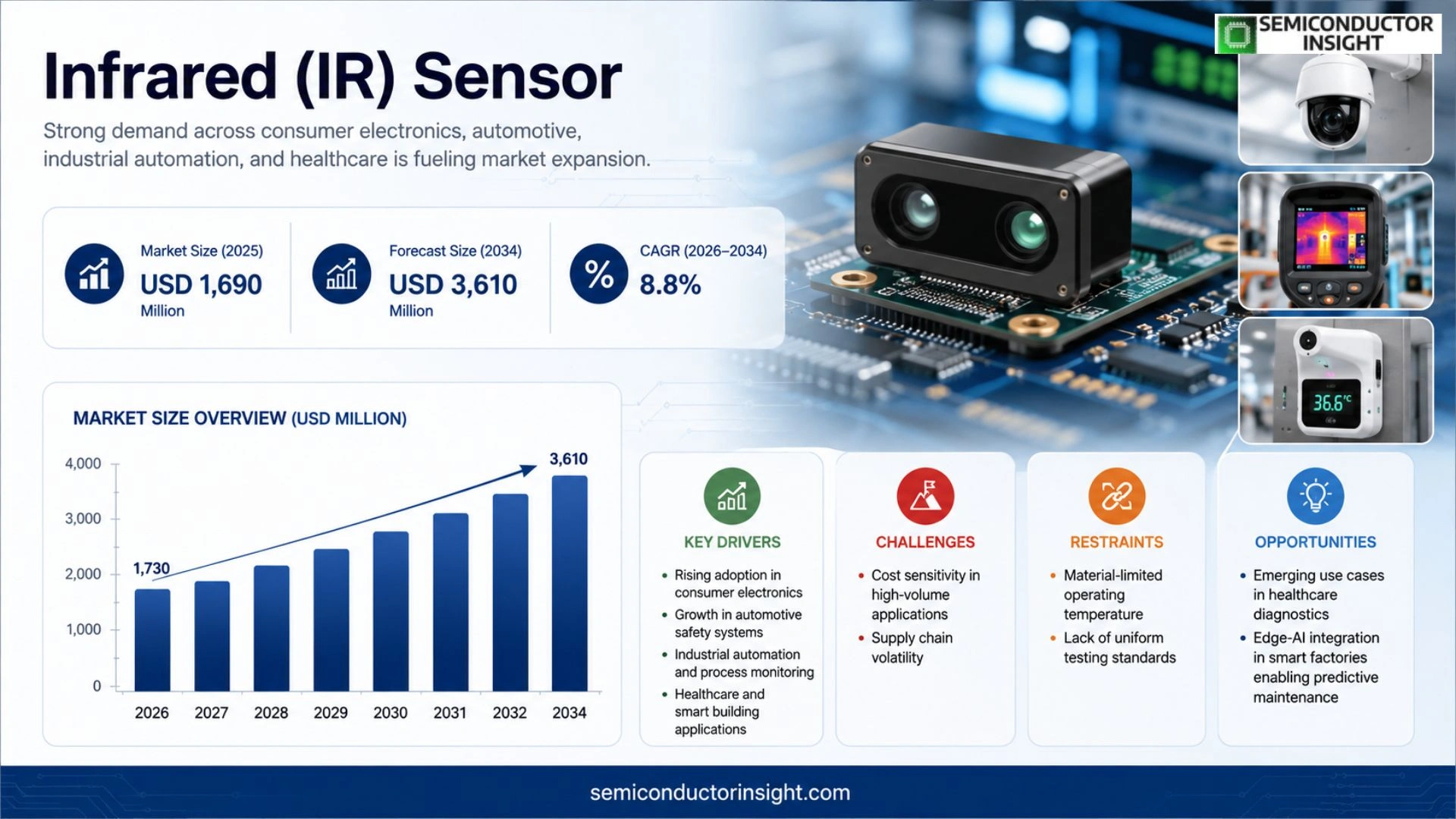
Global Infrared (IR) Sensor market size is projected to grow from USD 1,690 million in 2025 to approximately USD 3,610 million by 2034, exhibiting a CAGR of about 8.8% during the forecast period.
An Infrared (IR) sensor detects infrared radiation and converts it into an electrical signal, enabling temperature measurement, thermal mapping, presence/motion detection, and gas sensing based on characteristic IR absorption. Generally, IR sensors fall into two major categories: photon (photonic) detectors that rely on semiconductor photo‑electric effects,such as InGaAs, InSb or MCT,for high‑speed, high‑sensitivity detection from near‑IR to mid‑IR; and thermal detectors,including thermopiles, pyroelectric sensors and micro‑bolometers,that measure radiation‑induced heating and are widely used for thermometry, human detection and thermal imaging.
The market is gaining momentum because building‑energy efficiency programs are mandating occupancy‑based HVAC control while automotive safety regulations are requiring driver‑drowsiness monitoring and cabin‑environment sensing. Simultaneously, the proliferation of IoT devices is expanding demand for low‑cost PIR modules in smart‑home applications.Hamamatsu Photonics, Murata Manufacturing, Honeywell and other leading suppliers are broadening their portfolios with calibrated module offerings to capture this multi‑sector growth.
MARKET DRIVERS
Rising Adoption in Automotive Safety Systems
The Infrared (IR) Sensor Market is being reshaped by stricter safety standards that mandate non‑contact obstacle detection and pedestrian monitoring. Modern vehicles embed IR arrays in forward‑looking cameras to supplement radar, delivering higher resolution imaging under low‑light conditions. As manufacturers accelerate the rollout of Level‑2 and Level‑3 autonomy, the demand for compact, low‑latency IR modules has risen by ≈15 % YoY in the past twelve months.
Growth of Consumer Electronics and IoT Devices
Smartphones, wearables, and voice‑activated assistants increasingly rely on IR sensors for proximity detection, facial authentication, and ambient light sensing. The convergence of AI‑driven user interfaces and ultrathin form‑factors drives manufacturers to source sensors that combine sub‑millimeter packaging with >30 % power efficiency gains over legacy technologies. This trend has lifted unit shipments to an estimated 2.3 million units in 2023, a modest but steady climb.
➤ “Automotive compliance and consumer‑grade miniaturization together generate a dual‑track demand curve that lifts pricing power for premium IR sensor suppliers.”
Both segments feed each other: automotive programs stimulate higher‑volume production lines that lower costs for consumer devices, while the rapid iteration cycles of consumer electronics validate new architectures that later qualify for automotive safety certifications.
MARKET CHALLENGES
Cost Sensitivity in High‑Volume Applications
For manufacturers targeting mass‑market gadgets, price ceilings remain the most immediate barrier. Even a 5 % cost premium for advanced thermopile designs can erode margins on devices priced below $30. Consequently, suppliers are pressured to adopt wafer‑level packaging and standardize components, which narrows the scope for differentiated pricing.
Other Challenges
Supply Chain Volatility
The semiconductor ecosystem continues to grapple with volatile lead times for indium and silicon‑based substrates. Recent geopolitical tensions have elongated order cycles by 3‑4 weeks, forcing OEMs to hold higher safety stocks and, in turn, inflate working capital requirements.
MARKET RESTRAINTS
Material‑Limited Operating Temperature
Conventional IR sensor wafers lose responsivity beyond 85 °C, a threshold that clashes with automotive under‑hood environments and industrial furnaces. The need for high‑temperature tolerant materials, such as silicon‑on‑glass or chalcogenide glasses, introduces additional processing steps that raise unit costs.
Manufacturers that cling to legacy III‑V compounds risk losing market share to entrants that integrate micro‑electromechanical (MEMS) structures capable of withstanding 150 °C without performance degradation.
Furthermore, the lack of uniform testing standards across regions prolongs certification timelines, adding regulatory friction that hampers rapid market entry for innovative sensor designs.
MARKET OPPORTUNITIES
Emerging Use Cases in Healthcare Diagnostics
Non‑contact temperature screening, a practice accelerated by recent public‑health events, has opened a sizable niche for IR sensors that combine rapid response times with ±0.2 °C accuracy. Hospital networks are piloting bedside monitors that leverage these sensors to track patient vitals without adhesive electrodes, projecting a 12 % annual increase in demand for medical‑grade IR modules.
Edge‑AI integration within smart factories presents another growth vector. By embedding IR arrays into production lines, operators can detect heat signatures indicative of equipment wear, enabling predictive maintenance strategies that cut downtime by ≈20 %. This convergence of sensing and analytics invites OEMs to bundle firmware platforms, creating higher‑value offerings beyond the sensor itself.
Infrared (IR) Sensor Market Trends
Integration of IR Sensors into Smart Building Controls
Building owners are increasingly relying on occupancy‑based climate management to meet energy‑efficiency mandates. Infrared (IR) sensors, especially thermopile and PIR devices, provide reliable, contact‑free detection of presence and temperature, enabling HVAC systems to adjust output in real time. The shift from static schedules to data‑driven control loops reduces wasted heating and cooling, directly impacting operating costs. Vendors that bundle the sensor with edge‑processing algorithms are capturing higher average selling prices, while facility managers gain actionable insights through building‑management software. This convergence lowers the barrier for retrofitting older structures, creating a steady stream of demand that extends beyond new‑construction projects.
Other Trends
Automotive Cabin Intelligence Expansion
Regulatory requirements across Europe and North America are compelling manufacturers to embed driver‑alert and occupant‑monitoring functions in mainstream vehicles. Infrared (IR) sensor arrays, calibrated for low‑light reliability, are being paired with AI models that assess driver drowsiness, seat occupancy, and cabin temperature uniformity. As these functionalities move from premium to volume models, the content per vehicle rises, prompting suppliers to standardize calibration processes to meet automotive‑grade reliability thresholds. The emerging ecosystem of sensor‑plus‑software packages also creates new revenue streams for OEMs that can offer turnkey solutions to Tier‑1 integrators.
Manufacturing Consistency and Margin Pressures
The production model for IR sensors hinges on a platform‑die approach followed by precise packaging and calibration steps. Yield variability in hermetic sealing or IR‑window uniformity can quickly erode gross margins, which already range from 35 % to 55 % for industrial‑grade parts. Companies that adopt “fab‑lite” strategies,keeping design in‑house while outsourcing packaging,are better positioned to balance capacity with quality demands. However, the need for rigorous traceability and long certification cycles in automotive and industrial segments continues to compress cash‑flow timing, making supply‑chain agility a competitive differentiator for participants in Infrared (IR) Sensor Market.
COMPETITIVE LANDSCAPE
Key Industry Players
Infrared Sensor market: competitive structure and vendor dynamics
The market is anchored by a handful of vertically‑integrated manufacturers that retain control over wafer processing, sensor architecture and algorithm development. Hamamatsu Photonics, with its long‑standing expertise in InGaAs and MCT photonic detectors, exemplifies this model, delivering high‑performance arrays that dominate aerospace and advanced industrial segments. Its ability to couple proprietary read‑out circuitry with in‑house calibration infrastructure creates a barrier to entry for rivals lacking similar scale. Parallel to Hamamatsu, Japanese firms such as Panasonic and Murata leverage a hybrid “fab‑lite + OSAT” approach, outsourcing packaging while focusing on MEMS thermopile and pyroelectric production. This configuration enables rapid capacity adjustments and keeps average selling prices competitive in consumer‑grade PIR and smart‑building applications. The resulting tiered landscape sees premium detector arrays clustered with a few IDM leaders, while mid‑range thermal sensors are supplied by a broader set of manufacturers that prioritize volume and cost efficiency.
Beyond the dominant tier, a diverse cohort of niche specialists fuels innovation in emerging sub‑markets. Excelitas Technologies and Teledyne offer customized quantum‑infrared solutions that cater to defense and scientific research, where performance trumps unit cost. European players such as ams OSRAM and Lynred focus on automotive‑grade thermal cameras, exploiting stricter safety standards to command higher margins. Meanwhile, companies like Honeywell, Texas Instruments, and Omron embed IR modules into broader sensor suites, targeting industrial automation and HVAC control. Asian innovators,including Dali Technology, Melexis, and TE Connectivity,have accelerated entry into IoT‑enabled smart‑building platforms by providing compact, network‑ready sensor packages. This proliferation of focused competitors intensifies pressure on pricing, accelerates feature integration, and pushes incumbents to expand their application portfolios to maintain relevance across the expanding IR ecosystem.
List of Key Infrared Sensor Companies Profiled
- Hamamatsu Photonics
- Excelitas Technologies
- Murata Manufacturing
- Raytheon
- InfraTec
- Teledyne
- Honeywell
- Texas Instruments
- ams OSRAM
- Panasonic
- Omron
- Lynred
- Melexis
- TE Connectivity
- Dali Technology
Segment Analysis:
| Segment Category | Sub-Segments | Key Insights |
| By Type |
|
Photonic Detectors
|
| By Application |
|
Automotive & Intelligent Transportation
|
| By End User |
|
Automotive OEMs
|
| By Integration Approach |
|
Sensor‑Plus‑Algorithm Packages
|
| By Value‑Chain Position |
|
Midstream Sensor Designers & Fab‑Lite Integrators
|
Regional Analysis: Infrared (IR) Sensor Market
North America
OEMs prioritize miniature, low‑power IR modules to meet space‑constrained designs. The shift toward silicon‑based photodiodes reflects a desire for faster response times and tighter integration with microcontrollers, enabling edge‑processing capabilities that diminish reliance on cloud analytics.
Automotive safety systems, building‑automation HVAC controls, and advanced robotics dominate demand. Within each vertical, the sensor’s ability to operate across a broad temperature range differentiates premium offerings from commodity alternatives.
Harmonized safety standards across the United States and Canada simplify certification pathways. Recent updates to electromagnetic compatibility directives reduce testing cycles, encouraging faster rollout of next‑generation IR solutions.
A handful of legacy players maintain market share through extensive distribution networks, while start‑ups differentiate with proprietary waveband tuning and AI‑enhanced signal processing, creating a dynamic competitive tableau.
Europe
European manufacturers benefit from a regulatory environment that emphasizes energy efficiency and occupational safety. Countries such as Germany and France channel public‑private funds into smart‑factory initiatives, where IR sensors serve as the eyes of cyber‑physical systems. The region’s focus on sustainability drives the integration of IR detection in building‑management platforms that modulate lighting and ventilation based on occupant presence. Suppliers that can certify compliance with EU directives on electromagnetic emissions enjoy an edge, as many downstream integrators require documented conformance before procurement.
Asia‑Pacific
In Asia‑Pacific, rapid industrialization and a burgeoning consumer electronics sector create a fertile backdrop for sensor expansion. China’s manufacturing hubs adopt IR technology to streamline quality‑control lines, while Japan’s automotive giants experiment with long‑range IR profiling for night‑time navigation. South Korea invests heavily in semiconductor research, yielding innovative focal‑plane arrays that promise higher pixel densities. Although cost pressures remain intense, firms that combine volume pricing with localized support services are capturing the majority of new contracts.
South America
South American economies are leveraging IR sensing to improve resource management in agriculture and mining. Brazil’s agribusiness firms integrate IR cameras to monitor canopy health, reducing pesticide use and enhancing yield predictability. Meanwhile, Chilean mining operations employ rugged IR detectors to monitor equipment temperatures, preventing unscheduled shutdowns. Market participants that can offer ruggedized enclosures and localized after‑sales training find themselves preferred partners in a region where technical expertise is still developing.
Middle East & Africa
The Middle East & Africa region reflects a growing interest in smart‑city infrastructure and oil‑field automation. In the Gulf, IR sensors are embedded in security perimeter systems that detect intrusions under extreme heat conditions. African nations, looking to expand renewable‑energy grids, adopt IR‑based fault detection to safeguard photovoltaic arrays. Distribution challenges persist, yet firms that establish regional hubs and provide multilingual technical documentation are better positioned to tap into emerging projects.
Report Scope
This market research report provides a comprehensive analysis of the Infrared (IR) Sensor Market , covering the forecast period 2026–2034. It offers detailed insights into market dynamics, technological advancements, competitive landscape, and key trends shaping the industry.
Key focus areas of the report include:
- Market Overview: The report begins with an overview outlining its current market scenario, key growth indicators, and industry transformation drivers. It discusses macroeconomic factors, demand–supply balance, regulatory landscape, and the strategic role of semiconductors in powering advancements across industries such as automotive, telecommunications, consumer electronics, and industrial automation.
- Market Size & Forecast: Historical data and future projections for revenue, unit shipments, and market value across major regions and segments.
- Segmentation Analysis: Detailed breakdown by product type, technology, application, and end-user industry to identify high-growth segments and investment opportunities.
- Regional Insights: Insights into market performance across North America, Europe, Asia-Pacific, Latin America, and the Middle East & Africa, including country-level analysis where relevant.
- Competitive Landscape: Profiles of leading market participants, including their product offerings, R&D focus, manufacturing capacity, pricing strategies, and recent developments such as mergers, acquisitions, and partnerships.
- Technology Trends & Innovation: Assessment of emerging technologies, integration of AI/IoT, semiconductor design trends, fabrication techniques, and evolving industry standards.
- Market Drivers & Restraints: Evaluation of factors driving market growth along with challenges, supply chain constraints, regulatory issues, and market-entry barriers.
- Stakeholder Insights: Insights for component suppliers, OEMs, system integrators, investors, and policymakers regarding the evolving ecosystem and strategic opportunities.
Primary and secondary research methods are employed, including interviews with industry experts, data from verified sources, and real-time market intelligence to ensure the accuracy and reliability of the insights presented.
FREQUENTLY ASKED QUESTIONS:
What is the current market size of Infrared (IR) Sensor Market?
-> Infrared (IR) Sensor Market is expected to reach USD 2943 million by 2034, growing at a CAGR of 8.8% during the forecast period.
Which key companies operate in Infrared (IR) Sensor Market?
-> Key players include Hamamatsu Photonics, Excelitas Technologies, Murata Manufacturing, Raytheon, InfraTec, Teledyne, Honeywell, Texas Instruments, Nippon Ceramic, ams OSRAM, Panasonic, Omron, Lynred, Leonardo DRS, BAE Systems, Heimann, Melexis, Amphenol Advanced Sensors, TE Connectivity, Wuhan Guide, Raytron Microelectronics, Dali Technology, Senba, Sunshine Technologies, Orisystech.
What are the key growth drivers?
-> Key growth drivers include government‑led energy‑efficiency and decarbonisation programs that boost building‑automation demand, regulatory safety mandates driving in‑cabin automotive IR adoption, and expanding industrial safety and process‑monitoring applications.
Which region dominates the market?
-> Asia-Pacific currently holds the largest share of Infrared (IR) Sensor Market, driven by strong manufacturing bases in China, Japan, and South Korea, while also showing the fastest growth trajectory.
What are the emerging trends?
-> Emerging trends include high‑resolution passive IR (PIR) and micro‑motion detection for smart buildings, AI‑coupled cabin intelligence and driver‑monitoring systems in automotive, and the migration of thermopile‑based sensors from consumer devices to mission‑critical industrial safety and energy‑efficiency solutions.
Get Sample Report PDF for Exclusive Insights
Report Sample Includes
- Table of Contents
- List of Tables & Figures
- Charts, Research Methodology, and more...
 Download Sample Report PDF