MCT Infrared Preamplifier Detector Market Insights
Global MCT Infrared Preamplifier Detector market is projected to grow from USD 166 million in 2032 to approximately USD 185 million by 2034, exhibiting a CAGR of about 5.6 % during the forecast period.
MCT infrared preamplifier detectors integrate a mercury‑cadmium‑telluride (MCT) photon detector with a low‑noise preamplifier circuit within a single module. This architecture combines the wide‑band, high‑sensitivity detection capability of MCT material with immediate signal amplification, improving signal‑to‑noise ratio, anti‑interference performance and usable bandwidth,attributes essential for long‑cable, weak‑signal and high‑speed measurement applications.
The upward trajectory is underpinned by expanding demand in national‑defense security systems, aerospace instrumentation and scientific research laboratories. Concurrently, advances in high‑purity Hg/Cd/Te substrate production and precision packaging have lowered unit costs, while key manufacturers such as Thorlabs, InfraRed Associates and VIGO Photonics continue to broaden their portfolios through incremental product launches.
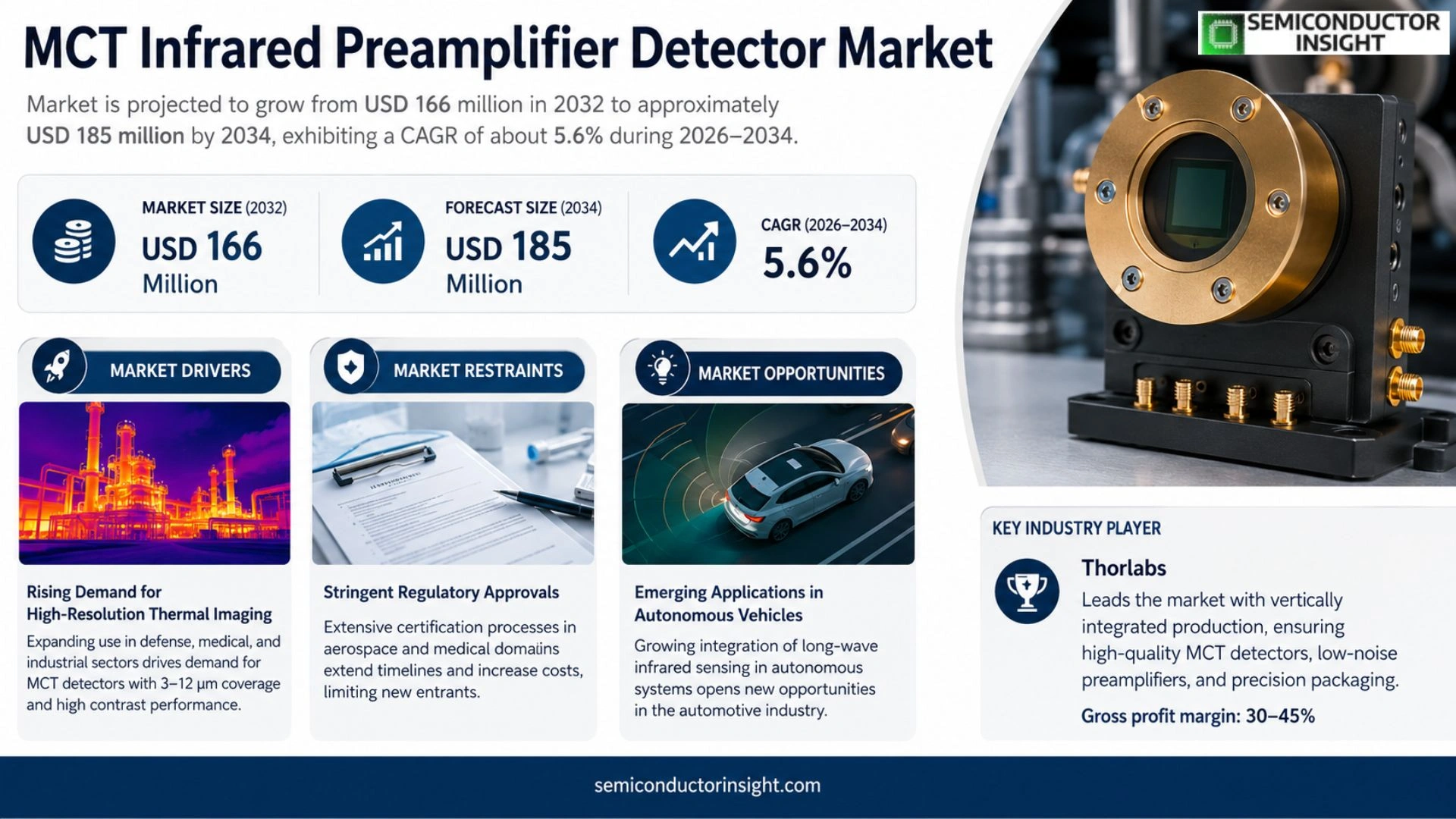
MARKET DRIVERS
Rising Demand for High‑Resolution Thermal Imaging
MCT Infrared Preamplifier Detector Market is buoyed by expanding requirements for thermal cameras that can resolve sub‑pixel details in defense surveillance, medical diagnostics, and industrial inspection. Stakeholders cite the ability of MCT detectors to operate across 3‑12 µm wavelengths, delivering the contrast needed for early fault detection in power‑plant turbines. Companies that integrate these detectors into next‑gen systems are capturing premium pricing because customers value the reduction in false‑alarm rates.
Advancements in MCT Material Processing
Recent breakthroughs in molecular‑beam epitaxy and liquid‑phase epitaxy have lowered defect densities, translating into higher quantum efficiency and longer detector life‑cycles. Manufacturers that have mastered these processes are able to offer devices with noise‑equivalent power (NEP) improvements of up to 30 % while maintaining wafer yields above 80 %. The technical edge drives procurement decisions, especially for OEMs requiring consistent performance across large production runs.
➤ “Material uniformity now dictates competitive advantage more than circuit design” – senior technologist, leading detector supplier
Collectively, the push for sharper imaging and the maturation of crystal growth techniques create a feedback loop: higher performance fuels market acceptance, which in turn funds further R&D investment. Firms that align their roadmaps with these drivers are positioned to capture a larger share of MCT Infrared Preamplifier Detector Market in the near term.
MARKET CHALLENGES
Cost Sensitivity in End‑User Segments
While performance metrics have improved, the unit price of MCT preamplifier assemblies remains a hurdle for mid‑range security installations and portable medical devices. Buyers often benchmark against uncooled microbolometer alternatives, which, despite lower sensitivity, deliver sufficient functionality at a fraction of the cost. Suppliers must therefore justify the premium through demonstrable ROI, such as reduced maintenance cycles or extended detector lifespan.
Other Challenges
Supply Chain Volatility
The reliance on high‑purity mercury‑cadmium‑telluride crystals ties the industry to a limited set of specialty material providers. Recent geopolitical shifts have introduced lead times that can exceed six months, pressuring manufacturers to hold larger inventories or seek secondary sources, both of which erode profit margins.
MARKET RESTRAINTS
Stringent Regulatory Approvals
Regulatory bodies across aerospace and medical domains impose exhaustive qualification procedures for infrared detection modules. The certification timeline, often spanning 12‑18 months, adds a fixed overhead that smaller entrants struggle to absorb. This barrier filters market participants, consolidating volume with a handful of firms capable of navigating the compliance landscape.
MARKET OPPORTUNITIES
Emerging Applications in Autonomous Vehicles
Autonomous navigation systems increasingly incorporate long‑wave infrared sensing to enhance pedestrian detection in low‑visibility conditions. MCT Infrared Preamplifier Detectors, with their rapid response time and broad spectral coverage, align well with the safety‑critical algorithms driving this sector. Early partnerships between detector manufacturers and automotive chip designers hint at a lucrative niche that could expand the overall market footprint.
MCT Infrared Preamplifier Detector Market Trends
Integration of Low‑Noise Amplifiers Elevates System Capability
The 2025 valuation of MCT Infrared Preamplifier Detector Market stood at $114 million, and sales volumes reached 25,360 units at an average price of $4,912. By 2032 the market is slated to reach $166 million, a compound annual rise of 5.6 %. This trajectory is anchored in the unique architecture of the detector: a mercury‑cadmium‑telluride photon element paired with a co‑located low‑noise preamplifier. The combined package squeezes out more signal‑to‑noise ratio, expands usable bandwidth and tolerates long‑cable runs, which in turn opens doors for high‑speed measurement in defense, aerospace and scientific research. Buyers are moving away from discrete detector‑amplifier chains because the integrated solution cuts board‑level complexity, reduces calibration overhead and improves overall reliability.
Other Trends
Manufacturing Concentration Among Top Five Players
Industry specialists note that five firms,Thorlabs, InfraRed Associates, Infrared Systems Development Corporation, Kolmar Technologies and VIGO Photonics,command roughly one‑third of global revenue in 2025. Their dominance stems from control of high‑purity Hg/Cd/Te raw material supplies and proprietary epitaxial growth processes (MBE/LPE). The tight margin envelope of 25‑50 % encourages these leaders to invest in precision resistor and capacitor networks that further lower noise floors, reinforcing their competitive moat. Smaller entrants face steep capital requirements for clean‑room capacity and temperature‑control modules, which curtails new‑player market entry.
Supply‑Chain Consolidation Shapes Pricing Dynamics
Upstream components such as ZnSe windows, TEC packages and micro‑crystal temperature regulators have become increasingly sourced from a narrowed pool of suppliers. This consolidation drives modest price stability despite the modest increase in unit price observed from $4,912 in 2025 onward. End‑users,instrument manufacturers, system integrators and research institutes,benefit from predictable cost structures, allowing them to allocate capital toward system‑level enhancements rather than component‑level contingencies. The net effect is a more mature market environment where profit margins remain healthy while fostering incremental innovation in detector packaging and calibration methods.
COMPETITIVE LANDSCAPE
Key Industry Players
MCT Infrared Preamplifier Detector Market Competitive Landscape
Thorlabs commands the dominant share of MCT Infrared Preamplifier Detector Market, leveraging its vertically integrated production line that spans Hg/Cd/Te epitaxy, low‑noise preamplifier design, and precision packaging. The company’s ability to source high‑purity substrates in‑house reduces lead times and protects margins, which translates into a gross profit envelope of 30‑45 % on its detector modules. Thorlabs’ R&D pipeline focuses on expanding linear‑mode performance while shrinking the thermal control envelope, a move that aligns with demanding aerospace contracts where cable length and signal integrity are critical. Its distribution network, anchored in North America and Europe, feeds both OEM system integrators and end‑user research labs, reinforcing a market structure where a handful of vertically integrated firms compete with a broader set of specialized niche players.
Beyond the market leader, a constellation of specialist manufacturers shapes the competitive landscape. InfraRed Associates and ISDC have carved out defense‑oriented niches by tailoring preamplifier gain to meet stringent radar‑cross‑section specifications, while Kolmar Technologies differentiates through its LPE‑grown MCT wafers that deliver higher uniformity for photoconductive devices. VIGO Photonics and Healthy Photon concentrate on compact, battery‑operated modules for portable spectroscopy, exploiting the higher signal‑to‑noise ratio that integrated preamplification provides. Asian incumbents such as Hamamatsu Photonics and Newport Corporation compete on volume, supplying bulk detector kits to semiconductor inspection equipment. Excelitas Technologies and Leonardo DRS leverage their broader sensor portfolios to bundle MCT preamplifiers with ancillary cooling and control electronics, creating value‑added solutions for space‑flight experiments. European players like Raytheon Technologies, L3Harris, and Bosch Sensortec reinforce the market’s regional diversification, each emphasizing ruggedisation and compliance with IEC standards, which sustains a fragmented yet highly technical supplier ecosystem.
List of Key MCT Infrared Preamplifier Detector Companies Profiled
- Thorlabs
- InfraRed Associates
- Infrared Systems Development Corporation (ISDC)
- Kolmar Technologies
- VIGO Photonics
- Healthy Photon
- Hamamatsu Photonics
- Newport Corporation
- Excelitas Technologies
- Leonardo DRS
- Raytheon Technologies
- L3Harris Technologies
- Bosch Sensortec
- Siemens AG
- BAE Systems
Segment Analysis:
| Segment Category | Sub-Segments | Key Insights |
| By Type |
|
Photovoltaic Type is widely regarded as the leading segment because it delivers intrinsic low‑noise performance and simplifies system design. – Enables compact, battery‑operated modules for field‑deployed defense platforms. – Provides superior signal‑to‑noise ratio in long‑cable, weak‑signal scenarios. – Favoured by researchers for its stable bias‑free operation, reducing calibration effort. |
| By Application |
|
National Defense and Security dominates because the technology meets stringent reliability and fast‑response requirements. – Critical for missile‑tracking and infrared surveillance where detection of weak signatures is essential. – Integrated preamplifier architecture enhances immunity to electromagnetic interference in rugged environments. – Supports real‑time data processing for command‑and‑control systems. |
| By End User |
|
Instrument Manufacturers are the primary drivers, seeking high‑performance detector modules for spectroscopy, metrology and gas analysis. – Require reliable calibration and long‑term stability to meet stringent laboratory standards. – Favor modular designs that can be readily incorporated into diverse measurement platforms. – Emphasize low power consumption to support portable field instruments. |
| By Operating Mode |
|
Linear Mode remains prevalent due to its predictable response and ease of integration with analog readout circuits. – Offers consistent gain across a wide dynamic range, critical for scientific imaging. – Aligns well with low‑noise preamplifier designs that maximize detection fidelity. – Simplifies system architecture, reducing the need for complex timing electronics. |
| By Product Type |
|
Integrated Module leads because it bundles detector, preamplifier and temperature control in a single package, reducing system complexity. – Accelerates time‑to‑market for OEMs that prefer turnkey solutions. – Enhances thermal stability, a key factor for consistent infrared performance. – Provides robust packaging that withstands harsh environmental conditions encountered in defense and aerospace deployments. |
Regional Analysis: MCT Infrared Preamplifier Detector Market
OEMs are embedding MCT preamplifiers directly onto focal‑plane arrays, reducing interconnect loss and simplifying thermal management. This integration boosts signal fidelity for high‑resolution imaging, a priority for defense contractors seeking clearer night‑vision capabilities.
Military surveillance, space‑based platforms, and industrial process monitoring dominate demand. Each segment values the detector’s ability to operate at modest cooling levels while maintaining low dark current, influencing procurement specifications.
Export‑control regimes around infrared technologies compel manufacturers to maintain domestic test labs. Companies that navigate these rules efficiently can offer faster lead times, an advantage in time‑critical defense contracts.
Venture capital directed at photonic startups and government R&D grants create a fertile financing environment. Capital inflows enable rapid prototyping, accelerating the transition from laboratory to production scale.
Europe
European players leverage strong collaborative research networks, particularly within the EU Horizon programmes, to refine MCT detector performance. Nations such as Germany and France host specialized wafer‑fab facilities that focus on low‑defect epitaxy, a critical factor for high‑end imaging. The region’s automotive sector, increasingly interested in driver‑assistance LIDAR, is prompting cross‑industry pilots that blend automotive‑grade reliability with infrared sensitivity. While procurement budgets are more conservative than in North America, long‑term contracts with space agencies and security ministries provide steady revenue streams. Intellectual‑property frameworks across the EU also encourage joint ventures, allowing firms to share risk while co‑developing niche applications such as non‑intrusive gas monitoring. These dynamics collectively nurture a market that values stability, collaborative innovation, and compliance with stringent environmental standards.
Asia‑Pacific
Asia‑Pacific exhibits the fastest shift from experimental to volume production, driven largely by China’s strategic push for indigenous infrared capabilities and Japan’s continued leadership in precision optics. Domestic semiconductor clusters in Shanghai and Tokyo are scaling up MCT wafer capacity, yet quality disparities persist, prompting some manufacturers to source critical components from established North American suppliers. The region’s burgeoning drone market creates a new demand vector; low‑weight, high‑sensitivity detectors are essential for surveillance payloads. Meanwhile, India’s defense modernization plan allocates resources toward home‑grown detection systems, fostering partnerships between research institutes and private firms. The overall environment is characterized by aggressive government incentives, a rapidly expanding talent pool, and a willingness to adopt riskier production techniques to capture market share.
South America
In South America, market activity centers around Brazil’s aerospace initiatives and Argentina’s scientific research institutions. Both countries receive government grants aimed at diversifying beyond traditional oil‑based economies, encouraging investment in photonic technologies. Local firms often focus on ruggedized detector packages suitable for tropical conditions, where humidity and temperature swings challenge performance. Although the region lacks large‑scale foundry infrastructure, strategic alliances with North American equipment suppliers enable technology transfer and limited domestic assembly. The modest size of the market is offset by niche opportunities in environmental monitoring, where infrared sensing aids in forest fire detection and illegal mining surveillance.
Middle East & Africa
Middle East & Africa’s interest in MCT Infrared Preamplifier Detector Market is largely security‑driven, with Gulf Cooperation Council nations investing heavily in border‑control and maritime surveillance systems. The harsh desert climate underscores the appeal of detectors that function effectively at elevated ambient temperatures, reducing cooling burdens. South Africa’s aerospace sector also explores infrared solutions for satellite payloads, supported by a modest but skilled engineering base. Limited local manufacturing capacity means most hardware is imported, yet regional procurement offices are beginning to demand customized specifications that address sand‑storm resilience and low‑maintenance operation, prompting suppliers to adapt designs for this environment.
Report Scope
This market research report provides a comprehensive analysis of the MCT Infrared Preamplifier Detector Market , covering the forecast period 2026–2034. It offers detailed insights into market dynamics, technological advancements, competitive landscape, and key trends shaping the industry.
Key focus areas of the report include:
- Market Overview: The report begins with an overview outlining its current market scenario, key growth indicators, and industry transformation drivers. It discusses macroeconomic factors, demand–supply balance, regulatory landscape, and the strategic role of semiconductors in powering advancements across industries such as automotive, telecommunications, consumer electronics, and industrial automation.
- Market Size & Forecast: Historical data and future projections for revenue, unit shipments, and market value across major regions and segments.
- Segmentation Analysis: Detailed breakdown by product type, technology, application, and end-user industry to identify high-growth segments and investment opportunities.
- Regional Insights: Insights into market performance across North America, Europe, Asia-Pacific, Latin America, and the Middle East & Africa, including country-level analysis where relevant.
- Competitive Landscape: Profiles of leading market participants, including their product offerings, R&D focus, manufacturing capacity, pricing strategies, and recent developments such as mergers, acquisitions, and partnerships.
- Technology Trends & Innovation: Assessment of emerging technologies, integration of AI/IoT, semiconductor design trends, fabrication techniques, and evolving industry standards.
- Market Drivers & Restraints: Evaluation of factors driving market growth along with challenges, supply chain constraints, regulatory issues, and market-entry barriers.
- Stakeholder Insights: Insights for component suppliers, OEMs, system integrators, investors, and policymakers regarding the evolving ecosystem and strategic opportunities.
Primary and secondary research methods are employed, including interviews with industry experts, data from verified sources, and real-time market intelligence to ensure the accuracy and reliability of the insights presented.
FREQUENTLY ASKED QUESTIONS:
What is the current market size of MCT Infrared Preamplifier Detector Market?
-> Global MCT Infrared Preamplifier Detector market is projected to grow from USD 185 million by 2034, exhibiting a CAGR of about 5.6 % during the forecast period.
Which key companies operate in MCT Infrared Preamplifier Detector Market?
-> Key players include Thorlabs, InfraRed Associates, Infrared Systems Development Corporation (ISDC), Kolmar Technologies, VIGO Photonics, Healthy Photon, among others.
What are the key growth drivers?
-> Key growth drivers include the need for high‑sensitivity detection in defense and aerospace, the requirement for low‑noise amplification over long cables, and increasing demand for high‑speed measurement in scientific research, all of which boost demand for integrated MCT detector‑preamplifier modules.
Which region dominates the market?
-> North America holds a leading share, driven primarily by strong defense and aerospace programs in the United States, while Europe and Asia‑Pacific also show robust growth.
What are the emerging trends?
-> Emerging trends include advanced packaging with micro‑crystal technology, improved temperature‑control (TEC) solutions for enhanced detector stability, and integration of low‑power operational amplifiers to expand application scope in portable and space‑borne systems.

Get Sample Report PDF for Exclusive Insights
Report Sample Includes
- Table of Contents
- List of Tables & Figures
- Charts, Research Methodology, and more...
 Download Sample Report PDF