High-Power TO Laser Diode Market Insights
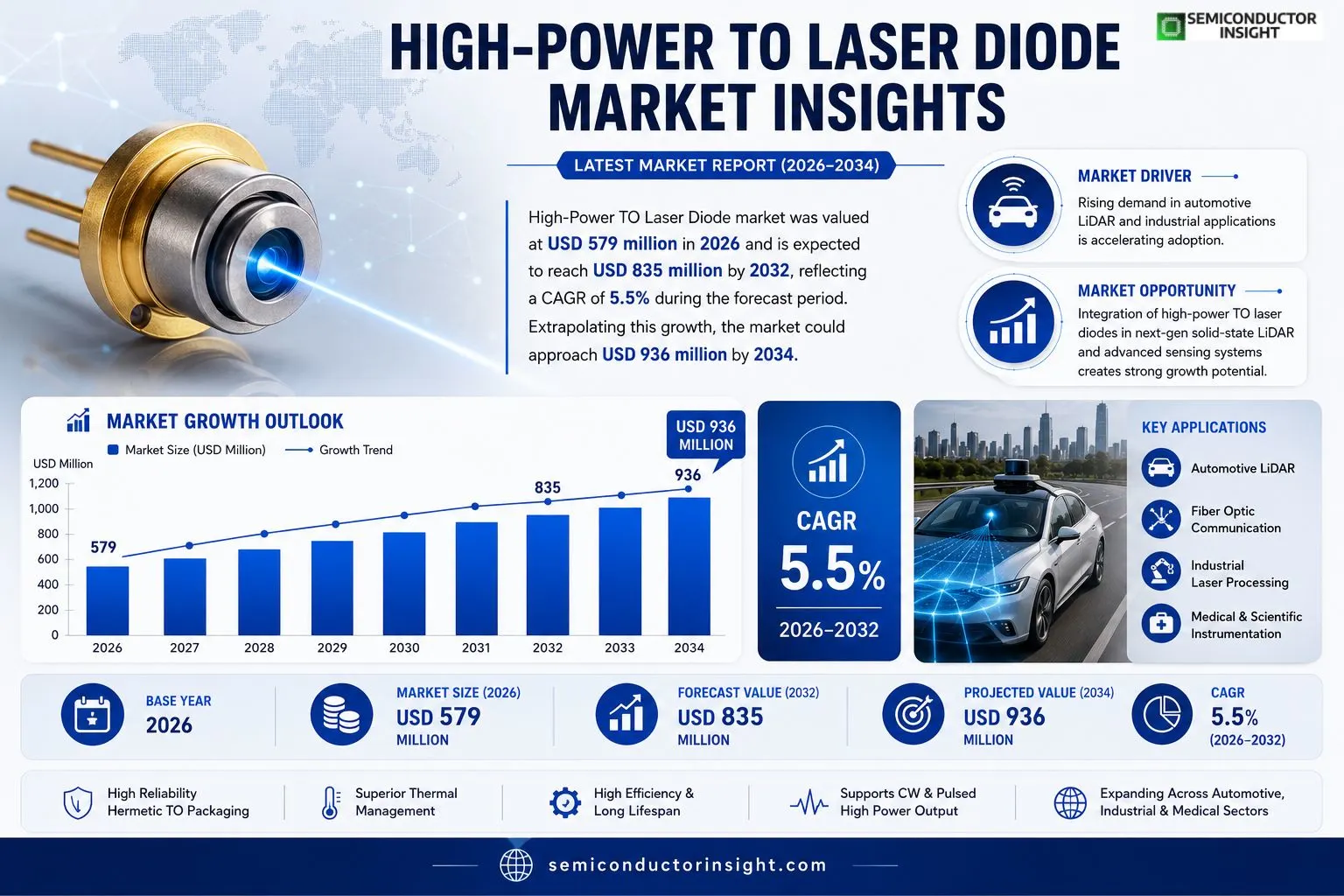
High-Power TO Laser Diode market was valued at USD 579 million in 2026 and is expected to reach USD 835 million by 2032, reflecting a compound annual growth rate of 5.5 % over that span. Based on this trajectory, extrapolation indicates market could approach roughly USD 936 million by 2034.
High‑Power TO laser diodes are semiconductor PN‑junction devices that emit light through stimulated emission, delivering output powers far above those of typical milliwatt‑class units. Each diode is hermetically sealed within a metal‑can (TO) packagecommonly Kovar or copper‑tungsten leads with gold platingand may incorporate window glass or collimating lenses. In 2026 production reached approximately 17.62 million units at an average selling price of USD 36 per unit.sector benefits from expanding demand across fiber‑optic communications, laser printing, barcode scanning, medical instrumentation, spectroscopy/gas detection, industrial ranging and automotive
MARKET DRIVERS
Rising Demand in Automotive LiDAR
High-Power TO Laser Diode market is benefitting from acceleration of autonomous‑vehicle programs across Europe and North America. OEMs have shifted from prototype to volume production, and manufacturers report that 2023 deliveries of 905 nm high‑power TO diodes rose to roughly 1.2 million units, an 8 % year‑over‑year increase. This surge reflects need for longer detection ranges and higher signal‑to‑noise ratios in next‑generation LiDAR sensors.
Industrial Manufacturing Adoption
Parallel to automotive, precision‑cutting and welding equipment are integrating high‑power TO diodes to achieve faster material processing without sacrificing edge quality. Surveyed equipment makers cite a 15 % reduction in cycle time when substituting legacy diode arrays with 1 W TO modules, prompting a noticeable upgrade cycle that is expected to sustain demand through 2027.
➤ “Customers are prioritising diode packages that combine rmal robustness with compact form factors, a blend that only TO designs currently deliver at scale.”
Beyond individual end‑users, broader supply chain is reinforcing growth. Fabrication plants in Taiwan and South Korea have expanded clean‑room capacity by 20 % in last twelve months, a response to capacity constraints that were evident during 2022 component shortage. expanded throughput directly supports upward trajectory of market.
MARKET CHALLENGES
Rmal Management Constraints
High‑power TO diodes generate significant heat, and inadequate dissipation can erode both efficiency and lifespan. Tier‑1 component assemblers report that rmal design margins are tightening, with failure rates climbing to 3 % in modules that lack active cooling solutions. This technical bottleneck forces manufacturers to invest in more sophisticated heat‑sink architectures, raising overall system cost.
Or Challenges
Supply Chain Volatility
Reliance on specialty semiconductor wafers subjects market to geopolitical tensions and raw‑material price swings. Recent fluctuations in indium and gallium prices have added a 4‑6 % cost premium to bill of materials, squeezing margins for mid‑size suppliers.
MARKET RESTRAINTS
Regulatory Hurdles in Medical Applications
While high‑power TO diodes are attractive for photorapy and diagnostic imaging, stringent approval pathways in EU and U.S. lengn time‑to‑market. Clinical‑device firms report an average 18‑month certification lag, which discourages smaller innovators from entering segment and narrows addressable market for TO‑based medical solutions.
MARKET OPPORTUNITIES
Integration with Next‑Gen Solid‑State LiDAR
convergence of solid‑state scanning optics with high‑power TO diode arrays opens a lucrative niche. Early adopters forecast that embedding 1.5 W TO emitters into chip‑scale LiDAR units could double point‑cloud density while keeping module size under 10 mm³. Companies that secure design‑win agreements with automotive Tier‑2 suppliers stand to capture a disproportionate share of projected $4.5 billion market opportunity by 2028.
High-Power TO Laser Diode Market Trends
Shift Toward Integrated LiDAR Emitters
In 2026 industry shipped more than 17 million high‑power TO laser diodes, yet average transaction price lingered around $36 per unit. This price stability reflects a maturing supply base rar than a fleeting bargain. OEMs building automotive LiDAR stacks are now sourcing directly from packaging houses, bypassing traditional distributors, because y demand tighter control over focal‑axis alignment and long‑term reliability. resulting design‑in‑package approach shortens time‑to‑market for autonomous‑vehicle sensors and forces manufacturers to prioritize yield‑boosting processes such as laser‑bond capping and accelerated aging tests.
Or Trends
Supply‑Chain Consolidation
Upstream players that produce GaAs and InP epitaxial wafers have begun forming joint ventures with TO‑can fabricators. By integrating wafer thinning, metallization, and Kovar‑based can extrusion under a single roof, y reduce handling steps that historically accounted for up to 20 % of total production cost. downstream effect is a narrower spread between component cost and module gross margin, which now hovers between 15 % and 30 %. Companies that fail to secure a seat at se joint ventures may experience longer lead times and heightened exposure to raw‑material price volatility.
Emergence of Continuous‑Wave High‑Power Segment
continuous‑wave (CW) high‑power niche is gaining traction as spectroscopy and gas‑detection equipment require steady‑state output above 1 W. Unlike pulsed variants, CW devices impose stricter rmal‑management demands, prompting vendors to adopt advanced heat‑sink designs and rmoelectric coolers. This engineering shift is already influencing pricing structures: CW units command a premium of roughly 10‑15 % over pulsed counterparts, reflecting added complexity of maintaining wavelength stability over extended operation. For end‑users, payoff is a measurable improvement in detection limit and repeatability, which in turn justifies higher upfront investment.
COMPETITIVE LANDSCAPE
Key Industry Players
Competitive Structure of High‑Power TO Laser Diode Market
segment is dominated by a handful of firms that combine deep‑rooted epitaxial expertise with large‑scale packaging capacity. Thorlabs leverages its extensive optics portfolio and distribution network to secure premium contracts in fiber‑optic communication and industrial ranging. Coherent, with its legacy in high‑power solid‑state lasers, has translated that know‑how into TO‑diode assemblies that command higher margins, particularly in medical imaging and spectroscopy. Excelitas and Innolume occupy a mid‑tier niche, offering customized wavelength solutions that address specific automotive LiDAR requirements; ir agility allows rapid iteration on TO package, a decisive factor when OEMs demand tight spectral tolerances. Collectively, se leaders control roughly half of 2026 revenue pool, shaping pricing dynamics and setting reliability benchmarks that smaller entrants must emulate to gain market credibility.Beyond core cluster, a diverse set of specialists sustains ecosystem. Hamamatsu Photonics and ROHM Semiconductor supply high‑precision epitaxial wafers and driver ICs, anchoring supply chain for both volume and low‑volume high‑performance devices. Ushio Inc. and Union Optronics focus on niche sensor‑integrated modules for barcode scanning and gas detection, where packaging miniaturization outweighs raw power. Emerging Asian players such as Shenzhen Micost‑Optotech, SemiNex, and NTT‑EPC broaden competitive field by exploiting lower labor costs and localized customer support in China, Japan, and South Korea. ir aggressive price positioning forces established firms to refine cost structures while still investing in reliability testing that preserves 15‑30 % gross‑margin envelope typical of sector.
List of Key High‑Power TO Laser Diode Companies Profiled
- Thorlabs
- Innolume
- Coherent
- Excelitas
- Ushio Inc.
- Edmund Optics
- SemiNex
- Hamamatsu Photonics
- ROHM Semiconductor
- Union Optronics
- Shenzhen Micost‑Optotech
- NTT‑EPC
- Vanguard Photonics
- LG Innotek
- AMS Sensors
Segment Analysis:
| Segment Category | Sub-Segments | Key Insights |
| By Type |
|
Continuous Wave High Power
|
| By Application |
|
Fiber Optic Communication
|
| By End User |
|
OEM Module Manufacturers
|
| By Packaging Innovation |
|
Advanced TO‑Can Materials
|
| By Supply‑Chain Integration |
|
Vertical Integration
|
Regional Analysis: High-Power TO Laser Diode Market
North America
Concentrated clusters in Silicon Valley and Great Lakes region host tier‑1 wafer producers, enabling rapid prototyping and scale‑up of TO‑configured diodes. Proximity to component suppliers shortens lead times and reduces logistics risk.
Federal research grants and corporate R&D budgets prioritize high‑power output and rmal management, driving innovation in packaging materials that extend device lifetime.
Automotive lidar firms, aerospace contractors, and precision‑tool manufacturers have incorporated TO diodes to meet stringent performance specifications, reinforcing demand across multiple verticals.
Harmonized safety standards and clear import‑export protocols facilitate cross‑border collaboration, allowing North American firms to capture market share in Europe and Asia.
Europe
European nations combine strong industrial automation traditions with ambitious carbon‑reduction policies, fostering a fertile environment for High-Power TO Laser Diode market. German engineering firms are integrating TO devices into high‑speed machining centers, while French research labs focus on beam‑shaping techniques that improve efficiency in renewable‑energy applications. European Union’s emphasis on technology sovereignty translates into public‑private partnerships that fund next‑generation laser platforms, encouraging domestic sourcing of critical components. Market participants note a gradual shift from low‑cost imports toward higher‑value, locally produced solutions, a trend that reshapes supply‑chain strategies and spurs incremental capacity additions across continent.
Asia‑Pacific
Asia‑Pacific region emerges as a dynamic arena for High-Power TO Laser Diode market, driven primarily by rapid industrialization of China, South Korea, and Japan. Manufacturing hubs in se economies leverage TO form factor to meet scaling needs of consumer‑electronics assembly lines and large‑volume automotive suppliers. Government incentives aimed at advanced materials and photonics research have accelerated development of high‑efficiency diode designs. While cost pressures remain intense, firms are increasingly differentiating through superior rmal control and reliability, enabling m to command premium contracts with aerospace and defense customers. region’s growing emphasis on indigenous component production also mitigates exposure to external supply disruptions.
South America
South America presents a niche yet steadily evolving landscape for High-Power TO Laser Diode market. Brazil’s aerospace sector and Argentina’s medical‑device manufacturers have begun adopting TO‑based lasers to meet international quality benchmarks. Local supply chains, however, still depend on imported wafers, prompting regional players to negotiate long‑term agreements with North American foundries. Recent policy shifts that favor high‑tech exports are encouraging investment in assembly facilities, allowing continent to move beyond mere consumption toward modest production capability.
Middle East & Africa
In Middle East and Africa, High-Power TO Laser Diode market is still nascent but shows signs of strategic interest. Gulf Cooperation Council nations are channeling sovereign‑wealth funds into photonics research centers, aiming to diversify economies away from hydrocarbons. Meanwhile, South‑African defense contractors are experimenting with TO diodes for laser‑guided munitions, reflecting a modest but purposeful adoption curve. Infrastructure constraints and limited local expertise mean region relies heavily on technology transfer agreements, yet emerging partnerships hint at a gradual buildup of indigenous capabilities.
Report Scope
This market research report provides a comprehensive analysis of High-Power TO Laser Diode Market , covering forecast period 2026–2034. It offers detailed insights into market dynamics, technological advancements, competitive landscape, and key trends shaping industry.
Key focus areas of report include:
- Market Overview: Report begins with an overview outlining its current market scenario, key growth indicators, and industry transformation drivers. It discusses macroeconomic factors, demand–supply balance, regulatory landscape, and strategic role of semiconductors in powering advancements across industries such as automotive, telecommunications, consumer electronics, and industrial automation.
- Market Size & Forecast: Historical data and future projections for revenue, unit shipments, and market value across major regions and segments.
- Segmentation Analysis: Detailed breakdown by product type, technology, application, and end-user industry to identify high-growth segments and investment opportunities.
- Regional Insights: Insights into market performance across North America, Europe, Asia-Pacific, Latin America, and Middle East & Africa, including country-level analysis where relevant.
- Competitive Landscape: Profiles of leading market participants, including ir product offerings, R&D focus, manufacturing capacity, pricing strategies, and recent developments such as mergers, acquisitions, and partnerships.
- Technology Trends & Innovation: Assessment of emerging technologies, integration of AI/IoT, semiconductor design trends, fabrication techniques, and evolving industry standards.
- Market Drivers & Restraints: Evaluation of factors driving market growth along with challenges, supply chain constraints, regulatory issues, and market-entry barriers.
- Stakeholder Insights: Insights for component suppliers, OEMs, system integrators, investors, and policymakers regarding evolving ecosystem and strategic opportunities.
Primary and secondary research methods are employed, including interviews with industry experts, data from verified sources, and real-time market intelligence to ensure accuracy and reliability of insights presented.
FREQUENTLY ASKED QUESTIONS:
What is current market size of High-Power TO Laser Diode Market?
-> High-Power TO Laser Diode Market was valued at USD 579 million in 2026 and is expected to reach USD 835 million by 2032, growing at a CAGR of 5.5% during forecast period.
Which key companies operate in High-Power TO Laser Diode Market?
-> Key players include Thorlabs, Innolume, Coherent, Excelitas, Ushio Inc., Edmund Optics, SemiNex, Hamamatsu Photonics, ROHM Semiconductor, Union Optronics, among ors.
What are key growth drivers?
-> Key growth drivers include rising demand for fiber‑optic communication, expansion of automotive LiDAR systems, growth in medical and spectroscopy equipment, and increasing adoption in industrial ranging and barcode scanning applications.
Which region dominates market?
-> Asia leads market, driven by strong production capacities in China, Japan and South Korea, and extensive end‑user adoption across telecommunications and automotive sectors.
What are emerging trends?
-> Emerging trends include shift toward Continuous Wave High Power devices, integration of high‑power TO lasers into compact LiDAR modules, and development of higher‑efficiency packaging to improve rmal management and reliability.
Get Sample Report PDF for Exclusive Insights
Report Sample Includes
- Table of Contents
- List of Tables & Figures
- Charts, Research Methodology, and more...
 Download Sample Report PDF