Multi-point Laser Doppler Vibration Meter Market Insights
Multi-point Laser Doppler Vibration Meter market was valued at USD 50.81 million in 2026 and will reach USD 76.81 million by 2034, reflecting a CAGR of 6.2 % over the forecast period.
A multi‑point laser Doppler vibration meter is an advanced non‑contact optical measurement instrument that exploits the laser‑Doppler effect. When a laser beam strikes a vibrating surface, the reflected light exhibits a frequency shift proportional to the motion; detecting this shift enables precise calculation of vibration velocity, displacement and acceleration at several discrete points simultaneously. The technology supports modal testing and NVH analysis of automotive, rail‑transit and aerospace structures, acoustic characterization of MEMS devices, condition monitoring of precision machine tools, assessment of piezoelectric transducers and health monitoring of materials.The upward trend stems from expanding requirements for high‑resolution vibration analysis across automotive & transportation, optoelectronic devices and medical equipment sectors. Manufacturers such as Polytec, Optomet, HoloBright, Sunnyinnovation Optical Intelligence and SIMTRUM Pte. Ltd. are expanding product portfolios and investing in algorithmic enhancements, which strengthens market competitiveness.
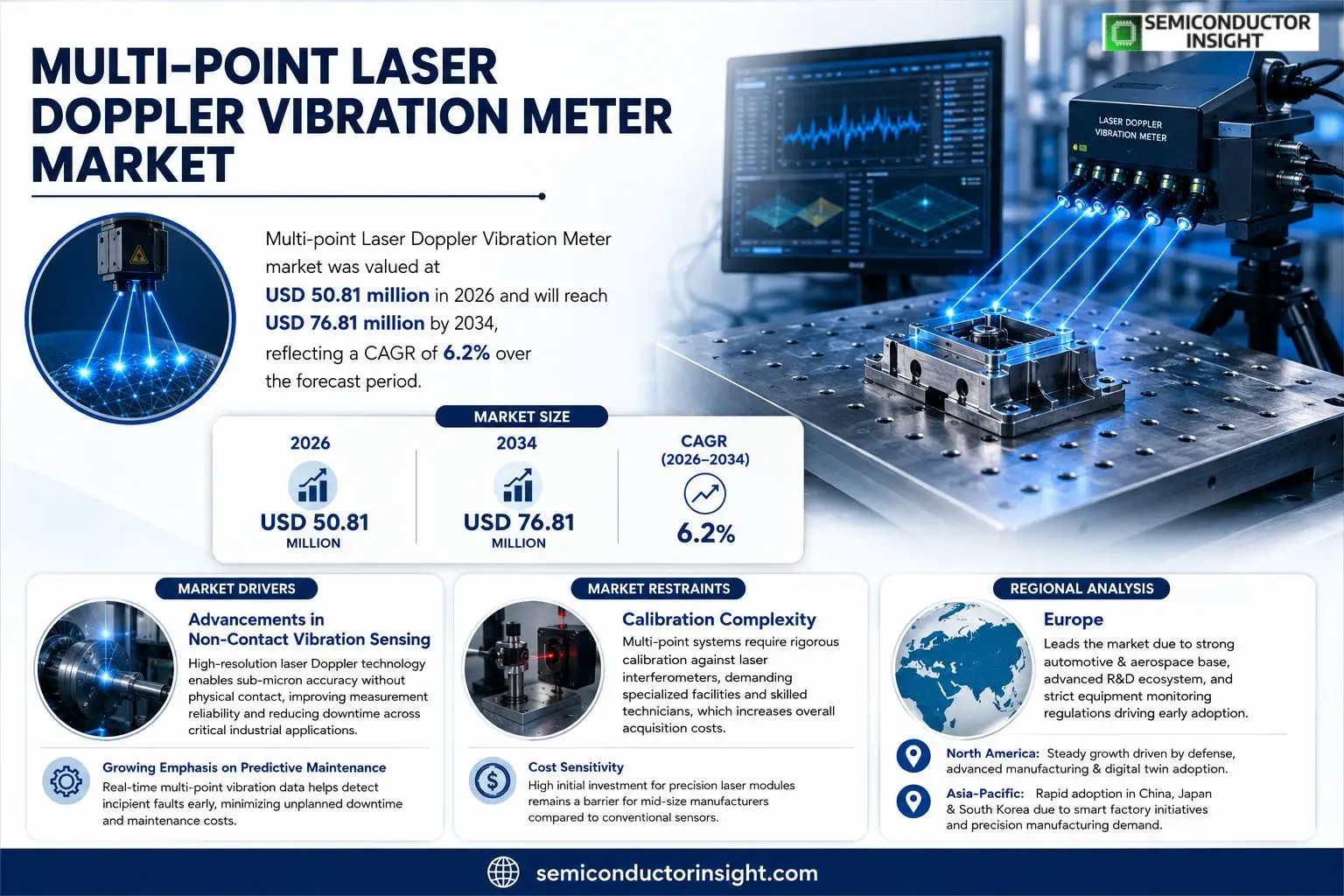
MARKET DRIVERS
Advancements in Non‑Contact Vibration Sensing
The integration of multi‑point laser Doppler technology with high‑resolution photodetectors has elevated measurement accuracy to sub‑micron levels. This technical leap enables engineers to capture vibrational profiles on rotating shafts without physical contact, eliminating wear‑related errors and reducing downtime for sensor installation.
Growing Emphasis on Predictive Maintenance
Enterprises across aerospace, automotive and heavy‑industry sectors are transitioning from corrective to predictive maintenance regimes. By leveraging real‑time vibration data from multi‑point laser Doppler meters, they can identify incipient faults before they propagate, thereby safeguarding asset reliability and trimming unplanned outage costs.
➤ “The ability to acquire synchronized vibration snapshots at multiple locations simultaneously is reshaping fault‑diagnosis pathways across high‑speed machinery.”
Consequently, OEMs are embedding these meters into next‑generation control cabinets, creating a feedback loop that aligns sensor output with adaptive control algorithms. This synergy further accelerates the market’s upward trajectory.
MARKET CHALLENGES
Calibration Complexity
Achieving traceable accuracy requires multi‑point systems to undergo rigorous calibration against laser interferometers. The process demands specialized facilities and skilled technicians, inflating acquisition costs for smaller operators.
Other Challenges
Cost Sensitivity
The upfront capital outlay for high‑precision laser modules remains a barrier for mid‑size manufacturers, especially when alternative contact‑based vibration sensors offer lower entry thresholds.
MARKET RESTRAINTS
Regulatory Compliance Hurdles
Safety standards for laser emissions vary across jurisdictions, compelling suppliers to certify each unit for multiple markets. The associated testing and documentation workload can delay product roll‑outs, dampening momentum in regions with stringent laser‑use regulations.
MARKET OPPORTUNITIES
Emerging Applications in Smart Manufacturing
Industry 4.0 platforms are increasingly demanding granular, real‑time vibration insights to feed digital twins. Multi‑point laser Doppler vibration meters, with their ability to deliver synchronized data streams, are uniquely positioned to become a core sensor layer within these cyber‑physical ecosystems, unlocking new revenue streams for vendors that can integrate seamlessly with IoT middleware.
Multi-point Laser Doppler Vibration Meter Market Trends
Adoption Fueled by Automotive NVH Demands
Laser Doppler Vibration Meter Market recorded revenues of $50.81 million in 2026 and is on track to reach $76.81 million by 2034. Production of the instruments hit 2,013 units last year, with an average selling price of roughly $27,640 per unit. Automotive and railway manufacturers are intensifying modal‑testing programs to tame NVH issues, and the ability of multi‑point systems to capture vibration data at several locations simultaneously makes them indispensable. This capability shortens test cycles, reduces reliance on multiple single‑point setups, and translates into measurable cost savings for OEMs. Consequently, equipment purchasers are allocating larger portions of their test‑budget to these advanced meters, a shift that reshapes spending patterns across the sector.
Other Trends
Rise of Parallel Multi‑point Platforms
Parallel‑array configurations are gaining traction because they enable dense spatial sampling without sacrificing measurement speed. Manufacturers such as Polytec and Optomet have introduced models that integrate eight to twelve laser heads on a single chassis, targeting high‑frequency micro‑structure applications such as MEMS and ultrasonic transducers. The parallel segment is projected to expand sharply, reflecting customer demand for rapid, high‑resolution data in precision‑machine‑tool monitoring and medical‑device validation. This trend encourages suppliers of optical fibers, couplers and high‑speed ADCs to fine‑tune their offerings, tightening the coupling between upstream component makers and end‑users.
Supply‑Chain Consolidation Elevates Margins
Gross profit margins across Laser Doppler Vibration Meter Market now sit between 30 % and 55 %, a range driven by vertical integration of laser sources and demodulation electronics. Companies that have secured in‑house narrow‑linewidth fiber lasers report lower component cost volatility and faster time‑to‑market for new product families. This consolidation also reduces the bargaining power of external optical‑component distributors, allowing manufacturers to retain a larger share of the upside as demand from automotive, aerospace and precision‑instrument sectors continues to rise. For market participants, the strategic implication is clear: investing in core photonic capabilities can safeguard profitability while supporting the broader trend toward more sophisticated vibration‑analysis solutions.
COMPETITIVE LANDSCAPE
Key Industry Players
Multi‑point Laser Doppler Vibration Meter Market – Competitive Overview
Polytec dominates the upper tier of the market, leveraging a broad portfolio that couples high‑resolution interferometric heads with proprietary demodulation firmware. The company’s aggressive R&D pipeline, illustrated by recent firmware upgrades that reduce latency and improve phase stability, has cemented its position among automotive OEMs and aerospace labs that demand sub‑micron displacement accuracy across dozens of measurement points. Polytec’s scale allows it to negotiate bulk pricing on narrow‑linewidth fiber lasers, squeezing gross margins toward the higher end of the 30‑55 % range reported for the sector. Its extensive service network in Europe and North America also translates into faster after‑sales support, a decisive factor for customers operating large test rigs where downtime directly impacts production schedules. As a result, Polytec commands roughly one‑third of global revenue in 2026, shaping price‑setting dynamics and setting performance benchmarks that smaller firms must emulate to stay relevant.Beyond the leader, a cluster of specialized firms differentiates itself through niche technologies or regional focus. Optomet has built a reputation for compact, scanning‑type systems that excel in high‑frequency micro‑structure analysis, making it a preferred supplier for MEMS and photonic device manufacturers in Japan and South Korea. HoloBright and Sunnyinnovation Optical Intelligence concentrate on parallel multi‑point architectures, offering turnkey solutions for rail‑transit vibration assessment, a segment where simultaneous data capture at numerous points reduces test time dramatically. SIMTRUM Pte. Ltd., headquartered in Singapore, supplies cost‑effective units to Southeast Asian precision‑machining firms, often bundling custom software for modal analysis. Additional players such as Toptica, Menlo Systems, Nitto Denko, Bruker, Yokogawa, and Vantec contribute either high‑power laser sources or advanced signal‑processing hardware, creating a fragmented yet collaborative ecosystem where partnership agreements are common to meet the full‑stack requirements of end‑users.
List of Key Multi-point Laser Doppler Vibration Meter Companies Profiled
- Polytec
- Optomet
- HoloBright
- Sunnyinnovation Optical Intelligence
- SIMTRUM Pte. Ltd.
- Toptica
- Menlo Systems
- Nitto Denko
- Bruker
- Yokogawa
- Vantec
- LaserTech Solutions
Segment Analysis:
| Segment Category | Sub-Segments | Key Insights |
| By Type |
|
Parallel Multi‑point
|
| By Application |
|
Automotive & Transportation
|
| By End User |
|
Test & Measurement Laboratories
|
| By Frequency Band |
|
Low‑Frequency Large Structures
|
| By Component Integration |
|
Fiber‑Laser Based Sources
|
Regional Analysis: Multi-point Laser Doppler Vibration Meter Market
Europe
Recent EU directives on equipment diagnostics require higher levels of continuous monitoring, prompting manufacturers to upgrade to multi‑point laser doppler systems that meet traceability and data‑integrity standards.
Partnerships between German universities and sensor vendors accelerate algorithmic improvements, delivering finer spatial resolution and faster acquisition rates for complex machinery.
With component shortages persisting, European firms prioritize local sourcing of laser diodes and optics, reducing lead times and insulating projects from global disruptions.
End users cite immediate fault detection and the ability to monitor multiple points simultaneously as decisive factors when selecting laser doppler vibration meters over conventional sensors.
North America
North America holds a solid foothold, driven mainly by the United States’ focus on advanced manufacturing and the defense sector’s stringent asset health standards. Companies there favour scalable platforms that integrate laser‑based vibration data with existing IoT dashboards, allowing real‑time analytics across distributed plant sites. The market benefits from a venture capital ecosystem that funds start‑ups developing AI‑enhanced interpretation software, thereby expanding the functional envelope of the instruments. While adoption rates lag behind Europe, the incremental shift toward digital twins in heavy‑industry plants suggests a steady upward trajectory for Laser Doppler Vibration Meter Market.
Asia‑Pacific
Asia‑Pacific exhibits a rapidly maturing demand base, especially in China, Japan, and South Korea where high‑volume production lines demand precise vibration monitoring. Governments in the region are rolling out incentives for smart factory upgrades, prompting mid‑size manufacturers to evaluate laser doppler solutions as part of broader digital transformation roadmaps. However, the fragmented supplier landscape and varying standards across countries generate a cautious buying approach, favouring proven technologies from established European vendors. The trajectory points toward a gradual expansion as local OEMs seek to reduce scrap rates and improve product quality.
South America
In South America, Brazil and Argentina lead efforts to embed vibration monitoring within their expanding petrochemical and mining sectors. Industry leaders prioritize ruggedized laser systems that can withstand harsh environmental conditions while delivering accurate multi‑point measurements. Market growth is tempered by limited capital availability, but where financial backing exists, firms quickly recognise cost avoidance through early fault detection. The region’s outlook hinges on broader economic stability and the ability to import high‑performance components without prohibitive tariffs.
Middle East & Africa
The Middle East & Africa region shows emerging interest, anchored by mega‑project developments in the UAE and Saudi Arabia that require cutting‑edge condition monitoring. Oil‑field operators and large‑scale power plants are experimenting with laser doppler meters to enhance equipment uptime in extreme temperatures. Africa’s market remains nascent; however, increasing investments in renewable energy infrastructure open opportunities for vibration analytics to safeguard turbine and solar tracker performance. Strategic partnerships with European technology providers are likely to accelerate market acceptance.
Report Scope
This market research report provides a comprehensive analysis of the Multi-point Laser Doppler Vibration Meter Market , covering the forecast period 2026–2034. It offers detailed insights into market dynamics, technological advancements, competitive landscape, and key trends shaping the industry.
Key focus areas of the report include:
- Market Overview: The report begins with an overview outlining its current market scenario, key growth indicators, and industry transformation drivers. It discusses macroeconomic factors, demand–supply balance, regulatory landscape, and the strategic role of semiconductors in powering advancements across industries such as automotive, telecommunications, consumer electronics, and industrial automation.
- Market Size & Forecast: Historical data and future projections for revenue, unit shipments, and market value across major regions and segments.
- Segmentation Analysis: Detailed breakdown by product type, technology, application, and end-user industry to identify high-growth segments and investment opportunities.
- Regional Insights: Insights into market performance across North America, Europe, Asia-Pacific, Latin America, and the Middle East & Africa, including country-level analysis where relevant.
- Competitive Landscape: Profiles of leading market participants, including their product offerings, R&D focus, manufacturing capacity, pricing strategies, and recent developments such as mergers, acquisitions, and partnerships.
- Technology Trends & Innovation: Assessment of emerging technologies, integration of AI/IoT, semiconductor design trends, fabrication techniques, and evolving industry standards.
- Market Drivers & Restraints: Evaluation of factors driving market growth along with challenges, supply chain constraints, regulatory issues, and market-entry barriers.
- Stakeholder Insights: Insights for component suppliers, OEMs, system integrators, investors, and policymakers regarding the evolving ecosystem and strategic opportunities.
Primary and secondary research methods are employed, including interviews with industry experts, data from verified sources, and real-time market intelligence to ensure the accuracy and reliability of the insights presented.
FREQUENTLY ASKED QUESTIONS:
What is the current market size of Multi-point Laser Doppler Vibration Meter Market?
-> Laser Doppler Vibration Meter Market was valued at USD 50.81 million in 2026 and is expected to reach USD 76.81 million by 2034, growing at a CAGR of 6.2% during the forecast period.
Which key companies operate in Multi-point Laser Doppler Vibration Meter Market?
-> Key players include Polytec, Optomet, HoloBright, Sunnyinnovation Optical Intelligence, SIMTRUM Pte. Ltd..
What are the key growth drivers?
-> Key growth drivers include increasing demand for modal testing and NVH analysis in automotive, aerospace, and rail transit, growth of MEMS and micro‑electro‑acoustic devices, and the need for condition monitoring of precision machine tools and medical equipment.
Which region dominates the market?
-> The market shows strong activity across North America, Europe, and Asia, with significant adoption in automotive and aerospace sectors driving global demand.
What are the emerging trends?
-> Emerging trends include integration of advanced signal‑processing algorithms powered by AI, development of compact scanning multi‑point systems, and expansion into high‑frequency microstructure applications such as MEMS and biomedical devices.

Get Sample Report PDF for Exclusive Insights
Report Sample Includes
- Table of Contents
- List of Tables & Figures
- Charts, Research Methodology, and more...
 Download Sample Report PDF