Non-contact Laser Vibration Meter Market Insights
Global Non-contact Laser Vibration Meter market size was valued at USD 579 million in 2026. Forecasts indicate growth to USD 818 million by 2034, a compound annual growth rate of 5.1 percent over the period.
A non‑contact laser vibration meter is a testing and measurement system that employs laser Doppler vibration (LDV) or interferometry to capture velocity, displacement or acceleration of a target without physical contact. The device projects a laser beam onto the surface, receives reflected echoes and extracts vibration information by demodulating frequency‑shift or phase‑change signals; results are presented through spectrum, time‑domain or modal analysis software.The sector benefits from expanding applications in automotive NVH analysis, aerospace structural testing, precision machine‑tool diagnostics and MEMS characterization. Companies such as Polytec, Optomet and GAO Tek have broadened their portfolios with advanced optics and high‑speed digital demodulation modules, while recent collaborations focus on improving weak‑reflection handling and automated reporting features.
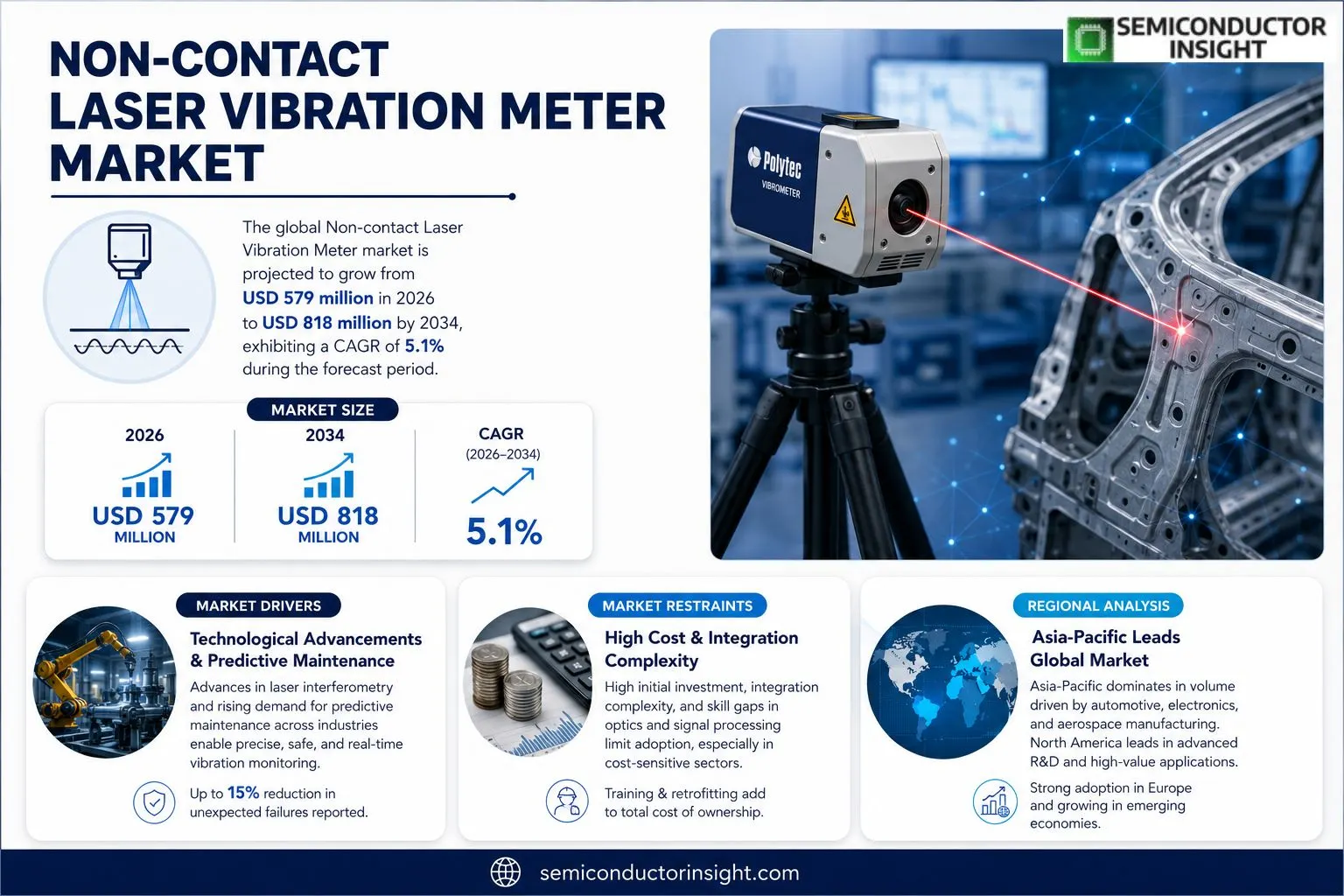
MARKET DRIVERS
Technological Advancements Enabling Precise Measurements
The integration of fiber‑optic interferometry with high‑speed lasers has lowered the detection threshold for minute displacements, allowing manufacturers to monitor equipment health without physical contact. This capability reduces downtime and improves safety in hazardous environments, which is why plant operators are reevaluating traditional accelerometer‑based programs.
Demand for Predictive Maintenance Across Heavy Industries
Industries such as petrochemical processing, aerospace, and wind energy are shifting from reactive repairs to condition‑based strategies. By capturing vibration signatures from a distance, the non‑contact laser unit feeds real‑time analytics into enterprise asset‑management platforms, enhancing root‑cause diagnostics and extending component life cycles.
➤ Companies that embed laser‑based vibration monitoring into digital twins report up to a 15 % reduction in unexpected failures.
As regulatory frameworks tighten around equipment reliability, the Non‑contact Laser Vibration Meter Market gains credibility as a compliance‑friendly solution that meets both safety and performance criteria.
MARKET CHALLENGES
Capital Expenditure and Integration Complexity
Initial outlay for laser‑based systems remains higher than legacy sensors, and the requirement for calibrated optical paths can strain existing maintenance crews. Organizations must allocate budget for training and for retrofitting fixtures, which tempos the rollout in cost‑sensitive sectors.
Other Challenges
Regulatory Hurdles
Some jurisdictions impose strict laser safety classifications, mandating additional protective enclosures and documentation. These compliance steps extend project timelines and increase total cost of ownership.
MARKET RESTRAINTS
Limited Awareness and Skill Gaps
Many mid‑size manufacturers lack exposure to non‑contact vibration technology, often defaulting to familiar piezoelectric solutions. Skill gaps in optics and signal processing hinder adoption, as engineers hesitate to transition without proven internal expertise.
MARKET OPPORTUNITIES
Expansion into Renewable Energy Infrastructure
Wind turbine blades and solar‑tracker assemblies present high‑value targets for laser‑based vibration monitoring. The ability to assess structural health from a distance aligns with the operational constraints of remote farms, opening a new revenue stream for solution providers.
Integration with AI‑Driven Analytics
Embedding machine‑learning models within the measurement platform enables automated anomaly detection, reducing analyst workload. Vendors that bundle robust analytics with the hardware are poised to differentiate themselves and capture premium market share.
Non-contact Laser Vibration Meter Market Trends
Shift Toward Scanning‑Type Instruments
Manufacturers are expanding the portfolio of scanning‑type meters as customers demand higher spatial resolution for complex structures such as vehicle bodies and aerospace panels. The scanning architecture allows a single system to capture vibration data at dozens of points without repositioning the probe, which shortens test cycles and reduces labor costs. This capability is especially valuable where regulatory compliance requires full‑field modal analysis. Suppliers that can deliver reliable galvo‑driven scanners alongside robust autofocus are gaining traction in automotive OEMs and aerospace research labs, prompting a reallocation of R&D budgets toward opto‑mechanical precision rather than solely improving point‑type laser sources.
Other Trends
Integration of Advanced Signal‑Processing Algorithms
Software layers are evolving from simple spectrum displays to intelligent diagnostic suites that automatically isolate modal parameters, filter speckle noise, and generate compliance reports. Machine‑learning classifiers trained on historic vibration signatures are now embedded in the analysis stack, enabling early fault detection in rotating machinery and MEMS devices. Companies that couple proprietary algorithms with open‑API access create ecosystems where third‑party developers can add niche modules, turning the meter into a platform rather than a single‑purpose instrument. This shift reshapes the revenue model, moving from one‑off hardware sales toward recurring software licensing and service contracts.
Emergence of Application‑Specific Solutions
Vertical markets are requesting custom‑configured units that align with their unique operating environments. In high‑temperature turbine testing, ruggedized housings and fiber‑optic delivery replace traditional free‑space optics; in micro‑acoustic research, ultra‑low‑noise detectors and high‑frequency bandwidth become the baseline. Vendors are responding by modularizing core componentsaser source, detector, scannerso that end users can mix and match based on temperature rating, frequency range, or integration constraints. This modular strategy shortens time‑to‑market for specialized projects and opens new pricing tiers, allowing smaller firms to adopt premium technology without the expense of a full‑scale system.
COMPETITIVE LANDSCAPE
Key Industry Players
Competitive overview of non‑contact laser vibration meter manufacturers
Polytec remains the market’s anchor, leveraging a portfolio that spans point‑type and scanning‑type instruments with integrated software suites for modal analysis and operational deformation assessment. Its extensive patent base in narrow‑linewidth laser sources and balanced detection architecture underpins a pricing premium that translates into a gross margin near the upper end of the sector range. The company’s global service network, especially in automotive and aerospace hubs, sustains recurring revenue through calibration contracts and software upgrades, reinforcing its lead in both unit shipments and overall revenue share.Beyond the incumbent, a cluster of specialized firms is reshaping niche segments. Optomet focuses on high‑frequency, low‑power devices tailored for MEMS and micro‑electro‑acoustic testing, while GAO Tek concentrates on ruggedized scanners for rotating‑machinery diagnostics in heavy‑industry environments. HoloBright (S) Private Limited and OMS Corporation differentiate through proprietary anti‑speckle optics that improve signal quality on low‑reflectivity surfaces. Emerging players such as OmniSensing Photonics and Wuhan Jingze Technology are accelerating adoption in the Chinese market by offering cost‑competitive solutions coupled with local after‑sales support, thereby pressuring incumbents on price in that region.
List of Key Non-contact Laser Vibration Meter Companies Profiled
- Polytec
- Optomet
- GAO Tek
- HoloBright (S) Private Limited
- OMS Corporation
- ONO SOKKI
- Ometron
- Vibrations
- SIOS Meßtechnik GmbH
- Sunnyinnovation Optical Intelligence
- OmniSensing Photonics
- Wuhan Jingze Technology
- Renishaw (UK)
- Keysight Technologies
Segment Analysis:
| Segment Category | Sub-Segments | Key Insights |
| By Type |
|
Point Type
|
| By Application |
|
Automotive & Transportation
|
| By End User |
|
Manufacturers
|
| By Technology |
|
Laser Doppler Vibrometry
|
| By Deployment Environment |
|
In‑field / On‑site
|
Regional Analysis: Non-contact Laser Vibration Meter Market
Europe
Automotive and aerospace factories are retrofitting laser vibration meters onto robotic cells to capture dynamic behaviour without interfering with high‑speed tooling. The ability to monitor vibratory signatures remotely aligns with Industry 4.0 initiatives that demand continuous, data‑driven optimisation of production throughput.
The EU’s Machinery Directive encourages the use of non‑intrusive measurement technologies, citing reduced risk of operator exposure. Compliance audits now reference laser‑based diagnostics as evidence of proactive vibration management, prompting firms to upgrade legacy piezo‑electric setups.
By eliminating physical contact probes, manufacturers sidestep shortages of specialised sensor components. This independence from consumable parts strengthens supply continuity, especially in sectors where just‑in‑time logistics dominate operational planning.
Universities in Scandinavia and the Benelux region receive joint funding to explore adaptive laser algorithms that compensate for surface reflectivity. Early results suggest a new generation of meters capable of handling diverse materials without recalibration.
North America
North America continues to leverage its extensive industrial base to push the non‑contact laser vibration meter market into sectors such as oil‑field equipment monitoring and renewable‑energy turbine maintenance. Companies in the United States prioritize integration with cloud‑based analytics platforms, reflecting a broader shift toward predictive maintenance ecosystems. The emphasis on reducing manual inspection time resonates with higher labour costs and safety concerns prevalent in the region. American OEMs also favour modular sensor suites that can be swapped across multiple asset classes, a strategy that minimizes capital outlay while expanding data coverage across plant floors.
Asia‑Pacific
In Asia‑Pacific, rapid expansion of semiconductor fabs and high‑speed rail networks fuels demand for precise vibration monitoring without contaminating cleanroom environments. The non‑contact nature of laser meters satisfies stringent contamination control protocols, enabling manufacturers to protect wafer yield while tracking equipment health. Nations such as Japan and South Korea invest heavily in automation, and local suppliers are beginning to co‑develop turnkey solutions that embed laser sensors directly into robotic end‑effectors, reinforcing the region’s reputation for fast technology adoption.
South America
South American markets, particularly Brazil and Chile, are adopting laser vibration meters to improve the reliability of mining conveyor systems and hydro‑electric power installations. The region’s focus on extending asset life stems from the high cost of importing spare parts and the logistical challenges of servicing remote sites. Operators value the ability to conduct remote diagnostics, which reduces the need for on‑site specialist visits and aligns with broader cost‑containment initiatives across the continent.
Middle East & Africa
The Middle East & Africa exhibit growing interest in laser‑based vibration diagnostics for petrochemical complexes and large‑scale solar farms. Energy producers in the Gulf Cooperation Council are modernising their asset‑management frameworks to meet ambitious carbon‑reduction targets, and non‑contact meters provide a low‑maintenance alternative suitable for harsh, high‑temperature environments. In Africa, nascent industrial parks are selecting laser vibration meters as part of initial equipment specifications, aiming to embed advanced condition‑monitoring capabilities from the outset rather than retrofitting later.
Report Scope
This market research report provides a comprehensive analysis of the Non-contact Laser Vibration Meter Market , covering the forecast period 2026–2034. It offers detailed insights into market dynamics, technological advancements, competitive landscape, and key trends shaping the industry.
Key focus areas of the report include:
- Market Overview: The report begins with an overview outlining its current market scenario, key growth indicators, and industry transformation drivers. It discusses macroeconomic factors, demand–supply balance, regulatory landscape, and the strategic role of semiconductors in powering advancements across industries such as automotive, telecommunications, consumer electronics, and industrial automation.
- Market Size & Forecast: Historical data and future projections for revenue, unit shipments, and market value across major regions and segments.
- Segmentation Analysis: Detailed breakdown by product type, technology, application, and end-user industry to identify high-growth segments and investment opportunities.
- Regional Insights: Insights into market performance across North America, Europe, Asia-Pacific, Latin America, and the Middle East & Africa, including country-level analysis where relevant.
- Competitive Landscape: Profiles of leading market participants, including their product offerings, R&D focus, manufacturing capacity, pricing strategies, and recent developments such as mergers, acquisitions, and partnerships.
- Technology Trends & Innovation: Assessment of emerging technologies, integration of AI/IoT, semiconductor design trends, fabrication techniques, and evolving industry standards.
- Market Drivers & Restraints: Evaluation of factors driving market growth along with challenges, supply chain constraints, regulatory issues, and market-entry barriers.
- Stakeholder Insights: Insights for component suppliers, OEMs, system integrators, investors, and policymakers regarding the evolving ecosystem and strategic opportunities.
Primary and secondary research methods are employed, including interviews with industry experts, data from verified sources, and real-time market intelligence to ensure the accuracy and reliability of the insights presented.
FREQUENTLY ASKED QUESTIONS:
What is the current market size of Non-contact Laser Vibration Meter Market?
->Non-contact Laser Vibration Meter Market was valued at USD 579 million in 2026 and is projected to reach USD 818 million by 2034, representing a CAGR of 5.1% during the forecast period.
Which key companies operate in Non-contact Laser Vibration Meter Market?
-> Key players include Polytec, Optomet, GAO Tek, HoloBright (S) Private Limited, OMS Corporation, ONO SOKKI, Ometron, Vibrations, SIOS Meßtechnik GmbH, Sunnyinnovation Optical Intelligence, OmniSensing Photonics, Wuhan Jingze Technology.
What are the key growth drivers?
-> Growth is driven by rising demand for non‑contact vibration analysis in automotive, rail‑transit, aerospace, and precision manufacturing; increasing adoption of laser Doppler vibrometry for high‑temperature, rotating, and miniature components; and the need for long‑distance, EMI‑immune measurement solutions.
Which region dominates the market?
-> Asia‑Pacific leads in volume due to extensive automotive and aerospace production, while North America remains a strong revenue contributor thanks to advanced research institutions and industrial equipment manufacturers.
What are the emerging trends?
-> Emerging trends include integration of AI‑based signal processing, development of higher‑bandwidth and miniaturized laser modules, and enhanced software analytics for real‑time modal and operational deformation (ODS) reporting.

Get Sample Report PDF for Exclusive Insights
Report Sample Includes
- Table of Contents
- List of Tables & Figures
- Charts, Research Methodology, and more...
 Download Sample Report PDF