GRIN Fiber Collimator Market Insights
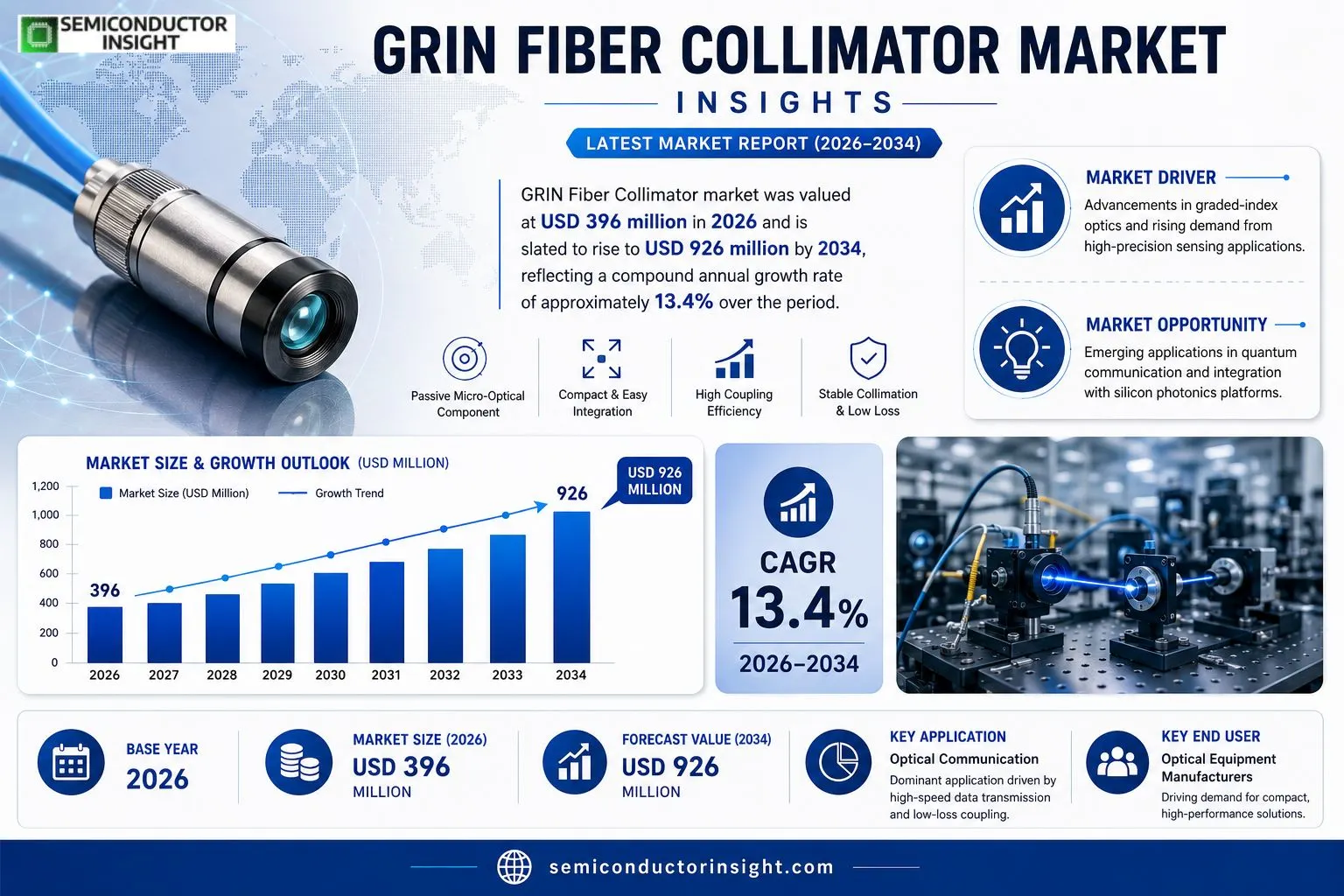
GRIN Fiber Collimator market was valued at USD 396 million in 2026 and is slated to rise to USD 926 million by 2034, reflecting a compound annual growth rate of approximately 13.4% over the period.
A GRIN fiber collimator is a passive micro‑optical component that uses a graded‑index lens to transform the divergent beam from an optical‑fiber end‑face into an almost parallel beam, or alternatively couples free‑space parallel light into a fiber. It typically consists of a GRIN lens, a ceramic or metal sleeve, an optical‑fiber pigtail or connector, and an anti‑reflection coating. Its compact size, straightforward assembly and cost efficiency drive adoption across optical‑communication testing, fiber‑optic sensing, laser coupling/isolation/combining, spectroscopic instruments, OCT and biophotonics systems, quantum optics platforms and modular automation testing where stable collimation and high coupling efficiency are essential.
MARKET DRIVERS
Advancements in Graded‑Index Optics
The evolution of graded‑index (GRIN) lens manufacturing has lowered wavefront distortion, enabling tighter beam collimation. Precision molding and laser‑driven polishing now deliver sub‑micron surface tolerances, which directly enhances the performance envelope of GRIN fiber collimators. This technical leap expands the addressable market beyond traditional telecom links.
Demand from High‑Precision Sensing Applications
Industries such as biomedical imaging, LIDAR, and aerospace testing rely on compact, alignment‑tolerant optics. The push toward miniaturized sensor modules drives engineers to select GRIN fiber collimators for their small footprint and inherent robustness against vibration. Consequently, OEMs are allocating larger share of R&D budgets to integrate these components.
➤ Manufacturers that integrate micro‑assembly techniques gain a competitive edge
Adoption of automated pick‑and‑place platforms reduces labor intensity and improves repeatability, translating into lower total cost of ownership for end‑users. When GRIN Fiber Collimator Market benchmarks against conventional bulk optics, the cost advantage becomes a decisive factor for volume manufacturers.
MARKET CHALLENGES
Regulatory Hurdles in Medical Devices
Medical‑grade collimators must satisfy stringent FDA and CE certifications, which prolong product qualification cycles. Small and medium‑size suppliers often lack dedicated compliance teams, resulting in delayed market entry and reduced agility.
Other Challenges
Supply Chain Volatility
The reliance on high‑purity glass substrates subjects manufacturers to fluctuations in raw material pricing. Recent geopolitical tensions have exposed the fragility of cross‑border logistics, prompting firms to reassess single‑source contracts.Coupled with rising labor costs in established fabrication hubs, these dynamics compress profit margins and force players to explore cost‑saving innovations such as in‑house glass synthesis.
MARKET RESTRAINTS
Thermal Stability Limitations
GRIN lenses exhibit temperature‑dependent refractive index shifts, which can degrade beam quality in high‑heat environments. While passive compensation techniques exist, they increase design complexity and bill‑of‑materials cost.Alternative collimation solutions, such as micro‑prism arrays, are gaining traction in sectors where thermal drift is intolerable, thereby siphoning potential demand from the GRIN segment.Furthermore, the capital expenditure required to retrofit existing production lines with temperature‑controlled chambers presents a barrier for legacy manufacturers seeking to upgrade their portfolios.
MARKET OPPORTUNITIES
Emerging Applications in Quantum Communication
Quantum key distribution (QKD) networks depend on low‑loss, highly stable optical interfaces. GRIN fiber collimators, with their minimal insertion loss and compact form factor, are uniquely positioned to meet the stringent alignment tolerances demanded by quantum channels.Integration with silicon photonics platforms is opening new avenues for on‑chip beam shaping. Collaborative projects between foundries and optical component firms are prototyping hybrid modules that embed GRIN collimators directly onto photonic chips, promising a surge in demand.APAC’s rapid rollout of fiber‑to‑the‑home (FTTH) and 5G backhaul infrastructure creates a fertile environment for deploying GRIN‑based solutions in dense urban deployments, where space constraints and performance specifications converge.
GRIN Fiber Collimator Market Trends
Rising Demand for High‑Precision Optical Coupling in Data Centers
The acceleration of cloud services has forced hyperscale operators to pack more transceivers per rack. As wavelengths shrink and channel counts climb, the tolerance budget for fiber‑to‑chip interfaces tightens dramatically. GRIN Fiber Collimator devices, with their compact form factor and ability to produce near‑parallel beams, are becoming the preferred solution for intra‑rack testing and automated link verification. Their low insertion loss and repeatable alignment reduce downtime, directly influencing carrier‑level service‑level agreements. Vendors that embed these collimators into turnkey transceiver modules are therefore capturing a larger share of the data‑center equipment spend, while system integrators benefit from faster rollout cycles and lower inventory complexity.
Other Trends
Integration of GRIN Collimators in Quantum Photonics
Quantum key distribution and entanglement‑based sensing rely on exquisitely stable free‑space pathways. Unlike bulk lenses, graded‑index elements preserve beam quality over short distances without introducing additional alignment stages. Recent prototype demonstrations show that embedding a GRIN Fiber Collimator directly onto a photonic chip lowers the platform’s footprint by 30 % and improves coupling efficiency beyond 95 %. This performance edge is prompting research institutions and emerging quantum‑hardware firms to specify GRIN‑based solutions in grant proposals, creating a nascent but fast‑moving demand segment that sits outside traditional telecom channels.
Shift Toward Low‑Outgassing Materials for Industrial Automation
Industrial test rigs that operate in clean‑room or vacuum environments demand components with minimal volatile organic compound (VOC) release. Manufacturers are therefore revisiting the ceramic and metal sleeve compositions of GRIN Fiber Collimators, opting for high‑purity alloys and low‑outgassing potting compounds. This material evolution not only extends device lifetime under thermal cycling but also satisfies stringent aerospace and semiconductor‑fab specifications. Companies that pre‑emptively qualify their collimator lines for these regimes gain a competitive edge, as system designers increasingly favor suppliers who can certify compliance without costly redesigns. Consequently, the supply chain is seeing a modest shift toward specialized coating services and tighter tolerances on end‑face beveling, reinforcing the importance of upstream material quality for downstream system reliability.
COMPETITIVE LANDSCAPE
Key Industry Players
Competitive Overview of GRIN Fiber Collimator Market
Thorlabs dominates the GRIN fiber collimator segment through a vertically integrated model that spans precision glass‑preform production to final assembly for data‑center testing kits. Its extensive product catalogue, backed by an established service network, allows the firm to command gross margins that regularly exceed 40 %. By leveraging economies of scale in GRIN lens grinding and coating, Thorlabs can offer unit prices near the market average while preserving a cost advantage in high‑volume orders. The company’s strong relationships with optical‑communication OEMs and research laboratories reinforce a barrier to entry for new entrants, consolidating its position at the top of the midstream value chain.Beyond the market leader, a cluster of specialized manufacturers competes on niche capabilities. Newport Corporation and Edmund Optics differentiate themselves with adjustable‑focus collimators and premium ceramic sleeves, targeting laboratories that require sub‑micron alignment tolerance. Laser Components and Flyin Group focus on cost‑efficient fixed‑focal products for industrial automation, often securing contracts with sensor integrators in Asia. Optek Systems, Mightex, SQS, Brimrose Corp., and C.F. Technology (Beijing) each carve out regional footholdsleveraging local supply chains for GRIN glass and low‑outgassing potting compoundsto serve customers in Europe and the Pacific. Emerging players such as Hamamatsu Photonics and OZ Optics introduce hybrid glass‑silicon lens stacks, aiming to raise coupling efficiency for quantum‑optics platforms. Collectively, this diversified ecosystem yields a competitive environment where product‑specific performance, regional manufacturing agility, and after‑sales support shape market share.
List of Key GRIN Fiber Collimator Companies Profiled
- Thorlabs
- Newport Corporation
- Laser Components
- Flyin Group
- Optek Systems
- Mightex
- SQS
- Edmund Optics
- Brimrose Corp.
- C.F. Technology (Beijing)
- Hamamatsu Photonics
- OZ Optics
Segment Analysis:
| Segment Category | Sub-Segments | Key Insights |
| By Type |
|
Fixed Focal Length
|
| By Application |
|
Optical Communication
|
| By End User |
|
Optical Equipment Manufacturers
|
| By Fiber Type |
|
Single‑Mode
|
| By System Integration |
|
Data Center Testing
|
Regional Analysis: GRIN Fiber Collimator Market
Europe
A dense network of precision optics workshops in the Benelux region enables low‑volume, high‑value production runs. This agility supports bespoke GRIN lens configurations that larger fabs cannot accommodate, sustaining demand from niche research labs.
EU directives on optical component safety and electromagnetic compatibility compel manufacturers to adopt rigorous testing protocols, which, while costly, enhance product credibility in global markets.
Telecom carriers upgrading to space‑division multiplexing, as well as aerospace firms requiring lightweight beam collimators, constitute the primary revenue streams for European suppliers.
Horizon Europe grants increasingly favor projects that combine GRIN optics with silicon photonics, encouraging cross‑disciplinary ventures that expand market reach.
North America
North America’s GRIN Fiber Collimator Market is driven by the United States’ expansive data‑center footprint and a defense sector that values high‑precision optical assemblies. While the region lacks the same level of coordinated R&D funding as Europe, private venture capital flows into startups that marry GRIN lenses with integrated photonic chips. This financial dynamism creates an environment where rapid prototype cycles are feasible, attracting telecom operators eager for compact collimation solutions to densify network cores. The principal challenge lies in navigating a fragmented standards landscape, which can slow adoption for manufacturers lacking deep regulatory expertise.
Asia‑Pacific
In Asia‑Pacific, rapid urbanization and aggressive broadband roll‑out programs stimulate interest in GRIN Fiber Collimator technologies, especially in countries such as Japan and South Korea. Local manufacturers benefit from lower labor costs and sizable domestic demand for high‑speed fiber links, yet they often contend with intellectual‑property pressures from established European players. Collaborative research consortia funded by regional governments aim to close the technology gap, focusing on integrating GRIN optics into emerging 5G backhaul architectures. Market growth will hinge on the ability to harmonize product specifications across diverse national standards.
South America
South America exhibits a cautious yet growing appetite for GRIN Fiber Collimator solutions, primarily in Brazil’s expanding telecom infrastructure. Operators view the technology as a pathway to extend network reach without incurring the weight penalties of traditional bulk optics. However, limited local expertise and reliance on imported components curtail the speed of market uptake. Partnerships with European firms are emerging as a pragmatic approach to acquire know‑how while tailoring solutions to regional cost sensitivities.
Middle East & Africa
The Middle East & Africa region presents a mixed outlook. Wealthier Gulf states invest heavily in smart‑city initiatives, where high‑density fiber networks demand efficient collimation components. Conversely, many African nations remain constrained by nascent broadband penetration, limiting immediate demand. Companies that can offer modular GRIN solutions adaptable to both high‑end projects and cost‑restricted deployments stand to gain a foothold as the region gradually upgrades its optical backbone.
Report Scope
This market research report provides a comprehensive analysis of the GRIN Fiber Collimator Market , covering the forecast period 2026–2034. It offers detailed insights into market dynamics, technological advancements, competitive landscape, and key trends shaping the industry.
Key focus areas of the report include:
- Market Overview: The report begins with an overview outlining its current market scenario, key growth indicators, and industry transformation drivers. It discusses macroeconomic factors, demand–supply balance, regulatory landscape, and the strategic role of semiconductors in powering advancements across industries such as automotive, telecommunications, consumer electronics, and industrial automation.
- Market Size & Forecast: Historical data and future projections for revenue, unit shipments, and market value across major regions and segments.
- Segmentation Analysis: Detailed breakdown by product type, technology, application, and end-user industry to identify high-growth segments and investment opportunities.
- Regional Insights: Insights into market performance across North America, Europe, Asia-Pacific, Latin America, and the Middle East & Africa, including country-level analysis where relevant.
- Competitive Landscape: Profiles of leading market participants, including their product offerings, R&D focus, manufacturing capacity, pricing strategies, and recent developments such as mergers, acquisitions, and partnerships.
- Technology Trends & Innovation: Assessment of emerging technologies, integration of AI/IoT, semiconductor design trends, fabrication techniques, and evolving industry standards.
- Market Drivers & Restraints: Evaluation of factors driving market growth along with challenges, supply chain constraints, regulatory issues, and market-entry barriers.
- Stakeholder Insights: Insights for component suppliers, OEMs, system integrators, investors, and policymakers regarding the evolving ecosystem and strategic opportunities.
Primary and secondary research methods are employed, including interviews with industry experts, data from verified sources, and real-time market intelligence to ensure the accuracy and reliability of the insights presented.
FREQUENTLY ASKED QUESTIONS:
What is the current market size of GRIN Fiber Collimator Market?
-> GRIN Fiber Collimator Market was valued at USD 396 million in 2026 and is expected to reach USD 926 million by 2034, growing at a CAGR of 13.4% during the forecast period.
Which key companies operate in GRIN Fiber Collimator Market?
-> Key players include Thorlabs, Newport Corporation, Laser Components, Flyin Group, Optek Systems, Mightex, SQS, Edmund Optics, Brimrose Corp., C.F.Technology (Beijing), among others.
What are the key growth drivers?
-> Growth is driven by rising demand in optical communication networks, data‑center optical device testing, fiber‑optic sensing and interferometry, laser and amplifier coupling, spectroscopic and metrological instruments, OCT & biophotonics, quantum/precision optics platforms, and industrial automation testing that require stable collimation and high coupling efficiency.
Which region dominates the market?
-> The market is broadly distributed across major regionsincluding North America, Europe, and Asiawith significant demand reported in the United States, China, Japan, and Germany, reflecting a globally balanced market footprint.
What are the emerging trends?
-> Emerging trends include miniaturization of GRIN collimator modules, integration with silicon‑photonic platforms, increased adoption in quantum optics experiments, and development of low‑outgassing, temperature‑stable packaging for high‑reliability industrial applications.
Get Sample Report PDF for Exclusive Insights
Report Sample Includes
- Table of Contents
- List of Tables & Figures
- Charts, Research Methodology, and more...
 Download Sample Report PDF