Multi-point Laser Vibration Meter Market Insights
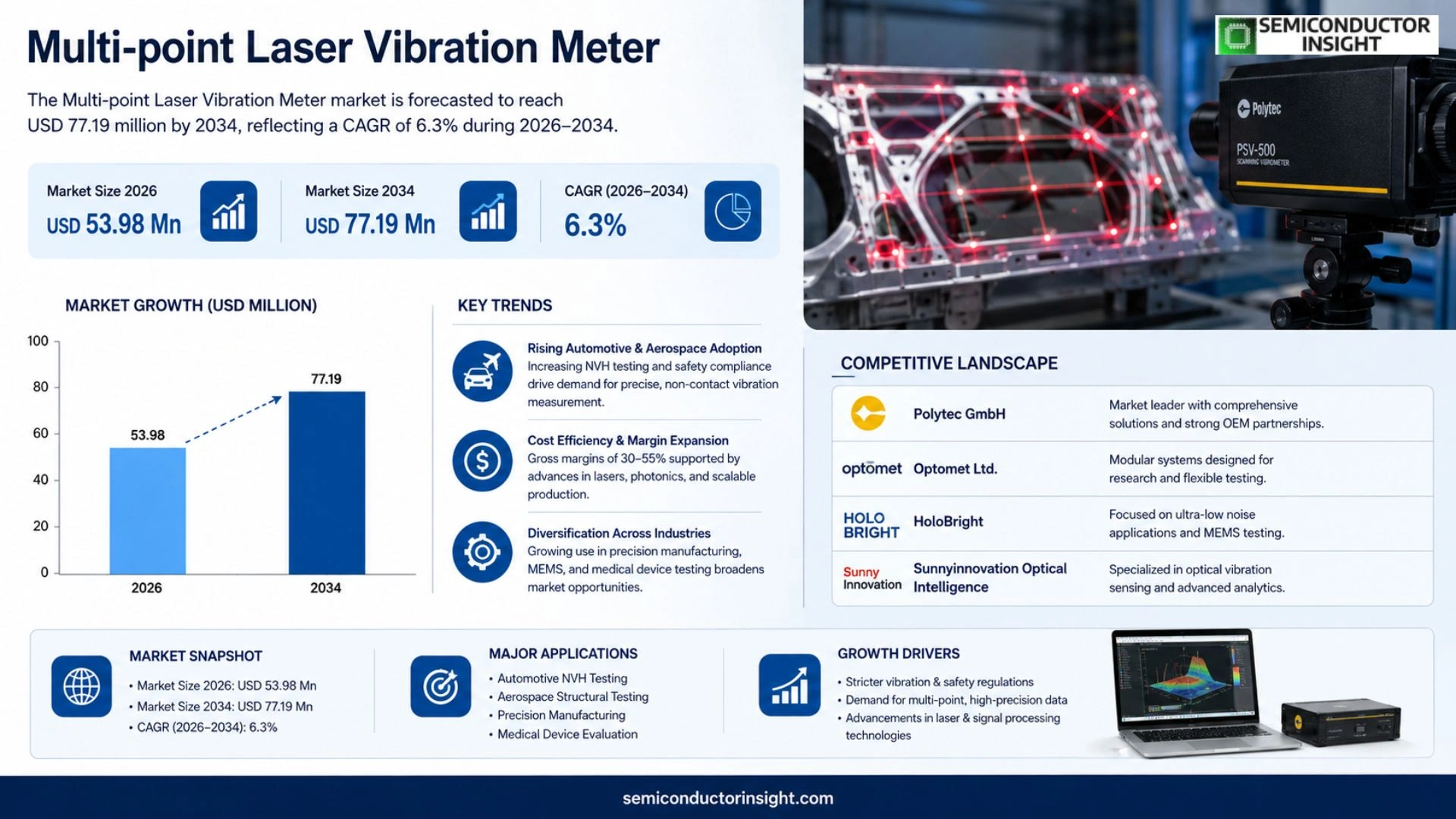
Multi-point Laser Vibration Meter market was valued at USD 50.81 million in 2025 and is forecasted to reach USD 77.19 million by 2032, reflecting a CAGR of 6.3% over the forecast horizon.
Multi‑point Laser Vibration Meters are non‑contact optical instruments that exploit the laser Doppler effect to capture frequency shifts from vibrating surfaces. By analysing these shifts, velocity, displacement and acceleration can be derived simultaneously at several discrete points, enabling precise modal testing of large structures as well as high‑frequency micro‑devices such as MEMS.
Growth is underpinned by expanding NVH requirements in automotive and rail sectors, heightened focus on structural health monitoring in aerospace, and broader adoption of MEMS testing in consumer electronics. Advances in narrow‑linewidth fiber lasers and high‑speed digitisation have lowered entry barriers, encouraging test laboratories and OEMs alike to integrate multi‑point solutions. Leading suppliers,including Polytec, Optomet, HoloBright, Sunnyinnovation Optical Intelligence and SIMTRUM Pte.Ltd.,continue to broaden their portfolios through incremental hardware upgrades and software algorithm enhancements.
MARKET DRIVERS
Increasing demand for non‑contact inspection
Multi-point Laser Vibration Meter Market is gaining traction as manufacturers prioritize non‑contact measurement to avoid sensor wear on rotating components. By eliminating physical contact, plants reduce downtime and extend equipment life, which directly improves overall productivity.
Advancements in laser sensor technology
Recent breakthroughs in diode stability and wavelength tuning have lowered measurement uncertainty, allowing engineers to capture subtle vibration signatures across multiple points simultaneously. This technical edge makes laser‑based meters a preferred alternative to traditional piezoelectric arrays.
➤ The convergence of tighter quality standards and affordable laser modules is reshaping condition‑monitoring strategies worldwide.
As OEMs embed predictive‑maintenance algorithms into their control systems, the value proposition of multi‑point laser solutions becomes increasingly compelling, prompting capital allocation toward next‑generation instrumentation.
MARKET CHALLENGES
High upfront investment
Deploying a full suite of laser vibration meters requires a sizable budget for hardware, calibration tools, and staff training. For mid‑size facilities, the cost‑benefit ratio can appear marginal until a clear ROI is demonstrated through reduced unscheduled outages.
Other Challenges
Integration with legacy monitoring platforms
Many plants operate legacy analog or early‑digital vibration systems. Aligning newer laser data streams with existing SCADA interfaces demands custom middleware, which can delay deployment and increase project complexity.
MARKET RESTRAINTS
Regulatory compliance hurdles
In sectors such as aerospace and nuclear power, certification processes for laser‑based monitoring equipment are rigorous. The need to satisfy multiple safety standards can elongate time‑to‑market, discouraging smaller vendors from entering Multi-point Laser Vibration Meter Market.
MARKET OPPORTUNITIES
Emerging applications in renewable energy
Wind turbine gearboxes and offshore solar tracker mechanisms present a fertile ground for multi‑point laser vibration analysis. The ability to monitor dispersed components from a single optical line reduces the need for extensive cabling, a distinct advantage in remote, weather‑exposed installations.
Multi-point Laser Vibration Meter Market Trends
Rising Adoption in Automotive and Aerospace Testing
The global market registered a valuation of roughly USD 50.8 million in 2025 and is estimated to climb to about USD 77.2 million by 2032. Production volumes topped 2,000 units in 2025, while the average selling price hovered near USD 27,640. This upward trajectory reflects intensified demand from automotive OEMs and aerospace integrators that rely on precise modal testing to meet tightening NVH (noise‑vibration‑harshness) regulations and safety certifications. As vehicle electrification spreads, the need to validate lightweight structures and high‑speed rotating components pushes engineers toward non‑contact optical solutions. Simultaneously, aerospace programs are modernising their ground‑testing facilities, favoring instruments capable of simultaneous multi‑point measurements to reduce test time and improve data fidelity. The combination of regulatory pressure and product‑development speed therefore fuels a steady uptick in unit shipments and justifies the modest price premium associated with laser‑based systems.
Other Trends
Cost Efficiency and Margin Expansion
Gross profit margins for manufacturers sit between 30 % and 55 %, a range that underscores both the high‑value nature of the core interferometric hardware and the cost discipline achievable through volume production of narrow‑linewidth lasers and integrated photonic components. Suppliers that have secured stable sources of fiber lasers and high‑speed ADCs tend to realise better cost structures, allowing them to offer competitive pricing without eroding profitability. As the supply chain matures, economies of scale are expected to lower the per‑unit cost of optical heads and signal‑processing boards, potentially compressing margins for newer entrants while rewarding incumbents with entrenched relationships. This cost dynamic also encourages OEMs to bundle multiple units for large‑scale testing programmes, further stabilising revenue streams for the leading players.
Diversification into Precision Manufacturing and Medical Devices
Beyond the traditional automotive and aerospace segments, the market is witnessing a noticeable shift toward precision‑machine‑tool monitoring, MEMS device characterisation, and medical equipment vibration assessment. The ability of multi‑point laser systems to capture high‑frequency micro‑structural vibrations makes them attractive for quality‑control labs that need to validate the performance of piezoelectric transducers or surgical robotics. This broadening of application scope introduces new revenue channels and mitigates reliance on any single industry’s cyclical demand. For suppliers, the diversification necessitates software extensions,such as advanced spectral analysis and automated reporting,to satisfy the distinct compliance frameworks of each vertical. Companies that can seamlessly integrate these capabilities are likely to capture incremental market share, while those that remain focused solely on automotive‑centric solutions may find growth opportunities increasingly limited.
COMPETITIVE LANDSCAPE
Key Industry Players
Multi-point Laser Vibration Meter Market: Competitive Overview
The market is led by a handful of well‑capitalized incumbents whose product portfolios combine high‑precision fiber‑laser sources with proprietary signal‑processing algorithms. Polytec GmbH commands the largest share, leveraging its long‑standing reputation in optical metrology to secure contracts with automotive OEMs and aerospace integrators. Its ability to ship turnkey systems,integrating laser heads, high‑speed ADCs and bespoke software,creates a barrier for newcomers and sustains pricing power. Optomet Ltd. follows closely, differentiating through a modular architecture that appeals to research institutions seeking flexibility in modal testing. HoloBright and Sunnyinnovation Optical Intelligence occupy the upper‑mid tier, each focusing on niche segments such as MEMS device characterization, where ultra‑low noise detection is paramount. The concentration of revenue among these four firms reflects a market where scale, calibration expertise, and after‑sales support are decisive factors for client selection.
Beyond the top tier, a diverse set of specialized manufacturers injects competition on technological depth and application focus. SIMTRUM Pte. Ltd. has carved out a presence in precision machine‑tool monitoring by pairing its laser heads with AI‑enhanced vibration analytics. KVH Industries targets rail‑transit vibration assessment through ruggedized field units, while Nanosonics concentrates on medical‑equipment diagnostics. Smaller innovators such as LIGO Technologies, Bruker Instruments, HBM (Hottinger Brüel & Kjær), National Instruments and Keysight Technologies contribute incremental advances in detector arrays and FPGA‑based processing, often partnering with system integrators to reach end users. This tiered ecosystem fosters a dynamic where large players protect core markets while niche firms chase emerging opportunities, shaping both pricing structures and the pace of innovation.
List of Key Multi-point Laser Vibration Meter Companies Profiled
- Polytec GmbH
- Optomet Ltd.
- HoloBright Inc.
- Sunnyinnovation Optical Intelligence
- SIMTRUM Pte. Ltd.
- KVH Industries
- Nanosonics Ltd.
- LIGO Technologies
- Bruker Instruments
- HBM (Hottinger Brüel & Kjær)
- National Instruments
- Keysight Technologies
- Photonics Insight Corp.
Segment Analysis:
| Segment Category | Sub-Segments | Key Insights |
| By Type |
|
Parallel Multi-point
|
| By Application |
|
Automotive & Transportation
|
| By End User |
|
Test Laboratories
|
| By Technology |
|
Laser Source Types
|
| By Market Driver |
|
Advanced Modal Testing
|
Regional Analysis: Multi-point Laser Vibration Meter Market
OEMs in the United States are embedding multi‑point laser sensors directly onto robotics lines, allowing real‑time defect detection and reducing scrap rates. The seamless integration with existing PLC architectures shortens the validation timeline for new production cells.
Leading aerospace firms employ laser vibration meters for turbine blade health monitoring, a practice that has become a cornerstone of their safety assurance programs and has spurred ancillary service ecosystems.
Power generation operators are scaling laser‑based vibration analysis across wind farms and gas turbines, attracted by the technology’s ability to capture minute oscillations that traditional transducers miss.
Recent mergers among sensor manufacturers have created a more unified distribution network in North America, improving lead times and offering bundled calibration services that enhance customer confidence.
Europe
European manufacturers are capitalising on stringent EU directives that prioritise equipment longevity and carbon‑efficient operations. Nations such as Germany and France are channeling public‑private funds into Industry 4.0 pilots, where laser vibration meters serve as critical data sources for digital twins. The emphasis on cross‑border standardisation facilitates smoother market entry for vendors, while a mature aftermarket service culture ensures that operators receive continuous technical support, extending the functional lifespan of deployed assets.
Asia-Pacific
In the Asia‑Pacific corridor, rapid industrialisation combined with escalating demand for high‑speed production drives interest in laser‑based vibration diagnostics. China’s strategic push for advanced manufacturing and India’s burgeoning heavy‑industry sector create sizeable downstream demand. However, the market is still navigating heterogeneous regulatory landscapes, prompting local partners to act as translators between global technology providers and regional compliance offices. Collaborative test‑beds in Singapore and South Korea illustrate how regional ecosystems are experimenting with predictive maintenance models that could reshape cost structures.
South America
South American economies are transitioning from legacy monitoring methods toward more sophisticated laser solutions, especially within Brazil’s oil‑and‑gas sector and Chile’s mining operations. The shift is propelled by a growing awareness of equipment downtime costs and a regional push for operational resilience against geopolitical volatility. While financing constraints limit large‑scale rollouts, joint ventures with North American firms are introducing leasing arrangements that mitigate upfront CAPEX, thereby broadening market penetration.
Middle East & Africa
The Middle East & Africa region exhibits a heterogeneous adoption pattern. In the Gulf Cooperation Council, oil and petrochemical plants are early adopters, leveraging laser vibration meters to comply with asset‑integrity programs mandated by sovereign wealth funds. Conversely, sub‑Saharan markets are still evaluating cost‑benefit ratios amid limited technical expertise. Partnerships with multinational engineering firms are beginning to deliver training programmes that demystify laser diagnostics, setting the stage for a gradual but steady market expansion.
Report Scope
This market research report provides a comprehensive analysis of the Multi-point Laser Vibration Meter Market , covering the forecast period 2026–2034. It offers detailed insights into market dynamics, technological advancements, competitive landscape, and key trends shaping the industry.
Key focus areas of the report include:
- Market Overview: The report begins with an overview outlining its current market scenario, key growth indicators, and industry transformation drivers. It discusses macroeconomic factors, demand–supply balance, regulatory landscape, and the strategic role of semiconductors in powering advancements across industries such as automotive, telecommunications, consumer electronics, and industrial automation.
- Market Size & Forecast: Historical data and future projections for revenue, unit shipments, and market value across major regions and segments.
- Segmentation Analysis: Detailed breakdown by product type, technology, application, and end-user industry to identify high-growth segments and investment opportunities.
- Regional Insights: Insights into market performance across North America, Europe, Asia-Pacific, Latin America, and the Middle East & Africa, including country-level analysis where relevant.
- Competitive Landscape: Profiles of leading market participants, including their product offerings, R&D focus, manufacturing capacity, pricing strategies, and recent developments such as mergers, acquisitions, and partnerships.
- Technology Trends & Innovation: Assessment of emerging technologies, integration of AI/IoT, semiconductor design trends, fabrication techniques, and evolving industry standards.
- Market Drivers & Restraints: Evaluation of factors driving market growth along with challenges, supply chain constraints, regulatory issues, and market-entry barriers.
- Stakeholder Insights: Insights for component suppliers, OEMs, system integrators, investors, and policymakers regarding the evolving ecosystem and strategic opportunities.
Primary and secondary research methods are employed, including interviews with industry experts, data from verified sources, and real-time market intelligence to ensure the accuracy and reliability of the insights presented.
FREQUENTLY ASKED QUESTIONS:
What is the current market size of Multi-point Laser Vibration Meter Market?
-> Multi-point Laser Vibration Meter Market was valued at USD 50.81 million in 2025 and is expected to reach USD 77.19 million by 2032, growing at a CAGR of 6.3% during the forecast period.
Which key companies operate in Multi-point Laser Vibration Meter Market?
-> Key players include Polytec, Optomet, HoloBright, Sunnyinnovation Optical Intelligence, SIMTRUM Pte. Ltd.
What are the key growth drivers?
-> Key growth drivers include increasing demand for NVH testing in automotive and aerospace, rising adoption of precision monitoring for machine tools and rotating machinery, expanding use of MEMS and micro‑electro‑acoustic devices, and the need for advanced non‑contact vibration analysis in material and structural health monitoring.
Which region dominates the market?
-> North America holds a significant share driven by strong automotive and aerospace sectors, while Asia-Pacific exhibits rapid growth due to expanding manufacturing bases in China, Japan, and South Korea.
What are the emerging trends?
-> Emerging trends include integration of AI‑enabled data analytics for real‑time vibration assessment, development of portable multi‑point scanning systems, and advances in high‑speed digital signal processing to improve measurement accuracy for high‑frequency micro‑structures.

Get Sample Report PDF for Exclusive Insights
Report Sample Includes
- Table of Contents
- List of Tables & Figures
- Charts, Research Methodology, and more...
 Download Sample Report PDF