Home Laser Engraving Machine Market Insights
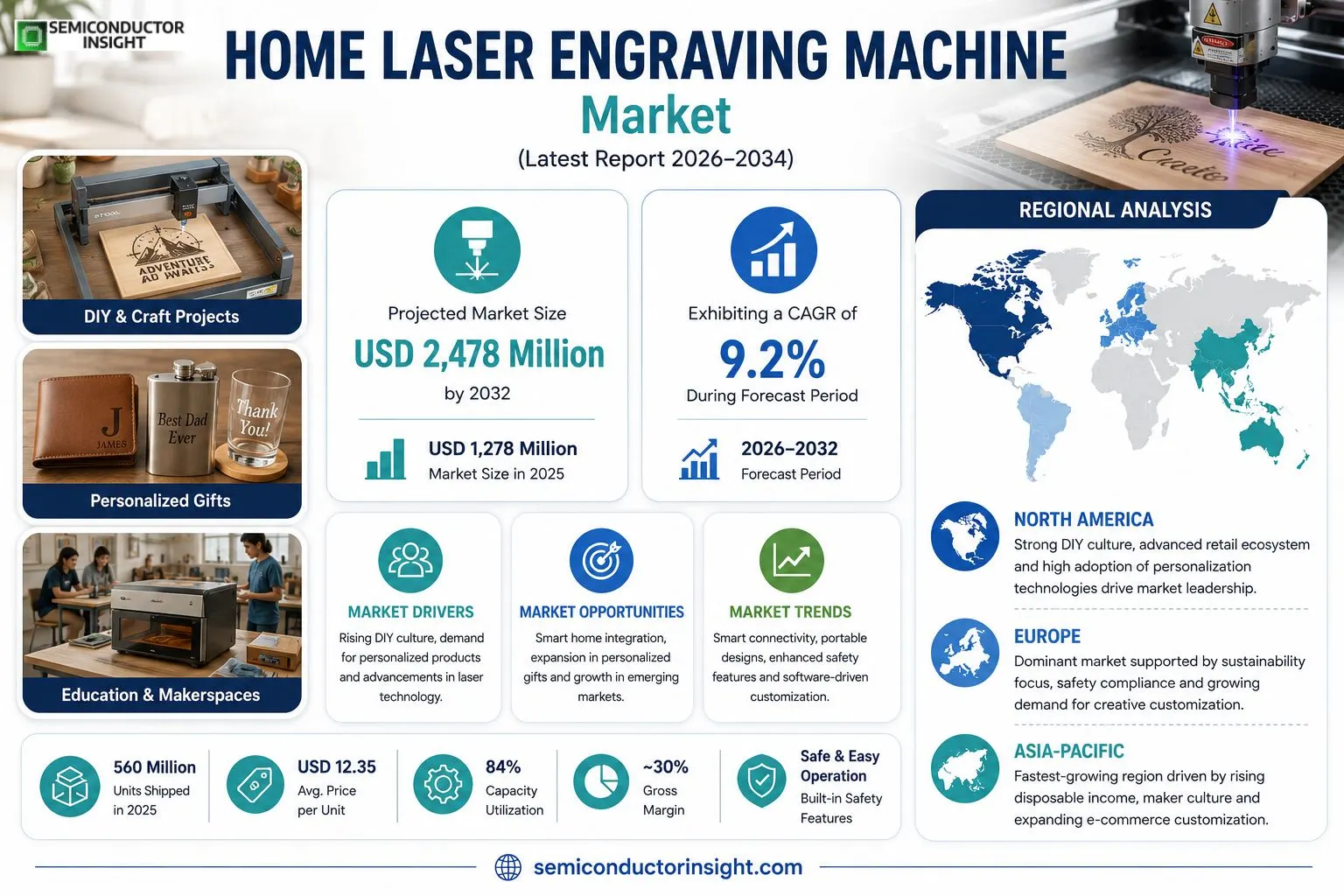
Home Laser Engraving Machine market size was valued at USD 1,278 million in 2025 and will rise to USD 2,478 million by 2032, delivering a CAGR of 9.2 % for the forecast period.
A home laser engraving machine is a compact digital fabrication device intended for personal or household use. It employs a diode or low‑power CO₂ laser combined with CNC motion control and design software to cut or mark materials such as wood, leather, acrylic, paper and select plastics. Compared with industrial‑grade equipment it offers lower cost, ease of operation and built‑in safety features, making it popular among hobbyists, small‑scale entrepreneurs and educational makerspaces.The market expands because DIY culture gains momentum, e‑commerce platforms fuel demand for personalized products and equipment prices continue to fall. Key manufacturersincluding xTool, Atomstack, Ortur, LaserPecker, Creality, Glowforge, Trotec and Epilog Laserare introducing models with higher power options, mobile‑app control and portable designs to capture craft hobbyists, education sectors and micro‑business sellers.
MARKET DRIVERS
Increasing DIY Culture
Home Laser Engraving Machine Market is buoyed by a surge in do‑it‑yourself projects, as homeowners seek cost‑effective ways to personalize décor, furniture, and small‑scale accessories. This shift translates into repeat purchases of consumables and upgrades, creating a stable revenue stream for manufacturers.
Advancements in Fiber Laser Technology
Recent improvements in diode and fiber laser modules have lowered power requirements while delivering sharper detail on a broader range of substrates. Such technical progress reduces entry barriers for hobbyists and encourages professional users to adopt compact units for prototyping.
➤ “Precision that once required industrial‑floor equipment is now achievable on a kitchen countertop, reshaping the value proposition for home‑based creators.”
Combined, these forces stimulate a virtuous cycle: greater consumer confidence drives higher unit sales, which in turn fuels further R&D investment, reinforcing Home Laser Engraving Machine Market’s momentum.
MARKET CHALLENGES
Technical Barriers for Hobbyists
Despite user‑friendly interfaces, many first‑time buyers encounter calibration complexities that affect cut quality. The learning curve can deter casual users, leading to lower satisfaction scores and potential churn.
Other Challenges
Safety Regulations
Regional safety standards increasingly mandate built‑in shielding and automatic shut‑off features. Compliance adds to component costs, squeezing margins for low‑priced models.
MARKET RESTRAINTS
High Initial Investment
The upfront outlay for a capable home unit remains a deterrent for budget‑conscious consumers, especially when comparable tabletop alternatives are priced lower but lack laser capability.
Limited Material Compatibility
Current models struggle with thicker plastics and certain wood composites, restricting the range of projects that can be completed without outsourcing to professional services.
Scarcity of After‑sales Support
Many vendors operate primarily online, offering minimal local service networks. Delayed repairs can frustrate users and erode brand loyalty.
MARKET OPPORTUNITIES
Integration with Smart Home Platforms
Embedding IoT connectivity allows machines to be scheduled via voice assistants, opening a revenue stream for subscription‑based design libraries that sync with home automation ecosystems.
Expansion into Personalized Gift Segment
Consumers increasingly seek bespoke items for celebrations; laser‑engraved metal keychains, glassware, and wooden keepsakes present high‑margin niches that manufacturers can target with targeted marketing campaigns.
Emerging Markets in Southeast Asia
Rising disposable income and a growing maker movement in countries such as Vietnam and the Philippines signal untapped demand, prompting distributors to localize product assortments and pricing strategies.
Home Laser Engraving Machine Market Trends
DIY Adoption Accelerates Consumer Base
In recent years, hobbyists and small‑scale entrepreneurs have embraced compact laser devices as an extension of the broader maker movement. The convenience of plug‑and‑play operation, combined with affordable diode‑laser modules, has turned Home Laser Engraving Machine Market into a focal point for personalized product creation. Users cite the ability to personalize gifts, fabricate unique décor, and launch micro‑brands on e‑commerce platforms as primary motivations. This shift has widened the addressable audience beyond traditional craftsmen to include millennials seeking side‑income streams, thereby reshaping sales channels toward online marketplaces and specialty hobby retailers.
Other Trends
Smart Connectivity and App‑Driven Workflows
Manufacturers are embedding Bluetooth and Wi‑Fi modules that link directly to mobile design apps. This evolution reduces reliance on desktop software, allowing creators to edit graphics on tablets while the machine executes cuts in real time. The seamless user experience shortens setup cycles and lowers the barrier for first‑time buyers. As a result, firms that prioritize intuitive app ecosystems are capturing a larger share of the home‑user segment, while those lagging in software integration face declining relevance.
Safety Enhancements Expand Household Acceptance
Safety concerns have historically limited broader household penetration. Recent product generations incorporate automatic shut‑off sensors, enclosed beam paths, and child‑lock functions that meet stricter consumer‑grade certifications. These features not only reassure families but also enable retailers to position the devices alongside other household electronics. The heightened emphasis on protection aligns with growing consumer expectations for low‑risk, at‑home manufacturing tools, encouraging mainstream adoption and creating opportunities for ancillary services such as warranty extensions and consumable sales.
COMPETITIVE LANDSCAPEKey Industry Players
Competitive Overview of Home Laser Engraving Machine Market
xTool has leveraged a tightly integrated hardware‑software ecosystem to secure a leading share of the consumer segment. By offering modular diode‑laser modules, cloud‑based design libraries and an intuitive desktop interface, the company has attracted hobbyists seeking reliable performance without a steep learning curve. Its aggressive pricing strategy, combined with a robust distribution network across North America, Europe and Asia, reinforces its position as the benchmark for quality‑focused buyers. The firm’s emphasis on safety certifications and portable chassis has also opened channels in educational programs and maker‑space curricula, expanding its addressable market beyond pure DIY enthusiasts.Beyond the flagship, a cluster of specialized manufacturers is carving out niches through differentiated product attributes. Atomstack and Ortur compete on raw power and price, appealing to small‑scale e‑commerce sellers who prioritize throughput. LaserPecker’s ultra‑compact handheld units target on‑the‑go personalization, while Creality and Glowforge focus on seamless integration with 3‑D printing workflows. European incumbents such as Trotec and Epilog Laser bring legacy industrial expertise into the home arena, offering high‑precision optics that attract professional craftsmen. Emerging brands like Full Spectrum Laser, Dremel, Boss Laser, Thunder Laser, Small Laser, Flux and Beamo round out the landscape, each emphasizing unique software ecosystems or material versatility to capture fragmented user groups.
List of Key Home Laser Engraving Machine Companies Profiled
Segment Analysis:
| Segment Category | Sub-Segments | Key Insights |
| By Type |
|
Diode Laser
|
| By Application |
|
DIY & Craft Making
|
| By End User |
|
Hobbyists & Makers
|
| By Machine Structure |
|
Open Frame
|
| By Control Method |
|
Mobile App Control
|
Regional Analysis: Home Laser Engraving Machine Market
North America
The prevalence of maker‑culture podcasts and DIY tutorial series has cultivated a mindset where personalizing everyday objects feels routine. This cultural shift fuels demand for home‑grade laser devices that promise quick setup, intuitive UI, and reliable safety interlocks, making the technology approachable for non‑technical users.
Federal agencies have issued clear guidelines on laser classification for consumer products, granting manufacturers a predictable compliance pathway. The resulting regulatory certainty encourages investment in higher‑performance models while preserving consumer trust in product safety.
Proximity to semiconductor and optics suppliers shortens component lead times, enabling rapid prototyping cycles. This logistical advantage lets firms respond to emerging design trends without the bottlenecks typical of distant sourcing strategies.
Domestic brands differentiate through integrated software ecosystems, bundling cloud‑based design libraries with hardware sales. This value‑added approach deepens user engagement and creates recurring revenue streams beyond the initial machine purchase.
Europe
European consumers exhibit a strong preference for environmentally responsible manufacturing, prompting brands to highlight low‑energy laser modules and recyclable housing materials. In Germany and the Nordic region, design‑centric retail concepts showcase the aesthetic possibilities of engravings on wood, glass, and metal, reinforcing the technology’s appeal to interior‑design enthusiasts. Regulatory bodies across the EU maintain a harmonized safety framework, which simplifies cross‑border product launches and encourages pan‑European marketing campaigns. Meanwhile, a fragmented network of boutique workshops acts as a grassroots distribution channel, offering personalized service that bridges the gap between online discovery and hands‑on experimentation.
Asia‑Pacific
The Asia‑Pacific arena is defined by a youthful population eager to express identity through customized accessories. Markets such as Japan, South Korea, and Australia see a surge in compact laser units that integrate with mobile apps, catering to on‑the‑go creators. Localized content creators publish region‑specific design templates, accelerating adoption among first‑time buyers. Although import duties in some territories raise price points, the proliferation of domestic component manufacturers is beginning to offset cost pressures, allowing regional players to compete on both price and performance.
South America
In South America, emerging middle‑class households view home laser engraving as a pathway to small‑scale entrepreneurship. Countries like Brazil and Chile report a growing community of artisans who sell personalized goods through social‑media marketplaces. The market’s evolution is supported by micro‑financing initiatives that subsidize the acquisition of entry‑level machines, lowering the barrier to entry for fledgling creators. Cultural festivals that celebrate handcrafted items further amplify demand, positioning the technology as a catalyst for localized value‑addition.
Middle East & Africa
The Middle East & Africa region is witnessing an incremental shift from industrial‑grade laser applications to consumer‑focused solutions, largely driven by rising disposable incomes in the Gulf states and urban expansion in Sub‑Saharan corridors. Retailers are curating showroom experiences that allow shoppers to preview engraving results on a variety of substrates, helping demystify the technology. Simultaneously, regional distributors are forming alliances with software developers to localize design interfaces, ensuring cultural relevance and easing adoption among non‑English speaking users.
Report Scope
This market research report provides a comprehensive analysis of the Home Laser Engraving Machine Market , covering the forecast period 2026–2034. It offers detailed insights into market dynamics, technological advancements, competitive landscape, and key trends shaping the industry.
Key focus areas of the report include:
- Market Overview: The report begins with an overview outlining its current market scenario, key growth indicators, and industry transformation drivers. It discusses macroeconomic factors, demand–supply balance, regulatory landscape, and the strategic role of semiconductors in powering advancements across industries such as automotive, telecommunications, consumer electronics, and industrial automation.
- Market Size & Forecast: Historical data and future projections for revenue, unit shipments, and market value across major regions and segments.
- Segmentation Analysis: Detailed breakdown by product type, technology, application, and end-user industry to identify high-growth segments and investment opportunities.
- Regional Insights: Insights into market performance across North America, Europe, Asia-Pacific, Latin America, and the Middle East & Africa, including country-level analysis where relevant.
- Competitive Landscape: Profiles of leading market participants, including their product offerings, R&D focus, manufacturing capacity, pricing strategies, and recent developments such as mergers, acquisitions, and partnerships.
- Technology Trends & Innovation: Assessment of emerging technologies, integration of AI/IoT, semiconductor design trends, fabrication techniques, and evolving industry standards.
- Market Drivers & Restraints: Evaluation of factors driving market growth along with challenges, supply chain constraints, regulatory issues, and market-entry barriers.
- Stakeholder Insights: Insights for component suppliers, OEMs, system integrators, investors, and policymakers regarding the evolving ecosystem and strategic opportunities.
Primary and secondary research methods are employed, including interviews with industry experts, data from verified sources, and real-time market intelligence to ensure the accuracy and reliability of the insights presented.
FREQUENTLY ASKED QUESTIONS:
What is the current market size of Home Laser Engraving Machine Market?
-> Home Laser Engraving Machine Market was valued at USD 1,278 million in 2025 and is expected to reach USD 2,478 million by 2032.
What is the expected CAGR for Home Laser Engraving Machine Market?
-> The market is projected to grow at a compound annual growth rate of 9.2% over the forecast period.
Which key companies operate in Home Laser Engraving Machine Market?
-> Key players include xTool, Atomstack, Ortur, LaserPecker, Creality, Glowforge, Trotec, Epilog Laser, among others.
What are the key growth drivers?
-> Key growth drivers include rising DIY culture, increasing demand for personalized products, declining equipment costs, adoption in maker education, and expanding e‑commerce customization services.
Which region dominates the market?
-> Asia‑Pacific is the fastest‑growing region, while Europe remains a dominant market in terms of revenue.
What are the emerging trends?
-> Emerging trends include greater intelligence and IoT integration, lightweight portable designs, enhanced safety features, and software‑driven customization tools.
Get Sample Report PDF for Exclusive Insights
Report Sample Includes
- Table of Contents
- List of Tables & Figures
- Charts, Research Methodology, and more...
 Download Sample Report PDF