GRIN Lens Fiber Collimator Market Insights
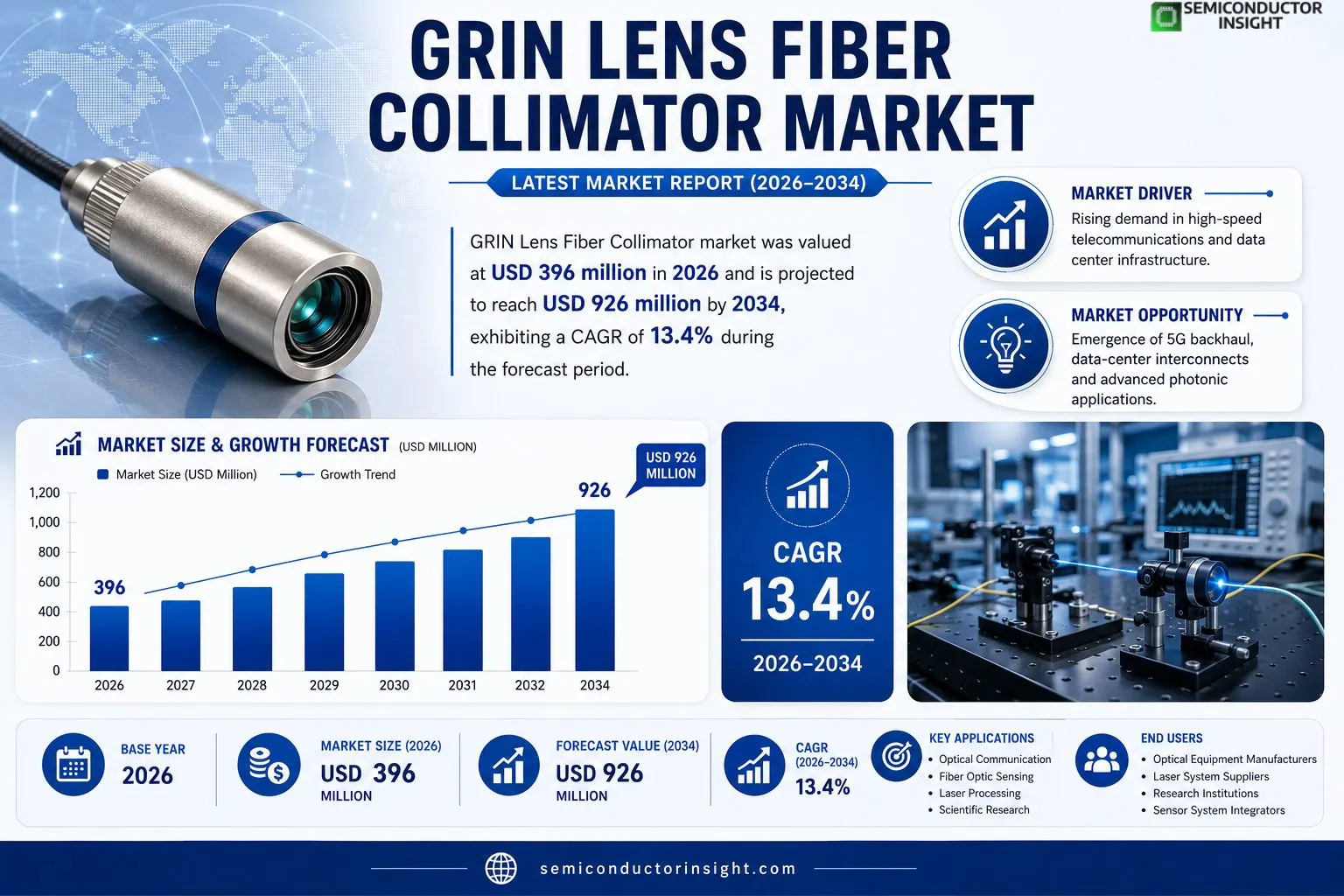
GRIN Lens Fiber Collimator market size was valued at USD 396 million in 2026. The market is projected to grow from USD 396 million in 2026 to USD 926 million by 2034, exhibiting a CAGR of 13.4 % during the forecast period.
A GRIN lens fiber collimator is a passive micro‑optical device that uses a graded‑index lens to transform a diverging beam from an optical fiber into approximately parallel light (collimation), or to efficiently couple free‑space parallel light into an optical fiber. It typically consists of a GRIN lens, a ceramic/metal sleeve, an optical fiber pigtail or connector, and a protective coating.The market is gaining momentum because production reached 3.64 million units in 2026 with an average selling price of USD 119 per unit. These devices are integral to optical communication testing, fiber‑optic sensing, laser coupling/isolation, spectroscopic instruments, OCT and biophotonics systems, as well as quantum optics platforms. Leading manufacturers such as Thorlabs, Newport Corporation, Laser Components, Flyin Group and Edmund Optics are expanding their portfolios; gross profit margins typically range from 25 % to 45 %.
MARKET DRIVERS
Rising Demand in High‑Speed Telecommunications
The upgrade of backbone and access networks to accommodate ever‑higher data rates forces service providers to seek components that can launch and receive light with minimal divergence. GRIN Lens Fiber Collimator Market players benefit as operators prioritize compact collimators capable of sustaining bandwidth‑intensive traffic without incurring excessive insertion loss.
Advancements in Integrated Photonics
Silicon‑photonic platforms increasingly embed micro‑optic elements, and the graded‑index (GRIN) lens provides a seamless bridge between waveguide chips and fiber arrays. This integration reduces alignment steps, shortens assembly cycles, and creates a compelling value proposition for OEMs targeting data‑center and lidar applications.
➤ “The convergence of miniaturisation and performance is reshaping component choices for next‑generation optical systems.”
Cost structures are also shifting; manufacturers that can combine high‑precision moulding with scalable testing see margin improvement, prompting greater investment in GRIN‑based collimator lines across the market.
MARKET CHALLENGES
Manufacturing Tolerances and Yield
Achieving the exact refractive‑index gradient required for optimal beam shaping remains a delicate process. Small deviations translate into beam‑pointing errors that can jeopardise system reliability, leading many suppliers to confront yield pressures and higher unit costs.
Other Challenges
Supply Chain Volatility
Fluctuations in raw‑material pricing for high‑purity glass and the limited number of qualified coating facilities introduce lead‑time uncertainties that can stall production schedules.
MARKET RESTRAINTS
Price Sensitivity in Emerging Regions
While advanced networks are expanding, many operators in fast‑growing economies remain constrained by capex limits. The premium associated with precision‑engineered GRIN lenses can deter adoption, prompting a preference for lower‑cost bulk‑optic alternatives until economies of scale lower prices.
MARKET OPPORTUNITIES
Emergence of 5G Backhaul and Data‑Center Interconnects
The rollout of dense 5G small‑cell clusters and the scaling of hyperscale data‑centers create a demand for compact, high‑efficiency collimation solutions. Companies that can tailor GRIN lens designs to specific wavelength bands and connector formats stand to capture new revenue streams, especially as network architects seek to reduce footprint while preserving signal fidelity.
GRIN Lens Fiber Collimator Market Trends
Growing Reliance on High‑Precision Collimation in Data‑Center Testing
The surge in cloud‑driven services and hyperscale data‑center deployment has intensified the requirement for optical testing equipment that can deliver repeatable, low‑loss coupling. Manufacturers of test modules are gravitating toward GRIN‑based collimators because the graded‑index design eliminates the need for complex alignment fixtures, reducing assembly time and material waste. This technical advantage translates into a measurable improvement in throughput for test lines, where even a few percent gain in coupling efficiency can affect overall system performance. Moreover, the modest unit price of roughly US$119 enables system integrators to maintain competitive bill‑of‑materials costs while meeting the tighter power‑budget constraints imposed by next‑generation transceivers. As a result, the upstream suppliers of GRIN glass preforms and low‑VOC potting compounds are experiencing steadier order patterns, reinforcing the stability of the value chain.
Other Trends
Supply‑Chain Consolidation and Margin Management
Vertical integration is becoming a salient feature among mid‑stream collimator manufacturers. By acquiring ceramic sleeve producers or establishing in‑house coating facilities, firms can better control lead times for AR/BBAR layers that are critical for maintaining high transmission rates. This strategy also softens exposure to raw‑material price volatility, a factor that has historically squeezed gross margins that typically range between 25 % and 45 %. Companies that successfully align their procurement and engineering functions report tighter cost structures and an ability to offer differentiated packaging optionssuch as low‑outgassing variants for aerospace‑grade optical bencheswithout eroding profitability.
Competitive Landscape Shifts Toward Application‑Specific Solutions
Established players such as Thorlabs, Newport and Edmund Optics continue to dominate revenue streams, yet a noticeable pivot toward niche markets is emerging. Quantum‑communication research groups and biophotonics laboratories are demanding custom focal‑length modules with tighter tolerances, prompting smaller innovators like Flyin Group and Optek Systems to launch application‑specific product lines. This diversification broadens the overall addressable market and forces incumbents to accelerate their R&D pipelines, particularly in the realm of polarization‑maintaining fiber interfacing. For buyers, the expanding portfolio means greater choice but also heightened due‑diligence requirements to verify long‑term reliability. From a strategic standpoint, firms that can bundle collimators with integrated monitoring electronics stand to capture incremental value in both the optical‑communication and scientific‑research segments.
COMPETITIVE LANDSCAPE
Key Industry Players
Competitive Overview of GRIN Lens Fiber Collimator Market
Thorlabs dominates the upper tier of the market, leveraging a broad optical‑component portfolio and a well‑established distribution network that spans research labs, telecom equipment makers, and industrial integrators. Its ability to pair GRIN lens technology with precision alignment kits gives it a pricing edge and sustains a gross margin near the top of the industry range. Newport Corporation follows closely, differentiating itself through high‑volume manufacturing of metal‑sleeve assemblies and a strong focus on laser‑system OEMs. Both firms benefit from vertical integration that lowers component‑sourcing risk and shortens lead times, a decisive factor for customers who operate under tight production schedules in data‑center testing and quantum‑optics research.Beyond the headline leaders, a cadre of specialized manufacturers injects competitive pressure in niche segments. Flyin Group and Optek Systems concentrate on compact, low‑cost collimators for fiber‑optic sensing and portable metrology, often customizing AR coatings for harsh environments. Mightex and SQS target laser‑processing applications, where high‑damage‑threshold designs command premium pricing. Edmund Optics supplies a broad catalog to scientific‑research institutions, emphasizing interchangeable housing options. Brimrose Corp. and C.F. Technology (Beijing) supply the Asian market with locally sourced ceramic ferrules, reducing import tariffs and enabling faster regional delivery. Smaller players such as Laser Components, Sourced Light, and Fiberoptics Technology focus on adjustable‑focal‑length models, catering to laboratories that require flexible test setups. The diversity of product focus and regional footholds creates a fragmented but vibrant competitive landscape that encourages continuous innovation.
List of Key GRIN Lens Fiber Collimator Companies Profiled
- Thorlabs
- Newport Corporation
- Laser Components
- Flyin Group
- Optek Systems
- Mightex
- SQS
- Edmund Optics
- Brimrose Corp.
- C.F. Technology (Beijing)
- Sourced Light
- Fiberoptics Technology
- Optical Components Ltd.
Segment Analysis:
| Segment Category | Sub-Segments | Key Insights |
| By Type |
|
Fixed Focal Length dominates due to its mechanical simplicity and reliable performance in high‑volume optical communication modules.
|
| By Application |
|
Optical Communication remains the principal application driver, feeding demand from high‑speed transceiver and testing equipment markets.
|
| By End User |
|
Optical Communication Equipment Manufacturers prioritize GRIN collimators for their role in ensuring low‑insertion loss and high repeatability in transceiver assemblies.
|
| By Fiber Type |
|
Single‑Mode is the leading fiber type, favored for its compatibility with high‑bandwidth telecom and precision metrology applications.
|
| By Technology Feature |
|
Integrated Packaging is rapidly gaining traction as system designers seek to minimize footprint and assembly steps.
|
Regional Analysis: GRIN Lens Fiber Collimator Market
North America
The concentration of high‑precision glass‑forming facilities alongside silicon photonics fabs shortens the logistics loop for GRIN Lens Fiber Collimator components. Proximity mitigates inventory risk and permits rapid iteration on design tweaks, which translates into shorter time‑to‑market for end‑users seeking customized beam‑shaping solutions.
Federal export controls on advanced optics affect the flow of GRIN lens technology, yet the region’s well‑established compliance frameworks provide clear guidance for manufacturers. This regulatory clarity helps firms navigate cross‑border sales without jeopardizing project timelines.
Defense contractors, telecom equipment providers, and scientific research labs dominate demand. Each segment values the compactness and low‑loss characteristics of GRIN collimators, but they differ in volume expectations, prompting manufacturers to adopt flexible production lines.
Clusters around Boston, Silicon Valley, and Toronto host startups that experiment with novel index‑gradient profiles. Their collaborations with university labs accelerate the translation of theoretical breakthroughs into commercially viable collimator modules.
Europe
European manufacturers benefit from a strong heritage in precision optics, especially in Germany and France, where legacy lens‑making expertise dovetails with modern photonic integration. The region’s emphasis on sustainability drives the adoption of GRIN Lens Fiber Collimator systems that reduce material waste through compact designs. Telecom operators across the EU upgrade backbone networks, favouring components that combine high performance with minimal footprint, thereby reinforcing demand for GRIN‑based solutions. Additionally, aerospace programs in the United Kingdom and the Netherlands leverage the technology for space‑qualified optical benches, creating a niche that supports specialized supplier ecosystems.
Asia‑Pacific
The Asia‑Pacific landscape is shaped by rapid adoption of 5G and burgeoning data centre roll‑outs, particularly in China, South Korea, and Japan. Local firms are investing heavily in in‑house GRIN lens fabrication to reduce reliance on imports, a strategic move that shortens supply chains and protects intellectual property. Manufacturing hubs in Taiwan and Singapore are emerging as aggregation points for high‑volume GRIN collimator assemblies, capitalising on low‑cost labour and advanced automation. Meanwhile, defense modernization initiatives across the region view the technology as a means to achieve tighter beam control for directed‑energy systems, adding another layer of strategic importance.
South America
In South America, Brazil leads the market, with telecom operators seeking to upgrade regional backhaul networks. The continent’s growing emphasis on research collaborations between universities and emerging optics firms nurtures a modest but increasingly skilled workforce capable of producing GRIN components. Although the overall market size remains smaller, the presence of mining and agritech enterprises that require robust, compact optical systems presents a unique growth avenue for specialized collimator applications.
Middle East & Africa
The Middle East & Africa region shows a measured uptake of GRIN Lens Fiber Collimator technology, driven primarily by oil‑field instrumentation and satellite communications projects that demand high‑precision optics in harsh environments. United Arab Emirates and Saudi Arabia invest in knowledge‑transfer partnerships with European firms, fostering local competency in gradient‑index lens design. In Africa, pilot projects in telemedicine and remote sensing illustrate the technology’s potential to bridge connectivity gaps, though broader market penetration hinges on infrastructure development and skill acquisition.
Report Scope
This market research report provides a comprehensive analysis of the GRIN Lens Fiber Collimator Market , covering the forecast period 2026–2034. It offers detailed insights into market dynamics, technological advancements, competitive landscape, and key trends shaping the industry.
Key focus areas of the report include:
- Market Overview: The report begins with an overview outlining its current market scenario, key growth indicators, and industry transformation drivers. It discusses macroeconomic factors, demand–supply balance, regulatory landscape, and the strategic role of semiconductors in powering advancements across industries such as automotive, telecommunications, consumer electronics, and industrial automation.
- Market Size & Forecast: Historical data and future projections for revenue, unit shipments, and market value across major regions and segments.
- Segmentation Analysis: Detailed breakdown by product type, technology, application, and end-user industry to identify high-growth segments and investment opportunities.
- Regional Insights: Insights into market performance across North America, Europe, Asia-Pacific, Latin America, and the Middle East & Africa, including country-level analysis where relevant.
- Competitive Landscape: Profiles of leading market participants, including their product offerings, R&D focus, manufacturing capacity, pricing strategies, and recent developments such as mergers, acquisitions, and partnerships.
- Technology Trends & Innovation: Assessment of emerging technologies, integration of AI/IoT, semiconductor design trends, fabrication techniques, and evolving industry standards.
- Market Drivers & Restraints: Evaluation of factors driving market growth along with challenges, supply chain constraints, regulatory issues, and market-entry barriers.
- Stakeholder Insights: Insights for component suppliers, OEMs, system integrators, investors, and policymakers regarding the evolving ecosystem and strategic opportunities.
Primary and secondary research methods are employed, including interviews with industry experts, data from verified sources, and real-time market intelligence to ensure the accuracy and reliability of the insights presented.
FREQUENTLY ASKED QUESTIONS:
What is the current market size of GRIN Lens Fiber Collimator Market?
-> GRIN Lens Fiber Collimator Market was valued at USD 396 million in 2026 and is expected to reach USD 926 million by 2034, at a CAGR of 13.4% during the forecast period.
Which key companies operate in GRIN Lens Fiber Collimator Market?
-> Key players include Thorlabs, Newport Corporation, Laser Components, Flyin Group, Optek Systems, Mightex, SQS, Edmund Optics, Brimrose Corp., C.F. Technology (Beijing), among others.
What are the key growth drivers?
-> Key growth drivers include rapid expansion of optical communication networks, increasing demand for data center testing equipment, growth in fiber‑optic sensing applications, and rising adoption of laser and amplifier coupling solutions.
Which region dominates the market?
-> North America, Europe, and Asia are the primary regions driving demand, with the United States and China representing the largest individual market contributors.
What are the emerging trends?
-> Emerging trends include integration of GRIN collimators in photonic integrated circuits, development of higher‑efficiency low‑loss designs for quantum optics, and expanding use in automated industrial testing platforms.

Get Sample Report PDF for Exclusive Insights
Report Sample Includes
- Table of Contents
- List of Tables & Figures
- Charts, Research Methodology, and more...
 Download Sample Report PDF