Infraright Photodetectors and Infraright Focal Plane Arrays Market Insights
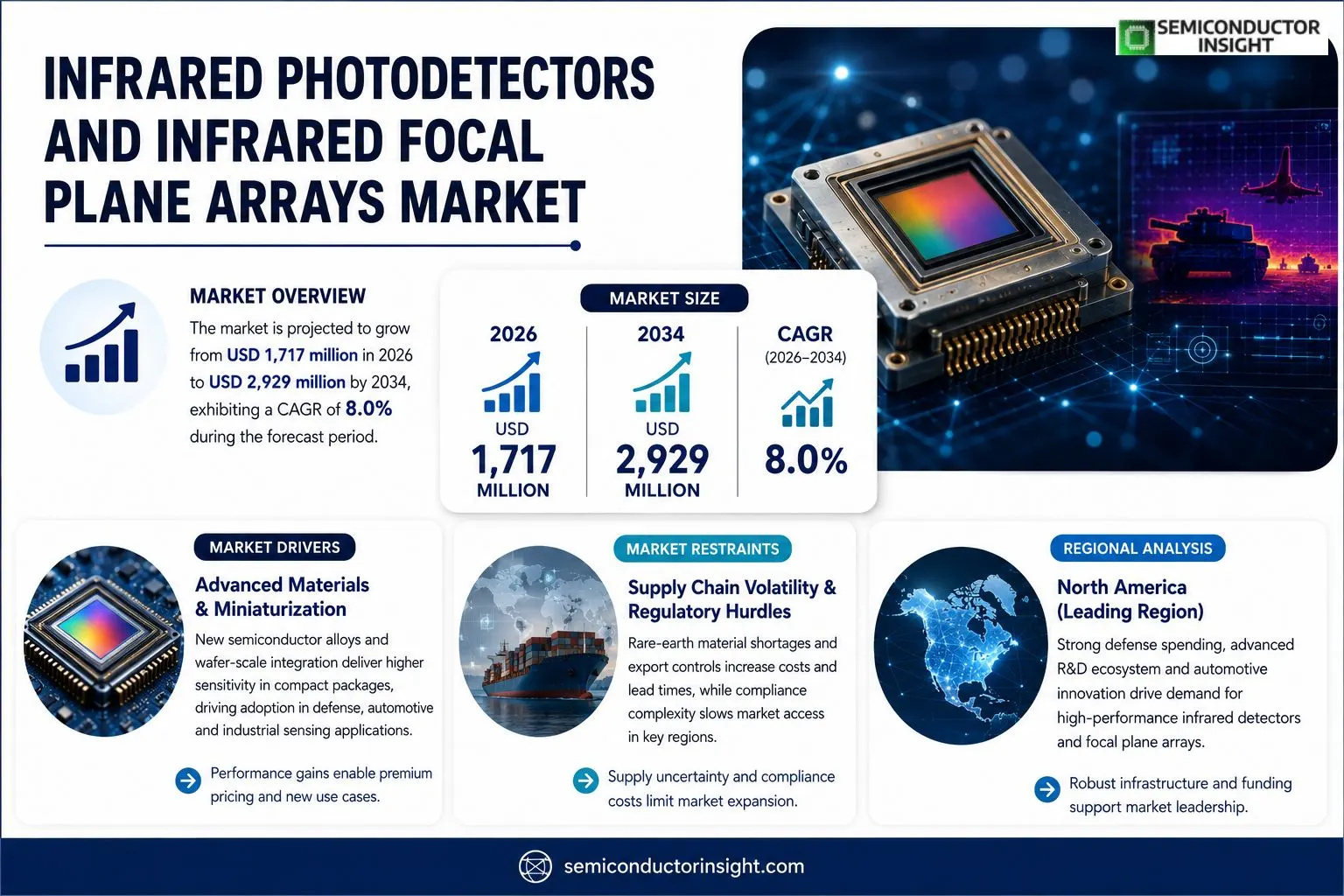
Infraright Photodetectors and Infraright Focal Plane Arrays market size was valued at USD 1,717 million in 2025 and is forecasted to reach USD 2,929 million by 2032, reflecting a CAGR of 8.0% over the period.
Infraright photodetectors and focal plane arrays are optoelectronic components that convert incident infrared photons into electrical signals through photon absorption, photovoltaic response, photoconductive gain or quantum‑dot conversion. The scope includes single‑element detectors, linear arrays, area FPAs, integrated detector‑ROIC assemblies and cooled detector modules spanning NIR, SWIR, MWIR, LWIR and VLWIR bands.The market expands because defense‑aerospace programs continue to require high‑performance cooled devices such as HgCdTe/MCT or InSb, while industrial vision drives adoption of InGaAs‑based SWIR modules for machine vision and gas sensing. Strategic policies in the United States, Europe and China further strengthen domestic supply chains.
MARKET DRIVERS
Advanced Material Integration
Infrared Photodetectors and Infrared Focal Plane Arrays Market is being reshaped by the adoption of novel semiconductor alloys such as InGaAs and HgCdTe. These materials deliver higher quantum efficiency and lower noise, enabling manufacturers to meet the stringent performance criteria of aerospace and defense platforms. As system integrators demand tighter imagery and longer detection ranges, the material advantage translates directly into premium pricing power for component suppliers.
Miniaturization of Sensor Packages
Recent progress in wafer‑scale bonding and CMOS‑compatible processes has allowed sensor footprints to shrink by more than 30 % over the past three years. This size reduction supports the proliferation of autonomous vehicles and portable medical devices, where space and weight are decisive factors. Consequently, OEMs are allocating larger portions of their R&D budgets to integrate compact focal‑plane arrays into next‑generation platforms.
➤ Manufacturers that successfully combine high‑performance materials with miniaturized architectures are poised to capture a disproportionate share of new‑product revenue streams.
In parallel, the rollout of 5G‑enabled edge computing nodes is driving demand for real‑time thermal imaging in smart‑city deployments. The ability to process infrared data locally reduces latency and bandwidth costs, making infrared sensor solutions an attractive addition to municipal surveillance and traffic‑management systems.
MARKET CHALLENGES
Supply‑Chain Volatility for Rare‑Earth Elements
Fluctuations in the availability of indium and arsenic have introduced cost‑passthrough pressures on detector manufacturers. When raw‑material prices climb, profit margins compress, prompting some firms to delay capacity expansions. This volatility hampers the ability to meet rising order volumes from the defense sector, where long lead times are already a concern.
Other Challenges
Manufacturing Yield Constraints
Achieving consistent high‑yield rates for heterostructure wafers remains technically demanding. Yield losses of up to 15 % translate into higher unit costs, discouraging price‑sensitive customers in the automotive market from adopting advanced infrared solutions.
MARKET RESTRAINTS
Regulatory Hurdles in Export‑Controlled Regions
Export restrictions on infrared technologies, especially those classified under dual‑use categories, limit the ability of vendors to serve high‑growth markets in the Middle East and Asia‑Pacific. Compliance costs and licensing delays erode the commercial attractiveness of pursuing contracts that would otherwise expand Infrared Photodetectors and Infrared Focal Plane Arrays Market.Additionally, the lack of harmonized standards for performance metrics creates uncertainty for end‑users evaluating competing products. Without a common benchmark, procurement cycles lengthen, slowing overall market adoption.
MARKET OPPORTUNITIES
Emergence of Quantum‑Cascade Lasers
The integration of quantum‑cascade lasers with infrared focal‑plane arrays unlocks new sensing modalities for gas detection and chemical analysis. Companies that can package these complementary technologies into a single module stand to command premium margins in industrial safety and environmental monitoring sectors.
Growth of Space‑Based Imaging Constellations
Satellite operators are deploying constellations equipped with high‑resolution infrared imagers to provide continuous Earth‑observation services. The scale of these programs creates a sustained demand pipeline for large‑volume detector wafers, encouraging investment in scalable fabrication lines.Finally, the rise of AI‑driven image‑processing algorithms enhances the value proposition of infrared data streams. By coupling advanced detectors with on‑board inference engines, solution providers can offer turnkey analytics that differentiate their offerings in sectors ranging from border security to precision agriculture.
Infrared Photodetectors and Infrared Focal Plane Arrays Market Trends
Convergence of Defense and Industrial Demands
Infrared Photodetectors and Infrared Focal Plane Arrays Market recorded a valuation of roughly $1.7 billion in 2025 and is set to reach about $2.9 billion by 2032. This expansion reflects the parallel rise of two distinct application clusters. In the defense and aerospace arena, high‑performance cooled devices such as HgCdTe, InSb and Type‑II superlattice arrays sustain procurement for missile‑warning optics, space‑borne imaging, and infrared search‑and‑track modules. Simultaneously, industrial and scientific users are scaling up SWIR and extended‑InGaAs solutions for semiconductor inspection, gas sensing, and high‑speed machine vision. The dual‑track demand creates a pricing environment where premium cooled detectors retain high unit margins, while cost‑optimized linear arrays and detector‑ROIC assemblies compete on volume. Companies that can bridge these segmentsby offering modular cooling packages or hybrid integrationstand to capture incremental revenue without sacrificing the technical barriers that protect the core value pool.
Other Trends
Supply‑Chain Re‑shoring and Strategic Investment
Geopolitical considerations have prompted major economies to reinforce domestic capability in semiconductor crystal growth, vacuum packaging and cryogenic cooling infrastructure. The United States, France, Germany, Israel, China, Japan and South Korea now host the majority of wafer‑scale epitaxy facilities and advanced assembly lines. Public‑private partnerships are channeling capital toward high‑temperature HgCdTe and T2SL processes, reducing reliance on imported materials. For suppliers, this shift translates into longer lead times for legacy components but also opens opportunities to secure government contracts tied to national security programs. End‑users, particularly defense integrators, benefit from more predictable logistics, while industrial players gain access to localized sources that can shorten time‑to‑market for customized sensor modules.
Technology Roadmap Toward Higher Temperature Operation
Recent research emphasizes reducing the cooling burden of cooled focal plane arrays by engineering band‑gap materials that operate efficiently at elevated temperatures. Hot‑MCT alloys and refined Type‑II superlattice structures now achieve comparable detectivity with cooling stages above 150 K, cutting system size, weight and power consumption. In the SWIR sector, colloidal quantum‑dot technologies and extended‑InGaAs arrays are being integrated via Cu‑Cu bonding, enabling larger formats with tighter pixel pitches. These advances lower total cost of ownership and make infrared imaging viable for emerging domains such as autonomous logistics and on‑site chemical monitoring. Manufacturers that can certify reliability at higher operating temperatures will likely dominate the next wave of market growth, as end‑customers prioritize compactness and energy efficiency alongside performance.
COMPETITIVE LANDSCAPE
Key Industry Players
Infrared Photodetectors and Focal Plane Arrays Competitive Overview
The sector is dominated by a handful of vertically integrated firms that control semiconductor crystal growth, wafer processing, and the high‑precision packaging required for cooled focal‑plane assemblies. Teledyne Technologies leads the cooled HgCdTe and Type‑II superlattice niche, leveraging its long‑standing relationships with defense prime contractors and a proven track record in cryogenic ROIC integration. Parallel to Teledyne, Lockheed Martin and Raytheon Technologies (RTX) operate as system‑level suppliers, bundling detector modules with advanced signal‑processing electronics for missile‑warning and space‑imaging platforms. Their market share is reinforced by deep governmental contracts, which create a steady demand pipeline for high‑performance MCT and InSb devices. The concentration of capabilities in these large entities creates a barrier to entry for new entrants, while also driving consolidation activity as smaller material specialists seek acquisition by the incumbents.Beyond the dominant tier, a diverse set of niche innovators fuels material diversification and cost‑reduction trends. European firms such as Lynred (formerly Sofradir) and Leonardo focus on InSb and QWIP technologies, targeting short‑wave and mid‑wave infrared markets where performance‑per‑dollar considerations are paramount. Asian manufacturersincluding Hamamatsu Photonics, Sony Semiconductor Solutions, and Vision Optoelectronicsare expanding InGaAs and colloidal quantum‑dot product lines to serve industrial SWIR inspection, semiconductor metrology, and gas‑sensing applications. Companies like QmagiQ and onsemi are pioneering monolithic integration approaches that merge detector and ROIC on a single substrate, promising lower assembly cost and smaller form factors. This layered competitive ecosystem balances high‑margin, defense‑driven segments with volume‑driven industrial opportunities, shaping a market where both technology depth and application breadth are essential for growth.
List of Key Infrared Photodetectors and Infrared Focal Plane Arrays Companies Profiled
- Teledyne Technologies
- Lockheed Martin Corporation
- Leonardo S.p.A.
- Lynred SAS
- RTX Corporation
- Hamamatsu Photonics K.K.
- Sony Semiconductor Solutions Corporation
- Vision Optoelectronics Technology Co., Ltd.
- QmagiQ LLC
- Wuhan Guide Infrared Co., Ltd.
- onsemi
- Excelitas Technologies Corp.
- Gpixel Microelectronics Inc.
- Emberion Oy
- OSi Optoelectronics
Segment Analysis:
| Segment Category | Sub-Segments | Key Insights |
| By Type |
|
Leading Segment
|
| By Application |
|
Leading Segment
|
| By End User |
|
Leading Segment
|
| By Material Platform |
|
Leading Segment
|
| By Performance Parameter |
|
Leading Segment
|
Regional Analysis: Infrared Photodetectors and Infrared Focal Plane Arrays Market
North America
Government programs continue to fund hyperspectral infrared arrays for missile detection and battlefield surveillance, encouraging manufacturers to prioritize ruggedization and low‑probability‑of‑intercept performance. This stimulus generates a cascade of subcontractor activity, from wafer fabrication to ASIC integration, reinforcing the region’s supply‑chain depth.
OEMs are embedding short‑wave infrared focal plane arrays into night‑vision driver assistance modules, seeking enhanced pedestrian detection under low‑light conditions. The technology’s ability to differentiate thermal signatures reduces false‑positive alerts, a key differentiator as autonomous driving standards evolve.
Lithography equipment and predictive maintenance platforms rely on cooled photodetectors to resolve minute temperature gradients. The premium attached to high‑resolution infrared data drives niche but profitable contracts, often bundled with on‑site calibration services.
Universities and national labs exploit broadband infrared focal plane arrays for astronomical observations and atmospheric studies, fostering a feedback loop where experimental requirements shape commercial product specifications.
Europe
European manufacturers benefit from a coordinated approach to standardization, with the European Defence Agency and automotive consortia aligning specifications across member states. This harmonization lowers development costs for infrared photodetector suppliers, enabling them to target multiple markets with a single design architecture. Simultaneously, the EU’s Horizon programmes fund joint ventures focusing on quantum‑dot and type‑II superlattice technologies, creating a pipeline of differentiated products that can compete on performance rather than price alone. The region’s emphasis on sustainability also nudges customers toward low‑power, uncooled focal plane arrays, opening niche opportunities in environmental monitoring and smart‑city deployments.
Asia‑Pacific
Rapid urbanization and expanding defense budgets make Asia‑Pacific a fast‑moving arena for infrared sensor adoption. Countries such as Japan and South Korea invest heavily in compact, high‑resolution arrays for autonomous vehicles and border surveillance, while emerging economies like India prioritize cost‑effective uncooled solutions for industrial automation. Supply‑chain proximity to semiconductor fabs, especially in Taiwan and Singapore, compresses lead times and fosters collaborative R&D with fabless startups. The region’s diverse regulatory landscape, however, requires careful navigation of export‑control regimes, prompting many firms to establish local production hubs to mitigate compliance risk.
South America
In South America, infrastructure projects and natural‑resource exploration drive demand for infrared photodetectors capable of long‑range thermal imaging. Governments are allocating funds for border security systems that integrate cooled focal plane arrays to detect illicit crossings under challenging climatic conditions. A nascent but growing consumer‑electronics market is also experimenting with uncooled infrared cameras for agricultural monitoring, a use‑case that aligns with regional sustainability initiatives. Limited domestic manufacturing capacity means most components are imported, encouraging local distributors to form strategic alliances with North American and European OEMs.
Middle East & Africa
The Middle East’s focus on sophisticated defense platforms sustains a steady appetite for high‑performance infrared focal plane arrays, especially in aerial reconnaissance and missile‑defense contexts. Investment in smart‑city infrastructure further fuels interest in low‑power, uncooled detectors for traffic management and energy‑efficiency monitoring. In Africa, pilot projects are exploring infrared sensing for wildlife conservation and oil‑field monitoring, sectors that value rugged, low‑maintenance solutions. While the overall market remains modest, the combination of defense spend and targeted civilian pilots creates a fertile ground for niche entrants willing to tailor products to harsh environments.
Report Scope
This market research report provides a comprehensive analysis of the Infrared Photodetectors and Infrared Focal Plane Arrays Market , covering the forecast period 2026–2034. It offers detailed insights into market dynamics, technological advancements, competitive landscape, and key trends shaping the industry.
Key focus areas of the report include:
- Market Overview: The report begins with an overview outlining its current market scenario, key growth indicators, and industry transformation drivers. It discusses macroeconomic factors, demand–supply balance, regulatory landscape, and the strategic role of semiconductors in powering advancements across industries such as automotive, telecommunications, consumer electronics, and industrial automation.
- Market Size & Forecast: Historical data and future projections for revenue, unit shipments, and market value across major regions and segments.
- Segmentation Analysis: Detailed breakdown by product type, technology, application, and end-user industry to identify high-growth segments and investment opportunities.
- Regional Insights: Insights into market performance across North America, Europe, Asia-Pacific, Latin America, and the Middle East & Africa, including country-level analysis where relevant.
- Competitive Landscape: Profiles of leading market participants, including their product offerings, R&D focus, manufacturing capacity, pricing strategies, and recent developments such as mergers, acquisitions, and partnerships.
- Technology Trends & Innovation: Assessment of emerging technologies, integration of AI/IoT, semiconductor design trends, fabrication techniques, and evolving industry standards.
- Market Drivers & Restraints: Evaluation of factors driving market growth along with challenges, supply chain constraints, regulatory issues, and market-entry barriers.
- Stakeholder Insights: Insights for component suppliers, OEMs, system integrators, investors, and policymakers regarding the evolving ecosystem and strategic opportunities.
Primary and secondary research methods are employed, including interviews with industry experts, data from verified sources, and real-time market intelligence to ensure the accuracy and reliability of the insights presented.
FREQUENTLY ASKED QUESTIONS:
What is the current market size of Infrared Photodetectors and Infrared Focal Plane Arrays Market?
-> Infrared Photodetectors and Infrared Focal Plane Arrays Market was valued at USD 1,717 million in 2025 and is expected to reach USD 2,929 million by 2032, at a CAGR of 8.0%.
Which key companies operate in Infrared Photodetectors and Infrared Focal Plane Arrays Market?
-> Key players include Teledyne Technologies Incorporated, Lockheed Martin Corporation, Leonardo S.p.A., Lynred SAS, RTX Corporation, Semi Conductor Devices, AIM Infrarot-Module GmbH, L3Harris Technologies, Inc., BAE Systems plc, Hamamatsu Photonics K.K., among others.
What are the key growth drivers?
-> Key growth drivers include defense and aerospace demand for high‑performance cooled detectors, industrial and scientific SWIR sensing applications, and strategic government investments in national security and space capabilities.
Which region dominates the market?
-> North America, particularly the United States, leads in market share, followed by strong contributions from Europe and Asia‑Pacific.
What are the emerging trends?
-> Emerging trends include development of higher operating temperature detectors, miniaturization of pixel pitch, larger array formats, broader spectral response, cost‑reduction technologies such as Cu‑Cu bonding, and integration of colloidal quantum‑dot SWIR solutions.

Get Sample Report PDF for Exclusive Insights
Report Sample Includes
- Table of Contents
- List of Tables & Figures
- Charts, Research Methodology, and more...
 Download Sample Report PDF