Perovskite Quantum Dot Market Insights
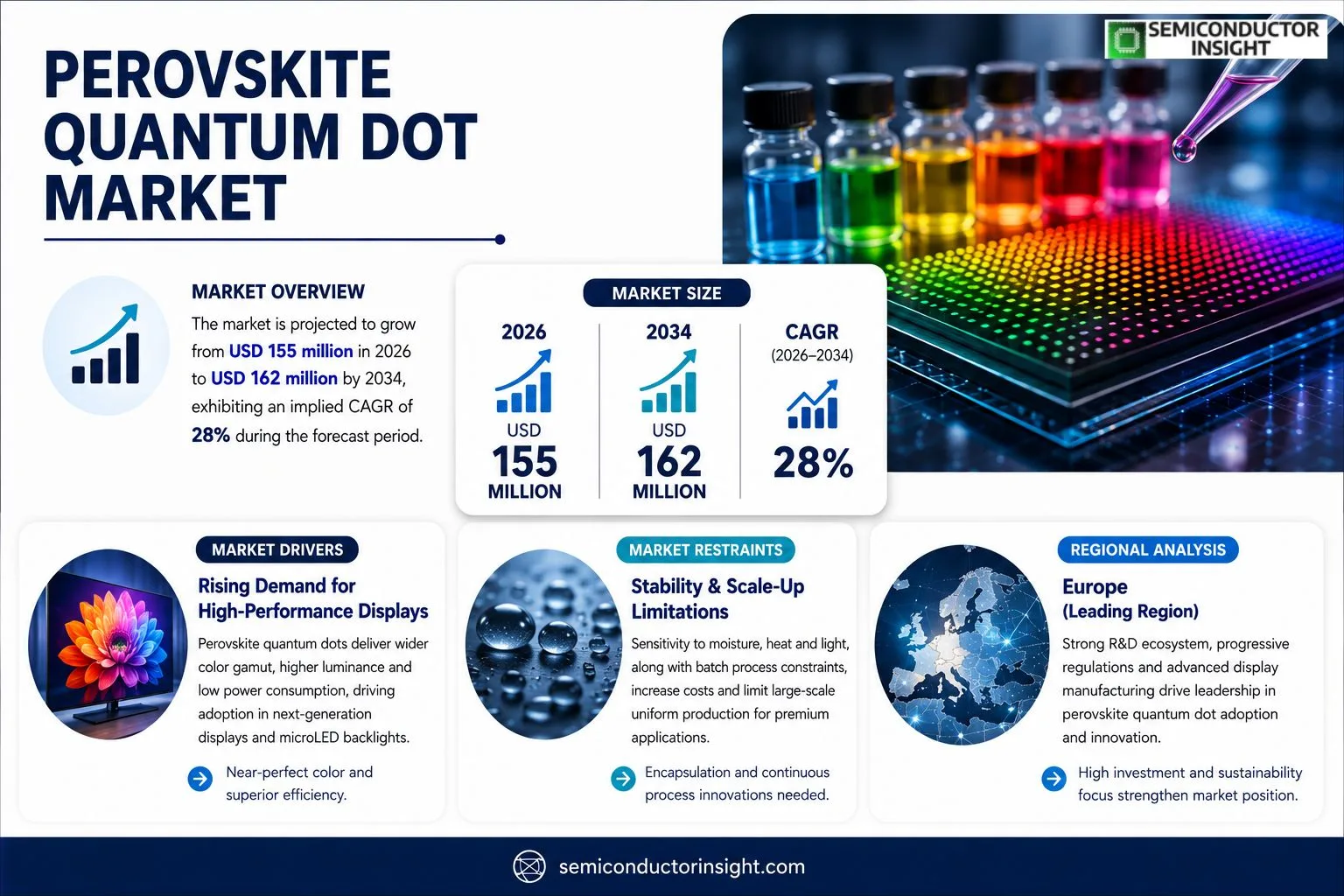
Perovskite Quantum Dot market size was valued at USD 26.03 million in 2025. The market is projected to grow from USD 155 million in 2026 to USD 162 million by 2034, exhibiting an implied CAGR of approximately 28 % during the forecast period.
Perovskite quantum dots are nanoscale optoelectronic materials based on metal‑halide perovskite structures.Their core value lies in narrow emission bandwidth, high photoluminescence efficiency and composition‑tunable wavelength. They are produced via solution synthesis, hot‑injection or ligand‑assisted reprecipitation and supplied as colloidal dispersions, inks or color‑conversion films.The principal applications include display colour conversion, LCD backlighting, microLED colour‑conversion layers and research‑grade optoelectronic components, while commercial adoption hinges on long‑term stability, lead management and batch‑to‑batch consistency.
MARKET DRIVERS
Rising demand for high‑performance display technologies
Perovskite Quantum Dot Market is gaining traction among manufacturers of ultra‑thin televisions and next‑generation monitors because the material delivers a wider color gamut and higher luminance compared with traditional phosphors. Recent product launches have showcased panels that achieve near‑perfect Rec. 2020 coverage, prompting OEMs to allocate design resources toward integrating perovskite emitters. This shift reflects a broader industry focus on delivering richer visual experiences while maintaining low power consumption.
Advances in synthesis that lower production cost
Laboratory breakthroughs in hot‑injection and ligand‑exchange methods have streamlined the scale‑up of perovskite quantum dots, trimming material waste by roughly 20 % over the last twelve months. The cost advantage is amplified by the ability to substitute expensive rare‑earth inks with earth‑abundant precursors, a factor that resonates with cost‑sensitive consumer electronics firms seeking margin protection.
➤ “When manufacturers can achieve sub‑$10 per square meter pricing for perovskite‑based films, the adoption curve accelerates dramatically,” an industry consultant noted.
Beyond displays, the improved charge‑carrier dynamics of perovskite nanocrystals are fueling interest in solid‑state lighting and optical sensors, creating cross‑segment momentum that reinforces the overall health of Perovskite Quantum Dot Market.
MARKET CHALLENGES
Stability concerns under operational stress
Despite impressive optoelectronic performance, perovskite quantum dots remain vulnerable to moisture, heat, and prolonged photon exposure. Field data from early‑adopter display lines reveal a gradual decline in peak brightness after 1,000 operating hours, prompting manufacturers to invest heavily in encapsulation strategies. The additional engineering steps increase bill‑of‑materials, tempering the cost benefits highlighted in the driver analysis.
Other Challenges
Regulatory and safety hurdles
Regulators in major markets are still defining exposure limits for lead‑based perovskite formulations. Companies that rely on lead‑free chemistries must navigate a fragmented compliance landscape, which can delay time‑to‑market and impose extra testing expenditures.
MARKET RESTRAINTS
Scale‑up limitations of batch processes
Current manufacturing relies on batch reactors that struggle to maintain uniform particle size distribution when volumes exceed a few hundred liters. Inconsistent dot size translates to color‑shift issues that are unacceptable for premium display applications, forcing producers to limit output or invest in continuous‑flow equipment—both of which constrain the pace at which Perovskite Quantum Dot Market can expand.
MARKET OPPORTUNITIES
Integration with wearable photonics
Wearable devices require lightweight, flexible emitters that can operate at low voltage. Perovskite quantum dots, with their solution‑processable nature, are ideally suited for roll‑to‑roll printing on polymer substrates. Early pilot programs in smart‑glasses and health‑monitoring patches suggest a niche where Perovskite Quantum Dot Market could capture premium pricing, provided that encapsulation advances keep the dots resilient to sweat and bending.
Perovskite Quantum Dot Market Trends
Display‑Centric Color‑Conversion Gains Momentum
The emergence of narrow‑band emission and high photoluminescence efficiency has repositioned perovskite quantum dots as a preferred material for next‑generation display panels. Manufacturers of LCD backlights and color‑conversion films are capitalising on the ability to tune emission wavelength through compositional adjustments, thereby simplifying the stack‑up required for high‑colour‑purity panels. In microLED assemblies, the same tunability reduces the need for multiple epitaxial layers, cutting both material cost and processing steps. Early pilot projects in Asia and Europe demonstrate that integrating these nanocrystals can lift colour gamut performance to beyond‑Rec.2020 levels, a benchmark that traditional CdSe‑based solutions struggle to meet without complex overcoating. The trend is reinforced by growing customer‑qualification programmes that focus on batch‑to‑batch repeatability, a prerequisite for volume production.
Other Trends
Regional Supply‑Chain Evolution
Supply‑side dynamics reveal a fragmented yet progressively coordinated ecosystem. Japan continues to dominate continuous‑flow synthesis and resin‑composite engineering, leveraging decades of display‑material expertise. Chinese players, meanwhile, have accelerated the formation of a localized value chain by offering colloidal dispersions, polymer masterbatches, and colour‑conversion films aimed at domestic display fabs. European firms differentiate through IP‑driven formulation services and collaborative research networks that bridge material science with device engineering. North America remains a niche source of research‑grade chemicals and early‑stage solar‑adjacent routes, feeding academic prototypes rather than large‑scale production. The gradual alignment of synthesis capabilities, encapsulation technologies, and regulatory compliance across these regions is reducing lead times and fostering cross‑border partnerships, which in turn expands the addressable market for display applications.
Materials Stability and Regulatory Alignment
Commercial roll‑out is still gated by long‑term stability and lead‑management concerns. Encapsulation breakthroughs, such as polymer‑matrix sealing and inorganic barrier layers, are extending operational lifetimes from a few hundred to several thousand hours under accelerated ageing tests. Simultaneously, industry consortia are negotiating lead‑free formulations that retain the high‑efficiency characteristics of halide perovskites while satisfying tightening environmental standards. Customers in the display sector are placing heightened emphasis on reliability metrics during qualification, prompting suppliers to adopt tighter process controls and statistical process control (SPC) frameworks. This focus on durable, compliant material packages is reshaping supplier‑customer dialogues, turning what was once an R&D curiosity into a viable commercial offering within Perovskite Quantum Dot Market.
COMPETITIVE LANDSCAPE
Key Industry Players
Perovskite Quantum Dot Market – Competitive Overview
The sector is anchored by a handful of firms that have moved beyond laboratory samples into pilot‑scale production. Zhijing Technology (Beijing) Co., Ltd. leads the cluster of Chinese manufacturers, offering colloidal dispersions and color‑conversion films for LCD backlighting. Its early partnership with major display OEMs has created a supply chain capable of delivering batch‑to‑batch consistency, a prerequisite for commercial adoption. In Japan, Zeon Corporation distinguishes itself through continuous‑flow synthesis and resin‑composite formulations that meet stringent reliability standards for microLED integration. European entrants such as Avantama AG focus on IP‑rich formulation platforms, leveraging decades of display‑material expertise to provide masterbatch solutions that align with existing coating lines. Collectively, these players shape a market structure where material‑development capabilities, encapsulation know‑how, and regional manufacturing footprints dictate access to high‑value display customers.Beyond the headline companies, a diverse set of niche operators contributes depth to the ecosystem. Wenzhou XinXin TaiJing Technology and Nanjing Muke Nano Technology specialize in ligand‑assisted reprecipitation routes, catering to research institutions that demand tunable emission wavelengths. ISE Chemicals and American Elements supply high‑purity precursors that support both academic and pilot‑scale production. Smaller firms such as Green Science Alliance, Nanografi Nano Technology, and Nanochemazone Inc. target the photodetector and X‑ray imaging segments, where stability under radiation exposure is critical. North American research‑grade suppliers, exemplified by Nanochemazone Inc., provide custom synthesis services that enable rapid prototyping for emerging PeLED applications. This layered landscape of large‑scale developers, specialized Chinese manufacturers, and agile boutique suppliers ensures that the market can address both immediate display needs and longer‑term specialty uses.
List of Key Perovskite Quantum Dot Companies Profiled
- Zhijing Technology (Beijing) Co., Ltd.
- Zeon Corporation
- Wenzhou XinXin TaiJing Technology Co., Ltd.
- Avantama AG
- ISE Chemicals Corporation
- American Elements
- Helio Display Materials
- Quantum Solutions
- Nanjing Muke Nano Technology Co., Ltd.
- Jiangsu XFNANO Materials Tech Co., Ltd.
- Green Science Alliance Co., Ltd.
- Alfa Chemistry
- Nanografi Nano Technology
- Nanochemazone Inc.
- Xi’an Ruixi Biological Technology Co., Ltd.
Segment Analysis:
| Segment Category | Sub-Segments | Key Insights |
| By Type |
|
Inorganic Perovskite Quantum Dots are favored for their robust crystal lattice and intrinsic stability. – Their narrow emission bandwidth aligns with high‑color‑purity display demands. – Solution‑processable nature enables seamless integration with existing coating and printing lines. – Early‑stage commercial samples demonstrate repeatable photoluminescence performance across pilot production runs. – Compatibility with advanced encapsulation techniques mitigates long‑term degradation concerns. – Analysts note strong alignment with customer qualification pathways in the display sector. |
| By Application |
|
Display Color Conversion stands out because it directly leverages the narrow bandwidth and high color purity of perovskite quantum dots. – Integration into LCD backlight films offers tangible performance lifts without major equipment changes. – Color‑conversion layers for microLEDs benefit from low‑temperature processing, supporting yield improvements. – Early customer qualification projects are emphasizing long‑term stability and lead‑management strategies. – The segment attracts sustained R&D focus from both material innovators and major display OEMs. – Market participants view this application as the most realistic pathway to volume commercialization. |
| By End User |
|
Display Manufacturers are the primary adopters due to the immediate value proposition of enhanced color gamut. – Their established supply chains facilitate rapid prototyping of color‑conversion films. – Collaboration with material suppliers accelerates qualification cycles and feedback loops. – Emphasis on lead‑free formulation and encapsulation reliability drives material selection criteria. – The segment benefits from clear regulatory pathways compared with emerging sensor applications. – Ongoing pilot projects are shaping the next generation of high‑performance display panels. |
| By Synthesis Route |
|
Ligand‑assisted Reprecipitation has gained traction because of its scalability and mild processing conditions. – The method delivers consistent particle size distribution, supporting batch‑to‑batch repeatability. – It enables formulation of colloidal dispersions and inks that integrate smoothly with printing technologies. – Researchers highlight reduced defect densities, which translate to higher photoluminescence efficiency. – The approach aligns with low‑temperature coating processes preferred by display manufacturers. – Industry observers consider it a pragmatic bridge between laboratory synthesis and pilot‑scale production. |
| By Product Form |
|
Colloidal Dispersion remains the foundational product format for early market entry. – Its fluid nature facilitates direct deposition onto substrates via slot‑die coating or spray techniques. – Engineers appreciate the ability to tune concentration for precise color‑conversion thickness control. – Stability enhancements through surface ligand engineering address long‑term performance concerns. – The format serves as a versatile feedstock for downstream ink, film, and composite development. – Customer feedback loops frequently begin with dispersion trials before committing to more complex formulations. |
Regional Analysis: Perovskite Quantum Dot Market
Europe
Recent EU directives on hazardous substances have tightened permissible lead levels, compelling manufacturers to adopt lead‑free perovskite chemistries. This regulatory pressure accelerates research into tin‑based formulations while simultaneously opening market space for compliant suppliers who can certify material safety across the supply chain.
European coalitions of raw‑material providers and device integrators are establishing dual‑sourcing strategies to mitigate geopolitical disruptions. Collaborative logistics platforms enable real‑time inventory visibility, reducing lead times for critical precursors and enhancing overall production stability.
Clusters in Scandinavia and the Benelux region nurture start‑ups focused on scaling perovskite quantum dot synthesis. Venture capital inflows and incubator programs foster rapid prototyping, allowing firms to move from proof‑of‑concept to pilot fabrication within a compressed timeframe.
Premium television brands leveraging perovskite emitters market themselves on superior color gamut and energy efficiency, resonating with environmentally conscious European buyers. This consumer predisposition encourages OEMs to allocate larger bill‑of‑materials shares to the technology.
North America
In North America, Perovskite Quantum Dot Market is shaped by a strong venture capital ecosystem and aggressive patent activity. Silicon Valley’s investment culture fuels early‑stage start‑ups that prioritize rapid scaling, while major semiconductor firms experiment with hybrid architectures that integrate perovskite layers. The region’s emphasis on high‑performance displays for gaming and automotive heads‑up displays creates a demand for emitters that can deliver both brightness and stability. However, regulatory scrutiny concerning lead content remains a hurdle, prompting many firms to explore encapsulation techniques to balance performance with compliance. The interplay between capital availability and regulatory considerations generates a distinctive growth pathway that hinges on technological breakthroughs achieving commercial reliability.
Asia-Pacific
Asia‑Pacific’s market dynamics are driven by massive manufacturing capacity and cost‑sensitive customer bases. Countries such as China, South Korea and Taiwan host extensive LCD and OLED fabs that are beginning to pilot perovskite quantum dots for niche backlighting applications. Government subsidies aimed at advanced materials research lower entry barriers for domestic firms, while the region’s export‑oriented electronics sector pressures suppliers to offer low‑cost, high‑volume solutions. Nevertheless, the fragmented nature of the supply chain, with numerous small‑scale reagent producers, introduces variability in material quality, prompting larger OEMs to impose strict qualification standards. The overall trajectory reflects a balance between scale‑driven price competitiveness and the necessity for consistent product performance.
South America
South America’s involvement in Perovskite Quantum Dot Market is still nascent, yet regional trade agreements are encouraging technology transfer from more established markets. Brazil’s growing renewable‑energy sector sees potential in perovskite‑based lighting for off‑grid applications, where high luminous efficacy can reduce energy consumption. Local academic collaborations with European institutes aim to develop region‑specific formulations that tolerate higher humidity levels common to the climate. While commercial deployment remains limited, the strategic focus on sustainable lighting solutions could position South America as a niche adopter within the broader market landscape.
Middle East & Africa
In the Middle East and Africa, market interest centers on high‑temperature stability and desert‑compatible display technologies. Pilot projects in the United Arab Emirates explore perovskite quantum dots for large‑area signage that must endure intense solar exposure without degradation. Meanwhile, African telecom operators are investigating perovskite‑enhanced LEDs for low‑power base stations, aligning with broader connectivity goals. The scarcity of local raw‑material suppliers drives reliance on imports, making supply chain diversification a critical consideration. Strategic partnerships with European research hubs provide a conduit for technology transfer, positioning the region to adopt advanced emissive solutions as infrastructure investments mature.
Report Scope
This market research report provides a comprehensive analysis of the Perovskite Quantum Dot Market , covering the forecast period 2026–2034. It offers detailed insights into market dynamics, technological advancements, competitive landscape, and key trends shaping the industry.
Key focus areas of the report include:
- Market Overview: The report begins with an overview outlining its current market scenario, key growth indicators, and industry transformation drivers. It discusses macroeconomic factors, demand–supply balance, regulatory landscape, and the strategic role of semiconductors in powering advancements across industries such as automotive, telecommunications, consumer electronics, and industrial automation.
- Market Size & Forecast: Historical data and future projections for revenue, unit shipments, and market value across major regions and segments.
- Segmentation Analysis: Detailed breakdown by product type, technology, application, and end-user industry to identify high-growth segments and investment opportunities.
- Regional Insights: Insights into market performance across North America, Europe, Asia-Pacific, Latin America, and the Middle East & Africa, including country-level analysis where relevant.
- Competitive Landscape: Profiles of leading market participants, including their product offerings, R&D focus, manufacturing capacity, pricing strategies, and recent developments such as mergers, acquisitions, and partnerships.
- Technology Trends & Innovation: Assessment of emerging technologies, integration of AI/IoT, semiconductor design trends, fabrication techniques, and evolving industry standards.
- Market Drivers & Restraints: Evaluation of factors driving market growth along with challenges, supply chain constraints, regulatory issues, and market-entry barriers.
- Stakeholder Insights: Insights for component suppliers, OEMs, system integrators, investors, and policymakers regarding the evolving ecosystem and strategic opportunities.
Primary and secondary research methods are employed, including interviews with industry experts, data from verified sources, and real-time market intelligence to ensure the accuracy and reliability of the insights presented.
FREQUENTLY ASKED QUESTIONS:
What is the current market size of Perovskite Quantum Dot Market?
-> Perovskite Quantum Dot Market was valued at USD 26.03 million in 2025 and is expected to reach USD 154 million by 2032 with a CAGR of 27.9% during the forecast period.
Which key companies operate in Perovskite Quantum Dot Market?
-> Key players include Zhijing Technology (Beijing) Co., Ltd., Wenzhou XinXin TaiJing Technology Co., Ltd., ISE Chemicals Corporation, Zeon Corporation, Helio Display Materials, Quantum Solutions, Avantama AG, American Elements, Yang-Ming Quantum Tech Ltd., Nanjing Muke Nano Technology Co., Ltd., Jiangsu XFNANO Materials Tech Co., Ltd., Green Science Alliance Co., Ltd., Alfa Chemistry, Nanografi Nano Technology, Nanochemazone Inc., Xi’an Ruixi Biological Technology Co., Ltd., among others.
What are the key growth drivers?
-> Key growth drivers include narrow emission bandwidth, high photoluminescence efficiency, composition‑tunable emission wavelength, low‑temperature processability, and compatibility with coating, printing and thin‑film integration, which drive demand in display color conversion, LCD backlighting, microLED and research‑grade optoelectronic materials.
Which region dominates the market?
-> Asia leads the market owing to a large number of material developers in China and strong composite material capabilities in Japan, while Europe and North America also play significant roles in formulation expertise and research‑grade supply.
What are the emerging trends?
-> Emerging trends include development of stable encapsulation technologies, lead‑free or lead‑managed PQDs, integration of PQDs into color‑conversion films for microLED displays, and expanding research applications in photodetectors, X‑ray imaging and spectral conversion.
Get Sample Report PDF for Exclusive Insights
Report Sample Includes
- Table of Contents
- List of Tables & Figures
- Charts, Research Methodology, and more...
 Download Sample Report PDF