Fiber Laser Vibration Meter Market Insights
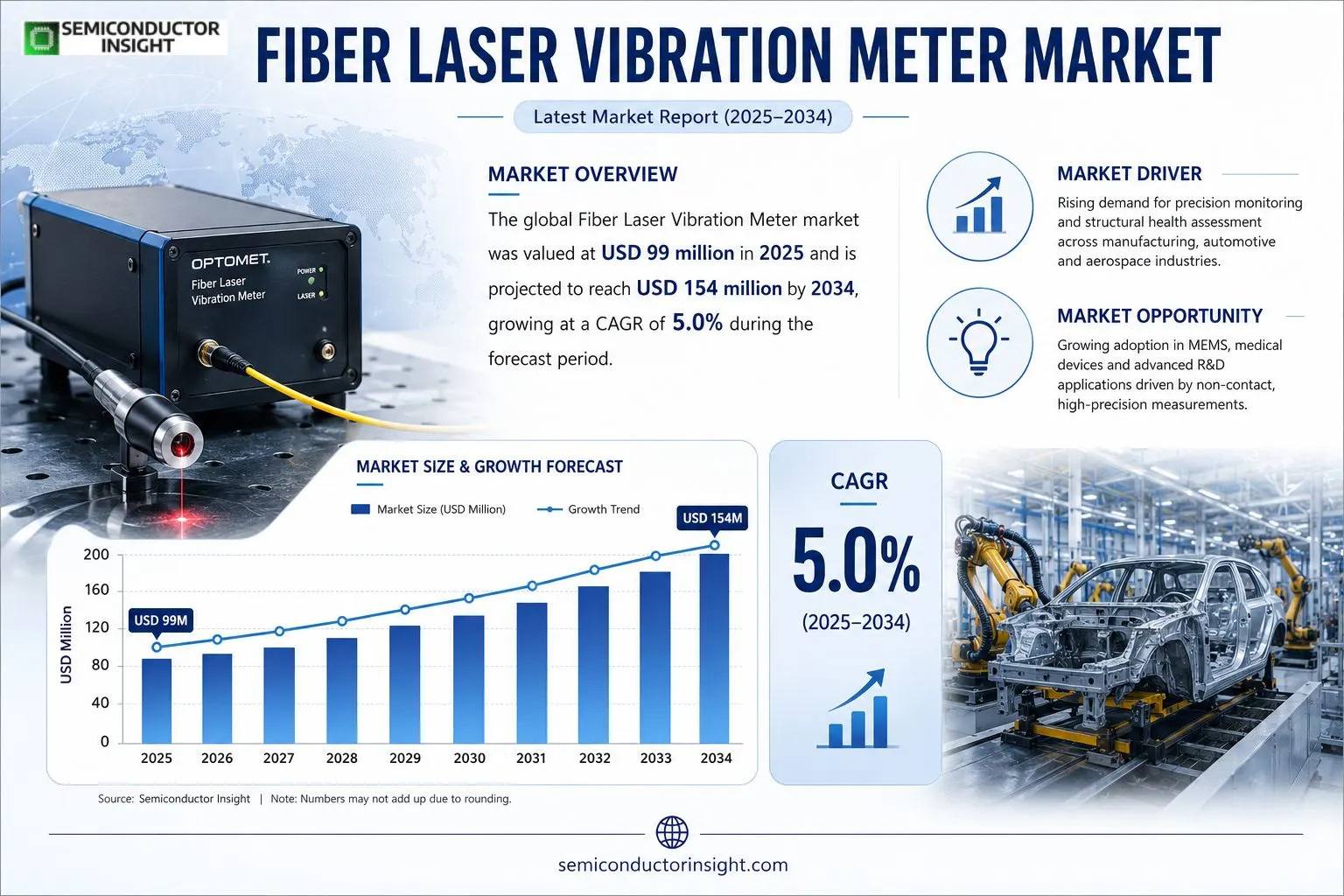
Fiber Laser Vibration Meter market size was valued at USD 99 million in 2025. The market will grow from USD 99 million in 2025 to approximately USD 154 million by 2034, exhibiting a CAGR of about 5.0% during the forecast period.
A fiber laser vibration meter is a non‑contact, high‑precision optical interferometry system that exploits the laser Doppler effect to quantify vibration velocity, displacement and acceleration of structures or equipment. By measuring the frequency shift of reflected light after illumination of a vibrating surface, it delivers wide‑bandwidth, ultra‑sensitive detection suitable for modal testing, NVH analysis and micro‑electro‑acoustic characterization.The market is expanding because automotive and aerospace manufacturers are intensifying structural health monitoring programs, while MEMS producers require accurate acoustic profiling for product validation. Advances in narrow‑linewidth fiber lasers and high‑speed ADC/FPGA demodulation modules have lowered system costs, encouraging adoption across precision machine‑tool monitoring and medical device testing. Recent product launches by Optomet, GAO Tek and SmarAct GmbH illustrate how manufacturers are capitalizing on these trends.
MARKET DRIVERS
Increasing Demand for Precision Monitoring in Manufacturing
Manufacturers are transitioning toward tighter tolerance specifications, and the ability to capture micro‑level vibration data has become a decisive factor for quality assurance. Fiber‑based sensors deliver superior signal‑to‑noise ratios, allowing engineers to pinpoint wear patterns before they affect product integrity, which in turn fuels adoption across automotive, aerospace, and high‑tech sectors.
Advancements in Fiber Laser Technology
Recent breakthroughs in diode‑pumped fiber lasers have lowered power consumption while extending operational lifespan. This technical progress reduces total cost of ownership, making the measurement systems attractive to small‑ and medium‑size enterprises that previously regarded such equipment as capital‑intensive.
➤ Industry surveys indicate that firms deploying fiber laser vibration meters achieve up to a 15 % reduction in downtime due to early fault detection.
Regulatory scrutiny on equipment reliabilityparticularly in sectors handling critical safety componentspushes OEMs to integrate continuous vibration monitoring. The resulting compliance advantage translates directly into market share gains for vendors offering proven fiber‑laser solutions.
MARKET CHALLENGES
High Initial Capital Outlay for Integrated Systems
While operating costs have declined, the upfront investment for a complete fiber laser vibration meter packageincluding laser source, photodetector, and data‑analytics softwareremains substantial. Organizations with constrained CAPEX budgets often defer acquisition, slowing overall market penetration.
Other Challenges
Skills Gap in Specialized Instrumentation
The accurate interpretation of high‑frequency vibration signatures requires engineers trained in both optics and signal processing. Companies that lack such expertise either outsource analysis, incurring additional expense, or risk misreading data, which can erode confidence in the technology.
MARKET RESTRAINTS
Limited Standardization Across Industries
Unlike traditional accelerometers, fiber laser vibration meters are not yet covered by a unified set of standards. The absence of widely accepted calibration protocols creates hesitation among procurement teams that favor equipment with clear, benchmarked specifications.Furthermore, integration with legacy supervisory control and data acquisition (SCADA) platforms often requires custom interfaces, adding to deployment time and cost. The extra engineering effort discourages some potential adopters, especially in regions with fragmented supply‑chain ecosystems.Supply‑chain volatility for high‑purity optical fibers can also constrain volume growth. Periodic shortages drive price spikes, making budgeting unpredictable for end users planning multi‑year rollouts.
MARKET OPPORTUNITIES
Integration with Predictive Maintenance Platforms
Software vendors are increasingly embedding fiber laser vibration data into AI‑driven predictive maintenance suites. This convergence enables real‑time condition monitoring across distributed assets, opening subscription‑based revenue models for equipment manufacturers.Another promising avenue lies in the expansion of smart‑factory initiatives within emerging economies. As these markets invest heavily in automation, the need for reliable, non‑invasive vibration diagnostics is becoming a core component of their digital transformation roadmaps.Finally, collaboration with research institutions to develop miniature, handheld fiber laser probes could unlock applications in field service and on‑site inspections, extending the addressable market beyond stationary plant environments.
Fiber Laser Vibration Meter Market Trends
Rising Adoption in High‑Precision Industries
The Fiber Laser Vibration Meter Market recorded revenue of roughly US$99 million in 2025. Production that year reached 5,071 units, each selling for an average of US$21,410, which together generated a gross profit margin that typically sits between 30 % and 55 %. Forecasts indicate the market will climb to about US$140 million by 2032, a trajectory driven by expanding demand for non‑contact vibration analysis in sectors such as automotive NVH testing, aerospace structural health monitoring, and MEMS device characterization. Companies that can integrate the interferometric core with advanced demodulation algorithms are positioned to capture a larger share of the incremental revenue, especially as customers seek tighter tolerance verification for increasingly complex components.
Other Trends
Shift Toward Integrated Software Solutions
Manufacturers are moving beyond hardware sales to bundle proprietary signal‑processing suites with each meter. This approach addresses the growing expectation among testing laboratories for turnkey workflows that combine real‑time spectral analysis, time‑frequency decomposition, and automated reporting. By packaging software licences alongside the optical head, vendors improve the value proposition and create recurring revenue streams. The trend also reduces the learning curve for end‑users, accelerating uptake in precision‑machine‑tool manufacturers where downtime for instrument calibration directly impacts production schedules. Consequently, firms that invest in robust, user‑friendly interfaces are likely to see higher repeat‑purchase rates and stronger customer loyalty.
Supply‑Chain Consolidation Among Laser Component Suppliers
Upstream, the ecosystem of narrow‑linewidth fiber lasers, high‑speed ADC/FPGA modules, and specialty optical couplers is experiencing a wave of mergers and strategic alliances. Consolidation reduces component cost variance and shortens lead times, two factors that are critical when production volumes remain modest relative to larger photonics markets. A tighter supply chain also aids manufacturers in maintaining the tight tolerances required for balanced detection and phase‑locked loops, thereby preserving measurement accuracy across the product line. As larger players absorb niche component specialists, the industry is likely to see a more uniform pricing structure, which could lower entry barriers for new entrants focused on niche applications such as medical ultrasound transducer testing.
COMPETITIVE LANDSCAPE
Key Industry Players
Fiber Laser Vibration Meter Market – Competitive Overview
Optomet dominates the arena, accounting for the largest slice of revenue in 2025. Its advantage stems from a vertically integrated supply chain that couples proprietary narrow‑linewidth fiber lasers with in‑house interferometric modules and advanced demodulation software. This configuration translates into higher gross marginsoften exceeding 45 %and enables the firm to command premium pricing while offering turnkey measurement solutions to automotive OEMs, aerospace research labs, and precision‑machine tool manufacturers. Optomet’s recent acquisition of a high‑speed ADC specialist broadens its product portfolio into scanning vibration measurement, reinforcing its position as the go‑to supplier for large‑scale testing facilities.Beyond the market leader, the competitive field is populated by a mix of regional specialists and technology‑focused innovators. GAO Tek and Wuhan Jingze Technology leverage cost‑effective semiconductor laser sources to serve fast‑growing Asian manufacturing hubs. SmarAct GmbH distinguishes itself with sub‑nanometer actuation interfaces that cater to MEMS and micro‑opto‑electronic testing. HoloBright (S) Private Limited and Sunnyinnovation Optical Intelligence have built niche expertise around low‑frequency, single‑point measurement for automotive NVH programs. OmniSensing Photonics offers custom‑engineered optical heads for medical‑device vibration analysis, while Beijing Huace Test Instrument supplies modular systems to university laboratories. Emerging challengers such as nLaser Solutions (USA), Zarmor Technologies (France), NKT Photonics (Denmark) and Thorlabs (USA) are expanding their foothold by partnering with FPGA manufacturers to deliver higher‑bandwidth platforms, thereby intensifying pressure on incumbent pricing structures.
List of Key Fiber Laser Vibration Meter Companies Profiled
- Optomet
- GAO Tek
- SmarAct GmbH
- HoloBright (S) Private Limited
- Sunnyinnovation Optical Intelligence
- OmniSensing Photonics
- Beijing Huace Test Instrument
- Wuhan Jingze Technology
- nLaser Solutions
- Zarmor Technologies
- NKT Photonics
- Thorlabs
- Coherent Inc.
- IPG Photonics
Segment Analysis:
| Segment Category | Sub-Segments | Key Insights |
| By Type |
|
Single-Point Vibration Measurement is the predominant choice because it delivers high‑resolution point‑wise data that supports detailed modal analysis.
|
| By Application |
|
Automotive & Transportation drives adoption as manufacturers pursue lower NVH levels and higher structural integrity.
|
| By End User |
|
Testing Laboratories are the primary end users because they require versatile, high‑precision instrumentation for diverse projects.
|
| By Bandwidth |
|
High Frequency segment gains traction as manufacturers target vibration sources in rotating machinery and MEMS devices.
|
| By Product Form |
|
Stationary Systems dominate the market because they deliver the stability and optical alignment required for high‑precision interferometry.
|
Regional Analysis: Fiber Laser Vibration Meter Market
Europe
Automotive chassis manufacturers are embedding fiber laser vibration meters into assembly lines to monitor weld integrity in real time. The granular data stream supports predictive maintenance models, shrinking the interval between quality checks and freeing capacity for higher‑volume output without compromising precision.
Harmonized EU directives on electromagnetic compatibility have reduced certification timelines for new sensor designs. Firms that align early with these standards capture early‑adopter advantage, especially in sectors where safety certifications dictate procurement cycles.
Convergence with IoT gateways enables seamless cloud analytics, turning raw vibration signatures into actionable alerts. This integration lowers the barrier for mid‑size plants to adopt advanced monitoring without extensive on‑site IT infrastructure.
Domestic players leverage proximity to component suppliers to iterate designs faster than Asian rivals. Their ability to customize optics and fiber coatings for niche applications sustains a premium pricing tier within the regional market.
North America
North American adopters are emphasizing the return on investment of fiber laser vibration meters in heavy‑industry settings, where downtime carries a high financial penalty. Companies are integrating these meters with legacy SCADA systems, creating hybrid monitoring architectures that extract value from existing data pipelines. The market benefits from a strong venture‑capital influx into sensor‑technology start‑ups, accelerating the rollout of AI‑driven analytics that translate vibration patterns into predictive insights. While the regulatory environment is less prescriptive than Europe, the emphasis on safety compliance in sectors such as oil & gas drives a steady demand for high‑accuracy measurement tools.
Asia‑Pacific
In the Asia‑Pacific corridor, rapid expansion of manufacturing capacity fuels interest in fiber laser vibration meters that can keep pace with high‑throughput lines. Chinese and Indian producers are scaling production volumes while Japanese firms focus on precision enhancements for semiconductor equipment. The region’s cost‑sensitivity pushes distributors toward bundled solutions that combine sensors with data‑logging software, offering a more complete value proposition. Although standards are evolving, the sheer volume of new facilities under construction creates a fertile ground for market penetration, especially where manufacturers seek to differentiate on quality assurance.
South America
South American manufacturers are at an inflection point, transitioning from imported analog vibration meters to locally sourced fiber‑laser alternatives. The shift is driven by a growing awareness of the long‑term maintenance savings associated with optical sensors, which tolerate harsher environments and require less frequent calibration. Brazil’s industrial policy encourages technology transfer, prompting joint ventures that embed European expertise within regional production lines. As utilities and mining operations modernize, the demand for reliable vibration monitoring escalates, positioning Fiber Laser Vibration Meter Market for incremental gains.
Middle East & Africa
In the Middle East and Africa, infrastructure projectsparticularly in renewable energy and petrochemical complexesare prompting early adoption of fiber laser vibration meters for critical asset monitoring. Stakeholders value the robustness of fiber optics against electromagnetic interference prevalent in high‑voltage environments. Partnerships between multinational sensor firms and local engineering consultancies are facilitating knowledge transfer, enabling operators to integrate advanced diagnostics without substantial upfront training costs. While market size remains modest, the strategic importance of reliable equipment in harsh climates underpins a steady, if measured, demand trajectory.
Report Scope
This market research report provides a comprehensive analysis of the Fiber Laser Vibration Meter Market , covering the forecast period 2026–2034. It offers detailed insights into market dynamics, technological advancements, competitive landscape, and key trends shaping the industry.
Key focus areas of the report include:
- Market Overview: The report begins with an overview outlining its current market scenario, key growth indicators, and industry transformation drivers. It discusses macroeconomic factors, demand–supply balance, regulatory landscape, and the strategic role of semiconductors in powering advancements across industries such as automotive, telecommunications, consumer electronics, and industrial automation.
- Market Size & Forecast: Historical data and future projections for revenue, unit shipments, and market value across major regions and segments.
- Segmentation Analysis: Detailed breakdown by product type, technology, application, and end-user industry to identify high-growth segments and investment opportunities.
- Regional Insights: Insights into market performance across North America, Europe, Asia-Pacific, Latin America, and the Middle East & Africa, including country-level analysis where relevant.
- Competitive Landscape: Profiles of leading market participants, including their product offerings, R&D focus, manufacturing capacity, pricing strategies, and recent developments such as mergers, acquisitions, and partnerships.
- Technology Trends & Innovation: Assessment of emerging technologies, integration of AI/IoT, semiconductor design trends, fabrication techniques, and evolving industry standards.
- Market Drivers & Restraints: Evaluation of factors driving market growth along with challenges, supply chain constraints, regulatory issues, and market-entry barriers.
- Stakeholder Insights: Insights for component suppliers, OEMs, system integrators, investors, and policymakers regarding the evolving ecosystem and strategic opportunities.
Primary and secondary research methods are employed, including interviews with industry experts, data from verified sources, and real-time market intelligence to ensure the accuracy and reliability of the insights presented.
FREQUENTLY ASKED QUESTIONS:
What is the current market size of Fiber Laser Vibration Meter Market?
-> Fiber Laser Vibration Meter Market was valued at USD 99 million in 2025 and is expected to reach USD 140 million by 2032, growing at a CAGR of 5.0% during the forecast period.
Which key companies operate in Fiber Laser Vibration Meter Market?
-> Key players include Optomet, GAO Tek, SmarAct GmbH, HoloBright (S) Private Limited, Sunnyinnovation Optical Intelligence, OmniSensing Photonics, Beijing Huace Test Instrument, Wuhan Jingze Technology, among others.
What are the key growth drivers?
-> Key growth drivers include rising demand for high‑precision, non‑contact vibration measurement in automotive, aerospace, railway, medical and precision manufacturing sectors, along with advances in optical interferometry technology and growing adoption of AI‑enabled signal processing.
Which region dominates the market?
-> The reference does not disclose a single dominant region; however, both the United States and China are highlighted as significant markets for fiber laser vibration meters.
What are the emerging trends?
-> Emerging trends include integration of AI‑driven data analytics, miniaturization for MEMS and medical device applications, expanded use of broadband high‑frequency measurement, and development of advanced algorithms for noise suppression and modal analysis.

Get Sample Report PDF for Exclusive Insights
Report Sample Includes
- Table of Contents
- List of Tables & Figures
- Charts, Research Methodology, and more...
 Download Sample Report PDF