Quantum Dot Lasers Market Insights
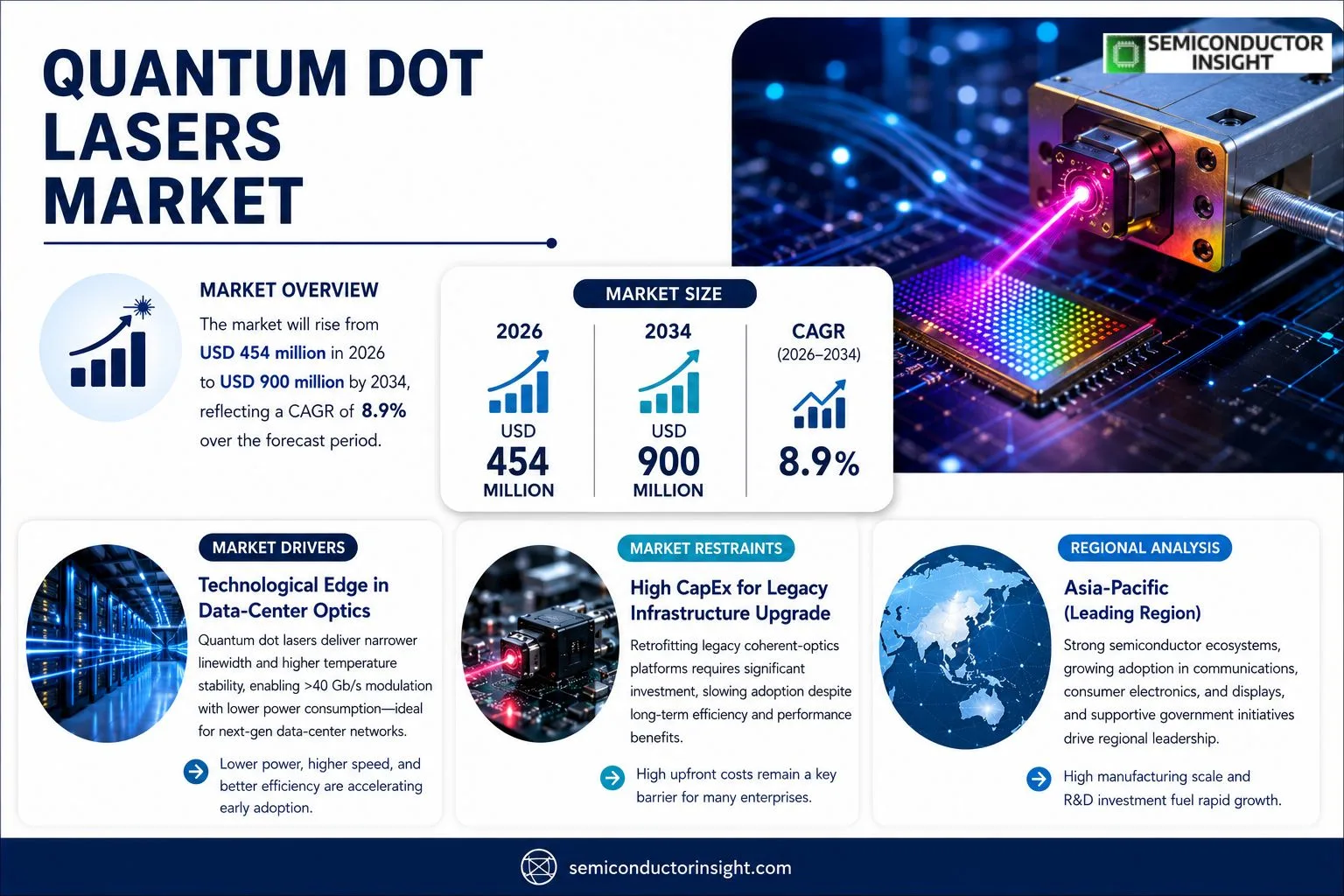
Quantum Dot Lasers market size was valued at USD 417 million in 2025. The market will rise from USD 454 million in 2026 to USD 900 million by 2034, reflecting a compound annual growth rate of approximately 8.9 % over the forecast horizon.
Quantum Dot Lasers are semiconductor lasers that employ nanoscale quantum‑dot structures as the active gain medium; these dots provide discrete energy states that enable lower threshold currents and wavelength tunability compared with conventional bulk‑material lasers.The upward trajectory is supported by efficiency gains, expanding uses such as optical‑communication links, data‑center interconnects and emerging quantum‑computing interfaces, while research focuses on high‑temperature stability and cost‑effective mass productionfactors that together shape competitive positioning for manufacturers like II‑VI Incorporated and QD Laser Inc.
MARKET DRIVERS
Technological Edge in Data‑Center Optics
Quantum Dot Lasers Market benefits from a rapid shift toward higher‑capacity data‑center interconnects. Quantum‑dot active layers deliver narrower linewidth and higher temperature stability, enabling manufacturers to push modulation rates beyond 40 Gb/s without resorting to complex cooling schemes. This performance edge translates into lower total cost of ownership for hyperscale operators, encouraging early adoption.
Growth in Augmented‑Reality Displays
Mobile‑AR headsets now require light sources that combine high brightness with precise wavelength control. Quantum dot lasers meet these criteria, allowing designers to achieve vivid color gamuts while maintaining compact form factors. As consumer AR devices move from prototype to mass market, supply chains are reconfiguring to source these lasers, creating a noticeable lift in revenue streams.
➤ Manufacturers that integrate monolithic quantum‑dot gain sections report up to a 15 % reduction in packaging complexity, directly improving production throughput.
Strategic partnerships between semiconductor foundries and photonics firms are accelerating the rollout of wafer‑scale integration. This collaboration shortens time‑to‑market for next‑generation optical transceivers, reinforcing the upward trajectory of Quantum Dot Lasers Market.
MARKET CHALLENGES
Supply‑Chain Volatility for Rare‑Earth Precursors
The dependency on indium‑based compounds for quantum‑dot synthesis introduces exposure to geopolitical fluctuations. Recent export restrictions have constrained inventory levels, forcing OEMs to increase safety stocks and, consequently, raising component costs.
Other Challenges
Manufacturing Yield Consistency
Achieving uniform dot size across 200‑mm wafers remains a hurdle. Variations in emission wavelength can lead to module rejection rates that exceed 8 %, eroding profit margins for early‑stage producers.
MARKET RESTRAINTS
High Capital Expenditure for Legacy Infrastructure Upgrade
Enterprises operating legacy coherent‑optics platforms must allocate substantial budgets to retrofit line cards compatible with quantum‑dot sources. The upfront outlay, often surpassing $200 million for large carriers, dampens the speed of adoption despite clear long‑term efficiencies.
MARKET OPPORTUNITIES
Emerging Role in LiDAR for Autonomous Vehicles
Quantum dot lasers are uniquely positioned to address the range and resolution demands of next‑generation LiDAR units. Their ability to emit narrow‑band, high‑peak‑power pulses reduces eye‑safety concerns while extending detection distances beyond 300 meters. Companies that align their R&D pipelines with automotive safety standards stand to capture a sizable share of this nascent revenue stream, bolstering the overall growth of Quantum Dot Lasers Market.
Quantum Dot Lasers Market Trends
Efficiency Improvements and Threshold Reduction
The latest production run of roughly 313 000 units demonstrates that manufacturers have refined epitaxial growth techniques enough to push external quantum efficiency above the mid‑40 % range. As the active quantum‑dot layer becomes more uniform, carriers recombine with fewer losses, which translates into lower threshold currentsoften cut by a third compared with the first‑generation devices. For end‑users, the immediate benefit is longer battery life in portable Lidar sensors and tighter power budgets for data‑center transceivers. Companies that can sustain this efficiency trajectory are positioned to secure contracts where operating cost is a decisive factor, particularly in telecom operators upgrading to flexible‑grid networks.
Other Trends
Thermal Management Advances
High‑temperature operation remains a practical hurdle; however, recent alloy engineering in the cladding layers has lowered the characteristic temperature (T0) penalty. Devices now retain over 85 % of their peak output at temperatures 20 °C higher than earlier models, enabling deployment in harsh industrial environments without active cooling. This shift reduces system‑level bill of materials and opens markets such as automotive LiDAR, where thermal headroom is scarce.
Multicolor Emission and System Integration
Manufacturers are increasingly delivering arrays that combine visible, near‑infrared, and mid‑infrared emitters on a single chip. The capability to toggle wavelengths on demand supports dense wavelength‑division multiplexing schemes, effectively expanding channel capacity without adding fibers. Simultaneously, advances in silicon photonics packaging let quantum‑dot sources sit alongside drivers and detectors within a few millimeters of total footprint. This miniaturization is reshaping product roadmaps for handheld projection displays and compact optical interconnect modules, where space and weight constraints dominate design choices.Beyond conventional optics, the technology is gaining traction in emerging quantum‑communication prototypes. By leveraging the narrow linewidth and low phase noise of quantum‑dot lasers, system architects can generate indistinguishable photons required for secure key‑distribution protocols. When coupled with the cost reductions achieved through high‑volume wafer processingunit costs have dropped from about $1 600 to just under $1 500the barrier to entry for experimental labs and early‑stage startups is lowering noticeably. The convergence of lower production cost, multicolor capability, and tighter integration signals a period of accelerated adoption across both established telecommunication infrastructures and nascent quantum‑network pilots.
COMPETITIVE LANDSCAPE
Key Industry Players
Quantum Dot Lasers: Competitive Dynamics and Market Positioning
II‑VI Incorporated stands out as the most diversified supplier in the quantum‑dot laser arena. Its control of epitaxial growth, wafer processing, and device packaging enables a cost structure that sustains a gross margin near 44 %, a rare combination of scale and specialization. The company’s portfolio spans visible, near‑infrared, and emerging mid‑infrared modules, positioning it to serve both data‑center interconnects and high‑brightness display segments. By leveraging an extensive IP base and a production footprint that exceeds 400 k units annually, II‑VI has built a barrier to entry that limits the ability of newcomers to match price‑performance metrics without substantial capital outlay.Beyond the market leader, a constellation of firms is sharpening niche advantages. QD Laser Inc. and Nanosys focus on multicolor emitters for optical‑communication links, while Sharp and Sony concentrate on laser‑display integration, capitalising on their consumer‑electronics heritage. European‑based Osram Opto Semiconductors and BASF exploit material‑science expertise to improve high‑temperature stability, a persistent technical hurdle. Asian powerhousesIntel, Samsung Electronics, LG Electronics, and Huawei Technologiesinvest heavily in on‑chip integration, seeking to embed quantum‑dot gain media within silicon photonics platforms. Japanese manufacturers such as Panasonic, Toshiba, and Hitachi High‑Technologies contribute robust manufacturing capacity for medical‑instrument lasers, whereas Mitsubishi Electric and Kyocera target industrial machining applications. NTT’s semiconductor arm adds a networking‑centric perspective, underscoring the sector’s cross‑industry appeal.
List of Key Quantum Dot Lasers Companies Profiled
- II‑VI Incorporated
- QD Laser Inc.
- Nanosys
- Sharp Corporation
- Sony Corporation
- Osram Opto Semiconductors
- BASF
- Intel Corporation
- Samsung Electronics
- LG Electronics
- Huawei Technologies
- Panasonic Corporation
- Toshiba Corporation
- Hitachi High‑Technologies Corporation
- Mitsubishi Electric Corporation
- Kyocera Corporation
- NTT (Nippon Telegraph and Telephone Corporation)
Segment Analysis:
| Segment Category | Sub-Segments | Key Insights |
| By Type |
|
Nano is emerging as the dominant form factor because:
|
| By Application |
|
Optical Communication drives strategic focus because:
|
| By End User |
|
Telecommunications benefits from quantum dot lasers through:
|
| By Material |
|
InAs/GaAs remains a cornerstone because:
|
| By Wavelength |
|
Near‑Infrared is pivotal for future markets because:
|
Regional Analysis: Quantum Dot Lasers Market
North America
Early adopters in data‑center interconnects have validated quantum dot laser modules against legacy InP devices, highlighting superior spectral purity and temperature stability, which encourages broader deployment across enterprise networks.
A handful of legacy photonics manufacturers and emerging start‑ups dominate the market, leveraging patents on dot synthesis and device integration to secure high‑margin contracts with telecom operators.
Close collaboration between semiconductor foundries and specialty material firms ensures a steady flow of high‑quality quantum dots, while regional logistics hubs reduce lead times for component delivery.
Harmonized safety and performance standards across the United States and Canada streamline certification, allowing manufacturers to launch products with confidence in both markets.
Europe
European activity centers around advanced research consortia that blend academic expertise with industrial funding, particularly in Germany, the Netherlands, and the UK. Policy incentives aimed at digital sovereignty have spurred investment in photonic components, positioning quantum dot lasers as a strategic technology for secure communications. Companies are focusing on niche applications such as LiDAR for autonomous vehicles and precision sensing, where wavelength agility offers a competitive edge. The fragmented nature of the market, however, creates challenges in achieving economies of scale, prompting firms to seek cross‑border joint ventures that pool R&D resources and share production capacity. Standardization efforts within the European Telecommunications Standards Institute are gradually aligning specifications, which should lower entry barriers for smaller players over the next few years.
Asia‑Pacific
The Asia‑Pacific region exhibits a rapid shift from cost‑driven manufacturing to performance‑focused development, especially in Japan, South Korea, and China. Government initiatives targeting next‑generation photonics have funneled substantial R&D grants into quantum dot laser research, accelerating prototype validation for consumer electronics and automotive sectors. Manufacturing prowess in Taiwan and Singapore provides a robust backdrop for scaling production, yet the market still wrestles with intellectual‑property concerns that can slow technology transfer. Collaborations between local chip makers and overseas design houses are emerging as a pragmatic route to bridge expertise gaps, while regional trade shows increasingly showcase application‑specific solutions rather than generic components.
South America
South American interest in quantum dot lasers is nascent but gaining momentum through university‑driven research programs in Brazil and Chile. Limited local fabrication capacity drives reliance on imports, which in turn raises cost sensitivity among potential adopters. Nevertheless, emerging sectors such as medical imaging and precision agriculture see clear advantages in the narrow linewidth and high efficiency of quantum dot devices. Regional partnerships with North American and European firms are beginning to materialize, offering technology licensing that could catalyze a modest domestic supply chain over the medium term.
Middle East & Africa
In the Middle East and Africa, the market is largely exploratory, with a handful of pilot projects concentrated on defense communications and renewable‑energy monitoring. Sovereign wealth funds are allocating capital to photonics start‑ups, seeking diversification beyond traditional energy assets. The scarcity of specialized manufacturing infrastructure means most deployments rely on turnkey solutions from established vendors. While adoption rates remain low, the strategic emphasis on high‑security communications may prompt incremental investments that lay the groundwork for future growth.
Report Scope
This market research report provides a comprehensive analysis of the Quantum Dot Lasers Market , covering the forecast period 2026–2034. It offers detailed insights into market dynamics, technological advancements, competitive landscape, and key trends shaping the industry.
Key focus areas of the report include:
- Market Overview: The report begins with an overview outlining its current market scenario, key growth indicators, and industry transformation drivers. It discusses macroeconomic factors, demand–supply balance, regulatory landscape, and the strategic role of semiconductors in powering advancements across industries such as automotive, telecommunications, consumer electronics, and industrial automation.
- Market Size & Forecast: Historical data and future projections for revenue, unit shipments, and market value across major regions and segments.
- Segmentation Analysis: Detailed breakdown by product type, technology, application, and end-user industry to identify high-growth segments and investment opportunities.
- Regional Insights: Insights into market performance across North America, Europe, Asia-Pacific, Latin America, and the Middle East & Africa, including country-level analysis where relevant.
- Competitive Landscape: Profiles of leading market participants, including their product offerings, R&D focus, manufacturing capacity, pricing strategies, and recent developments such as mergers, acquisitions, and partnerships.
- Technology Trends & Innovation: Assessment of emerging technologies, integration of AI/IoT, semiconductor design trends, fabrication techniques, and evolving industry standards.
- Market Drivers & Restraints: Evaluation of factors driving market growth along with challenges, supply chain constraints, regulatory issues, and market-entry barriers.
- Stakeholder Insights: Insights for component suppliers, OEMs, system integrators, investors, and policymakers regarding the evolving ecosystem and strategic opportunities.
Primary and secondary research methods are employed, including interviews with industry experts, data from verified sources, and real-time market intelligence to ensure the accuracy and reliability of the insights presented.
FREQUENTLY ASKED QUESTIONS:
What is the current market size of Quantum Dot Lasers Market?
-> Quantum Dot Lasers Market was valued at USD 417 million in 2025 and is expected to reach USD 712 million by 2032, growing at a CAGR of 8.9% during the forecast period.
Which key companies operate in Quantum Dot Lasers Market?
-> Key players include II-VI Incorporated, QD Laser Inc., Nanosys, Sharp Corporation, Sony Corporation, Osram Opto Semiconductors, TRUMPF, BASF, Intel Corporation, Samsung Electronics, LG Electronics, Huawei Technologies, Panasonic Corporation, Toshiba Corporation, Hitachi High‑Technologies Corporation, Mitsubishi Electric Corporation, Kyocera Corporation, Sony Semiconductor Solutions Corporation, Nippon Telegraph and Telephone Corporation (NTT).
What are the key growth drivers?
-> Key growth drivers include improved efficiency and lower threshold current, enhanced high‑temperature stability, development of multicolor lasers for optical communications and displays, miniaturization and integration with micro‑electronics, expanding applications in quantum communication and computing, low‑cost mass production enabled by manufacturing advances, and the rising demand for high‑brightness laser display technologies.
Which region dominates the market?
-> Asia holds a leading position in Quantum Dot Lasers Market, driven by strong semiconductor manufacturing ecosystems and growing adoption in communications, consumer electronics, and display applications.
What are the emerging trends?
-> Emerging trends include development of multicolor quantum dot lasers, further miniaturization for portable and integrated optical devices, increased focus on quantum communication and computing platforms, cost‑effective mass production techniques, and the integration of quantum dot lasers into next‑generation laser display systems for richer visual experiences.
Get Sample Report PDF for Exclusive Insights
Report Sample Includes
- Table of Contents
- List of Tables & Figures
- Charts, Research Methodology, and more...
 Download Sample Report PDF