High Power VCSEL Market Insights
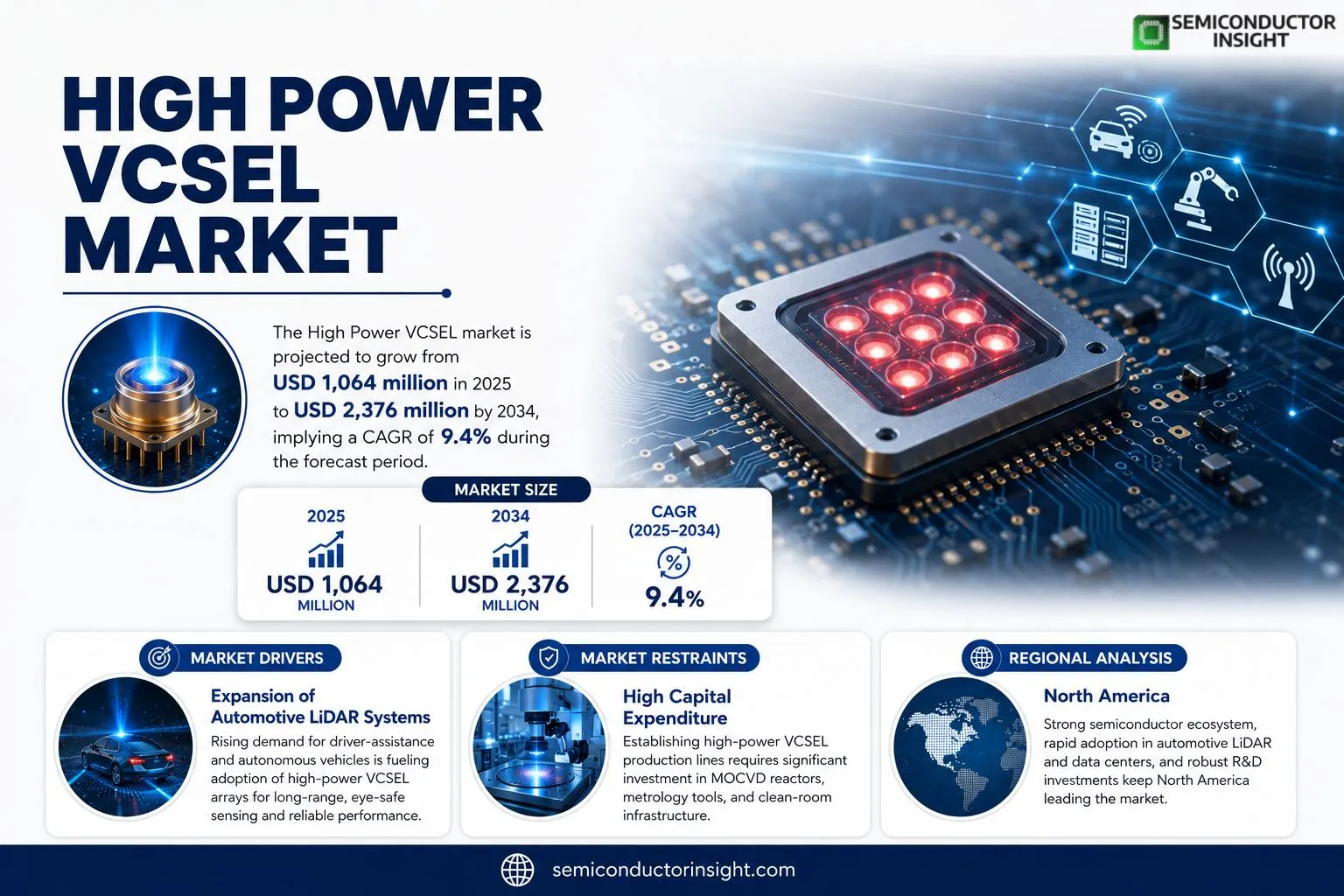
High Power VCSEL market size was valued at USD 1,064 million in 2025 and is expected to climb to USD 2,376 million by 2034, implying a compound annual growth rate of roughly 9.4 % over the period.
High Power VCSELs (Vertical‑Cavity Surface‑Emitting Lasers) are semiconductor laser devices engineered to emit elevated optical power through multi‑junction architectures, array configurations or sophisticated thermal management schemes. In 2025 the average unit price stood at about USD 6.4, supporting an estimated annual shipment of roughly 182 million units worldwide.The expansion of the market stems from rising adoption of automotive LiDAR sensing, increased demand for industrial vision systems and growing interest in high‑speed optical interconnects for data centers. Recent activity includes Lumentum’s launch of an automotive‑grade high‑power VCSEL family in March 2023 and Broadcom’s acquisition of a niche VCSEL packaging firm earlier this year, both moves that broaden supply‑chain capabilities and reinforce technology leadership.
MARKET DRIVERS
Expansion of Automotive Lidar Systems
The push toward higher levels of vehicle autonomy has translated into a surge of lidar modules that rely on High Power VCSEL arrays for reliable distance measurement. OEMs are integrating lidar into mid‑range ADAS suites, prompting component suppliers to upscale output power while preserving beam quality. This shift not only broadens the addressable customer base but also compresses product development cycles as manufacturers race to meet Tier‑1 specifications.
Data‑Center Interconnect Demands
Enterprises are replacing traditional copper links with optical interconnects capable of 100 Gbps and beyond. High‑power vertical‑cavity surface‑emitting lasers enable short‑reach links that reduce latency and power consumption in server racks. The migration is fueled by the need for dense compute fabrics, and it drives volume orders that stabilize High Power VCSEL Market across multiple wafer sizes.
➤ “In 2025, optical modules accounting for 30 % of new data‑center builds will feature VCSEL‑based transceivers,”
When these two forces intersectautomotive safety and data‑center efficiencythe market experiences a compound effect, expanding design windows and encouraging investment in next‑generation epitaxial growth techniques.
MARKET CHALLENGES
Manufacturing Yield Constraints
High‑power VCSEL fabrication demands precise control of cavity thickness and doping gradients. Even modest deviations can trigger catastrophic slope efficiency loss, inflating scrap rates. As a result, suppliers face a delicate balance between scaling output and preserving acceptable yields, which can slow the rollout of new product families.
Other Challenges
Thermal Management Issues
Elevated emission powers generate heat that must be dissipated without compromising beam uniformity. Conventional heat‑sink designs add packaging bulk, undermining the size‑sensitive applications that initially justified VCSEL adoption. Engineers are therefore compelled to explore advanced materials and hybrid integration schemes, adding to development timelines.
MARKET RESTRAINTS
High Capital Expenditure
Establishing a dedicated high‑power VCSEL production line requires multi‑million‑dollar investments in MOCVD reactors, metrology tools, and clean‑room infrastructure. For smaller players, the financial barrier curtails entry, consolidating market share among a limited set of incumbents and potentially stifling innovation diversity.
MARKET OPPORTUNITIES
Emerging 5G Small‑Cell Applications
5G rollouts are accelerating the deployment of dense small‑cell networks whose backhaul demands exceed the capabilities of traditional edge emitters. High‑power VCSELs, with their narrow spectral linewidth and turnkey array packaging, present a cost‑effective solution for line‑of‑sight links in urban micro‑cells, opening a revenue stream that complements existing telecom offerings.Integrating VCSEL sources onto photonic integrated circuits (PICs) promises to shrink module footprints while enhancing thermal performance. Foundries that master heterogeneous bonding can tap into the growing demand for compact, high‑bandwidth transceivers in both consumer and industrial segments.Lastly, the consumer augmented‑reality market is nudging headset manufacturers toward eye‑tracking systems that rely on bright, eye‑safe illumination. High‑power VCSELs meet the safety thresholds while delivering the illumination intensity required for low‑latency gaze detection, positioning the technology as a cornerstone of the next generation of wearables.
High Power VCSEL Market Trends
Automotive LiDAR as a Growth Engine
High Power VCSEL Market is feeling the impact of accelerated adoption of driver‑assist systems. Vehicle manufacturers are integrating lidar arrays that rely on multi‑junction VCSELs to deliver the range and eye‑safe power levels required for reliable obstacle detection. Because these arrays can be fabricated at wafer scale, system designers are able to keep bill‑of‑materials low while maintaining uniform beam quality across dozens of emitters. This cost advantage, combined with stricter safety regulations in North America and Europe, pushes automotive suppliers to qualify VCSEL modules for series production. The shift creates a clear incentive for component makers to invest in thermal‑management coatings and higher‑density epitaxial designs, ensuring that the devices meet the durability standards demanded by the automotive life‑cycle. As a result, the supply chain is rebalancing: upstream wafer growers see increased orders for high‑power epitaxy, while downstream packagers adapt to larger array formats and automotive‑grade testing protocols.
Other Trends
Pricing Pressure and Margin Management
Average unit pricing for high‑power emitters settled around US$6.4 in the most recent year, a level that reflects both the maturation of manufacturing yields and the competitive push from emerging players. Gross margins remain clustered between 40 % and 65 %, driven largely by the ability to control defect density during epitaxial growth and to optimize packaging steps that minimize thermal resistance. Companies that have introduced inline wafer‑level testing gain a pricing edge because they can identify out‑of‑spec devices early, reducing scrap rates. Meanwhile, OEMs in consumer electronics are negotiating larger volumes at modest price points, pressuring suppliers to streamline logistics and leverage economies of scale without eroding profitability.
Supply Chain Consolidation and Epitaxial Innovation
Recent months have seen a concentration of midstream fabs that specialize in array integration, a trend born from the need to align design cycles with automotive program timelines. This consolidation enables tighter coordination between chip layout engineers and optical test labs, shortening time‑to‑market for new wavelength bands such as 940 nm and 980 nm‑plus. At the same time, research into novel compound semiconductor alloys is delivering higher power densities without sacrificing beam uniformity, a development that directly supports next‑generation optical interconnects in data‑center environments. The combined effect of a tighter supply chain and breakthrough epitaxial processes positions High Power VCSEL Market to respond quickly to emerging standards across automotive, industrial vision, and high‑speed communications sectors.
COMPETITIVE LANDSCAPE
Key Industry Players
Competitive dynamics and strategic positioning in the High Power VCSEL sector
The High Power VCSEL field is anchored by a handful of vertically integrated firms whose control of epitaxial wafer production and advanced packaging grants them decisive market leverage. Lumentum, for instance, commands the top‑tier share by coupling its deep‑UV lithography expertise with a proprietary multi‑junction architecture that yields per‑unit margins up to 60 %. Its close relationships with automotive OEMs and data‑center equipment makers enable a pricing power that offsets the modest unit cost of roughly US$6.4. Parallel to Lumentum, ams OSRAM leverages its heritage in compound‑semiconductor material science to deliver high‑reliability arrays tailored for LiDAR illumination, securing long‑term contracts that stabilize its revenue stream. Broadcom’s aggressive acquisition of niche VCSEL designers has broadened its addressable market, allowing it to cross‑sell into consumer‑electronics and industrial vision platforms. The concentration of these three entities creates a tiered competitive environment where scale, design flexibility, and strategic partnerships dictate pricing, supply reliability, and the pace of technology refresh cycles.Beyond the dominant trio, several specialized players shape niche segments and act as catalysts for innovation. Coherent Corp has intensified its focus on high‑power array scaling, targeting next‑generation optical interconnects that demand uniform beam profiles. FLIR’s entry leverages its sensor expertise to embed VCSELs within advanced driver‑assistance systems, marrying imaging and illumination in a single package. TRUMPF Photonic Components differentiates through ultra‑precise thermal management solutions, a critical factor for automotive‑grade reliability. Smaller entrants such as VCSEL Technology, Laser Components, and Vixar concentrate on custom wavelength offerings (850 nm to 980 nm+), catering to medical imaging and industrial metrology customers. AKM Semiconductor and Vertilite pursue integration of VCSELs with driver electronics, shortening time‑to‑market for data‑communication modules. II‑VI Incorporated’s broad material portfolio supports experimental ultra‑high‑power prototypes, while Finisar maintains a foothold in the telecom segment through hybrid integration strategies. Collectively, these firms expand the ecosystem, compel incumbents to refine product roadmaps, and increase bargaining power for downstream users.
List of Key High Power VCSEL Companies Profiled
- Lumentum
- Lumentum
- ams OSRAM
- ams OSRAM
- Broadcom
- Broadcom
- Coherent Corp
- Coherent Corp
- FLIR Systems
- TRUMPF Photonic Components
- VCSEL Technology
- Laser Components
- AKM Semiconductor
- Vertilite
- Vixar
- II‑VI Incorporated
- Finisar
Segment Analysis:
| Segment Category | Sub-Segments | Key Insights |
| By Type |
|
Multi-model is gaining traction because:
|
| By Application |
|
Automotive emerges as the leading application because:
|
| By End User |
|
Automotive LiDAR Suppliers lead because:
|
| By Power Level |
|
Ultra‑High Power is pivotal because:
|
| By Emission Wavelength |
|
905 nm stands out because:
|
Regional Analysis: High Power VCSEL Market
North America
Companies headquartered in Silicon Valley and Boston have been integrating high‑output VCSELs into next‑generation data‑center transceivers, shortening the latency gap between optical and electrical interconnects.
Simultaneously, automotive OEMs in the United States and Canada are accelerating lidar adoption for advanced driver‑assistance systems, a move that forces suppliers to push output powers beyond the traditional 1‑W threshold.
The confluence of strong R&D tax incentives, a dense network of foundries, and an expanding talent pool keeps the pipeline of innovative designs robust.
As a result, original equipment manufacturers are favouring North American partners that can guarantee short lead‑times and customized wafer‑level testing, reinforcing the region’s market leadership.
Data‑center operators seek higher aggregate bandwidth, prompting designers to embed multi‑watt VCSEL arrays in transceiver modules. Automotive manufacturers, especially those experimenting with solid‑state lidar, rely on the same technology to achieve longer detection ranges while maintaining eye‑safe operation.
The FCC’s recent spectrum reallocation has opened additional bands for short‑reach optical links, nudging system architects toward higher‑power optoelectronic sources that can exploit the newly available bandwidth without compromising signal integrity.
Proximity to major wafer fabs in Arizona and New York reduces transit times for prototype runs. Moreover, an entrenched logistics network enables just‑in‑time delivery of custom‑doped epitaxial layers, a factor that many overseas competitors lack.
Public and private funds continue to target high‑performance photonics, offering series‑A and B financing rounds that accelerate productization. This capital flow sustains a pipeline of start‑ups that enrich the competitive landscape.
Europe
European manufacturers are capitalising on stringent energy‑efficiency directives, which encourage the replacement of legacy lasers with high‑output VCSELs in smart‑factory equipment. The region’s strong collaborative research framework, exemplified by joint programmes between German universities and French silicon‑photonic firms, yields incremental improvements in beam uniformity that are prized by telecommunications integrators. While funding levels trail North America, targeted EU Horizon initiatives keep the innovation cycle vibrant, especially for automotive safety applications requiring compliance with UNECE regulations.
Asia‑Pacific
Asia‑Pacific’s ascent is driven by aggressive rollout of 5G and burgeoning consumer electronics output. Chinese foundries benefit from economies of scale, allowing them to produce high‑power VCSEL wafers at competitive cost points, which in turn fuels adoption in low‑cost lidar modules for autonomous delivery vehicles. Japanese equipment makers are integrating these sources into high‑resolution projection systems, creating a feedback loop that spurs further performance enhancements. The region’s market depth is expanding despite a fragmented IP landscape that occasionally hampers cross‑border collaboration.
South America
In South America, the market is still nascent, yet localized demand is emerging from Brazil’s expanding data‑center footprint and Argentina’s pilot projects in agricultural imaging. Governments are offering tax incentives for high‑technology imports, encouraging regional distributors to stock high‑power VCSEL‑based transceivers. Supply constraints are gradually easing as multinational vendors establish regional logistics hubs, allowing end‑users to experiment with higher‑output devices without incurring prohibitive lead‑times.
Middle East & Africa
The Middle East & Africa region is witnessing early adoption driven by aerospace and defense contracts that require robust, eye‑safe illumination sources. United Arab Emirates’ smart‑city initiatives have earmarked high‑power VCSELs for biometric security scanners, while South Africa’s research institutions are exploring their utility in high‑throughput optical sensing for mineral exploration. Limited local fabrication capacity means the region remains import‑dependent, but growing procurement budgets signal a willingness to invest in premium photonic components.
Report Scope
This market research report provides a comprehensive analysis of the High Power VCSEL Market , covering the forecast period 2026–2034. It offers detailed insights into market dynamics, technological advancements, competitive landscape, and key trends shaping the industry.
Key focus areas of the report include:
- Market Overview: The report begins with an overview outlining its current market scenario, key growth indicators, and industry transformation drivers. It discusses macroeconomic factors, demand–supply balance, regulatory landscape, and the strategic role of semiconductors in powering advancements across industries such as automotive, telecommunications, consumer electronics, and industrial automation.
- Market Size & Forecast: Historical data and future projections for revenue, unit shipments, and market value across major regions and segments.
- Segmentation Analysis: Detailed breakdown by product type, technology, application, and end-user industry to identify high-growth segments and investment opportunities.
- Regional Insights: Insights into market performance across North America, Europe, Asia-Pacific, Latin America, and the Middle East & Africa, including country-level analysis where relevant.
- Competitive Landscape: Profiles of leading market participants, including their product offerings, R&D focus, manufacturing capacity, pricing strategies, and recent developments such as mergers, acquisitions, and partnerships.
- Technology Trends & Innovation: Assessment of emerging technologies, integration of AI/IoT, semiconductor design trends, fabrication techniques, and evolving industry standards.
- Market Drivers & Restraints: Evaluation of factors driving market growth along with challenges, supply chain constraints, regulatory issues, and market-entry barriers.
- Stakeholder Insights: Insights for component suppliers, OEMs, system integrators, investors, and policymakers regarding the evolving ecosystem and strategic opportunities.
Primary and secondary research methods are employed, including interviews with industry experts, data from verified sources, and real-time market intelligence to ensure the accuracy and reliability of the insights presented.
FREQUENTLY ASKED QUESTIONS:
What is the current market size of High Power VCSEL Market?
-> High Power VCSEL Market was valued at USD 1064 million in 2025 and is expected to reach USD 1990 million by 2032 with a CAGR of 9.4% over the forecast period.
Which key companies operate in High Power VCSEL Market?
-> Key players include Coherent Corp, FLIR, VCSEL, Laser Components, AKM, Lumentum, ams OSRAM, TRUMPF Photonic Components, Broadcom, Vertilite, Vixar, among others.
What are the key growth drivers?
-> Key growth drivers include the shift toward automotive sensing, industrial automation vision systems, next‑generation optical interconnects, and the demand for higher power density and reliability in VCSEL devices.
Which region dominates the market?
-> Asia holds the largest share of High Power VCSEL Market, driven by strong automotive and consumer electronics demand, while North America and Europe also show significant growth.
What are the emerging trends?
-> Emerging trends include advances in epitaxial design for higher power density, improved thermal management techniques, and the development of automotive‑grade reliability standards.
Get Sample Report PDF for Exclusive Insights
Report Sample Includes
- Table of Contents
- List of Tables & Figures
- Charts, Research Methodology, and more...
 Download Sample Report PDF