Infrared Fiber Laser Vibration Meter Market Insights
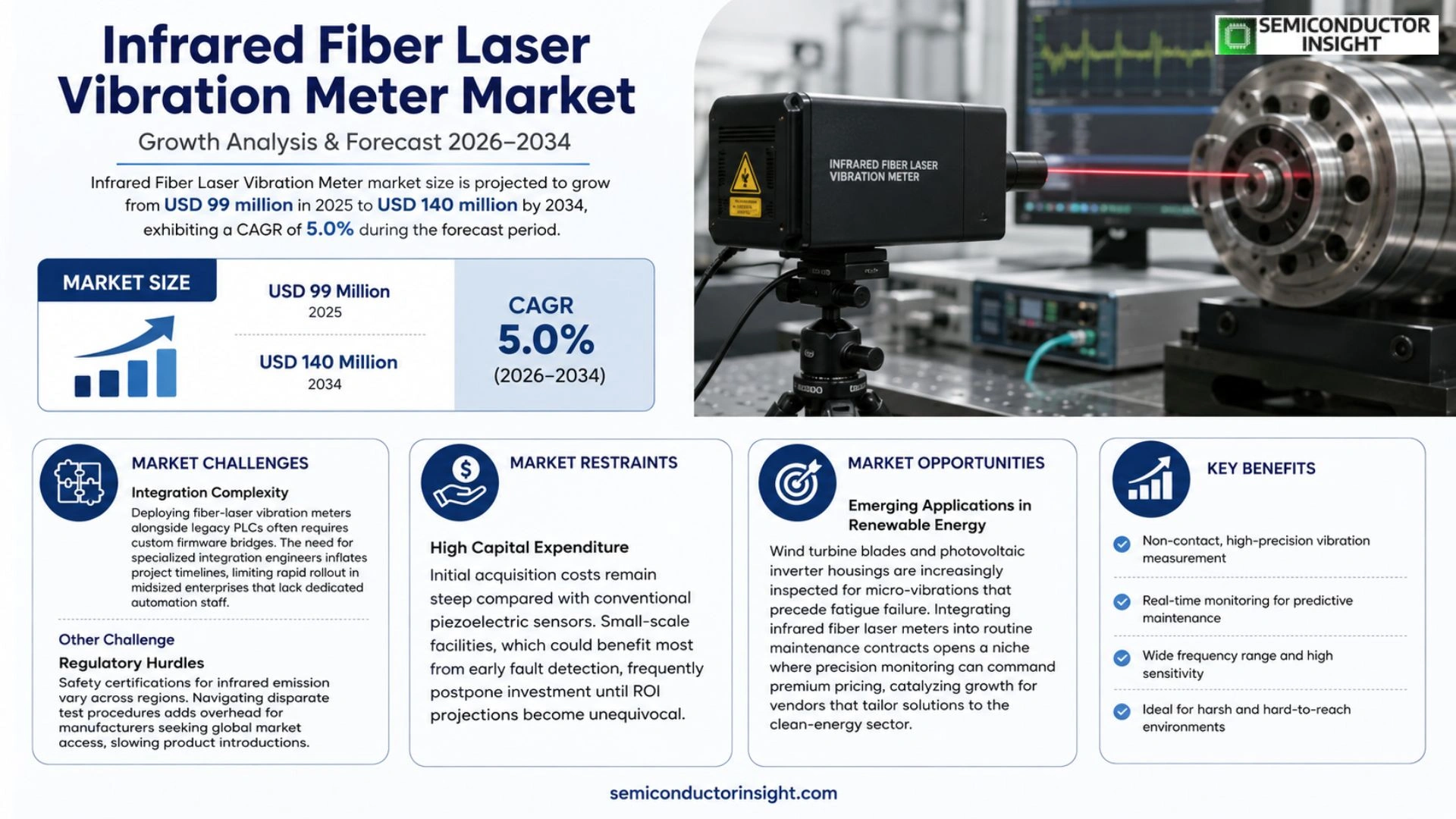
Global Infrared Fiber Laser Vibration Meter market size was valued at USD 99 million in 2025 to USD 140 million by 2032, exhibiting a CAGR of 5.0% during the forecast period.
Infrared fiber laser vibration meter refers to a non‑contact measurement system that employs a near‑infrared fiber‑coupled laser source. By leveraging laser Doppler vibration (LDV) or interferometric principles, the instrument demodulates phase or frequency shifts of light reflected from a test object, delivering velocity, displacement or acceleration data. Its architecture features flexible fiber deployment, remote electronics and immunity to electromagnetic interference, making it suitable for modal testing and NVH analysis in automotive, aerospace and rail‑transit structures, MEMS acoustic characterization, precision machine‑tool monitoring and medical device health assessment.
MARKET DRIVERS
Advancements in Laser Sensing Technology
The latest wave of fiber‑laser engineering has pushed measurement bandwidth well beyond 10 kHz, enabling detection of micro‑vibrations that were previously hidden. Higher signal‑to‑noise ratios allow operators to differentiate structural resonances from background interference, a capability that directly translates into reduced downtime for high‑value assets.
Expanding Industrial Automation Footprint
Manufacturers are increasingly embedding vibration diagnostics into robotic cells and CNC platforms. By feeding real‑time laser data into predictive‑maintenance algorithms, factories can shift from reactive repairs to condition‑based strategies, delivering measurable cost avoidance across Infrared Fiber Laser Vibration Meter Market.
➤ Precision data drives equipment reliability and informs smarter capital planning.
Because the technology now fits within the payload constraints of handheld inspection tools, field service teams are adopting it for on‑site assessments, enlarging the addressable customer base beyond traditional OEM channels.
MARKET CHALLENGES
Integration Complexity
Deploying fiber‑laser vibration meters alongside legacy PLCs often requires custom firmware bridges. The need for specialized integration engineers inflates project timelines, limiting rapid rollout in midsized enterprises that lack dedicated automation staff.
Other Challenges
Regulatory Hurdles
Safety certifications for infrared emission vary across regions. Navigating disparate test procedures adds overhead for manufacturers seeking global market access, slowing product introductions.
MARKET RESTRAINTS
High Capital Expenditure
Initial acquisition costs remain steep compared with conventional piezoelectric sensors. Small‑scale facilities, which could benefit most from early fault detection, frequently postpone investment until ROI projections become unequivocal.
MARKET OPPORTUNITIES
Emerging Applications in Renewable Energy
Wind turbine blades and photovoltaic inverter housings are increasingly inspected for micro‑vibrations that precede fatigue failure. Integrating infrared fiber laser meters into routine maintenance contracts opens a niche where precision monitoring can command premium pricing, catalyzing growth for vendors that tailor solutions to the clean‑energy sector.
Infrared Fiber Laser Vibration Meter Market Trends
Rising Adoption in Automotive and Aerospace
Infrared Fiber Laser Vibration Meter Market recorded revenue of roughly $99 million in 2025 and is forecasted to reach about $140 million by 2032, reflecting an average annual growth of close to five percent. This upward trajectory is anchored in the escalating need for non‑contact vibration analysis across high‑value sectors. Automotive manufacturers are increasingly embedding these meters into NVH test rigs to satisfy stricter comfort and durability standards, while aerospace OEMs rely on the same technology for structural health monitoring of airframes and propulsion components. The combination of fiber‑optic flexibility, immunity to electromagnetic interference, and remote electronic placement makes the solution uniquely suited to harsh test environments, prompting original equipment manufacturers to specify it as a baseline requirement rather than an optional add‑on. Consequently, suppliers that can guarantee consistent optical performance and rapid field servicing are positioned to capture premium margins.
Other Trends
Supply Chain Consolidation
Upstream, the pool of narrow‑linewidth laser source providers has narrowed, with a handful of firms now delivering both the fiber laser and the associated frequency‑stabilization modules. This consolidation reduces component variability but also concentrates bargaining power, pressuring downstream manufacturers to secure longer‑term contracts or to internalise critical optical modules. Midstream assemblers benefit from standardized optical heads, enabling higher production throughput and tighter cost control. On the downstream side, test laboratories and precision‑machinery producers are gravitating toward integrated solutions that bundle hardware, calibration, and after‑sales support, thereby simplifying procurement and reducing total‑ownership costs. The net effect is a market environment that rewards players with vertically integrated capabilities and discourages fragmented supply‑chain approaches.
Software‑Driven Data Analytics
Advanced signal‑processing algorithms are reshaping the value proposition of Infrared Fiber Laser Vibration Meter Market. Vendors are moving beyond raw displacement or velocity data, embedding spectral analysis, time‑frequency decomposition, and modal identification directly into the instrument firmware. Recent releases incorporate AI‑assisted defect detection that flags emerging fatigue signatures in real time, turning the meter into a predictive maintenance tool rather than a purely diagnostic device. This software layer creates recurring‑revenue opportunities through subscription‑based analytics packages and opens pathways for retrofitting existing hardware with over‑the‑air updates. Manufacturers that can demonstrate measurable reductions in downtime or maintenance costs through these analytics are likely to command stronger customer loyalty and differentiate themselves in a market where hardware specifications have begun to converge.
COMPETITIVE LANDSCAPE
Key Industry Players
Infrared Fiber Laser Vibration Meter Market – Competitive Overview
The market’s concentration revolves around a handful of firms that command the majority of revenue and dictate product road‑maps. Optomet, bolstered by an integrated supply chain for narrow‑linewidth fiber lasers, has leveraged its early entry to secure a dominant share of high‑precision automotive and aerospace contracts. GAO Tek follows closely, differentiating itself through proprietary interferometric modules that lower system noise and enable sub‑micron displacement accuracy, a capability that resonates with manufacturers of MEMS and medical instrumentation. These two leaders have established extensive service networks across North America and Europe, allowing them to capture the bulk of premium‑price orders while maintaining gross margins near the upper end of the 30‑55 % range.
Beneath the flagship tier, a diverse set of specialized players enriches the ecosystem. SmarAct GmbH focuses on compact, modular heads for laboratory use, while HoloBright (S) Private Limited supplies cost‑effective units for automotive NVH testing in emerging Asian markets. Sunnyinnovation Optical Intelligence and OmniSensing Photonics target niche segments such as precision machine‑tool monitoring, offering bundled software suites for real‑time modal analysis. Chinese manufacturers Beijing Huace Test Instrument and Wuhan Jingze Technology have expanded capacity rapidly, capitalizing on domestic demand and positioning themselves as attractive sourcing alternatives for mid‑range projects. Additional entrants,including Thorlabs, IP Photonics, Lumentum Holdings, Nanolaser Solutions, and MKS Instruments,provide complementary laser source technologies or advanced digital signal‑processing hardware, further fragmenting the supply base and fostering competitive pressure on pricing and innovation cycles.
List of Key Infrared Fiber Laser Vibration Meter Companies Profiled
- Optomet
- GAO Tek
- SmarAct GmbH
- HoloBright (S) Private Limited
- Sunnyinnovation Optical Intelligence
- OmniSensing Photonics
- Beijing Huace Test Instrument
- Wuhan Jingze Technology
- Thorlabs Inc.
- IPG Photonics
- Lumentum Holdings
- Nanolaser Solutions
- MKS Instruments
- Yokogawa Electric
Segment Analysis:
| Segment Category | Sub-Segments | Key Insights |
| By Type |
|
Single-Point Vibration Measurement
|
| By Application |
|
Automotive & Transportation
|
| By End User |
|
Test & Measurement Laboratories
|
| By Bandwidth |
|
Low Frequency
|
| By Product Form |
|
Handheld Devices
|
Regional Analysis: Infrared Fiber Laser Vibration Meter Market
The push for higher equipment reliability in sectors such as aerospace and semiconductor manufacturing fuels demand for advanced vibration monitoring. Clients seek tools that can detect micro‑oscillations before they cascade into costly failures, making infrared fiber laser technology attractive for its precision and immunity to electromagnetic interference.
Safety standards for high‑value production lines increasingly reference vibration thresholds, prompting manufacturers to adopt compliant measurement solutions. Agencies in the United States and Canada have issued guidance that aligns closely with the capabilities of infrared fiber laser meters, reinforcing market uptake.
Aerospace engine testing, semiconductor wafer processing, and advanced medical imaging equipment constitute the core user base. These segments prioritize minute vibration detection to safeguard product yield and patient safety, driving deeper penetration of laser‑based meters.
A handful of North‑American firms dominate design expertise, yet emerging players from Europe and Asia are introducing cost‑effective variants. Partnerships between hardware manufacturers and data‑analytics specialists are reshaping the competitive hierarchy, rewarding those who offer integrated solutions.
Europe
European manufacturers are leveraging strong governmental funding for Industry 4.0 initiatives, which includes vibration monitoring as a pillar of smart factories. Countries such as Germany and France are integrating laser‑based meters into automotive assembly lines to meet stringent quality benchmarks. The region’s fragmented supplier base encourages collaboration, and many firms are co‑developing bespoke solutions for aerospace and renewable‑energy turbines, where vibration control is critical for long‑term reliability.
Asia‑Pacific
Asia‑Pacific’s rapid expansion of high‑tech production hubs creates fertile ground for Infrared Fiber Laser Vibration Meter Market. Nations like Japan, South Korea, and China are upgrading legacy equipment to meet rising export standards, and laser vibration meters are seen as a cost‑effective path to achieve that. The region’s price‑sensitive environment pushes vendors to balance performance with affordability, spurring incremental innovations in sensor miniaturisation.
South America
In South America, the market is gaining traction as mining and oil‑and‑gas operations adopt precision monitoring to reduce unplanned downtime. Brazil’s emerging aerospace sector is also beginning to test laser‑based vibration solutions on engine components. Limited local manufacturing capability means many projects rely on imported systems, prompting distributors to offer comprehensive after‑sales support as a differentiator.
Middle East & Africa
The Middle East & Africa region is still in the early adoption phase, with oil‑refining complexes and new‑generation power plants driving initial demand. Investors are attracted by the technology’s ability to operate in harsh environments without degradation. Partnerships with European OEMs are facilitating technology transfer, while regional players focus on service contracts that include calibration and remote diagnostics.
Report Scope
This market research report provides a comprehensive analysis of the Infrared Fiber Laser Vibration Meter Market , covering the forecast period 2026–2034. It offers detailed insights into market dynamics, technological advancements, competitive landscape, and key trends shaping the industry.
Key focus areas of the report include:
- Market Overview: The report begins with an overview outlining its current market scenario, key growth indicators, and industry transformation drivers. It discusses macroeconomic factors, demand–supply balance, regulatory landscape, and the strategic role of semiconductors in powering advancements across industries such as automotive, telecommunications, consumer electronics, and industrial automation.
- Market Size & Forecast: Historical data and future projections for revenue, unit shipments, and market value across major regions and segments.
- Segmentation Analysis: Detailed breakdown by product type, technology, application, and end-user industry to identify high-growth segments and investment opportunities.
- Regional Insights: Insights into market performance across North America, Europe, Asia-Pacific, Latin America, and the Middle East & Africa, including country-level analysis where relevant.
- Competitive Landscape: Profiles of leading market participants, including their product offerings, R&D focus, manufacturing capacity, pricing strategies, and recent developments such as mergers, acquisitions, and partnerships.
- Technology Trends & Innovation: Assessment of emerging technologies, integration of AI/IoT, semiconductor design trends, fabrication techniques, and evolving industry standards.
- Market Drivers & Restraints: Evaluation of factors driving market growth along with challenges, supply chain constraints, regulatory issues, and market-entry barriers.
- Stakeholder Insights: Insights for component suppliers, OEMs, system integrators, investors, and policymakers regarding the evolving ecosystem and strategic opportunities.
Primary and secondary research methods are employed, including interviews with industry experts, data from verified sources, and real-time market intelligence to ensure the accuracy and reliability of the insights presented.
FREQUENTLY ASKED QUESTIONS:
What is the current market size of Infrared Fiber Laser Vibration Meter Market?
-> Infrared Fiber Laser Vibration Meter Market was valued at USD 99 million in 2025 and is expected to reach USD 140 million by 2032, growing at a CAGR of 5.0% during the forecast period.
Which key companies operate in Infrared Fiber Laser Vibration Meter Market?
-> Key players include Optomet, GAO Tek, SmarAct GmbH, HoloBright (S) Private Limited, Sunnyinnovation Optical Intelligence, OmniSensing Photonics, Beijing Huace Test Instrument, Wuhan Jingze Technology, among others.
What are the key growth drivers?
-> Key growth drivers include rising demand for non‑contact vibration measurement in automotive, aerospace, rail‑transit, precision machine tools, and medical device sectors, as well as the need for high‑precision modal testing and condition monitoring.
Which region dominates the market?
-> The available data indicates a globally distributed market with strong adoption across multiple regions; no single region is identified as dominant in the provided information.
What are the emerging trends?
-> Emerging trends include integration of advanced signal‑processing algorithms, AI‑enabled diagnostics, miniaturized fiber‑laser solutions for MEMS and micro‑electro‑acoustic devices, and expanding applications in health monitoring of structural and medical equipment.

Get Sample Report PDF for Exclusive Insights
Report Sample Includes
- Table of Contents
- List of Tables & Figures
- Charts, Research Methodology, and more...
 Download Sample Report PDF