Preamplifier HgCdTe Detector Market Insights
Global Preamplifier HgCdTe Detector market was valued at USD 114 million in 2025 and is forecasted to reach USD 166 million by 2034, reflecting a compound annual growth rate of approximately 5.6% over the period.
The preamplified mercury cadmium telluride (MCT) detector combines a HgCdTe photon‑absorbing element with an integrated low‑noise preamplifier. This architecture provides wide‑band infrared sensitivity together with immediate signal amplification, which enhances signal‑to‑noise ratio, interference resistance and usable bandwidth,critical for long‑cable, weak‑signal or high‑speed scenarios in national defense, aerospace and scientific research.
Market expansion is driven by increasing procurement of advanced infrared sensing solutions for defense platforms and growing adoption of high‑performance spectroscopic instruments in aerospace programs.
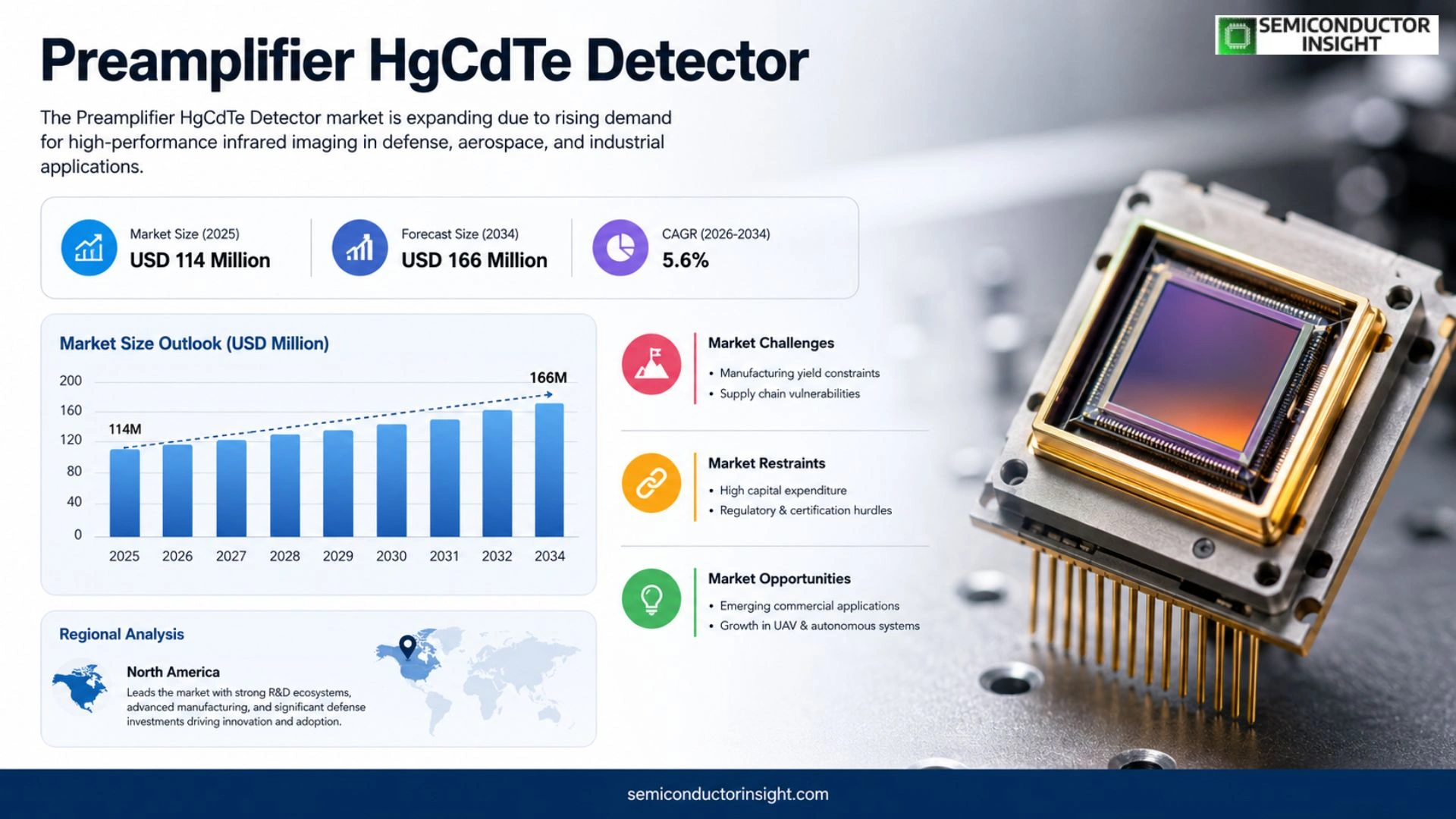
MARKET DRIVERS
Advances in Infrared Imaging Technology
Preamplifier HgCdTe Detector Market benefits from breakthroughs in narrow‑bandgap semiconductor processing that deliver superior quantum efficiency across the 2–12 µm range. Vendors now report detector noise levels dropping by up to 30 % while maintaining gain stability, a combination that unlocks higher‑resolution thermal imagery for scientific and industrial users.
Integration with Defense and Space Platforms
Modern missile‑warning systems and low‑Earth‑orbit telescopes are redefining their sensor suites around HgCdTe preamplifiers because the devices can tolerate harsh radiation environments while preserving signal fidelity. This architectural shift pushes system integrators to adopt new design standards, creating a cascade of procurement activity for Preamplifier HgCdTe Detector Market.
➤ Operators who prioritize real‑time data processing are increasingly selecting integrated preamplifier modules to shorten the analog‑to‑digital conversion chain, thereby reducing latency in critical missions.
In parallel, academic collaborations on hyperspectral imaging are generating demand for customized preamplifier configurations, prompting manufacturers to expand their product portfolios and invest in rapid prototyping capabilities.
MARKET CHALLENGES
Manufacturing Yield Constraints
HgCdTe crystal growth remains a delicate balance of temperature gradients and dopant uniformity. Even minor deviations can cause pixel‑level defects that force producers to discard up to 20 % of each wafer, inflating unit costs and limiting price‑competitiveness for Preamplifier HgCdTe Detector Market.
Other Challenges
Supply Chain Vulnerabilities
The scarcity of high‑purity cadmium and tellurium, compounded by geopolitical trade restrictions, hampers the ability of manufacturers to secure long‑term material contracts, introducing uncertainty into capacity planning.
MARKET RESTRAINTS
High Capital Expenditure
Establishing a fab line capable of producing HgCdTe wafers with sub‑micron precision requires multi‑hundred‑million‑dollar investments. Smaller entrants often lack the financial bandwidth to compete, causing market concentration among a handful of legacy players.
Beyond the initial outlay, ongoing expenditures for cryogenic testing and qualification impose additional cost layers, discouraging marginal projects that might otherwise explore niche applications.
Regulatory compliance for aerospace and defense certifications adds another hurdle; the rigorous documentation and audit processes extend time‑to‑market, further restraining rapid adoption cycles.
MARKET OPPORTUNITIES
Emerging Commercial Applications
Mid‑range thermal cameras for autonomous vehicle navigation are beginning to incorporate HgCdTe preamplifiers to achieve detection thresholds below 150 mK. This performance edge opens a lucrative segment where manufacturers can price premium solutions based on enhanced safety metrics.
The rise of unmanned aerial systems equipped for nighttime reconnaissance creates a parallel opportunity. Operators demand lightweight, low‑power detector modules, and the compact form factor of modern preamplifiers aligns well with UAV payload constraints.
Finally, the medical imaging field is exploring far‑infrared spectroscopy for non‑invasive diagnostics. Early pilots indicate that the signal‑to‑noise improvements offered by HgCdTe preamplifiers could reduce scan times, suggesting a forthcoming demand wave that Preamplifier HgCdTe Detector Market is well positioned to satisfy.
Preamplifier HgCdTe Detector Market Trends
Integrated Low‑Noise Amplification Elevates System Capability
The convergence of the HgCdTe photon sensor and a low‑noise preamplifier within a single module is redefining signal fidelity for infrared solutions. By eliminating external interconnects, the monolithic design curtails parasitic capacitance and preserves the weak photocurrent that characterises long‑wave infrared detection. Customers in national defense, aerospace, and advanced research report a measurable uplift in signal‑to‑noise ratio, which translates directly into extended detection ranges and finer spectral resolution. The architecture also simplifies thermal management, because the preamplifier can be thermally coupled to the detector’s temperature‑control system, reducing overall power consumption. For system integrators, the modular approach shortens development cycles: board‑level designers no longer need to accommodate bulky discrete amplifiers, allowing more compact payloads and faster time‑to‑market. This technical shift is a primary catalyst reshaping Preamplifier HgCdTe Detector Market.
Other Trends
Supply‑Chain Consolidation and Raw‑Material Security
High‑purity mercury, cadmium, and tellurium feedstocks remain a bottleneck for new entrants, prompting leading manufacturers to secure long‑term contracts with specialty material suppliers. Vertical integration efforts,particularly in epitaxial growth techniques such as MBE and LPE,are reducing dependency on external fabs and stabilizing unit cost volatility. The push for tighter control over substrate quality (e.g., CdZnTe) also mitigates yield loss during wafer processing, a factor that directly improves gross margin stability across the value chain. As a result, the upstream segment is witnessing a modest concentration, with a handful of firms commanding the majority of material supply, while mid‑stream assemblers benefit from more predictable input pricing.
Space‑Based Spectroscopy Spurs New Demand Segments
Satellite platforms targeting atmospheric monitoring and astronomical observation are increasingly specifying preamplified HgCdTe detectors for their superior bandwidth and resistance to electromagnetic interference. The requirement for real‑time, high‑speed data acquisition in low‑signal environments drives product iterations that emphasize faster rise times and tighter impedance matching. Instrument manufacturers are consequently allocating a larger portion of their R&D budgets to adapt the detector‑amplifier package for radiation‑hard environments, an effort that is expected to generate niche growth pockets. This application shift not only diversifies the end‑user base but also pressures vendors to extend warranty and calibration services, thereby adding a service‑oriented revenue stream to the traditional hardware business.
COMPETITIVE LANDSCAPE
Key Industry Players
Global Competitive Overview of Preamplifier HgCdTe Detector Market
Thorlabs dominates Preamplifier HgCdTe Detector segment through a blend of extensive optical‑system expertise and a vertically integrated supply chain that stretches from high‑purity Hg/Cd/Te crystal growth to final packaging. Its ability to pair proprietary low‑noise operational amplifiers with custom‑engineered MCT sensor arrays yields a product line that meets the stringent signal‑to‑noise requirements of defense and aerospace programs. The company’s R&D spend, focused on reducing thermal drift and enhancing bandwidth, translates into a price premium that sustains a healthy gross margin. Because Thorlabs controls both the detector core and the preamplifier architecture, it can rapidly iterate designs for emerging applications such as hyperspectral imaging, giving it a defensible market position and influencing supplier negotiations upstream.
Beyond the market leader, a cohort of specialized firms injects diversity into the competitive set. InfraRed Associates and Infrared Systems Development Corporation (ISDC) excel in niche defense contracts, leveraging deep ties with U.S. military labs to tailor modules for high‑speed telemetry. Kolmar Technologies and VIGO Photonics differentiate themselves through advanced thermal‑control packaging that extends detector performance in cryogenic environments. Healthy Photon, Hamamatsu Photonics, and Teledyne Imaging focus on scientific‑research clientele, offering customizable gain stages and rigorous calibration services. European contributors such as Leonardo DRS and L3Harris add value by integrating detectors into broader electro‑optical weapon systems, while Raytheon and Russian firm Scontel supply indigenous raw‑material processing capabilities that reduce reliance on imported substrates.
List of Key Preamplifier HgCdTe Detector Companies Profiled
- Thorlabs
- InfraRed Associates
- Infrared Systems Development Corporation (ISDC)
- Kolmar Technologies
- VIGO Photonics
- Healthy Photon
- Hamamatsu Photonics
- Teledyne Imaging
- Leonardo DRS
- L3Harris
- Raytheon Technologies
- Scontel
Segment Analysis:
| Segment Category | Sub-Segments | Key Insights |
| By Type |
|
Photovoltaic Type dominates because it offers intrinsic low noise characteristics, seamless integration with low‑power front‑end electronics, and robust performance under cryogenic conditions.
|
| By Application |
|
Aerospace emerges as the leading application due to demanding requirements for high‑speed, long‑cable signal integrity and resistance to harsh environmental conditions.
|
| By End User |
|
Research Institutions drive innovation because they require the highest detector sensitivity and flexibility for experimental setups.
|
| By Operating Mode |
|
Linear Mode is preferred for applications that demand continuous signal fidelity and precise amplitude representation.
|
| By Material Innovation |
|
High‑Purity Epitaxy underpins next‑generation detector performance by minimizing defect density and enhancing carrier mobility.
|
Regional Analysis: Preamplifier HgCdTe Detector Market
North America
A concentration of semiconductor research institutes drives breakthroughs in low‑noise amplification, directly influencing product roadmaps for HgCdTe detector arrays across the continent.
Proximity between raw‑material suppliers and assembly plants shortens logistics loops, reducing lead times and insulating manufacturers from global disruptions.
Harmonized standards for infrared safety and electromagnetic compatibility streamline certification, allowing firms to launch products across multiple verticals with fewer obstacles.
Venture capital and defense procurement programs funnel capital toward niche startups, accelerating the commercialization of cutting‑edge amplification technologies.
Europe
European stakeholders benefit from a strong tradition of precision optics, which translates into meticulous engineering of preamplifier interfaces for HgCdTe detectors. Collaborative frameworks among the EU’s research corridors promote standardization, while aerospace firms prioritize reliability, prompting suppliers to adopt rigorous qualification processes. Emerging market segments such as satellite‑based Earth observation are allocating budgets toward higher dynamic range capabilities, compelling manufacturers to refine signal‑to‑noise ratios without inflating system weight. The interplay of policy incentives for green technologies and a mature component ecosystem sustains a balanced growth trajectory for the regional market.
Asia‑Pacific
In the Asia‑Pacific, rapid expansion of telecommunications infrastructure and defense modernization programs drive demand for compact, high‑performance infrared sensing solutions. Nations like Japan and South Korea leverage advanced materials research to push the boundaries of quantum efficiency, while emerging economies invest in domestic fabrication capabilities to reduce reliance on imports. The region’s cost‑focused manufacturing culture pressures vendors to optimize the bill of materials, encouraging innovative packaging that maintains performance under tighter thermal constraints. These dynamics generate a fertile environment for both legacy players and agile newcomers.
South America
South American markets are witnessing a gradual uptake of infrared detection technologies within mining exploration and environmental monitoring sectors. Local firms partner with North American OEMs to adapt preamplifier designs for rugged field conditions, emphasizing durability over raw performance. Government incentives targeting scientific research foster modest but steady investments in detector development, while the continent’s growing aerospace ambitions hint at longer‑term demand for sophisticated imaging payloads. The overall outlook reflects cautious optimism, balanced by the need for technology transfer and capacity building.
Middle East & Africa
The Middle East & Africa region leverages its strategic location for defense and surveillance applications, where high‑resolution infrared imaging holds operational significance. Collaborative initiatives between regional defense ministries and international technology providers focus on integrating HgCdTe detector modules into unmanned platforms. Meanwhile, African nations explore satellite‑based climate observation, prompting interest in compact, power‑efficient preamplifiers. Though market size remains modest, targeted investments and cross‑border partnerships are laying the groundwork for a more pronounced presence in the global supply chain.
Report Scope
This market research report provides a comprehensive analysis of the Preamplifier HgCdTe Detector Market , covering the forecast period 2026–2034. It offers detailed insights into market dynamics, technological advancements, competitive landscape, and key trends shaping the industry.
Key focus areas of the report include:
- Market Overview: The report begins with an overview outlining its current market scenario, key growth indicators, and industry transformation drivers. It discusses macroeconomic factors, demand–supply balance, regulatory landscape, and the strategic role of semiconductors in powering advancements across industries such as automotive, telecommunications, consumer electronics, and industrial automation.
- Market Size & Forecast: Historical data and future projections for revenue, unit shipments, and market value across major regions and segments.
- Segmentation Analysis: Detailed breakdown by product type, technology, application, and end-user industry to identify high-growth segments and investment opportunities.
- Regional Insights: Insights into market performance across North America, Europe, Asia-Pacific, Latin America, and the Middle East & Africa, including country-level analysis where relevant.
- Competitive Landscape: Profiles of leading market participants, including their product offerings, R&D focus, manufacturing capacity, pricing strategies, and recent developments such as mergers, acquisitions, and partnerships.
- Technology Trends & Innovation: Assessment of emerging technologies, integration of AI/IoT, semiconductor design trends, fabrication techniques, and evolving industry standards.
- Market Drivers & Restraints: Evaluation of factors driving market growth along with challenges, supply chain constraints, regulatory issues, and market-entry barriers.
- Stakeholder Insights: Insights for component suppliers, OEMs, system integrators, investors, and policymakers regarding the evolving ecosystem and strategic opportunities.
Primary and secondary research methods are employed, including interviews with industry experts, data from verified sources, and real-time market intelligence to ensure the accuracy and reliability of the insights presented.
FREQUENTLY ASKED QUESTIONS:
What is the current market size of Preamplifier HgCdTe Detector Market?
-> Preamplifier HgCdTe Detector market is forecasted to reach USD 166 million by 2034, reflecting a compound annual growth rate of approximately 5.6%
Which key companies operate in Preamplifier HgCdTe Detector Market?
-> Key players include Thorlabs, InfraRed Associates, Infrared Systems Development Corporation (ISDC), Kolmar Technologies, VIGO Photonics, Healthy Photon.
What are the key growth drivers?
-> Key growth drivers include rising demand in national defense, aerospace, and scientific research for high‑sensitivity infrared detection, the need for low‑noise amplification of weak signals, and expansion of long‑cable, high‑speed measurement applications.
Which region dominates the market?
-> North America (especially the United States) currently holds the largest market share, driven by strong defense and aerospace programs, while Asia‑Pacific shows rapid growth due to increasing adoption in scientific research and aerospace sectors.
What are the emerging trends?
-> Emerging trends include advancements in HgCdTe epitaxial growth (MBE/LPE), integration of micro‑temperature control modules with preamplifiers, and development of compact, low‑noise preamplifier packages for enhanced signal‑to‑noise performance.
Get Sample Report PDF for Exclusive Insights
Report Sample Includes
- Table of Contents
- List of Tables & Figures
- Charts, Research Methodology, and more...
 Download Sample Report PDF