Infrared Imaging Photodetectors Market Insights
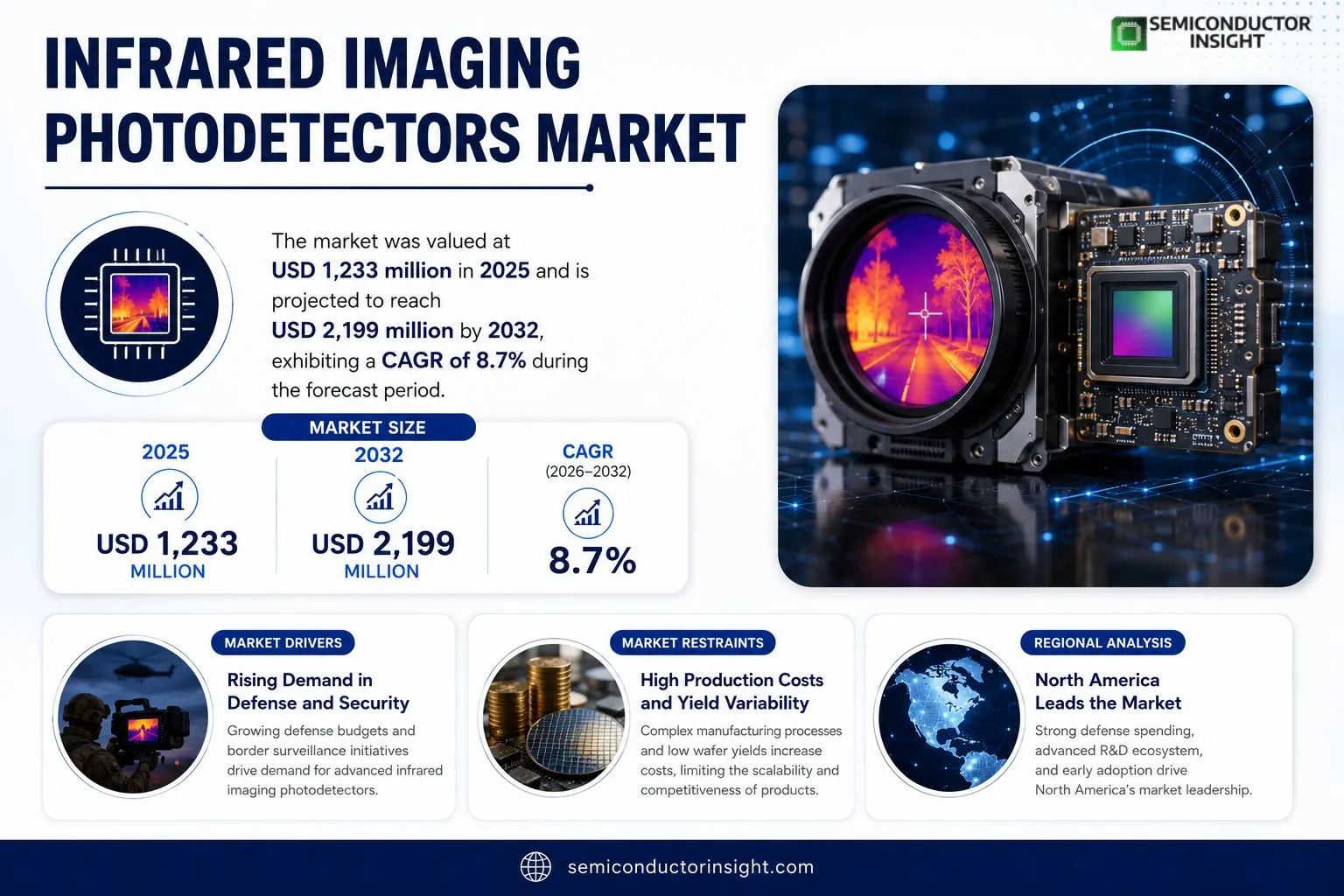
Infrared Imaging Photodetectors market was valued at USD 1,233 million in 2025 and is projected to reach USD 2,199 million by 2032, exhibiting a CAGR of 8.7% during the forecast period.
Infrared Imaging Photodetectors are semiconductor transducer devices that convert infrared radiation into measurable electrical signals. Their core function is the detection and imaging of the infrared spectral region through the photoelectric effect: when infrared photons strike a semiconductor material whose band‑gap is smaller than the photon energy, electron‑hole pairs are generated, producing a photocurrent under an applied electric field. This principle defines each detector’s response to specific infrared bands. From an industrial perspective, these photodetectors intersect semiconductor materials, micro‑electronics processing, precision optics, and vertical‑application domains such as thermal cameras, night‑vision systems, gas sensors, space remote sensing, medical diagnostics, and non‑destructive testing.
MARKET DRIVERS
Rising Demand in Defense and Security
Government procurement programs across North America and Europe have accelerated acquisitions of thermal‑vision systems for unmanned platforms, border surveillance, and missile‑guidance applications. The shift toward network‑centric warfare compels armed forces to integrate infrared imaging photodetectors that can operate reliably under adverse weather and low‑light conditions. This procurement surge translates into a steady influx of contracts valued in the low‑hundreds of millions, prompting manufacturers to expand capacity.
Advancements in Semiconductor Materials
Recent breakthroughs in epitaxial growth of InSb and HgCdTe wafers have lifted quantum efficiency by 12‑15 % while suppressing dark current. Simultaneously, emerging two‑dimensional materials such as black phosphorus are entering pilot production, offering tunable bandgaps that match specific wavelength bands. These material gains reduce system cost per pixel, making high‑resolution arrays viable for commercial imaging and automotive night‑vision markets.
➤ “The convergence of material science and defense spending creates a feedback loop that strengthens the supply chain and nurtures innovation,” notes a senior analyst at a leading research firm.
Collectively, the demand from security sectors coupled with material‑level performance improvements encourages original equipment manufacturers to embed infrared imaging photodetectors into next‑generation platforms, thereby expanding the addressable market beyond niche applications.
MARKET CHALLENGES
High Production Costs and Yield Variability
Fabricating high‑performance detectors requires sophisticated molecular‑beam epitaxy equipment and clean‑room environments. Even minor deviations in temperature control can trigger defect formation, driving wafer‑level yields below 70 %. The resulting cost pressure makes it difficult for smaller players to compete on price, limiting the breadth of supplier options for system integrators.
Other Challenges
Manufacturing Yield
Efforts to automate wafer inspection have reduced cycle time, yet the intrinsic sensitivity of infrared materials to contamination means that yield improvements plateau without substantial capital infusion.
MARKET RESTRAINTS
Stringent Regulatory Environment
Export controls governing dual‑use technologies subject infrared imaging photodetectors to licensing requirements in several jurisdictions. Compliance procedures increase lead times and add legal overhead, particularly for firms seeking to serve both military and civilian customers. The regulatory burden can deter new entrants and slow the rollout of innovative designs.
MARKET OPPORTUNITIES
Growth in Autonomous Vehicles and Industrial Inspection
Automakers are integrating infrared imaging photodetectors into driver‑assistance suites to enhance pedestrian detection in foggy conditions, while manufacturers of petrochemical plants employ the same sensors for predictive maintenance of pipelines. These secular trends open avenues for volume sales at lower price points, incentivizing suppliers to develop cost‑effective architectures that retain performance metrics required for safety‑critical functions.
Infrared Imaging Photodetectors Market Trends
Advancement of Cooled Detector Technologies
In defense circles, heightened investment in night‑vision and precision‑guidance capabilities has placed high‑performance cooled infrared detectors at the forefront of procurement programs. The requirement for reliable signal‑to‑noise ratios under low‑light conditions compels armed forces to favor systems that integrate cryogenically cooled focal‑plane arrays, which deliver superior sensitivity across narrow spectral bands. This preference feeds a steady flow of contracts for manufacturers that can sustain the complex assembly processes and maintain the stringent reliability standards demanded by aerospace platforms. As a consequence, suppliers are allocating R&D budgets toward improving cooling efficiency and extending detector lifecycles, thereby solidifying the link between defense spending and the continued evolution of cooled photodetector architectures.
Other Trends
Material Innovation and Uncooled Solutions
Parallel to the defense‑driven segment, the civilian market is experiencing a shift toward uncooled devices that capitalize on emerging semiconductor materials such as quantum‑dot alloys and graphene composites. These novel absorbers provide faster carrier dynamics and higher quantum efficiency, which translate into lower power consumption and thinner form factors. Manufacturers that have embraced these material platforms report a noticeable decline in bill‑of‑materials costs, making infrared imaging viable for applications ranging from predictive maintenance in power‑grid inspections to temperature‑screening stations in public venues. The convergence of material science breakthroughs with mature CMOS processing lines is eroding the cost barrier that previously limited infrared sensors to niche, high‑value installations.
Supply Chain Pressures and Competitive Landscape
The broader ecosystem surrounding infrared imaging photodetectors is feeling the strain of semiconductor shortages and volatile raw‑material pricing, particularly for compounds like mercury‑cadmium‑telluride that remain import‑dependent. Companies that have secured localized supply chains or diversified their material sources are better positioned to honor delivery schedules for both military and commercial customers. Meanwhile, the entry of Asian firms with vertically integrated production capabilities intensifies competition, prompting traditional players to explore strategic alliances or joint ventures that can alleviate capacity constraints. This evolving competitive dynamic underscores the importance of supply‑chain resilience as a decisive factor in capturing market share across the defense, industrial, and smart‑city segments.
COMPETITIVE LANDSCAPE
Key Industry Players
Infrared Imaging Photodetectors: Competitive Overview
Teledyne FLIR dominates the high‑performance cooled detector segment, leveraging its legacy in defense optics and a broad portfolio that spans night‑vision, missile‑guidance and airborne surveillance systems. Its vertical integrationfrom wafer‑scale material sourcing to focal‑plane‑array assemblycreates a cost advantage that smaller firms struggle to match. Raytheon and Lynred complement this landscape by focusing on niche military contracts and bespoke cryogenic solutions, respectively, both benefiting from long‑term government procurement pipelines. The concentration of revenue among these three firms sets a clear hierarchy, prompting mid‑tier manufacturers to pursue differentiation through uncooled technologies, faster response times, or specialized spectral bands.Beyond the tier‑1 cohort, a vibrant cluster of niche innovators is reshaping the market’s periphery. Companies such as Guide Sensmart, Raytron, Dali Technology and Hikvision exploit the surge in civil‑security and smart‑city deployments by offering cost‑efficient uncooled arrays that integrate seamlessly with IoT platforms. European specialists like InfraTec GmbH and Hamamatsu Photonics focus on high‑precision industrial inspection and medical diagnostics, where detector linearity and reliability outweigh pure sensitivity. Meanwhile, Asian playersincluding Murata Manufacturing, CETC and North Guangweiinvest heavily in emerging materials (e.g., quantum‑dot and graphene composites) to unlock performance gains without the expense of traditional mercury‑cadmium‑telluride devices. This diversified mid‑market fosters competitive pressure that accelerates innovation across the entire value chain.
List of Key Infrared Imaging Photodetectors Companies Profiled
- Teledyne FLIR
- Raytheon
- Lynred
- SemiConductor Devices
- AIM
- Excelitas
- Jenoptik
- Leonardo
- InfraTec GmbH
- Hamamatsu Photonics
- i3system
- VIGO Photonics
- Heimann Sensor
- Murata Manufacturing
- CETC
- Dahua
- Hikvision
- North Guangwei
- Guide Sensmart
- Dali Technology
- Raytron
Segment Analysis:
| Segment Category | Sub-Segments | Key Insights |
| By Type |
|
Photovoltaic Detector
|
| By Application |
|
Military Field
|
| By End User |
|
Defense & Aerospace
|
| By Operating Temperature |
|
Cryogenically Cooled Detector
|
| By Detection Material |
|
Mercury Cadmium Telluride (MCT)
|
Regional Analysis: Infrared Imaging Photodetectors Market
North America
Manufacturers in the region rapidly integrate quantum‑well structures and type‑II superlattice designs, creating detectors that balance sensitivity with power efficiency for portable platforms.
Defense, automotive Lidar, and aerospace remain the primary demand drivers, each imposing distinct performance envelopes that shape product specifications.
Export controls on high‑performance infrared components compel firms to adopt dual‑use compliance frameworks, influencing both design choices and market entry timing.
Proximity to silicon wafer fabs and specialty alloy producers reduces lead times, allowing North American players to respond swiftly to bespoke customer orders.
Europe
European stakeholders leverage a strong tradition of standards‑driven engineering, especially within the aerospace and medical imaging sectors. Collaborative programs funded by the European Union foster cross‑border research that yields detector concepts optimized for low‑temperature operation, a requirement for space telescopes. Meanwhile, strict environmental directives push vendors toward greener manufacturing practices, influencing material selection and packaging techniques. The result is a market segment that values reliability and compliance as much as raw performance, prompting firms to differentiate through certification and long‑term service agreements.
Asia‑Pacific
In the Asia‑Pacific, rapid industrialization and a burgeoning consumer electronics base create a fertile ground for cost‑effective infrared solutions. Nations such as Japan, South Korea, and Singapore host advanced fab facilities that specialize in high‑volume production of mid‑wave detectors for smart home and automotive applications. Concurrently, emerging economies like India and Vietnam are investing in research parks that aim to close the technology gap, attracting multinational partnerships. This mix of scale and emerging talent encourages a competitive pricing environment while still allowing for incremental performance improvements.
South America
South American activity centers on niche markets like agricultural monitoring and oil‑field inspection, where rugged, low‑cost infrared detectors are prized. Brazil’s aerospace programs drive modest demand for thermal imaging on unmanned platforms, while Chile’s mining sector seeks robust sensors for equipment health monitoring. Limited local semiconductor infrastructure means the region relies heavily on imports, prompting importers to focus on value‑added services such as calibration and field integration to maintain margins.
Middle East & Africa
The Middle East & Africa region exhibits a distinct demand pattern shaped by security and energy infrastructure. High‑temperature environments in the Gulf demand detectors with superior thermal stability, prompting OEMs to tailor packaging solutions for desert conditions. In Africa, satellite‑based remote sensing projects funded by governmental and international agencies create a nascent market for space‑qualified infrared photodetectors. Although overall volume remains modest, the strategic importance of these applications encourages selective investment in specialized product lines.
Report Scope
This market research report provides a comprehensive analysis of the Infrared Imaging Photodetectors Market , covering the forecast period 2026–2034. It offers detailed insights into market dynamics, technological advancements, competitive landscape, and key trends shaping the industry.
Key focus areas of the report include:
- Market Overview: The report begins with an overview outlining its current market scenario, key growth indicators, and industry transformation drivers. It discusses macroeconomic factors, demand–supply balance, regulatory landscape, and the strategic role of semiconductors in powering advancements across industries such as automotive, telecommunications, consumer electronics, and industrial automation.
- Market Size & Forecast: Historical data and future projections for revenue, unit shipments, and market value across major regions and segments.
- Segmentation Analysis: Detailed breakdown by product type, technology, application, and end-user industry to identify high-growth segments and investment opportunities.
- Regional Insights: Insights into market performance across North America, Europe, Asia-Pacific, Latin America, and the Middle East & Africa, including country-level analysis where relevant.
- Competitive Landscape: Profiles of leading market participants, including their product offerings, R&D focus, manufacturing capacity, pricing strategies, and recent developments such as mergers, acquisitions, and partnerships.
- Technology Trends & Innovation: Assessment of emerging technologies, integration of AI/IoT, semiconductor design trends, fabrication techniques, and evolving industry standards.
- Market Drivers & Restraints: Evaluation of factors driving market growth along with challenges, supply chain constraints, regulatory issues, and market-entry barriers.
- Stakeholder Insights: Insights for component suppliers, OEMs, system integrators, investors, and policymakers regarding the evolving ecosystem and strategic opportunities.
Primary and secondary research methods are employed, including interviews with industry experts, data from verified sources, and real-time market intelligence to ensure the accuracy and reliability of the insights presented.
FREQUENTLY ASKED QUESTIONS:
What is the current market size of Infrared Imaging Photodetectors Market?
-> Infrared Imaging Photodetectors Market was valued at USD 1233 million in 2025 and is expected to reach USD 2199 million by 2032, growing at a CAGR of 8.7% during the forecast period.
Which key companies operate in Infrared Imaging Photodetectors Market?
-> Key players include Teledyne FLIR, Raytheon, Lynred, SemiConductor Devices, AIM, Excelitas, Jenoptik, Leonardo, InfraTec GmbH, Hamamatsu Photonics, i3system, VIGO Photonics, Heimann Sensor, Murata Manufacturing, CETC, Dahua, Hikvision, North Guangwei, Guide Sensmart, Dali Technology, Raytron, among others.
What are the key growth drivers?
-> Key growth drivers include expanding security and defense budgets, the maturity of uncooled infrared detector technology reducing costs, research into new infrared‑sensitive materials such as quantum dots and graphene, and smart‑city initiatives driving demand for thermal imaging.
Which region dominates the market?
-> North America leads the market due to strong defense spending and border‑surveillance investments, while Europe and Asia also show significant growth potential.
What are the emerging trends?
-> Emerging trends include integration of quantum‑dot and graphene materials for higher sensitivity, AI‑enabled image processing for smart applications, and increased adoption of uncooled focal‑plane‑array technologies.

Get Sample Report PDF for Exclusive Insights
Report Sample Includes
- Table of Contents
- List of Tables & Figures
- Charts, Research Methodology, and more...
 Download Sample Report PDF