Tunable Diode Laser Analyser Market Insights
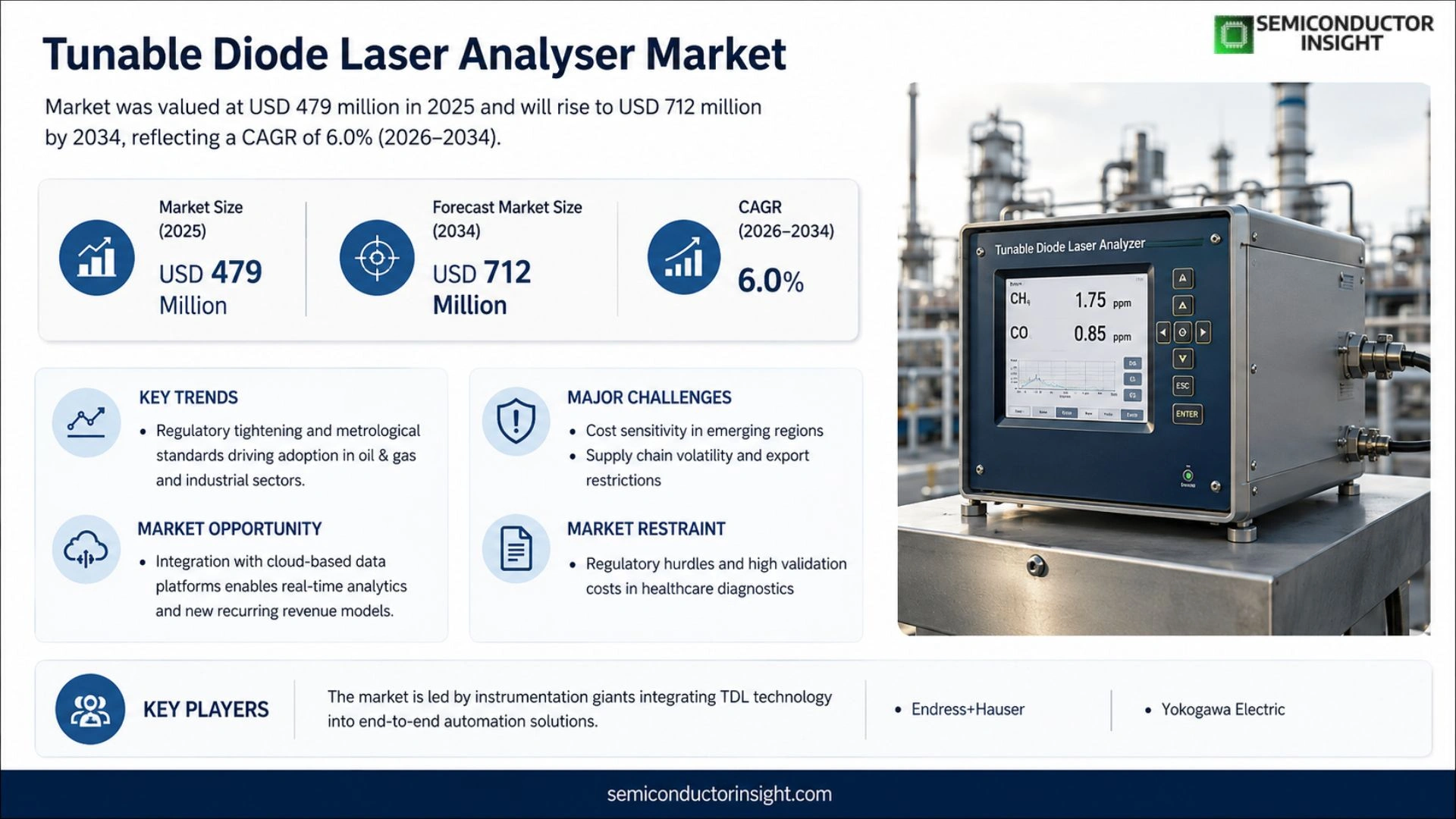
Global Tunable Diode Laser Analyser market was valued at USD 479 million in 2025 and will rise to USD 712 million by 2034, reflecting a CAGR of 6.0% over the forecast horizon.
Tunable diode laser absorption spectroscopy (TDLAS) employs a tunable semiconductor diode laser whose wavelength is swept across characteristic absorption lines of target gases. By analysing the attenuated light, the instrument quantifies species such as methane, carbon‑dioxide, water vapour and several acidic gases with detection limits in the parts‑per‑billion range. The analyser integrates transmitting optics, a light source, receiving optics and a gas‑cell chamber, enabling simultaneous measurement of concentration, temperature, pressure and flow velocity.
The upward trajectory stems from tighter emissions regulations in Europe and North America, expanding requirements for continuous methane monitoring in oil & gas operations, and growing adoption of real‑time gas analytics in power generation and petrochemical plants. Manufacturers are differentiating through advanced spectral algorithms, ruggedised opto‑mechanical designs and integrated data‑management interfaces that link directly to DCS/PLC systems.
MARKET DRIVERS
Rising Demand in Spectroscopy Applications
Tunable Diode Laser Analyser Market is being pulled forward by expanding use‑cases in gas‑phase spectroscopy, where customers require sub‑ppm detection limits and rapid scan rates. End‑users in environmental monitoring and semiconductor process control are substituting older broadband sources with tunable diodes because they deliver higher specificity without the need for extensive post‑processing.
Advancements in Semiconductor Materials
Recent breakthroughs in InP and GaAs alloy growth have lowered wafer‑level defect densities, translating into longer device lifetimes and tighter wavelength tolerances. Manufacturers can now ship analyzers that maintain calibration over five‑year intervals, a factor that directly improves total cost of ownership for capital‑intensive labs.
➤ Customers are willing to pay a premium of up to 15 % for instruments that guarantee drift‑free performance across a 2‑µm tuning range.
These technical gains are being reinforced by a growing ecosystem of software plugins that integrate laser tuning data with AI‑driven analytics, accelerating decision cycles for process engineers and reinforcing the commercial attractiveness of the sector.
MARKET CHALLENGES
Cost Sensitivity in Emerging Regions
Although performance metrics have improved, the upfront capital required for high‑resolution tunable diode systems remains a barrier for manufacturers in Southeast Asia and parts of Latin America. Many facilities operate on thin margins, prompting them to extend the adoption timeline despite clear long‑term productivity gains.
Other Challenges
Supply Chain Volatility
Fluctuations in semiconductor wafer availability, compounded by periodic export restrictions, have introduced lead‑time extensions of 30‑45 days for critical components. This unpredictability forces system integrators to hold higher inventory buffers, eroding profit margins.
The tightening of export controls on certain quantum‑dot technologies further limits the ability of OEMs to diversify their component base, heightening the risk profile for new product launches.
MARKET RESTRAINTS
Regulatory Hurdles in Healthcare Diagnostics
Stringent approval pathways for medical devices in the United States and EU demand extensive clinical validation for any tunable diode laser system intended for point‑of‑care diagnostics. The time and expense associated with multi‑center trials can add $2‑3 million to a product’s development budget, discouraging smaller entrants from pursuing this segment.
MARKET OPPORTUNITIES
Integration with Cloud‑Based Data Platforms
Deploying tunable diode analyzers that stream raw spectral data directly to cloud repositories opens avenues for real‑time cross‑facility benchmarking. Service providers can monetize value‑added analytics, creating recurring‑revenue models that offset the high initial equipment cost and accelerate market penetration.
Tunable Diode Laser Analyser Market Trends
Regulatory Tightening and Metrological Standards
European and North American methane‑regulation frameworks now demand continuous, auditable measurements, forcing plant owners to replace legacy sensors with high‑precision laser analysers. The EU 2024/1787 rule and the latest U.S. EPA mandate have catalysed procurement cycles that favour instruments capable of sub‑ppb detection while delivering traceable data streams. Production in 2025 topped 24,000 units, reflecting manufacturers’ response to this policy pressure. Unit pricing hovers near US$22, a level that many large refiners deem acceptable given the avoided penalties and the ability to demonstrate compliance on digital dashboards.
Other Trends
Technology‑Focused Differentiation and Service Orientation
Vendors are shifting from pure hardware competition to a bundled offering that includes proprietary spectral algorithms, automated window‑purge management, and remote calibration services. By embedding self‑diagnostic routines and cloud‑based performance analytics, suppliers extract recurring revenue through service contracts that can represent up to 30 % of total sales. This model also cushions margins against raw‑component price volatility, as the higher‑value software layer remains under the supplier’s control.
Broadening Downstream Applications
Operators in metals, cement and waste‑to‑energy sectors are now treating laser‑based gas analysis as a core process‑control tool rather than a compliance add‑on. Real‑time methane and carbon‑oxide data feed directly into combustion‑optimization loops, delivering fuel‑cost savings that outweigh the instrument’s capital outlay. Meanwhile, semiconductor fabs are employing the analysers to monitor trace moisture and ammonia, reducing defect rates. The convergence of measurement accuracy with enterprise‑wide data platforms is reshaping purchasing criteria: buyers seek instruments that integrate seamlessly with DCS/PLC systems and can generate audit‑ready logs for both operational efficiency and regulatory reporting.
COMPETITIVE LANDSCAPE
Key Industry Players
Tunable Diode Laser Analyser Market – Competitive Overview
The segment is dominated by a handful of multinational instrumentation groups that have integrated TDL laser technology into broader process‑automation portfolios. Endress+Hauser, leveraging its strong presence in flow‑measurement, pairs the analyser with DCS interfaces to deliver turnkey solutions for oil‑&‑gas pipelines, while Yokogawa Electric capitalises on its legacy in field instruments to offer highly rugged units for refinery stack monitoring. Both firms benefit from extensive service networks that turn initial sales into recurring calibration and remote‑diagnostic contracts, reinforcing margin stability. Siemens and ABB follow a similar model, embedding the analyser in digital‑twin environments where real‑time gas composition feeds optimisation algorithms. The market structure therefore reflects a concentration of revenue among these four vendors, accounting for roughly four‑fifths of global shipments, while the remainder of the market is fragmented across specialised manufacturers that focus on niche wavelengths or ultra‑low detection limits.
Beyond the core tier, a diverse set of specialists competes on performance attributes such as spectral discrimination, anti‑fouling window designs, and embedded safety certifications. Companies like Focused Photonics and Horiba target high‑precision laboratory and research installations, often supplying custom‑tuned diode arrays that address emerging regulatory mandates in Europe and North America. Regional players such as Shanghai ChangAi and WuHan Accurate Technology are expanding their footprint in China’s domestic monitoring programmes, benefitting from government incentives for locally sourced metrology equipment. Mid‑size firms including Servomex (Spectris), Mettler Toledo, and Teledyne Analytical Instruments differentiate through proprietary calibration gas kits and software analytics that translate raw absorption data into compliance‑ready reports. The competitive pressure from these niche operators drives continuous innovation in algorithmic baseline correction and adaptive purge systems, compelling the larger players to enrich their service bundles.
List of Key Tunable Diode Laser Analyser Companies Profiled
- Endress+Hauser SICK
- Yokogawa Electric
- Siemens AG
- ABB Ltd.
- Servomex (Spectris)
- Mettler Toledo
- Focused Photonics Inc.
- Horiba Ltd.
- AMETEK Inc.
- Fuji Electric Co., Ltd.
- Emerson Electric Co.
- Teledyne Analytical Instruments
- Shanghai ChangAi
- WuHan Accurate Technology
- Opsis AB
Segment Analysis:
| Segment Category | Sub-Segments | Key Insights |
| By Type |
|
In‑Situ
|
| By Application |
|
Oil & Gas
|
| By End User |
|
Refining
|
| By Technology |
|
TDLAS
|
| By Service Model |
|
Integrated Solutions
|
Regional Analysis: Tunable Diode Laser Analyser Market
North America
Federal agencies enforce stringent laser safety certifications, compelling vendors to embed advanced interlocks and diagnostic software. This pressure accelerates adoption of self‑checking modules that reduce downtime for end users while safeguarding personnel.
Semiconductor manufacturers and defense contractors dominate purchases, seeking analyzers that can resolve sub‑nanometer wavelength shifts. Their appetite for high‑resolution diagnostics drives incremental refinements in tuning speed and spectral fidelity.
Established photonics firms defend market share through strategic acquisitions of niche start‑ups, while new entrants focus on firmware‑centric differentiation, offering cloud‑linked analytics that appeal to data‑driven customers.
Integration of silicon photonics and AI‑based signal processing is reshaping product roadmaps, allowing analyzers to deliver real‑time feedback and predictive maintenance alerts, a capability increasingly demanded by large‑scale production lines.
Europe
European players benefit from a collaborative research environment anchored by the EU’s Horizon programmes, which fund cross‑border projects on tunable laser technology. Countries such as Germany and the Netherlands nurture industrial clusters where component suppliers and OEMs co‑develop bespoke solutions for automotive laser testing and environmental monitoring. While funding mechanisms provide a steady pipeline of innovation, fragmented standards across member states sometimes slow product harmonization, prompting manufacturers to design flexible platforms that can be adapted to local compliance requirements.
Asia‑Pacific
The Asia‑Pacific region is rapidly building a knowledge base in tunable diode analysis, driven largely by manufacturing intensity in China, South Korea, and Taiwan. OEMs in these markets prioritize cost‑competitiveness without sacrificing core performance, leading to a surge in simplified, high‑volume designs that serve semiconductor wafer inspection and medical device calibration. Government incentives aimed at expanding photonics capabilities are encouraging joint ventures between domestic firms and foreign technology leaders, fostering a talent exchange that accelerates skill acquisition across the supply chain.
South America
In South America, demand is emerging from the oil‑and‑gas sector, where precise laser diagnostics support leak detection and pipeline integrity checks. Brazil’s academic institutions are beginning to contribute to prototype development, yet the overall market remains constrained by limited local manufacturing capacity. Consequently, regional distributors rely heavily on imported analyzers, creating opportunities for suppliers who can offer robust after‑sales service networks and localized training programs to build confidence among end users.
Middle East & Africa
The Middle East & Africa market is shaped by high‑value projects in aerospace testing and renewable‑energy inspection, particularly in the Gulf Cooperation Council states. While purchasing power is strong, the scarcity of specialized technical personnel prompts operators to seek turnkey solutions that embed comprehensive support and remote diagnostics. Vendors that combine durable hardware with subscription‑based analytics are gaining traction, as they address the region’s need for reliability in harsh climates while limiting the upfront capital outlay.
Report Scope
This market research report provides a comprehensive analysis of the Tunable Diode Laser Analyser Market , covering the forecast period 2026–2034. It offers detailed insights into market dynamics, technological advancements, competitive landscape, and key trends shaping the industry.
Key focus areas of the report include:
- Market Overview: The report begins with an overview outlining its current market scenario, key growth indicators, and industry transformation drivers. It discusses macroeconomic factors, demand–supply balance, regulatory landscape, and the strategic role of semiconductors in powering advancements across industries such as automotive, telecommunications, consumer electronics, and industrial automation.
- Market Size & Forecast: Historical data and future projections for revenue, unit shipments, and market value across major regions and segments.
- Segmentation Analysis: Detailed breakdown by product type, technology, application, and end-user industry to identify high-growth segments and investment opportunities.
- Regional Insights: Insights into market performance across North America, Europe, Asia-Pacific, Latin America, and the Middle East & Africa, including country-level analysis where relevant.
- Competitive Landscape: Profiles of leading market participants, including their product offerings, R&D focus, manufacturing capacity, pricing strategies, and recent developments such as mergers, acquisitions, and partnerships.
- Technology Trends & Innovation: Assessment of emerging technologies, integration of AI/IoT, semiconductor design trends, fabrication techniques, and evolving industry standards.
- Market Drivers & Restraints: Evaluation of factors driving market growth along with challenges, supply chain constraints, regulatory issues, and market-entry barriers.
- Stakeholder Insights: Insights for component suppliers, OEMs, system integrators, investors, and policymakers regarding the evolving ecosystem and strategic opportunities.
Primary and secondary research methods are employed, including interviews with industry experts, data from verified sources, and real-time market intelligence to ensure the accuracy and reliability of the insights presented.
FREQUENTLY ASKED QUESTIONS:
What is the current market size of Tunable Diode Laser Analyser Market?
-> Tunable Diode Laser Analyser market was valued at USD 479 million in 2025 and will rise to USD 712 million by 2034, reflecting a CAGR of 6.0%
Which key companies operate in Tunable Diode Laser Analyser Market?
-> Key players include Endress+Hauser SICK, Servomex (Spectris), Mettler Toledo, Focused Photonics Inc., Siemens, Yokogawa Electric, ABB, NEO Monitors, Baker Hughes, HORIBA, AMETEK, Fuji Electric, Emerson, Shanghai Changai, WuHan Accurate Technology, Opsis AB, Nanjing KELISAIKE, Teledyne Analytical Instruments, Landun Photoelectron, among others.
What are the key growth drivers?
-> Key growth drivers include tighter methane and multi‑pollutant regulations (EU Regulation 2024/1787, U.S. EPA final rule), the metrologization of continuous monitoring, growing demand for low‑detection‑limit gas analysis in energy & power and hydrocarbon processing, and national initiatives in China to accelerate high‑precision multi‑component gas spectroscopy instrumentation.
Which region dominates the market?
-> Asia-Pacific is the fastest‑growing region, while Europe remains a dominant market in terms of revenue share.
What are the emerging trends?
-> Emerging trends include AI‑driven diagnostics and predictive maintenance, modular instrument designs with integrated DCS/PLC data interfaces, and advanced calibration algorithms that enhance long‑term accuracy and traceability for emissions compliance.

Get Sample Report PDF for Exclusive Insights
Report Sample Includes
- Table of Contents
- List of Tables & Figures
- Charts, Research Methodology, and more...
 Download Sample Report PDF