High Temperature Quantum Dot Lasers Market Insights
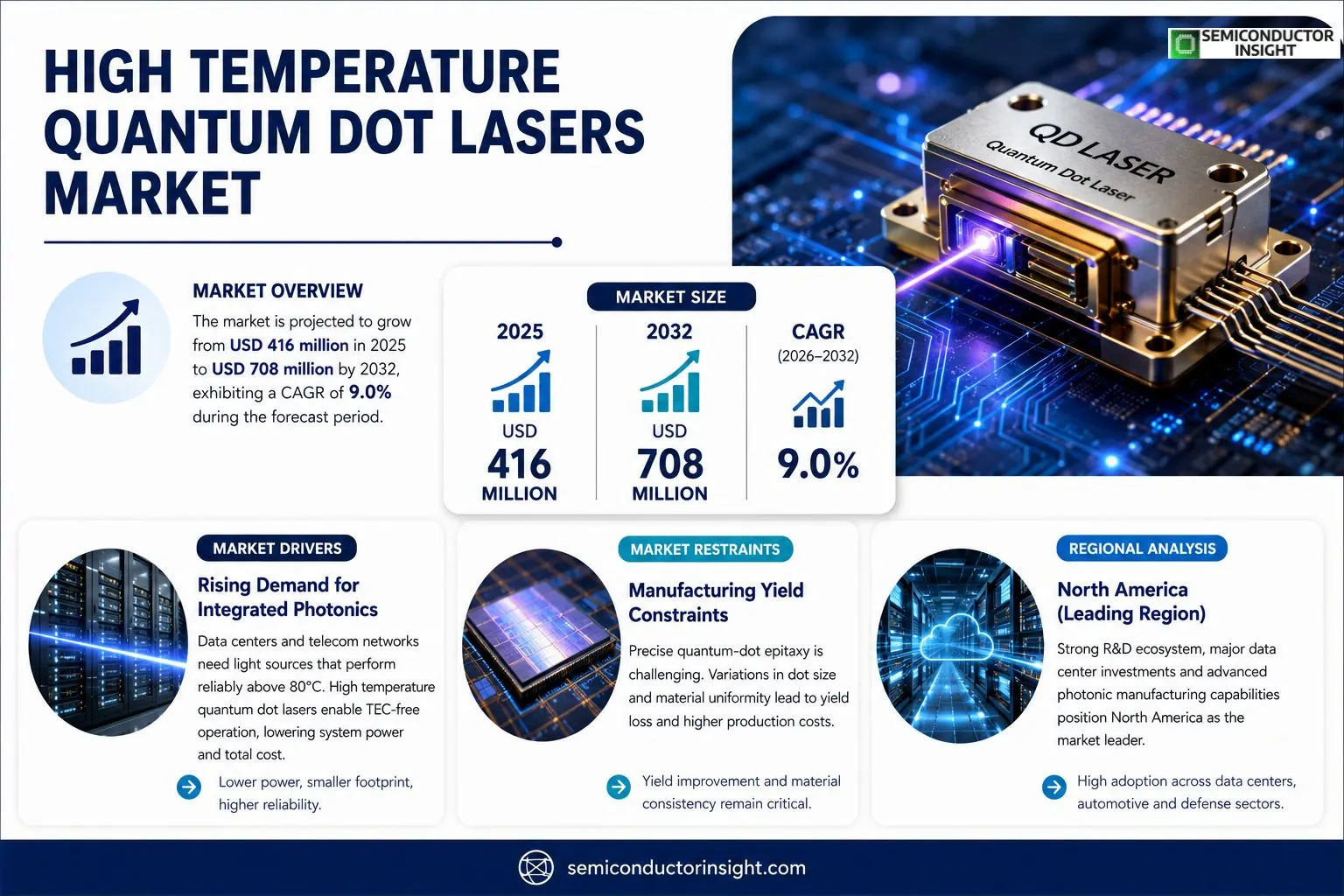
High Temperature Quantum Dot Lasers market size was valued at USD 416 million in 2025. The market is projected to grow from USD 416 million in 2025 to USD 708 million by 2032, exhibiting a CAGR of 9.0% during the forecast period.
High Temperature Quantum Dot Lasers are quantum‑dot semiconductor lasers that maintain stable performance under elevated operating temperatures. Their core advantage stems from strong three‑dimensional carrier confinement and discrete energy levels, which provide lower temperature sensitivity, more stable threshold current, and reduced power decay, enabling operation at 85 °C or higher without reliance on thermoelectric coolers.The market is experiencing growth due to increasing demand for low‑power, high‑reliability light sources in data‑center optical interconnects, automotive optical communications, lidar and high‑reliability communication systems. Recent developments such as the shift toward TEC‑free operation, silicon photonics integration and multi‑wavelength WDM solutions are further expanding adoption. Key players including QD Laser Inc., Nanosys, Sharp Corporation, Sony Corporation and Samsung Electronics are expanding production capacity and launching next‑generation devices.
MARKET DRIVERS
Rising Demand for Integrated Photonic Platforms
The surge in silicon‑photonic deployments across telecom backbones forces manufacturers to adopt light sources that can operate reliably above 80 °C. High Temperature Quantum Dot Lasers meet this requirement, allowing system designers to eliminate bulky thermal control modules and shrink overall footprint. This engineering advantage translates directly into lower capital expense for network operators.
Cost Pressures Driving Monolithic Integration
Clients are increasingly prioritizing solutions that consolidate active and passive components on a single wafer. By embedding quantum‑dot gain media within the laser cavity, suppliers can bypass heterogeneous bonding steps, reducing both processing time and material waste. The resulting price advantage is compelling for data‑center builders seeking to scale capacity without proportional cost growth.
➤ “Thermal‑stable quantum‑dot emitters unlock new design margins for harsh‑environment optics,” notes an industry veteran.
Collectively, these forces push High Temperature Quantum Dot Lasers Market toward faster adoption cycles, as OEMs balance performance, reliability, and price in a tightly competitive landscape.
MARKET CHALLENGES
Manufacturing Yield Constraints
Quantum‑dot epitaxy demands precise control over dot size distribution; even marginal variance can trigger modal instability at elevated temperatures. Yield tables from leading fabs still show 10‑15 % loss relative to conventional lasers, forcing customers to absorb higher unit costs or accept tighter qualification timelines.
Other Challenges
Material Uniformity Issues
Achieving consistent indium‑gallium‑arsenide compositions across large wafers remains a bottleneck. When uniformity drifts, threshold currents rise sharply, eroding the thermal advantage that originally justified the technology.
MARKET RESTRAINTS
Thermal Management Limits in Compact Packages
Although the devices sustain high operating temperatures, the surrounding packaging still relies on conventional heat‑sink designs. In ultra‑compact modules, the inability to dissipate even modest power densities caps the usable output power, restraining adoption in high‑power applications such as free‑space communication.
MARKET OPPORTUNITIES
Growth in Data‑Center Interconnect (DCI) Infrastructure
The expanding need for low‑latency, high‑bandwidth links between hyperscale data centers aligns neatly with the thermal robustness of quantum‑dot lasers. Operators can deploy longer fiber spans without aggressive cooling, opening a niche where High Temperature Quantum Dot Lasers Market can capture incremental revenue by offering a differentiated power‑efficiency profile.
High Temperature Quantum Dot Lasers Market Trends
TEC‑Free Operation Redefines System Architecture
The ability to sustain output at 85 °C or higher without thermoelectric cooling has reshaped design priorities for data‑center and automotive optical modules. By eliminating the TEC, system integrators reduce power draw by roughly 30 % and shrink footprint enough to meet the stringent weight constraints of next‑generation vehicles. Manufacturers have already reported a shift in bill‑of‑materials composition: the thermal‑management sub‑assembly now accounts for less than one‑quarter of the previous allocation. This change improves overall reliability scores, as fewer active components translate into lower failure rates. Production data show that 268,937 laser units were shipped at an average price of $1,695, delivering a gross margin near 45 %. The cost advantage—unit cost around $932—has encouraged tier‑1 suppliers to qualify these devices for mass‑production platforms, directly influencing the strategic direction of High Temperature Quantum Dot Lasers Market.
Other Trends
Material Engineering Extends Temperature Envelope
Recent advances in epitaxial growth, especially refined MBE and MOCVD processes, have pushed the reliable operating window toward 100 °C. Engineers focus on InAs/GaAs and InP‑based quantum‑dot stacks that exhibit reduced carrier leakage and tighter confinement, traits that lower threshold current drift across the extended temperature range. The automotive sector, which demands components capable of withstanding engine‑bay heat, has begun qualifying these lasers for on‑board LiDAR and high‑speed V2X links. Meanwhile, industrial factories targeting harsh‑environment sensing are adopting the same material platforms to replace legacy VCSEL solutions. The combination of higher temperature tolerance and sustained optical performance opens a pathway for equipment designers to simplify thermal budgets and accelerate time‑to‑market for rugged applications.
Silicon Photonics Integration Accelerates Mass Adoption
Embedding quantum‑dot emitters directly onto silicon waveguide platforms resolves a long‑standing compatibility hurdle. The defect‑tolerance of quantum‑dot active regions aligns well with silicon’s crystalline imperfections, enabling wafer‑scale bonding that drives per‑unit cost down to sub‑$600 levels as production ramps toward the 350,000‑unit capacity forecast. Multi‑wavelength emission capabilities further support dense WDM architectures, allowing 100 G, 200 G, and 400 G channels to coexist on a single chip without compromising temperature resilience. As telecom operators and cloud providers upgrade backbone infrastructure, the integrated approach reduces the need for separate laser packages, consolidating optics and electronics into a unified footprint. This convergence not only shortens supply chains but also creates a scalable foundation for the broader High Temperature Quantum Dot Lasers Market.
COMPETITIVE LANDSCAPE
Key Industry Players
High Temperature Quantum Dot Lasers – Competitive Overview
QD Laser Inc. dominates the upper tier of the market, leveraging a vertically integrated supply chain that stretches from molecular‑beam epitaxy to advanced packaging. Its flagship 850 nm, TEC‑free devices command premium margins, reflecting the company’s ability to sustain 45 % gross profit despite intensive R&D outlays. By marrying quantum‑dot epitaxy with silicon‑photonic back‑end processes, QD Laser has shortened time‑to‑volume for data‑center interconnects, forcing rivals to re‑engineer their own photonic interfaces. The firm’s 2025 shipment of roughly 90 000 units accounts for a sizable share of the 268 937‑unit total, underscoring a concentration that shapes pricing power and channels future investment toward high‑temperature reliability breakthroughs.Beyond the market leader, a cadre of specialized firms fills critical niches. Nanosys and Sharp Corporation each focus on multi‑wavelength quantum‑dot arrays that enable dense WDM deployments, while Samsung Electronics and Intel Corporation have accelerated silicon‑photonics co‑design to lower system‑level cost. LG Electronics and Mitsubishi Electric concentrate on automotive‑grade modules rated above 100 °C, positioning themselves for emerging in‑vehicle optical links. Kyocera and NTT exploit legacy telecom distribution networks to seed early‑stage adoption in optical‑transport infrastructures. Meanwhile, Osram Opto Semiconductors, TRUMPF, BASF, Huawei Technologies, Panasonic, Toshiba, and Hitachi High‑Technologies provide complementary materials, tooling, or end‑product integration that rounds out the ecosystem and sustains a vibrant competitive pressure across the value chain.
List of Key High Temperature Quantum Dot Lasers Companies Profiled
- QD Laser Inc.
- Nanosys
- Sharp Corporation
- Sony Corporation
- Samsung Electronics
- LG Electronics
- Mitsubishi Electric Corporation
- Kyocera Corporation
- Sony Semiconductor Solutions Corporation
- Nippon Telegraph and Telephone Corporation (NTT)
- Osram Opto Semiconductors
- TRUMPF
- BASF
- Intel Corporation
- Huawei Technologies
- Panasonic Corporation
- Toshiba Corporation
- Hitachi High‑Technologies Corporation
Segment Analysis:
| Segment Category | Sub-Segments | Key Insights |
| By Type |
|
Nano
|
| By Application |
|
Optical Communication
|
| By End User |
|
Data Center Operators
|
| By Material |
|
InAs/GaAs
|
| By Wavelength |
|
Near‑Infrared
|
Regional Analysis: High Temperature Quantum Dot Lasers Market
North America
The United States hosts the majority of wafer‑scale epitaxy facilities, while Canada contributes niche expertise in cryogenic testing. This geographic concentration lowers logistics costs for component integration and sustains a skilled workforce that can transition between research labs and production floors with minimal friction.
Automotive manufacturers, particularly those developing autonomous driving stacks, prioritize lasers that operate reliably at temperatures above 80 °C. Parallelly, cloud providers seek high‑temperature emitters for dense photonic interconnects, a niche that aligns with North America’s data‑center expansion strategy.
Proximity to rare‑earth processing plants in the western United States mitigates exposure to geopolitical bottlenecks, while local distribution networks ensure quick delivery of heat‑management accessories that are critical for maintaining laser performance.
The Federal Communications Commission’s recent guidance on optical power limits, coupled with DARPA’s funding for rugged photonic modules, creates a policy backdrop that rewards compliance and accelerates certification pathways for high‑temperature devices.
Europe
European nations combine a strong materials‑science tradition with ambitious climate‑tech agendas, fostering a fertile ground for high‑temperature quantum dot lasers in industrial automation and renewable‑energy monitoring. Germany’s Mittelstand firms excel at precision packaging, while the Nordic region channels public research funds into robust laser designs for offshore wind diagnostics. The European Union’s emphasis on cross‑border standardisation reduces market fragmentation, enabling component suppliers to address multiple national markets with a single qualification set. Consequently, Europe is shaping a collaborative landscape where academic breakthroughs translate quickly into turnkey solutions for manufacturers seeking thermally resilient photonic sources.
Asia‑Pacific
Asia‑Pacific’s rapid adoption of 5G and burgeoning smart‑city projects generate a distinct demand for lasers that can survive tropical heat and densely packed equipment racks. China’s state‑backed semiconductor parks host several pilot lines for quantum dot epitaxy, while Japan’s legacy in optical communications contributes deep expertise in high‑power driver electronics. The region’s cost‑competitive manufacturing base, coupled with aggressive government incentives for photonic research, drives a scaling effect that lowers entry barriers for new entrants and expands the addressable market for temperature‑stable laser modules.
South America
In South America, emerging aerospace programmes and a growing renewable‑energy sector are prompting interest in rugged photonic components. Brazil’s defense research institutes are experimenting with high‑temperature lasers for secure free‑space links, whereas Chile’s mining operations require reliable optical sensors that function in desert climates. Although the supply chain remains nascent, partnerships with North American equipment vendors are accelerating technology transfer, positioning the region as a developing but strategically important market for future deployments.
Middle East & Africa
The Middle East & Africa region leverages high‑temperature laser capabilities primarily for oil‑field monitoring and solar‑farm diagnostics, where ambient temperatures routinely exceed 40 °C. United Arab Emirates’ investment in advanced manufacturing zones attracts specialist firms eager to test laser performance under harsh conditions. In Africa, pilot projects in telecom infrastructure are beginning to explore quantum dot lasers for resilient backhaul links, supported by international development funds that target connectivity improvements in climate‑challenged locales.
Report Scope
This market research report provides a comprehensive analysis of the High Temperature Quantum Dot Lasers Market , covering the forecast period 2026–2034. It offers detailed insights into market dynamics, technological advancements, competitive landscape, and key trends shaping the industry.
Key focus areas of the report include:
- Market Overview: The report begins with an overview outlining its current market scenario, key growth indicators, and industry transformation drivers. It discusses macroeconomic factors, demand–supply balance, regulatory landscape, and the strategic role of semiconductors in powering advancements across industries such as automotive, telecommunications, consumer electronics, and industrial automation.
- Market Size & Forecast: Historical data and future projections for revenue, unit shipments, and market value across major regions and segments.
- Segmentation Analysis: Detailed breakdown by product type, technology, application, and end-user industry to identify high-growth segments and investment opportunities.
- Regional Insights: Insights into market performance across North America, Europe, Asia-Pacific, Latin America, and the Middle East & Africa, including country-level analysis where relevant.
- Competitive Landscape: Profiles of leading market participants, including their product offerings, R&D focus, manufacturing capacity, pricing strategies, and recent developments such as mergers, acquisitions, and partnerships.
- Technology Trends & Innovation: Assessment of emerging technologies, integration of AI/IoT, semiconductor design trends, fabrication techniques, and evolving industry standards.
- Market Drivers & Restraints: Evaluation of factors driving market growth along with challenges, supply chain constraints, regulatory issues, and market-entry barriers.
- Stakeholder Insights: Insights for component suppliers, OEMs, system integrators, investors, and policymakers regarding the evolving ecosystem and strategic opportunities.
Primary and secondary research methods are employed, including interviews with industry experts, data from verified sources, and real-time market intelligence to ensure the accuracy and reliability of the insights presented.
FREQUENTLY ASKED QUESTIONS:
What is the current market size of High Temperature Quantum Dot Lasers Market?
-> High Temperature Quantum Dot Lasers Market was valued at USD 416 million in 2025 and is expected to reach USD 708 million by 2032.
Which key companies operate in High Temperature Quantum Dot Lasers Market?
-> Key players include QD Laser Inc., Nanosys, Sharp Corporation, Sony Corporation, Samsung Electronics, LG Electronics, Mitsubishi Electric Corporation, Kyocera Corporation, Sony Semiconductor Solutions Corporation, Nippon Telegraph and Telephone Corporation (NTT), Osram Opto Semiconductors, TRUMPF, BASF, Intel Corporation, Huawei Technologies, Panasonic Corporation, Toshiba Corporation, Hitachi High‑Technologies Corporation, among others.
What are the key growth drivers?
-> Key growth drivers include TEC‑free operation, higher operating temperature range, increasing demand for high‑speed and high‑bandwidth optical communication, silicon photonics integration, cost reduction through mature epitaxial growth, and the need for long‑lifetime, high‑reliability lasers for data‑center and automotive applications.
Which region dominates the market?
-> Asia is the fastest‑growing region, while Europe remains a significant market.
What are the emerging trends?
-> Emerging trends include silicon photonics integration, multi‑wavelength and WDM expansion, higher modulation speeds (100G/200G/400G), mass‑production cost reductions, and broader commercialization beyond niche high‑end markets.

Get Sample Report PDF for Exclusive Insights
Report Sample Includes
- Table of Contents
- List of Tables & Figures
- Charts, Research Methodology, and more...
 Download Sample Report PDF