Key Statistics
Key Takeaways
- Laser Interferometry is the leading type because it provides traceable, nanometer-scale displacement measurement for lithography, precision motion and calibration.
- High-End Precision Manufacturing is the largest application, supported by semiconductor equipment, nano-imprint, precision machining and advanced motion-control systems.
- North America is the leading regional market in the current market structure, while Asia Pacific is the key emerging region through semiconductor equipment and precision manufacturing.
- High-end equipment manufacturers are the largest end-user group because they integrate fiber-delivered interferometric position feedback directly into motion stages and production tools.
- 2026 is a major product-renewal year. Renishaw launched RLE100, RLE200 and RLE300 interferometric laser encoders, with RLE300 measurement uncertainty reaching ±0.2 nm for demanding semiconductor motion-control applications.
High-Precision Fiber Laser Ruler Market Overview
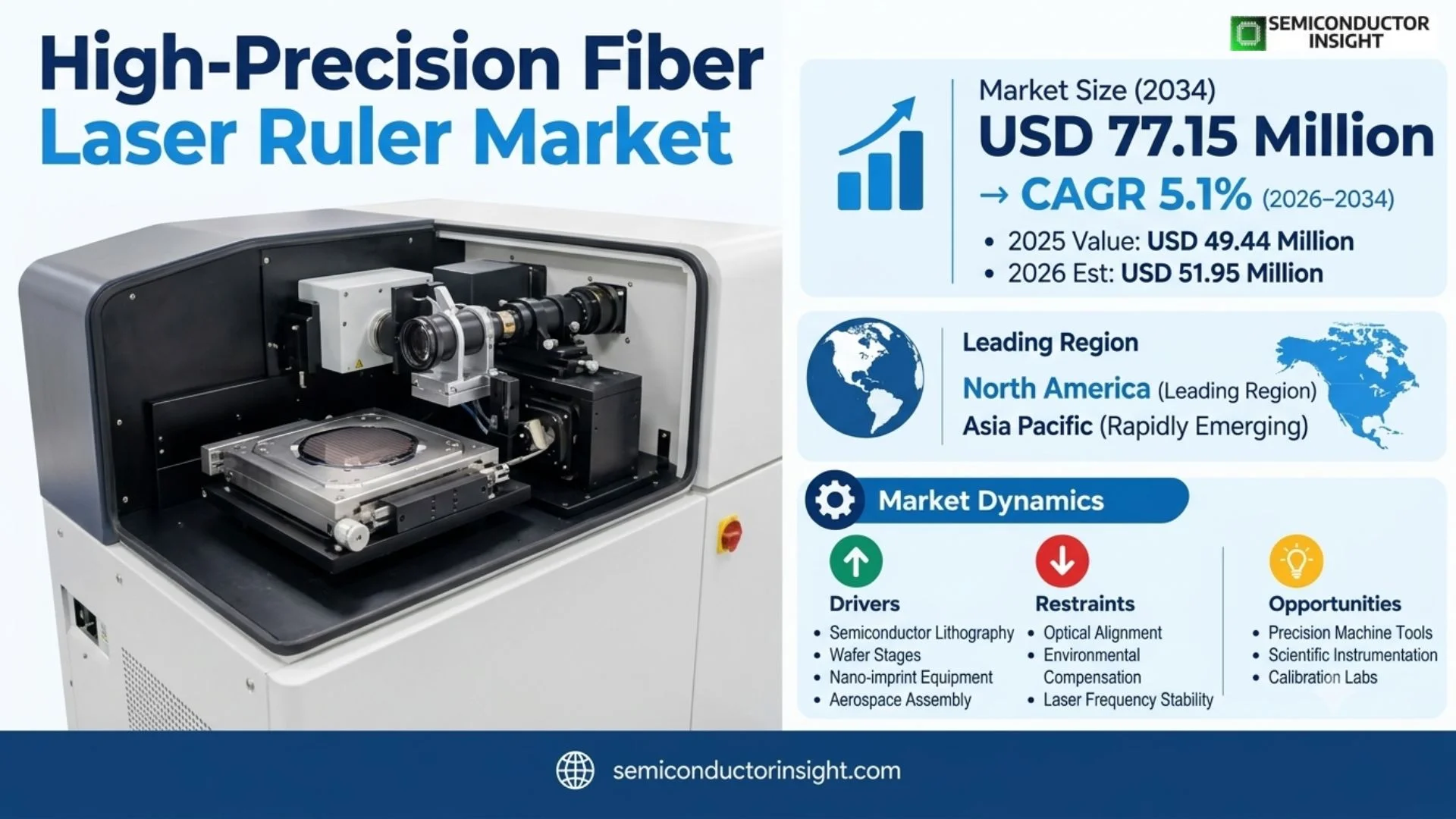
High-Precision Fiber Laser Ruler market is valued at USD 49.44 million in 2025 and is projected to reach USD 77.15 million by 2034, representing a 5.1% CAGR during 2026–2034. The 2026 estimated market size is USD 51.95 million. North America is the leading regional market, with Asia Pacific emerging rapidly through semiconductor and precision-manufacturing investment.
High-precision fiber laser rulers use laser interferometry or related optical measurement principles to measure linear displacement with very high accuracy and resolution. Optical fiber allows the laser source to be located away from the measurement head, reducing thermal influence near the precision stage and simplifying integration into compact or vacuum environments.
The technology is used in semiconductor lithography, wafer stages, nano-imprint equipment, precision machine tools, aerospace assembly, scientific instrumentation and calibration laboratories. Measurement quality depends on laser frequency stability, interferometer geometry, optical alignment, environmental compensation, sub-divisional error and motion-control electronics.
Unlike ordinary laser distance meters, this market focuses on metrology-grade systems where traceability, repeatability and nanometer-scale motion feedback are central requirements. The highest-value systems therefore combine optical hardware with diagnostic software, environmental compensation and integration interfaces for closed-loop stage control.
Segment Analysis: By Type
By type, the market is segmented into Laser Interferometry, Fiber-Optic Distance Measurement and related hybrid approaches. Laser interferometry leads because wavelength-referenced measurement provides the strongest precision and traceability for high-end motion systems.
| Type | Measurement profile | Market position |
|---|---|---|
| Laser Interferometry | Uses interference between reference and measurement beams to convert phase change into displacement. Heterodyne, homodyne and phase-shift approaches can deliver nanometer or sub-nanometer resolution. | Leading segment. Semiconductor motion control, calibration and scientific metrology prioritize interferometric accuracy. |
| Fiber-Optic Distance Measurement | Uses fiber-delivered laser light with interferometric, phase-modulated or related measurement methods to keep the laser source remote from the measurement point. | Strong growth segment where thermal isolation, compact probes and flexible routing are important. |
| Hybrid / Multi-Axis Systems | Combines interferometric measurement with advanced diagnostics, compensation or multiple axes for complex stage and machine geometries. | Premium segment for semiconductor equipment, aerospace fixtures and advanced multi-axis metrology. |
Measurement-principle and output-axis segmentation
The market also segments by measurement principle and output axis. Interferometric systems dominate static and dynamic precision applications, while multi-axis configurations reduce alignment time and support orthogonal stage measurement in complex equipment.
| Axis | Segments | Commercial implication |
|---|---|---|
| By Measurement Principle | Interferometric · Time-of-Flight · Phase-Shift / Phase-Modulated | Interferometry delivers the highest traceable precision; phase techniques balance range and integration; ToF is used where longer range matters more than ultimate nanometer resolution. |
| By Output Axis | Single Axis · Dual Axis · Triple / Multi-Axis | Single-axis systems are simplest; dual/multi-axis systems improve throughput and capture complex motion errors with fewer setups. |
Segment Analysis: By Application
By application, the market includes High-End Precision Manufacturing, Aerospace, Scientific Research & Metrology, Defense & Satellite Systems and Other Precision Applications. High-end precision manufacturing leads because semiconductor and advanced equipment makers need nanometer-scale position feedback.
| Application | Key market insight |
|---|---|
| High-End Precision Manufacturing | Lithography, nano-imprint, precision optics and advanced machine tools use interferometric rulers for stage positioning, calibration and inline process control. |
| Aerospace | Large assemblies, precision fixtures and component verification use non-contact measurement where alignment and dimensional traceability are critical. |
| Scientific Research & Metrology | National laboratories and calibration centers use interferometers as traceable reference instruments for displacement and motion systems. |
| Defense & Satellite Systems | Guidance components, optical assemblies and satellite mechanisms require high stability, rugged integration and traceable positioning. |
| Semiconductor Equipment | Wafer stages, inspection platforms and motion systems use fiber-delivered laser encoders to minimize thermal disturbance and maximize position accuracy. |
Regional Analysis
North America is the leading High-Precision Fiber Laser Ruler market, supported by aerospace, defense, semiconductor equipment, advanced manufacturing and metrology laboratories. Asia Pacific is the strongest emerging region through precision equipment production in China, Japan, South Korea and Taiwan.
How do regional precision-metrology markets differ?
North America emphasizes aerospace, defense, semiconductor equipment and research. Europe has deep precision-engineering and metrology expertise. Asia Pacific is expanding fastest through semiconductor manufacturing and domestic equipment development. Emerging regions remain smaller and depend more heavily on imported high-end systems.
| Region | Market position | Growth outlook | Core demand | Commercial priority |
|---|---|---|---|---|
| North America | Leading | High | Aerospace, semiconductor & metrology | Accuracy, traceability and support |
| Europe | Precision-engineering hub | Moderate to high | Machine tools, metrology & research | Calibration and long-term stability |
| Asia Pacific | Fast-emerging | High | Semiconductor, optics & automation | Local supply and integration |
| South America | Small | Selective | Research & industrial calibration | Cost and service |
| Middle East & Africa | Emerging | Selective | Aerospace, infrastructure & labs | Local expertise and support |
Competitive Landscape
Key participants include Renishaw, Chotest Technology, Lamotion, Hexagon Manufacturing Intelligence, Mitutoyo, ZEISS Metrology, KEYENCE, FARO Technologies, Nikon Metrology, Olympus, Leica Geosystems, Mahr and ZYGO. The market is semi-consolidated at the highest accuracy levels because laser stability, interferometer design and calibration support create significant barriers.
Renishaw is a leading supplier through RLE interferometric laser encoders and XL-80 calibration systems. Its 2026 RLE family improves frequency stability, diagnostics, serviceability and sub-divisional-error correction for semiconductor motion-control systems.
Chotest Technology competes through its PLR3000 series fiber-optic laser ruler, targeting microelectronics, micro-optics, lithography, aerospace and other ultra-precision applications. The product architecture combines a remote laser source, interferometric probe and retroreflector.
Other metrology companies compete through laser calibration, precision encoders, CMM systems and optical measurement platforms. Competitive advantage depends on uncertainty, thermal stability, traceability, software, integration and global recalibration support.
Competitive tier structure
| Competitive tier | Representative companies | Competitive strengths |
|---|---|---|
| Dedicated interferometric leaders | Renishaw; Chotest; Lamotion | Fiber-delivered laser encoders, precision displacement and semiconductor motion-control integration |
| Global metrology leaders | Hexagon; ZEISS; Mitutoyo; KEYENCE; FARO | Broad precision-measurement portfolios, service networks and industrial integration |
| Optical / specialty suppliers | Nikon Metrology; Mahr; ZYGO; Leica and others | Optics, calibration, specialized interferometry and niche applications |
Key companies profiled
Fiber Laser Ruler Production & Calibration Capacity Analysis
Production capacity depends on frequency-stable laser sources, optical fibers, interferometer heads, retroreflectors, high-speed detectors, precision electronics and calibration. Effective capacity is limited by the ability to verify uncertainty and traceability, not simply by assembly volume.
Calibration infrastructure is a strategic bottleneck. Premium systems must be verified against traceable standards, and customers may require periodic recalibration over many years. Global service laboratories therefore increase the practical value of a supplier’s installed base.
Integration engineering is another constraint. Semiconductor motion platforms can require vacuum compatibility, low heat load, sub-divisional-error correction and custom detector geometry, so applications engineering and commissioning capacity directly affect market growth.
Market Dynamics
Growth is driven by semiconductor equipment, advanced manufacturing, aerospace and nanometrology. Restraints include high system cost, specialist integration, calibration burden and competition from alternative encoders. Opportunities center on sub-nanometer motion feedback, multi-axis systems, vacuum-compatible encoders and digital condition monitoring.
MARKET DRIVERS
Semiconductor stages need tighter positioning
Smaller device features require more accurate stage feedback and lower measurement drift.
Fiber delivery reduces thermal disturbance
The laser source can be mounted remotely from sensitive motion stages.
Precision manufacturing needs traceable feedback
Interferometric measurement links displacement directly to a laser wavelength standard.
Digital diagnostics improve uptime
Modern encoders expose signal quality, operating status and faults for condition monitoring.
Drivers Impact Analysis
| Driver | Impact | Primary markets | Time horizon |
|---|---|---|---|
| Semiconductor equipment precision | High | Asia, North America, Europe | Persistent |
| Advanced machine calibration | High | Global precision manufacturing | Persistent |
| Aerospace / defense | Medium to high | North America, Europe, MEA | Persistent |
| Automation / digital metrology | Medium to high | Global | Medium term |
MARKET RESTRAINTS
Premium systems have high acquisition cost
Laser stability, optics and calibration add cost beyond conventional encoders.
Specialist alignment skills can be required
Incorrect optics or environmental compensation can reduce accuracy.
Vacuum and ultra-stable applications are difficult
Thermal, mechanical and optical disturbances must be tightly controlled.
Glass-scale and other encoders compete in less demanding systems
Many machines do not require interferometric accuracy.
Restraints Impact Analysis
| Restraint | Impact | Exposure | Time horizon |
|---|---|---|---|
| High purchase price | High | Mid-size manufacturers | Persistent |
| Calibration / service burden | Medium to high | Global installed base | Persistent |
| Integration complexity | High | Semiconductor / vacuum systems | Persistent |
| Alternative encoders | Medium | General motion control | Persistent |
MARKET OPPORTUNITIES
Expand semiconductor motion-control encoders
New RLE-class systems can be built directly into wafer stages and precision equipment.
Increase multi-axis integration
Capturing several motion axes simultaneously reduces setup time and improves machine calibration.
Add predictive diagnostics
Signal-quality and fault monitoring can reduce unexpected downtime.
Grow portable traceable calibration
Compact laser systems can serve machine-tool and CMM users without fixed metrology infrastructure.
High-Precision Fiber Laser Ruler Value Chain Analysis
Laser source & optics
Interferometer / detector integration
Calibration & software
Machine / stage integration
Laser frequency stability sets the measurement reference
Drift in wavelength directly affects displacement accuracy.
Optical geometry determines cyclic error
Interferometer design and alignment influence sub-divisional error and linearity.
Environmental compensation is essential in air
Temperature, pressure and humidity alter refractive index and must be corrected.
OEM integration determines real machine performance
Mechanical stiffness, thermal design and control-loop tuning influence final positioning accuracy.
Recent Developments in the High-Precision Fiber Laser Ruler Market
Renishaw launches RLE100, RLE200 and RLE300 laser encoders
The next-generation family targets semiconductor manufacturing and provides improved stability, modular serviceability and diagnostic capability.
Renishaw introduces RLE300 for ultra-high precision
The new system provides measurement uncertainty down to ±0.2 nm and doubles the operating linear range to 2 m for demanding motion-control environments.
Renishaw XL-80 supports 1 nm resolution machine calibration
The XL-80 provides ±0.5 ppm linear measurement accuracy, up to 80 m range and 50 kHz measurement rate.
Chotest PLR3000 targets ultra-precision manufacturing
The fiber-optic laser ruler uses laser interferometry and remote optical delivery for microelectronics, lithography, micro-optics and aerospace applications.
Renishaw expands RLE diagnostic and upgrade support
The RLE100, RLE200 and RLE300 family provides modular interfaces, diagnostics and upgrade paths from legacy RLE systems.
REPORT SCOPE & SEGMENTATION
| Attribute | Details |
|---|---|
| Study Period | 2021–2034 |
| Base Year | 2025 |
| Estimated Year | 2026 |
| Forecast Period | 2026–2034 |
| Historical Period | 2021–2025 |
| Market Size 2025 | USD 49.44 million |
| Market Size 2034 | USD 77.15 million |
| Growth Rate | 5.1% during 2026–2034 |
| Unit | Value (USD Million) and precision laser measurement-system shipments |
| By Type | Laser Interferometry · Fiber Optic Distance Measurement · Hybrid Systems |
| By Application | High-End Precision Manufacturing · Aerospace · Scientific Research & Metrology · Defense & Satellite Systems · Others |
| By End User | High-End Equipment Manufacturers · Research Institutes & Metrology Labs · Defense & Aerospace Organisations |
| By Measurement Principle | Interferometric · Time-of-Flight · Phase-Shift |
| By Output Axis | Single Axis · Dual Axis · Triple / Multi-Axis |
| By Region | Each region analysed by type, application, end user, measurement principle, output axis and country precision-engineering ecosystem North AmericaUnited States, Canada, Mexico EuropeUnited Kingdom, Germany, Switzerland and other European markets Asia PacificChina, Japan, South Korea, Taiwan, India and other Asian markets South AmericaBrazil, Argentina and other South American markets Middle East & AfricaUAE, Saudi Arabia, South Africa and other MEA markets |
| Key Companies Profiled | Renishaw · Chotest Technology · Lamotion · Hexagon Manufacturing Intelligence · Mitutoyo · ZEISS Metrology · KEYENCE · FARO Technologies · Nikon Metrology · Olympus · Leica Geosystems · Mahr GmbH · ZYGO Corporation |
| Customization Scope | Free report customization equivalent to up to four analyst working days with purchase. Addition or alteration to country, regional and segment scope. |
Frequently Asked Questions
What is the 2025 size of the High-Precision Fiber Laser Ruler market?
The market is valued at USD 49.44 million in 2025 and is projected to reach USD 77.15 million by 2034. The 2026 estimate is USD 51.95 million and the 2026–2034 CAGR is 5.1%.
Which technology leads the market?
Laser interferometry leads because it provides traceable nanometer-scale displacement measurement for precision manufacturing and motion control.
Which application is the largest?
High-End Precision Manufacturing is the largest application, including semiconductor lithography, nano-imprint, machine tools and advanced motion systems.
Which region leads the market?
North America is the leading regional market, while Asia Pacific is the strongest emerging region through semiconductor and precision-manufacturing growth.
What is the estimated market size in 2026?
The 2026 estimated market size is USD 51.95 million within the consistent 2025–2034 market series.
Why is fiber delivery useful?
Optical fiber lets the laser source sit away from the measurement point, reducing thermal disturbance and simplifying routing in compact or vacuum systems.
What are the main market restraints?
High purchase price, calibration burden, integration complexity and competition from alternative encoder technologies are the main restraints.
How accurate can modern systems be?
Premium semiconductor motion-control systems can reach sub-nanometer measurement uncertainty, while calibration systems provide nanometer-scale resolution over long ranges.
Which companies are active in the market?
Key participants include Renishaw, Chotest, Lamotion and global precision-metrology suppliers such as Hexagon, ZEISS, Mitutoyo, KEYENCE, FARO, Mahr and ZYGO.
What does the report cover?
The report covers laser interferometry, fiber-optic measurement, applications, end users, measurement principles, output axes, five global regions, production, competition, dynamics, developments and value chain.
Research Sources & Evidence Base
View primary and authoritative evidence used in this overview
- Renishaw. RLE100 / RLE200 / RLE300 Launch – August 2026 evidence on next-generation semiconductor laser encoders.
- Renishaw. RLE Interferometric Laser Encoder Systems – Official technical evidence on fiber-delivered interferometric position measurement and the RLE product family.
- Renishaw. XL-80 Laser Interferometer – Official evidence on 1 nm resolution, ±0.5 ppm accuracy and 80 m calibration range.
- Chotest Technology. PLR3000 Fiber Optic Laser Ruler – Official evidence on fiber-optic laser ruler architecture and ultra-precision applications.
- Renishaw. RLE Interfaces and Diagnostics – Official evidence on diagnostics, configuration and upgrade support for RLE systems.
Get Sample Report PDF for Exclusive Insights
Report Sample Includes
- Table of Contents
- List of Tables & Figures
- Charts, Research Methodology, and more...
 Download Sample Report PDF