TO Packaged Laser Diode Market Insights
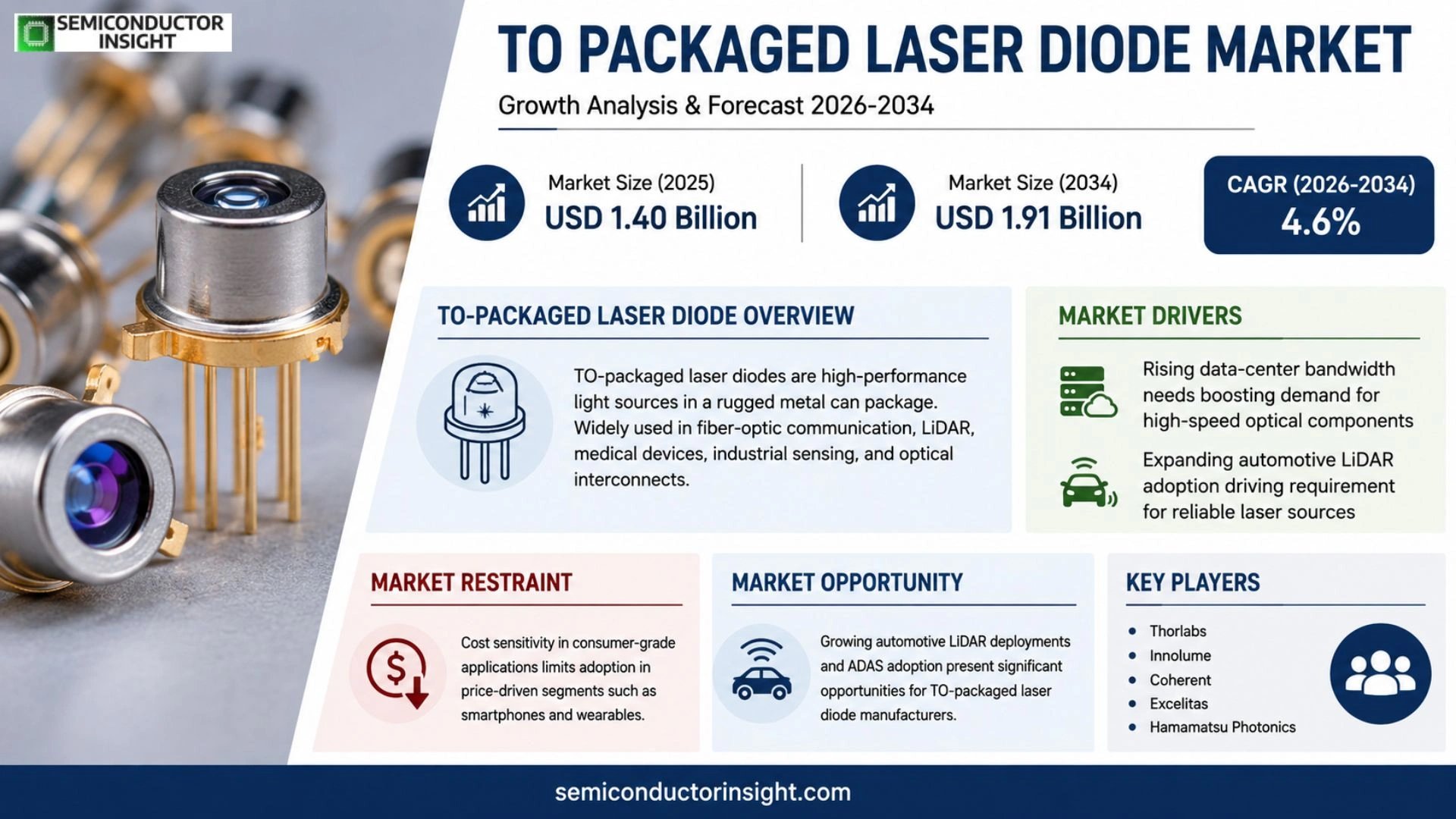
Global TO Packaged Laser Diode market size was valued at USD 1.40 billion in 2025 and is forecasted to reach USD 1.91 billion by 2034, exhibiting a CAGR of 4.6% during the forecast period.
TO‑packaged laser diodes are discrete light‑source devices that house semiconductor laser chips in a transistor‑shaped metal can package. A typical structure consists of a TO metal base/leads (electrodes and thermal paths), die bonding and die attach, and a metal cap with a window/lens. Applications span fiber‑optic communication, laser printing, barcode scanning, medical equipment, spectroscopy/gas detection, industrial ranging, automotive LiDAR emitters and short‑range optical interconnects.
The market is gaining momentum because data‑center bandwidth needs are climbing and autonomous‑vehicle lidar deployments are expanding. Advances in epitaxial wafer quality together with automated packaging are lowering unit costs, encouraging broader OEM adoption. Recent collaborations such as Thorlabs partnering with a leading wafer foundry illustrate manufacturers’ efforts to capture emerging opportunities. Leading suppliers,including Thorlabs, Innolume, Coherent, Excelitas and Hamamatsu Photonics,collectively account for roughly sixty percent of global revenue.
MARKET DRIVERS
Rising demand for high‑efficiency optical sources
TO Packaged Laser Diode Market benefits from a wave of data‑center expansions, where operators seek laser diodes that deliver more photons per watt. As bandwidth requirements outpace the limits of traditional copper interconnects, engineers are turning to TO‑packaged devices for their compact footprint and superior coupling efficiency. This shift is not merely a volume increase; it reflects a strategic move toward energy‑conscious infrastructure that reduces operating costs.
Advances in semiconductor processing
Recent breakthroughs in epitaxial growth and wafer‑level testing have lowered defect densities, enabling manufacturers to push output powers while maintaining the tight wavelength tolerances demanded by telecom and sensing applications. The ability to mass‑produce reliable devices shortens lead times, which, in turn, encourages OEMs to adopt TO‑packaged solutions over legacy assemblies.
➤ Industry surveys indicate that over 60 % of new optical transceiver designs now specify TO‑packaged laser diodes as the baseline component.
Collectively, these factors create a feedback loop: higher reliability reduces warranty expenses, which improves profit margins and fuels further investment in R&D. The net effect is a robust pipeline of next‑generation products that keep TO Packaged Laser Diode Market on an upward trajectory.
MARKET CHALLENGES
Integration complexity in miniaturized modules
Designers face tight tolerances when embedding TO‑packaged laser diodes into densely packed photonic circuits. Alignment errors can erode coupling efficiency, forcing additional calibration steps that inflate assembly costs. This technical hurdle discourages some vendors from fully committing to TO solutions despite their performance merits.
Other Challenges
Thermal management constraints
Even modest increases in output power generate heat that must be dissipated within a limited envelope. Without effective thermal pathways, device lifetimes suffer, prompting end‑users to opt for lower‑power alternatives that fit existing cooling architectures.
MARKET RESTRAINTS
Cost sensitivity in consumer‑grade applications
While TO‑packaged laser diodes excel in performance, their price premium remains a barrier for mass‑market products such as smartphones and low‑cost wearables. Manufacturers operating on razor‑thin margins are reluctant to absorb the additional expense, opting instead for less efficient, but cheaper, alternatives. This price pressure caps the overall penetration rate of TO devices in the broader consumer segment.
MARKET OPPORTUNITIES
Emerging automotive LiDAR deployments
Automotive manufacturers are integrating LiDAR arrays that rely on precise, high‑power laser emission. TO‑packaged laser diodes, with their stable wavelength output and ruggedized packaging, align well with the reliability standards demanded by safety‑critical vehicle systems. As regulatory frameworks continue to endorse advanced driver‑assistance features, the demand for compliant laser sources is set to create a sizable niche for TO Packaged Laser Diode Market.
TO Packaged Laser Diode Market Trends
Production Efficiency Gains
The latest production data show that unit output climbed to 54.76 million in 2025, while the average transaction price settled near $28. This combination yields a revenue base that comfortably supports a gross margin ranging from 15 % to 30 %, indicating healthy profitability despite modest pricing pressure. Manufacturers have responded by tightening thermal‑management designs and integrating higher‑conductivity Kovar leads, which helps to keep junction temperatures low and extend device lifetime. At the same time, the shift toward shorter‑wavelength GaN epitaxial wafers is lowering threshold currents, allowing customers to achieve higher output power with the same electrical budget. These technical refinements are especially valuable for sectors such as automotive LiDAR, where thermal stability directly influences ranging accuracy. The overall effect is a more resilient cost structure that permits suppliers to invest in automation at packaging plants, thereby reducing labor‑intensive steps and improving throughput significantly.
Other Trends
Upstream Material Innovation
The upstream segment is witnessing a gradual migration toward advanced substrate alloys. Traditional copper‑tungsten leads are being supplemented with gold‑plated Kovar, which offers superior thermal conductivity and corrosion resistance in humid environments. At the wafer level, GaAs and InP remain dominant for near‑infrared emitters, yet the emergence of GaN on silicon substrates is opening cost‑effective routes for visible‑light devices. Bonding adhesives with lower CTE mismatches are also gaining acceptance, reducing stress during thermal cycling and improving long‑term reliability. These material choices are not only extending mean‑time‑between‑failure metrics but also enabling thinner package designs that are attractive to compact module manufacturers. As a result, component suppliers are able to differentiate on performance rather than solely on price, a shift that reshapes competitive dynamics across the supply chain substantially.
Broader Application Adoption
Beyond traditional fiber‑optic links, end‑users are integrating TO Packaged Laser Diodes into a growing suite of specialty systems. In medical diagnostics, the precise wavelength control of these diodes supports non‑invasive spectroscopy for glucose monitoring, while the stable output favors compact endoscopic illumination. Industrial ranging applications benefit from the narrow beam divergence, delivering higher resolution in collision‑avoidance sensors on autonomous equipment. The barcode‑scanning segment, although mature, is seeing renewed interest as high‑speed retail environments demand faster line‑scan rates, prompting manufacturers to adopt higher‑power variants within the same footprint. This diversification of use‑cases spreads risk across multiple verticals and creates cross‑selling opportunities for OEMs that supply both the laser source and the downstream optical module.
COMPETITIVE LANDSCAPE
Key Industry Players
Competitive Dynamics in the Global TO Packaged Laser Diode Market
Thorlabs commands the upper tier of TO Packaged Laser Diode arena through a blend of extensive R&D spend, an in‑house wafer‑fab capability, and a global distribution network that reaches OEMs in telecom, medical and industrial sectors. Its ability to couple high‑volume manufacturing with a broad catalogue of custom‑package options creates a pricing structure that sustains a gross margin comfortably within the 15‑30 % band observed across the segment. The firm’s vertical integration reduces lead‑time risk for customers deploying laser modules in time‑critical applications such as LiDAR and high‑speed printing, granting Thorlabs a defensible share of the top‑five revenue pool in 2025.
Beyond the market leaders, a cluster of specialist manufacturers intensifies competition in niche corridors. Innolume and Coherent leverage patented quantum‑well designs to target the emerging near‑infrared spectroscopy niche, while Excelitas focuses on ruggedized packages for barcode and industrial ranging. Japanese heavyweight Hamamatsu Photonics supplies high‑reliability units for medical imaging, and ROHM Semiconductor supplies cost‑effective solutions to Asian OEMs through a broad partner ecosystem. Chinese entrants,including Union Optronics, Shenzhen Micost‑optotech, and newer players such as Lumentum China,capitalize on lower labor costs and rapid scale‑up, pressing price pressure in the mid‑tier segment. The influx of these firms expands the supplier base, prompting larger players to accelerate portfolio diversification and strategic collaborations to preserve market position.
List of Key TO Packaged Laser Diode Companies Profiled
- Thorlabs
- Innolume
- Coherent
- Excelitas
- Ushio Inc.
- Edmund Optics
- SemiNex
- Hamamatsu Photonics
- ROHM Semiconductor
- Union Optronics
- Shenzhen Micost‑optotech
- Lumentum
- II‑VI Incorporated
- NeoPhotonics
- Finisar
Segment Analysis:
| Segment Category | Sub-Segments | Key Insights |
| By Type |
|
Medium‑size TO‑18 / TO‑56 is emerging as the preferred choice because:
|
| By Application |
|
Industrial ranging drives strategic focus due to:
|
| By End User |
|
Automotive LiDAR providers are prioritizing TO diodes because:
|
| By Wavelength |
|
Near‑Infrared dominates strategic attention because:
|
| By Packaging Size |
|
Standard (≈5.6 mm) is favored for most module designs because:
|
Regional Analysis: TO Packaged Laser Diode Market
Asia‑Pacific
Foundries in the region have upgraded their epitaxial growth lines to accommodate the tight tolerances required by TO casings, resulting in higher yield rates. The shift toward wafer‑level testing reduces downstream rework, allowing suppliers to maintain competitive price points while preserving quality.
By localising key material sources such as indium phosphide substrates, manufacturers blunt the impact of geopolitical shocks. Integrated logistics hubs near major ports further streamline component flow to downstream assemblers.
High‑resolution projection systems and automotive driver‑assistance modules have adopted TO packages for their superior thermal performance, prompting OEMs to lock in long‑term supply contracts with regional vendors.
Harmonised safety standards across East Asian economies simplify certification processes, enabling faster market entry for new diode designs and encouraging cross‑border collaborative projects.
North America
North America’s market remains anchored by a strong research base and a mature consumer‑electronics supply chain. While domestic fab capacity lags behind Asia, the region compensates with a high concentration of system integrators that value the precision and reliability of TO packaged diodes for aerospace and defense applications. Collaborative R&D initiatives between universities and defense contractors generate niche solutions that keep North American firms relevant, albeit at higher cost structures. Companies that can offer extensive testing services and compliance documentation often secure premium contracts within this environment.
Europe
Europe’s strength lies in its focus on high‑value, safety‑critical sectors such as medical imaging and industrial automation. Regulatory rigor forces manufacturers to adopt rigorous qualification protocols, which in turn drives demand for TO packages with superior thermal stability. While production volumes are modest, European vendors differentiate through bespoke engineering support and on‑site validation labs, allowing them to command higher margins. The strategic emphasis on sustainability also spurs interest in diodes that deliver greater luminous efficacy within the TO form factor.
South America
The South American landscape is characterized by emerging demand for consumer electronics and an increasing appetite for renewable‑energy‑related laser solutions. Local firms often rely on imported wafers but are investing in assembly facilities that specialize in TO packaging to add value domestically. Market participants that can navigate import tariffs while offering rapid after‑sales support are likely to gain a foothold as the region’s industrialization accelerates.
Middle East & Africa
In the Middle East & Africa, growth is driven primarily by telecommunications upgrades and nascent defense projects that require rugged laser sources. Limited indigenous manufacturing means most TO packaged diodes are sourced from Asia, but regional distributors are establishing value‑added services such as custom bonding and environmental testing. Firms that can bundle these services with reliable logistics will find opportunities as infrastructure investments continue across the region.
Report Scope
This market research report provides a comprehensive analysis of the TO Packaged Laser Diode Market , covering the forecast period 2026–2034. It offers detailed insights into market dynamics, technological advancements, competitive landscape, and key trends shaping the industry.
Key focus areas of the report include:
- Market Overview: The report begins with an overview outlining its current market scenario, key growth indicators, and industry transformation drivers. It discusses macroeconomic factors, demand–supply balance, regulatory landscape, and the strategic role of semiconductors in powering advancements across industries such as automotive, telecommunications, consumer electronics, and industrial automation.
- Market Size & Forecast: Historical data and future projections for revenue, unit shipments, and market value across major regions and segments.
- Segmentation Analysis: Detailed breakdown by product type, technology, application, and end-user industry to identify high-growth segments and investment opportunities.
- Regional Insights: Insights into market performance across North America, Europe, Asia-Pacific, Latin America, and the Middle East & Africa, including country-level analysis where relevant.
- Competitive Landscape: Profiles of leading market participants, including their product offerings, R&D focus, manufacturing capacity, pricing strategies, and recent developments such as mergers, acquisitions, and partnerships.
- Technology Trends & Innovation: Assessment of emerging technologies, integration of AI/IoT, semiconductor design trends, fabrication techniques, and evolving industry standards.
- Market Drivers & Restraints: Evaluation of factors driving market growth along with challenges, supply chain constraints, regulatory issues, and market-entry barriers.
- Stakeholder Insights: Insights for component suppliers, OEMs, system integrators, investors, and policymakers regarding the evolving ecosystem and strategic opportunities.
Primary and secondary research methods are employed, including interviews with industry experts, data from verified sources, and real-time market intelligence to ensure the accuracy and reliability of the insights presented.
FREQUENTLY ASKED QUESTIONS:
What is the current market size of TO Packaged Laser Diode Market?
-> TO Packaged Laser Diode market size was valued at USD 1.40 billion in 2025 and is forecasted to reach USD 1.91 billion by 2034, exhibiting a CAGR of 4.6%.
Which key companies operate in TO Packaged Laser Diode Market?
-> Key players include Thorlabs, Innolume, Coherent, Excelitas, Ushio Inc., Edmund Optics, SemiNex, Hamamatsu Photonics, ROHM Semiconductor, Union Optronics, Shenzhen Micost-optotech, among others.
What are the key growth drivers?
-> Key growth drivers include rising demand for fiber‑optic communication, expansion of laser printing and barcode scanning, growth of automotive LiDAR systems, increased adoption in medical equipment and industrial ranging, and broader use in spectroscopy and gas detection.
Which region dominates the market?
-> Asia dominates TO Packaged Laser Diode market, with China accounting for the largest share of production and revenue.
What are the emerging trends?
-> Emerging trends include integration of TO laser diodes into high‑resolution LiDAR sensors, miniaturization for short‑range optical interconnects, and development of higher‑power, wavelength‑stable devices for spectroscopy and medical diagnostics.

Get Sample Report PDF for Exclusive Insights
Report Sample Includes
- Table of Contents
- List of Tables & Figures
- Charts, Research Methodology, and more...
 Download Sample Report PDF