Gradient Index (GRIN) Lens Fiber Collimator Market Insights
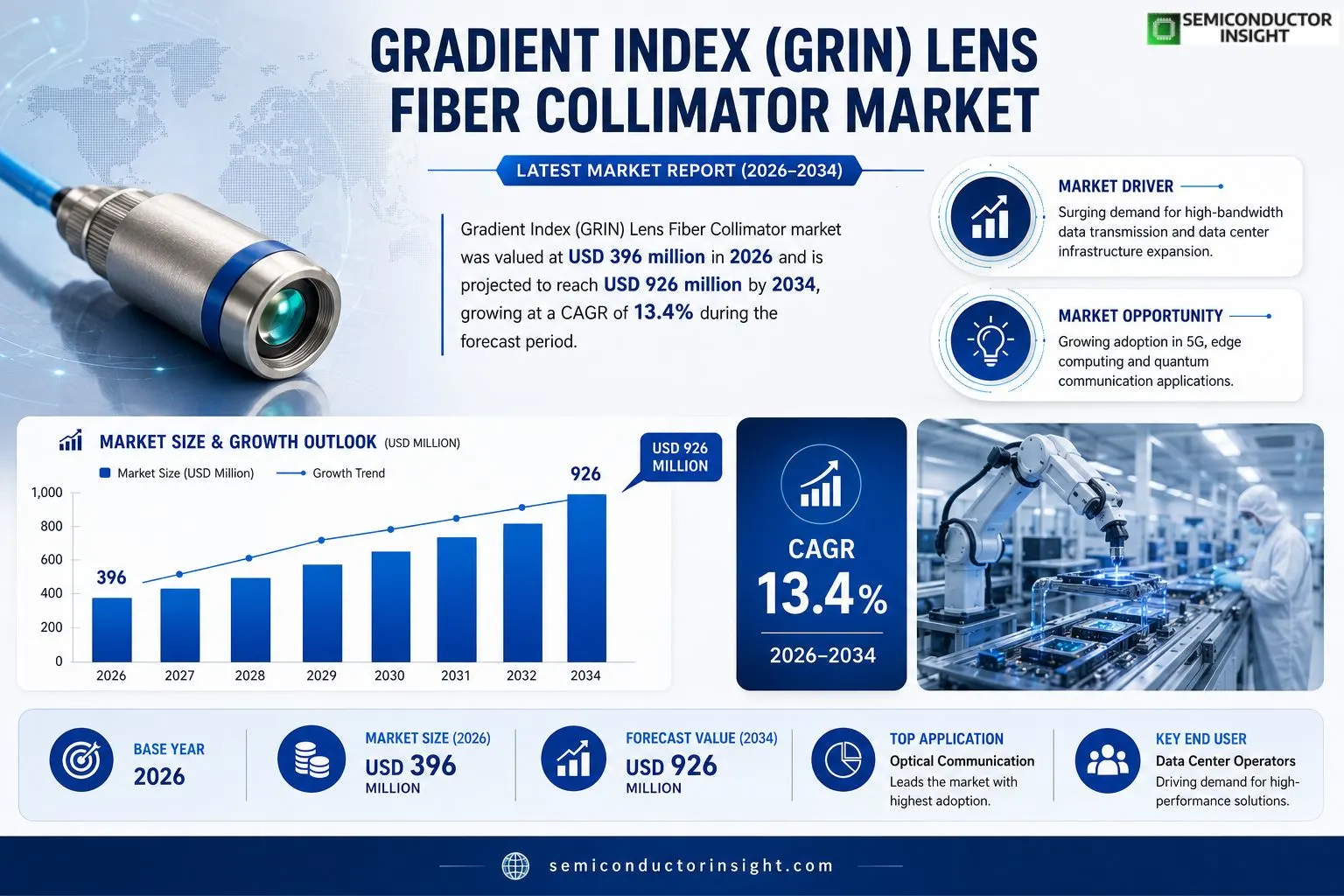
Gradient Index (GRIN) Lens Fiber Collimator Market was valued at USD 396 million in 2026 and is projected to reach USD 926 million by 2034, exhibiting a CAGR of 13.4% during the forecast period.
Gradient‑index (GRIN) lens fiber collimators are passive micro‑optical devices that use graded‑index lenses to transform divergent beams from the end face of an optical fiber into an approximately parallel light outputor efficiently couple free‑space parallel light into the fiber. A typical unit consists of a GRIN lens, ceramic or metal sheath, fiber pigtail or connector, and protective coating.The market gains momentum from rising data‑center bandwidth requirements, broader adoption of fiber‑optic sensing in industrial automation, and expanding use of laser systems for manufacturing and scientific research. Key manufacturersincluding Thorlabs, Newport Corporation, Laser Components, Flyin Group and Edmund Opticsare extending product lines and investing in advanced AR/BBAR coating processes to meet performance expectations.
MARKET DRIVERS
Increasing Demand for High‑Bandwidth Data Transmission
The surge in cloud‑based services, video‑streaming platforms, and data‑center interconnects has pushed network operators to adopt optical components that can sustain multi‑terabit capacities. Gradient Index (GRIN) Lens Fiber Collimator Market benefits because the technology delivers low insertion loss while preserving beam quality over short and medium distances, making it a preferred choice for backbone upgrades.
Advancements in Photonic Integration
Recent breakthroughs in silicon‑photonic platforms enable the embedding of GRIN lenses directly onto PICs, cutting assembly steps and improving alignment tolerance. This integration reduces form factor and cost per port, positioning the market to capture budgets earmarked for next‑generation transceiver modules.
➤ “A 30 % reduction in module size translates into a comparable decline in system‑level power consumption, a metric that OEMs now prioritize.”
Combined, the bandwidth pressures and the push toward compact photonic subsystems create a fertile environment where suppliers that can deliver high‑precision GRIN optics are likely to see sustained order inflows.
MARKET CHALLENGES
Manufacturing Complexity
Producing a gradient refractive‑index profile demands tight control over dopant diffusion during glass molding. Even minor deviations can cause beam‑tilt or focal‑shift, forcing manufacturers to invest in expensive metrology equipment and iterative process loops.
Other Challenges
Cost Sensitivity
End‑users, particularly in telecom, operate under stringent cap‑ex constraints. While GRIN lenses offer performance advantages, their premium price relative to conventional collimators can delay adoption unless volume discounts are realized.
MARKET RESTRAINTS
Regulatory Compliance and Standards
International standards such as IEC 61754‑2 impose strict tolerances on connector geometry and optical loss. Compliance testing adds time and expense, creating a barrier for smaller suppliers lacking certification infrastructure.In addition, the limited number of qualified calibration labs worldwide extends lead times for product qualification, which can deter fast‑moving OEMs from committing to new GRIN‑based designs.Environmental regulations governing hazardous chemicals used in the lens‑forming process further constrain scaling efforts, as manufacturers must implement waste‑handling protocols that increase operational overhead.
MARKET OPPORTUNITIES
Emergence of 5G and Edge‑Computing Infrastructure
The rollout of 5G networks and the parallel rise of edge‑computing nodes call for densely packed optical interconnects that operate reliably in confined spaces. GRIN lenses, with their short focal length and high coupling efficiency, are uniquely positioned to meet these spatial constraints.Furthermore, the advent of quantum‑key‑distribution (QKD) links introduces a niche where ultra‑low‑loss collimation is essential. Early movers that tailor GRIN solutions for quantum channels can secure premium contracts in the emerging secure‑communication segment.Finally, collaborative research programs between universities and photonic foundries are generating next‑generation polymer‑based GRIN materials that promise lower manufacturing cost and higher thermal stability, opening a pathway for cost‑effective expansion into consumer‑electronics optical modules.
Gradient Index (GRIN) Lens Fiber Collimator Market Trends
Escalating Data‑Center Throughput Requirements
The surge in data‑center traffic and the shift toward higher‑speed optical links have amplified the need for compact, low‑loss collimation solutions. Gradient Index (GRIN) Lens Fiber Collimator devices, by virtue of their miniature form factor and straightforward assembly, meet this requirement more efficiently than bulk‑optic alternatives. In 2026 global production reached 3.64 million units, each commanding an average selling price near US $119, a price point that sustains healthy gross margins ranging from 25 % to 45 %. Reliability testing under temperature extremes has shown the GRIN architecture retains collimation accuracy within ±0.5 % up to 85 °C, a factor that reassures designers of long‑term field performance. Moreover, the ease of integrating the unit into printed‑circuit‑board footprints accelerates time‑to‑market for new transceiver families, reinforcing a steady upward trajectory in unit shipments. These dynamics outline the current state of the Gradient Index (GRIN) Lens Fiber Collimator Market.
Other Trends
Supply‑Chain Consolidation
Supply‑chain consolidation has become a defining characteristic of the market. Upstream activities concentrate on high‑purity glass preforms, ion‑exchange gradient formation, and precision polishing, while midstream manufacturers standardize ceramic or metal sheaths and low‑outgassing potting compounds. This vertical alignment reduces lead times and improves temperature‑cycling resilience, attributes prized by sensor‑system integrators and laser‑module producers. Downstream, optical‑communication equipment makers and research institutions increasingly specify GRIN‑based collimators to simplify alignment procedures, thereby lowering bill‑of‑material costs. The resulting economies of scale reinforce profit margins that hover between a quarter and nearly half of revenue, encouraging both incumbent players and new entrants to invest in automated assembly lines. Recent joint ventures between European sheath producers and Asian fiber manufacturers have shortened logistics cycles, while Chinese domestic capacity expansion is pushing unit costs downward, prompting Tier‑1 OEMs to renegotiate supply contracts.
Application Diversification Across Emerging Sectors
Application diversification is reshaping the competitive outlook. Beyond conventional optical‑communication gear, GRIN lens fiber collimators are now integral to fiber‑optic sensing platforms, OCT imaging devices, and quantum‑precision experiments that demand stable beam profiles. Their ability to couple free‑space light into single‑mode fibers with minimal loss attracts laser‑processing manufacturers seeking tighter focus control. Simultaneously, the expanding portfolio of scientific‑research instruments creates demand spikes that are less price‑elastic, allowing manufacturers such as Thorlabs, Newport Corporation and Edmund Optics to command premium pricing on customized packages. This broadened usage spectrum mitigates reliance on any single end‑user segment and positions the market for sustained, balanced growth. Looking ahead, modest revisions to telecom‑infrastructure standards that favor standardized connector geometries are expected to streamline integration, while venture capital inflows into photonic‑packaging startups signal a broader shift toward monolithic optical modules that could incorporate GRIN collimators as native components.
COMPETITIVE LANDSCAPE
Key Industry Players
Competitive Overview of the GRIN Lens Fiber Collimator Market
Thorlabs dominates the high‑performance segment, leveraging its broad portfolio of precision optics and an integrated supply chain that spans glass pre‑form fabrication to final assembly. Its ability to offer custom AR/BBAR coatings and low‑outgassing potting compounds has helped it capture a sizable share of the optical‑communication and laser‑processing customers who demand tight tolerance and stable coupling efficiency. The company’s margin advantage stems from vertical integration and a worldwide distribution network that shortens lead times for data‑center testers and research labs alike.Beyond the market leader, a cluster of specialized manufacturers sustains the competitive fabric. Newport Corporation and Edmund Optics provide extensive catalog options for both fixed and adjustable focal‑length collimators, targeting system integrators that value modularity. Laser Components, Flyin Group, and Optek Systems focus on niche applications such as quantum‑optics platforms and OCT instruments, where bespoke sheath materials and precision ceramic ferrules are critical. Smaller firms like Mightex, SQS, Brimrose Corp., C.F. Technology (Beijing), and emerging Asian players such as Changchun Photonics and Shenzhen Optics expand the market depth by offering cost‑effective alternatives for sensor manufacturers and industrial‑automation testers.
List of Key Gradient Index (GRIN) Lens Fiber Collimator Companies Profiled
- Thorlabs
- Newport Corporation
- Edmund Optics
- Laser Components
- Flyin Group
- Optek Systems
- Mightex
- SQS
- Brimrose Corp.
- C.F. Technology (Beijing)
- Changchun Photonics
- Shenzhen Optics
Segment Analysis:
| Segment Category | Sub-Segments | Key Insights |
| By Type |
|
Fixed Focal Length dominates the market due to its inherent simplicity and reliability.
|
| By Application |
|
Optical Communication remains the leading application because stable collimation is critical for high‑speed data links.
|
| By End User |
|
Data Center Operators drive adoption through rigorous performance standards.
|
| By Fiber Type |
|
Single‑mode fibers are the primary choice for long‑reach, high‑capacity links.
|
| By Material |
|
Glass GRIN retains preference for high‑precision, low‑loss applications.
|
Regional Analysis: Gradient Index (GRIN) Lens Fiber Collimator Market
Europe
The European Union’s optical‑component standards have been harmonized through the IEC, reducing certification friction for GRIN lens assemblies. Recent amendments streamline safety testing for high‑power fiber systems, accelerating product roll‑out cycles for manufacturers targeting cross‑border projects.
Data‑center interconnects and automotive LiDAR integration dominate European procurement, reflecting both the region’s dense cloud infrastructure and its aggressive push toward autonomous‑vehicle validation corridors.
A tightly knit supplier network links glass‑forming firms in France with precision‑polishing workshops in Italy, enabling rapid prototype iteration. Vertical integration trends are evident as several OEMs acquire niche coating specialists to secure optical throughput.
Established players reinforce market share through incremental upgrades to NA‑bandwidth modules, while start‑ups focus on hybrid silicon‑photonic platforms that embed GRIN collimators, creating a layered competitive environment.
North America
North America’s approach to the Gradient Index (GRIN) Lens Fiber Collimator Market is heavily influenced by the intensity of venture‑backed R&D in Silicon Valley and research hubs across Canada. Telecom incumbents invest in fiber‑to‑the‑home upgrades, prompting OEMs to prioritize low‑cost, high‑volume GRIN solutions. Meanwhile, defense contracts for secure optical links drive specialty‑grade components, where performance tolerances outweigh price considerations. The region’s regulatory environment encourages rapid certification, allowing manufacturers to transition from prototype to production within compressed timelines.
Asia‑Pacific
In Asia‑Pacific, market momentum stems from the sheer scale of telecom expansion in China, India, and Southeast Asian economies. Operators are modernizing backbone networks to support mobile‑edge computing, and the compact geometry of GRIN lens collimators fits densely packed transmission racks. Government incentives for advanced manufacturing in Japan and South Korea foster local supply chains that can produce high‑precision glass gradients at competitive costs. The confluence of aggressive rollout schedules and cost‑sensitivity shapes a market that rewards both price‑performance balance and rapid serviceability.
South America
South America experiences a more measured adoption curve for the Gradient Index (GRIN) Lens Fiber Collimator Market, reflecting infrastructure investment cycles tied to public‑private partnerships. Brazil’s expanding fiber‑to‑the‑x initiatives open opportunities for mid‑range GRIN modules, while Argentina’s academic collaborations generate niche research outputs in low‑loss waveguide integration. The region’s challenges include fragmented logistics and variable import tariffs, which compel distributors to maintain buffer inventories and carefully manage lead‑times for high‑specification components.
Middle East & Africa
The Middle East & Africa region leverages its strategic position as a data‑traffic conduit between Europe and Asia, prompting telecom carriers to adopt high‑efficiency optical hardware. In the United Arab Emirates, smart‑city projects demand compact, reliable collimators for fiber‑based surveillance and IoT back‑haul. African markets, though still nascent, show growing interest as renewable‑energy micro‑grids rely on fiber‑optic monitoring, creating a niche for ruggedized GRIN lens assemblies that can endure harsh environmental conditions.
Report Scope
This market research report provides a comprehensive analysis of the Gradient Index (GRIN) Lens Fiber Collimator Market , covering the forecast period 2026–2034. It offers detailed insights into market dynamics, technological advancements, competitive landscape, and key trends shaping the industry.
Key focus areas of the report include:
- Market Overview: The report begins with an overview outlining its current market scenario, key growth indicators, and industry transformation drivers. It discusses macroeconomic factors, demand–supply balance, regulatory landscape, and the strategic role of semiconductors in powering advancements across industries such as automotive, telecommunications, consumer electronics, and industrial automation.
- Market Size & Forecast: Historical data and future projections for revenue, unit shipments, and market value across major regions and segments.
- Segmentation Analysis: Detailed breakdown by product type, technology, application, and end-user industry to identify high-growth segments and investment opportunities.
- Regional Insights: Insights into market performance across North America, Europe, Asia-Pacific, Latin America, and the Middle East & Africa, including country-level analysis where relevant.
- Competitive Landscape: Profiles of leading market participants, including their product offerings, R&D focus, manufacturing capacity, pricing strategies, and recent developments such as mergers, acquisitions, and partnerships.
- Technology Trends & Innovation: Assessment of emerging technologies, integration of AI/IoT, semiconductor design trends, fabrication techniques, and evolving industry standards.
- Market Drivers & Restraints: Evaluation of factors driving market growth along with challenges, supply chain constraints, regulatory issues, and market-entry barriers.
- Stakeholder Insights: Insights for component suppliers, OEMs, system integrators, investors, and policymakers regarding the evolving ecosystem and strategic opportunities.
Primary and secondary research methods are employed, including interviews with industry experts, data from verified sources, and real-time market intelligence to ensure the accuracy and reliability of the insights presented.
FREQUENTLY ASKED QUESTIONS:
What is the current market size of Gradient Index (GRIN) Lens Fiber Collimator Market?
-> Gradient Index (GRIN) Lens Fiber Collimator Market was valued at USD 396 million in 2026 and is expected to reach USD 926 million by 2034 with a CAGR of 13.4% during the forecast period.
Which key companies operate in Gradient Index (GRIN) Lens Fiber Collimator Market?
-> Key players include Thorlabs, Newport Corporation, Laser Components, Flyin Group, Optek Systems, Mightex, SQS, Edmund Optics, Brimrose Corp., C.F.Technology (Beijing), among others.
What are the key growth drivers?
-> Key growth drivers include rising data‑center traffic, expansion of optical communication networks, increasing adoption of fiber‑optic sensing and interferometry systems, and growing demand for compact, cost‑effective collimation solutions in laser processing and scientific research.
Which region dominates the market?
-> The source does not disclose a single dominant region; the market is globally distributed across North America, Europe, and Asia with significant activity in each.
What are the emerging trends?
-> Emerging trends include integration of GRIN collimators in modular optical paths for industrial automation testing, increased use in quantum and precision optics platforms, and development of low‑outgassing, temperature‑stable versions for high‑reliability applications.
Get Sample Report PDF for Exclusive Insights
Report Sample Includes
- Table of Contents
- List of Tables & Figures
- Charts, Research Methodology, and more...
 Download Sample Report PDF