MEMS & Sensor Tester Market Insights
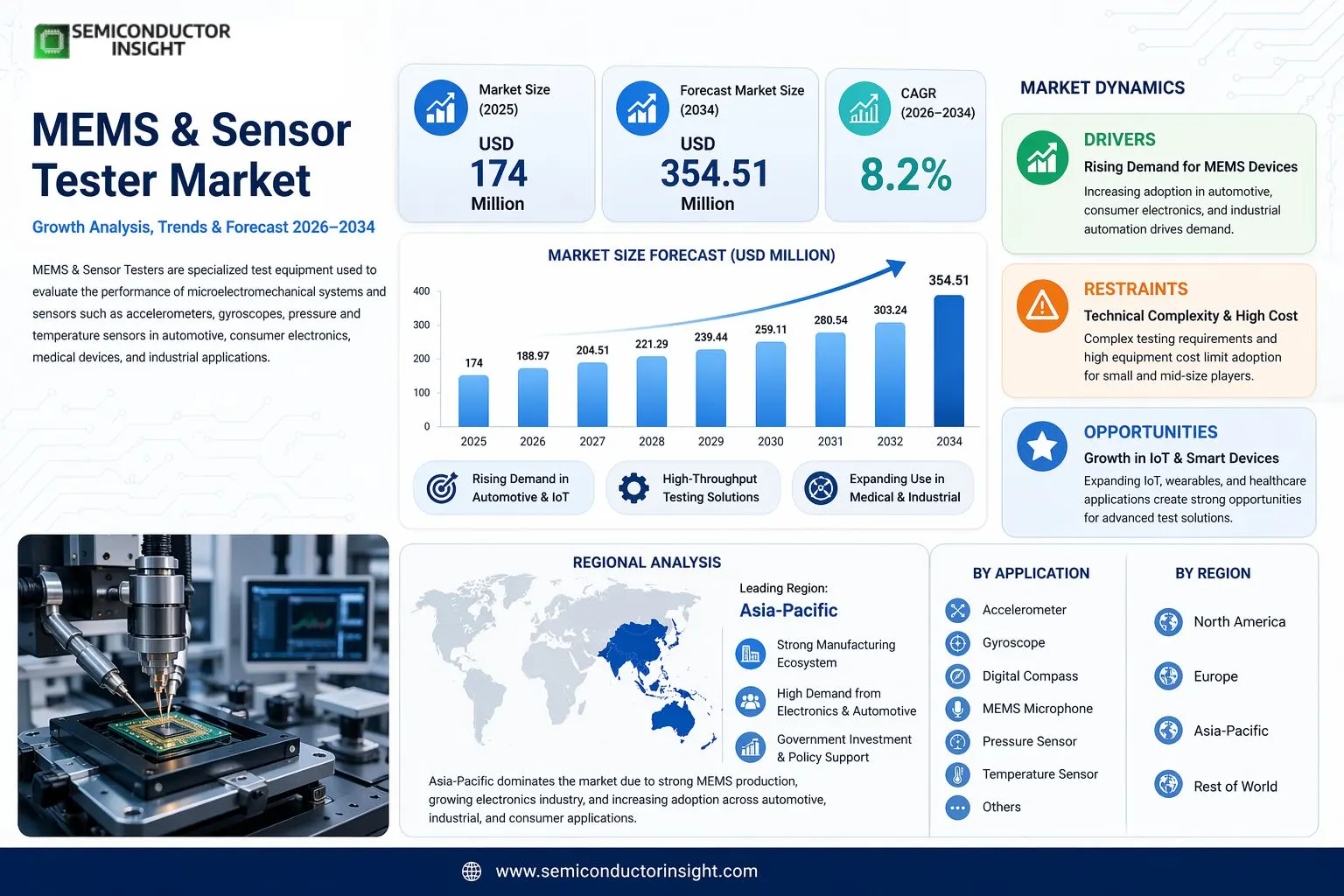
Global MEMS & Sensor Tester market size was valued at USD 174 million in 2025. The market is projected to grow from USD 188.97 million in 2026 to USD 354.51 million by 2034, exhibiting a CAGR of 8.2% during the forecast period.
A MEMS & Sensor Tester is a specialized test equipment used to evaluate the performance and functionality of Micro-Electro-Mechanical Systems (MEMS) devices and various types of sensors. MEMS are tiny mechanical devices integrated with electronics, typically in the range of micrometers to millimeters in size, that can perform tasks such as sensing, actuation, and signal processing. These testers measure various electrical, mechanical, and environmental parameters of MEMS and sensors , including accelerometers, gyroscopes, digital compasses, MEMS microphones, pressure sensors, and temperature sensors , to validate their performance and ensure compliance with required specifications.
The market is witnessing steady expansion driven by the proliferating adoption of MEMS-based components across automotive applications such as airbag sensors and electronic stability control systems, consumer electronics, medical devices, and industrial automation. Furthermore, the rising integration of sensors in Internet of Things (IoT) platforms and smart devices is reinforcing the demand for high-throughput, precision test solutions. Key global manufacturers operating in this space include Advantest, Cohu, Inc., NI (SET GmbH), STATEC, SPEA S.p.A., and YTEC, which collectively account for a significant share of Global market revenue.
MARKET DRIVERS
Rising Demand for MEMS Devices Across Consumer Electronics and Automotive Sectors
Global MEMS & Sensor Tester Market is experiencing robust growth, driven primarily by the accelerating adoption of microelectromechanical systems (MEMS) in consumer electronics, automotive applications, and industrial automation. As smartphones, wearables, and IoT-enabled devices increasingly incorporate MEMS-based accelerometers, gyroscopes, pressure sensors, and microphones, the demand for precision testing equipment capable of validating sensor performance has grown in parallel. Manufacturers are under pressure to ensure that every MEMS component meets stringent quality and reliability benchmarks before deployment, making advanced sensor testers a critical part of the production workflow.
Expansion of Automotive MEMS Applications Fueling Testing Infrastructure Investment
The automotive industry represents one of the most significant growth catalysts for MEMS & Sensor Tester Market. Modern vehicles rely on a broad array of MEMS sensors for functions including airbag deployment, tire pressure monitoring, electronic stability control, and advanced driver-assistance systems (ADAS). As the transition toward electric vehicles (EVs) and autonomous driving platforms accelerates, automotive-grade MEMS components require increasingly sophisticated test and measurement solutions. This has prompted semiconductor manufacturers and Tier 1 automotive suppliers to significantly expand their investment in wafer-level and package-level MEMS testing capabilities.
➤ The proliferation of MEMS sensors in next-generation automotive platforms, particularly those supporting ADAS and vehicle electrification, is expected to sustain elevated demand for high-throughput, precision MEMS & sensor testing systems throughout the forecast period.
Beyond automotive and consumer electronics, the healthcare and medical device sector is emerging as a notable driver for MEMS & Sensor Tester Market. MEMS-based pressure sensors, flow sensors, and biosensors are increasingly embedded in diagnostic equipment, implantable devices, and point-of-care platforms. Regulatory requirements in medical device manufacturing mandate rigorous functional and reliability testing, compelling medical OEMs and contract manufacturers to adopt dedicated MEMS testing solutions that can accommodate the high sensitivity and miniaturized form factors inherent to medical-grade MEMS components.
MARKET CHALLENGES
Technical Complexity of Testing Heterogeneous MEMS Sensor Architectures
One of the foremost challenges confronting MEMS & Sensor Tester Market is the inherent technical complexity associated with testing a highly diverse range of sensor types, each with distinct operating principles, output characteristics, and failure modes. Unlike conventional semiconductor devices, MEMS sensors respond to physical stimuli such as motion, pressure, humidity, and acoustic signals, requiring test systems to accurately generate and control these stimuli in a repeatable and calibrated manner. Developing test platforms that can simultaneously accommodate multiple sensor modalities while maintaining measurement accuracy at the microscale remains a significant engineering and commercial challenge for equipment vendors.
Other Challenges
High Capital Expenditure and Total Cost of Ownership
The procurement and maintenance of advanced MEMS & sensor testing equipment involves substantial capital investment. Wafer-level MEMS test systems, particularly those designed for high-volume manufacturing environments, require sophisticated mechanical, electrical, and environmental stimulus subsystems that drive up equipment costs. For small and medium-sized MEMS manufacturers and fabless design houses, the high total cost of ownership associated with dedicated sensor test infrastructure can constrain adoption and delay time-to-market for new product introductions.
Lack of Standardized Test Methodologies
The absence of universally adopted test standards and protocols across the MEMS industry continues to create fragmentation in MEMS & Sensor Tester Market. Different end-use segments , automotive, medical, industrial, and consumer , often maintain their own qualification and testing requirements, compelling test equipment providers to develop highly customized solutions for each application vertical. This lack of standardization increases development costs, limits equipment reusability across product families, and complicates the benchmarking of test coverage and quality metrics across the supply chain.
MARKET RESTRAINTS
Limitations Imposed by Miniaturization and Advanced Packaging Trends
The continued miniaturization of MEMS components and the widespread shift toward advanced packaging formats , including system-in-package (SiP), wafer-level chip-scale packaging (WLCSP), and heterogeneous integration , pose meaningful restraints on MEMS & Sensor Tester Market. As MEMS die dimensions shrink and packaging densities increase, conventional probe-based test methodologies face physical and electrical limitations that reduce test coverage and yield accuracy. Adapting existing test hardware to reliably contact and stimulate next-generation miniaturized MEMS structures requires significant re-engineering efforts that can slow the pace of product development within the test equipment segment.
Supply Chain Constraints and Geopolitical Factors Affecting Equipment Availability
Global semiconductor supply chain disruptions have had a tangible impact on MEMS & Sensor Tester Market, affecting the availability of critical components used in test system manufacturing, including precision analog front-end ICs, motion control hardware, and high-accuracy data acquisition modules. Additionally, evolving export control regulations and geopolitical tensions in key semiconductor manufacturing regions have introduced uncertainty into procurement timelines and cross-border technology transfer for test equipment vendors. These macroeconomic and regulatory factors represent near-to-medium-term restraints on market expansion, particularly for vendors dependent on globally distributed supply networks.
Long Equipment Qualification Cycles in High-Reliability End Markets
In high-reliability application segments such as automotive and aerospace, the qualification and validation of new MEMS test systems involves protracted approval cycles governed by industry standards such as AEC-Q100 and MIL-STD specifications. These lengthy qualification timelines can delay revenue recognition for test equipment vendors and deter end-users from upgrading to next-generation testing platforms, even when performance improvements are demonstrably significant. The resulting inertia toward established test solutions acts as a structural restraint on market growth and the adoption of innovative testing technologies within MEMS & Sensor Tester Market.
MARKET OPPORTUNITIES
Growth of IoT and Smart Sensor Networks Creating New Testing Demand
The rapid expansion of IoT ecosystems and smart sensor networks presents a compelling growth opportunity for MEMS & Sensor Tester Market. As billions of connected devices incorporating environmental, motion, and chemical MEMS sensors are deployed across smart cities, industrial automation platforms, and precision agriculture applications, the volume of MEMS components requiring functional validation is set to grow substantially. This demand surge is encouraging test equipment manufacturers to develop scalable, high-throughput testing architectures capable of supporting the cost-sensitive, high-volume production dynamics characteristic of the IoT sensor supply chain.
Integration of AI and Machine Learning in MEMS Test Systems
The integration of artificial intelligence and machine learning algorithms into MEMS & sensor test platforms represents a transformative opportunity for market participants. AI-driven test systems can enable adaptive test coverage optimization, predictive yield management, and real-time anomaly detection during production testing , capabilities that are increasingly valued as MEMS complexity and manufacturing volumes scale upward. Equipment vendors that can embed intelligent data analytics into their platforms are well-positioned to differentiate their offerings and command premium pricing, particularly in high-reliability automotive and medical MEMS manufacturing environments.
Emerging Opportunities in MEMS-Based Healthcare and Wearable Biosensor Testing
The convergence of MEMS technology with digital health platforms and wearable biosensors is opening new avenues for growth within MEMS & Sensor Tester Market. The increasing deployment of MEMS-based inertial sensors, biochemical sensors, and optical sensors in continuous health monitoring devices, surgical robotics, and remote patient monitoring systems is generating demand for specialized testing solutions tailored to medical-grade performance requirements. Regulatory pathways for digital health devices in major markets continue to tighten quality assurance expectations, reinforcing the strategic importance of robust MEMS sensor test infrastructure and creating a sustained, long-term opportunity for test equipment innovation and market expansion.
MEMS & Sensor Tester Market Trends
Rising Demand Across Automotive and Consumer Electronics Driving MEMS & Sensor Tester Market Growth
MEMS & Sensor Tester Market is experiencing sustained momentum, driven by the expanding deployment of Micro-Electro-Mechanical Systems across a broad range of industries. As MEMS devices become integral to automotive safety systems, consumer electronics, medical instrumentation, and industrial automation, the need for precise and reliable test equipment has grown considerably. MEMS & Sensor Testers validate the electrical, mechanical, and environmental performance of these miniaturized devices, ensuring they meet stringent specifications before integration into end products. The automotive sector, in particular, continues to be a significant demand driver, with airbag sensors, tire pressure monitoring systems, and advanced driver-assistance systems all relying on rigorously tested MEMS components.
Other Trends
Proliferation of MEMS Microphones and Inertial Sensors in Consumer Devices
The rapid adoption of smartphones, wearables, and smart home devices has accelerated demand for MEMS microphones, accelerometers, gyroscopes, and digital compasses. Each of these sensor types requires dedicated testing protocols to verify accuracy and durability under real-world conditions. As consumer electronics manufacturers push for higher production throughput, testers capable of handling higher units-per-hour (UPH) volumes have become increasingly relevant. The shift toward higher-throughput test platforms reflects a broader industry trend favoring efficiency and scalability in sensor validation workflows.
Medical and Industrial Applications Expanding the Addressable Market
Beyond automotive and consumer electronics, MEMS-based pressure sensors and temperature sensors are seeing growing adoption in medical devices and industrial automation systems. These applications demand high-reliability components, making comprehensive testing indispensable. The trend toward miniaturized diagnostic tools and smart manufacturing equipment is broadening the addressable market for MEMS & Sensor Tester solutions, with manufacturers developing specialized test configurations to meet sector-specific compliance and performance standards.
Asia-Pacific Emerging as a Key Regional Growth Hub
Asia, led by China, Japan, South Korea, and Southeast Asia, is emerging as a dominant region in Global MEMS & Sensor Tester market. The concentration of semiconductor and electronics manufacturing in this region, combined with increasing domestic consumption of connected devices, is supporting robust regional demand. Investments in local MEMS fabrication capacity are further reinforcing the need for advanced test infrastructure across the region.
Competitive Landscape and Technological Advancement Shaping Market Direction
MEMS & Sensor Tester Market features a competitive landscape anchored by established players such as Advantest, Cohu, Inc., NI (SET GmbH), STATEC, SPEA S.p.A., and YTEC. These companies are focused on developing test solutions that support increasingly complex sensor architectures while improving throughput and reducing cost-per-test. Continuous innovation in test hardware and software integration remains a defining trend, as manufacturers seek to align their offerings with evolving MEMS device complexity and the growing diversity of sensor applications across global end markets.
COMPETITIVE LANDSCAPE
Key Industry Players
MEMS & Sensor Tester Market: Competitive Dynamics and Leading Manufacturer Insights
Global MEMS & Sensor Tester market, valued at approximately USD 174 million in 2025 and projected to reach USD 305 million by 2032 at a CAGR of 8.6%, is characterized by a moderately consolidated competitive landscape. Advantest and Cohu, Inc. stand out as dominant forces, leveraging their deep-rooted expertise in semiconductor and electronic test equipment to deliver highly automated, high-throughput MEMS testing solutions. Advantest, in particular, has consistently invested in R&D to expand its tester portfolio to accommodate the growing complexity of MEMS devices used in automotive safety systems, consumer electronics, and medical applications. Cohu, Inc. complements this leadership through its broad handler and tester ecosystem, enabling efficient testing of accelerometers, gyroscopes, MEMS microphones, and pressure sensors at scale. Together with the top five global players, these companies collectively commanded a significant share of total market revenue in 2025, reinforcing the importance of technological differentiation and application-specific solutions in gaining competitive advantage.
Beyond the market leaders, a set of specialized and regionally significant players contribute meaningfully to the MEMS & Sensor Tester ecosystem. NI (SET GmbH) brings modular, software-defined test platforms suited for flexible MEMS validation workflows, while SPEA S.p.A. is recognized across Europe for its precision flying probe and functional test systems adaptable to sensor testing environments. STATEC and YTEC address niche segments with targeted tester configurations, particularly for high-volume production environments requiring Up to 20K UPH and Up to 30K UPH throughput capacities. As demand accelerates across application segments , including digital compasses, temperature sensors, and industrial-grade MEMS , competition is intensifying around throughput efficiency, test accuracy, multi-parameter evaluation capabilities, and integration with Industry 4.0 manufacturing frameworks. Emerging players from Asia, especially China, are also beginning to exert competitive pressure as the region scales domestic MEMS production infrastructure.
List of Key MEMS & Sensor Tester Companies Profiled
- Advantest
- Cohu, Inc.
- NI (SET GmbH)
- SPEA S.p.A.
- STATEC
- YTEC
- Teradyne
- Astronics Test Systems
- Chroma ATE Inc.
- National Instruments (NI)
- Rasco GmbH
- Multitest Electronic Systems
- Aehr Test Systems
- Lorlin Test Systems
- Mechatronic Systemtechnik GmbH
Segment Analysis:
| Segment Category | Sub-Segments | Key Insights |
| By Type |
|
Up to 30K UPH testers represent the leading segment in MEMS & Sensor Tester Market by type, driven by the increasing demand for high-throughput testing solutions across high-volume manufacturing environments.
|
| By Application |
|
Accelerometer testing represents the dominant application segment in MEMS & Sensor Tester Market, underpinned by the widespread deployment of accelerometers across automotive safety systems, consumer electronics, and industrial monitoring solutions.
|
| By End User |
|
Consumer Electronics stands as the leading end-user segment for MEMS & Sensor Testers, fueled by relentless innovation cycles and the massive scale of device production across smartphones, wearables, tablets, and smart home products.
|
| By Testing Technology |
|
Wafer-Level Testing is the dominant testing technology segment, reflecting the industry’s emphasis on early defect detection and cost reduction throughout the MEMS manufacturing process.
|
| By Deployment Mode |
|
Automated Test Equipment (ATE) Systems represent the leading deployment mode segment, as MEMS & Sensor Tester Market increasingly shifts toward fully automated, software-driven testing environments that can seamlessly integrate into smart manufacturing ecosystems.
|
Regional Analysis: MEMS & Sensor Tester Market
Asia-Pacific
Asia-Pacific’s MEMS & sensor tester market is underpinned by one of the world’s most vertically integrated semiconductor supply chains. From wafer fabrication through final test and packaging, the region offers end-to-end capabilities that reduce dependency on imported testing infrastructure. This self-contained ecosystem enables faster adoption of next-generation sensor tester platforms across both established OEMs and emerging domestic players.
State-directed industrial policies across China, Japan, and South Korea are channeling significant capital into semiconductor and MEMS R&D programs. Subsidies, tax incentives, and national technology roadmaps are directly stimulating investment in sensor tester equipment upgrades. These policy tailwinds create a structurally supportive environment for market expansion that extends well into the latter half of the forecast horizon.
The surge in electric vehicle production across China and the continued dominance of consumer electronics manufacturing across the broader Asia-Pacific corridor are key demand drivers for MEMS & sensor tester solutions. Stringent reliability requirements in automotive-grade MEMS sensors and miniaturized consumer devices are elevating the technical specifications demanded of test equipment, spurring continuous product innovation.
Asia-Pacific’s large pool of engineering talent, supported by world-class technical universities in Japan, China, and South Korea, sustains a strong pipeline of MEMS sensor tester innovation. Collaborative research between academic institutions and industry players is accelerating the commercialization of novel testing methodologies, including wafer-level test solutions and multi-axis sensor validation systems suited to complex MEMS architectures.
North America
North America represents a highly mature and technologically sophisticated segment of MEMS & Sensor Tester Market. The United States, in particular, is home to several of the world’s leading semiconductor equipment vendors and MEMS design houses, creating a robust domestic demand base for precision sensor testing solutions. The region’s strength lies in high-value end markets including aerospace & defense, medical devices, and advanced automotive systems, all of which impose stringent performance and compliance requirements on MEMS sensors and, by extension, the test equipment used to validate them. Increased federal investment in domestic semiconductor manufacturing through legislation such as the CHIPS and Science Act is progressively reshaping North America’s manufacturing footprint, which is expected to generate incremental demand for MEMS & sensor tester platforms over the forecast period. Canada also contributes to the regional landscape through its growing photonics and autonomous vehicle research communities, which intersect meaningfully with MEMS sensor testing requirements.
Europe
Europe occupies a strategically important position in Global MEMS & sensor tester market, characterized by its emphasis on high-precision engineering, automotive innovation, and industrial automation. Germany, in particular, serves as the epicenter of European MEMS sensor adoption, given the country’s deep-rooted automotive and industrial machinery sectors, both of which are undergoing extensive electrification and digital transformation. France and the Netherlands contribute through their active semiconductor research programs and specialized MEMS foundry operations. European regulatory frameworks, especially those governing automotive safety and medical device performance, create a compliance-driven demand environment that consistently elevates the technical bar for sensor tester solutions. The region’s commitment to Industry 4.0 adoption is further driving the integration of intelligent, automated test systems within MEMS production workflows, making Europe a meaningful contributor to global market evolution through 2034.
South America
South America remains an emerging but steadily developing participant in MEMS & Sensor Tester Market. Brazil leads regional activity, supported by its automotive manufacturing sector and growing electronics assembly industry, both of which are beginning to adopt MEMS-based sensing solutions at a meaningful scale. While the region does not yet host significant indigenous MEMS fabrication capacity, increasing foreign direct investment in local electronics production and a rising middle class driving demand for connected consumer devices are gradually expanding the addressable base for sensor testing infrastructure. Argentina and Chile are also witnessing early-stage engagement with MEMS technologies within their respective mining, agricultural monitoring, and environmental sensing sectors. Over the forecast period, South America is expected to transition from a predominantly import-dependent market to one with greater local testing and validation capabilities, particularly as supply chain localization becomes a strategic priority across industries.
Middle East & Africa
The Middle East & Africa region represents the nascent frontier of Global MEMS & sensor tester market, with growth driven primarily by large-scale infrastructure investment, smart city initiatives, and the expansion of oil & gas automation across Gulf Cooperation Council nations. The UAE and Saudi Arabia are leading regional engagement with advanced sensor technologies as part of their broader economic diversification agendas, which include significant investment in smart infrastructure, autonomous mobility, and industrial digitalization. These initiatives create downstream demand for MEMS sensors and, consequently, for reliable sensor tester solutions capable of validating devices deployed in demanding environmental conditions. Africa’s market activity is concentrated in South Africa and select North African nations, where telecommunications expansion and industrial modernization projects are fostering early adoption of MEMS-based sensing systems. While the region’s overall contribution to global market volume remains limited relative to Asia-Pacific or North America, its long-term growth trajectory is promising as technological infrastructure continues to mature.
Report Scope
This market research report provides a comprehensive analysis of MEMS & Sensor Tester Market, covering the forecast period 2026–2034. It offers detailed insights into market dynamics, technological advancements, competitive landscape, and key trends shaping the industry.
Key focus areas of the report include:
- Market Overview: The report begins with an overview outlining its current market scenario, key growth indicators, and industry transformation drivers. It discusses macroeconomic factors, demand–supply balance, regulatory landscape, and the strategic role of semiconductors in powering advancements across industries such as automotive, telecommunications, consumer electronics, and industrial automation.
- Market Size & Forecast: Historical data and future projections for revenue, unit shipments, and market value across major regions and segments.
- Segmentation Analysis: Detailed breakdown by product type, technology, application, and end-user industry to identify high-growth segments and investment opportunities.
- Regional Insights: Insights into market performance across North America, Europe, Asia-Pacific, Latin America, and the Middle East & Africa, including country-level analysis where relevant.
- Competitive Landscape: Profiles of leading market participants, including their product offerings, R&D focus, manufacturing capacity, pricing strategies, and recent developments such as mergers, acquisitions, and partnerships.
- Technology Trends & Innovation: Assessment of emerging technologies, integration of AI/IoT, semiconductor design trends, fabrication techniques, and evolving industry standards.
- Market Drivers & Restraints: Evaluation of factors driving market growth along with challenges, supply chain constraints, regulatory issues, and market-entry barriers.
- Stakeholder Insights: Insights for component suppliers, OEMs, system integrators, investors, and policymakers regarding the evolving ecosystem and strategic opportunities.
Primary and secondary research methods are employed, including interviews with industry experts, data from verified sources, and real-time market intelligence to ensure the accuracy and reliability of the insights presented.
FREQUENTLY ASKED QUESTIONS:
What is the current market size of MEMS & Sensor Tester Market?
-> Global MEMS & Sensor Tester Market was valued at USD 174 million in 2025 and is projected to reach USD 305 million by 2032, growing at a CAGR of 8.6% during the forecast period.
Which key companies operate in MEMS & Sensor Tester Market?
-> Key players include Advantest, Cohu, Inc., NI (SET GmbH), STATEC, SPEA S.p.A., and YTEC, among others. In 2025, Global top five players collectively held a significant share in terms of revenue.
What are the key growth drivers?
-> Key growth drivers include rising demand for MEMS devices in automotive applications (e.g., airbag sensors), growing adoption of consumer electronics incorporating accelerometers and gyroscopes, expanding use of MEMS in medical devices, and increasing industrial automation. The need to ensure reliability, accuracy, and durability of MEMS and sensor devices before product integration further fuels demand for specialized testers.
Which region dominates the market?
-> Asia represents a key growth region driven by strong manufacturing bases in China, Japan, South Korea, and Southeast Asia, while North America remains a significant market supported by advanced semiconductor and automotive industries. The report covers regional performance across North America, Europe, Asia, South America, and Middle East & Africa.
What are the emerging trends?
-> Emerging trends include increased integration of MEMS sensors in IoT-connected devices, growing demand for MEMS microphones and pressure sensors, advancements in high-throughput testing solutions (Up to 20K UPH and Up to 30K UPH segments), and expanding applications across accelerometers, gyroscopes, digital compasses, temperature sensors, and MEMS microphones.

Get Sample Report PDF for Exclusive Insights
Report Sample Includes
- Table of Contents
- List of Tables & Figures
- Charts, Research Methodology, and more...
 Download Sample Report PDF