Key Statistics
Key Takeaways
- 1200V SiC MOSFETs are the core commercial segment because electric-vehicle traction inverters, industrial drives, renewable-energy converters and high-voltage power supplies need a strong balance between efficiency, switching speed and voltage headroom.
- Electric vehicles remain the largest high-value application as SiC improves inverter efficiency, reduces cooling demand and supports higher-voltage battery architectures, while industrial and data-center power are becoming important incremental demand pools.
- Asia Pacific is the leading growth engine through EV production, renewable-energy deployment and semiconductor manufacturing in China, Japan and South Korea.
- 200 mm manufacturing is moving into commercial production. Infineon began customer shipments from 200 mm SiC in 2025, while Wolfspeed’s latest Gen 5 platform is designed and qualified on its 200 mm manufacturing line.
- Device efficiency continues to improve. Wolfspeed’s Gen 5 and ROHM’s fifth-generation SiC MOSFETs target lower on-resistance, smaller die area and higher power density for automotive, industrial and AI-related power systems.
SiC MOSFET Market Overview
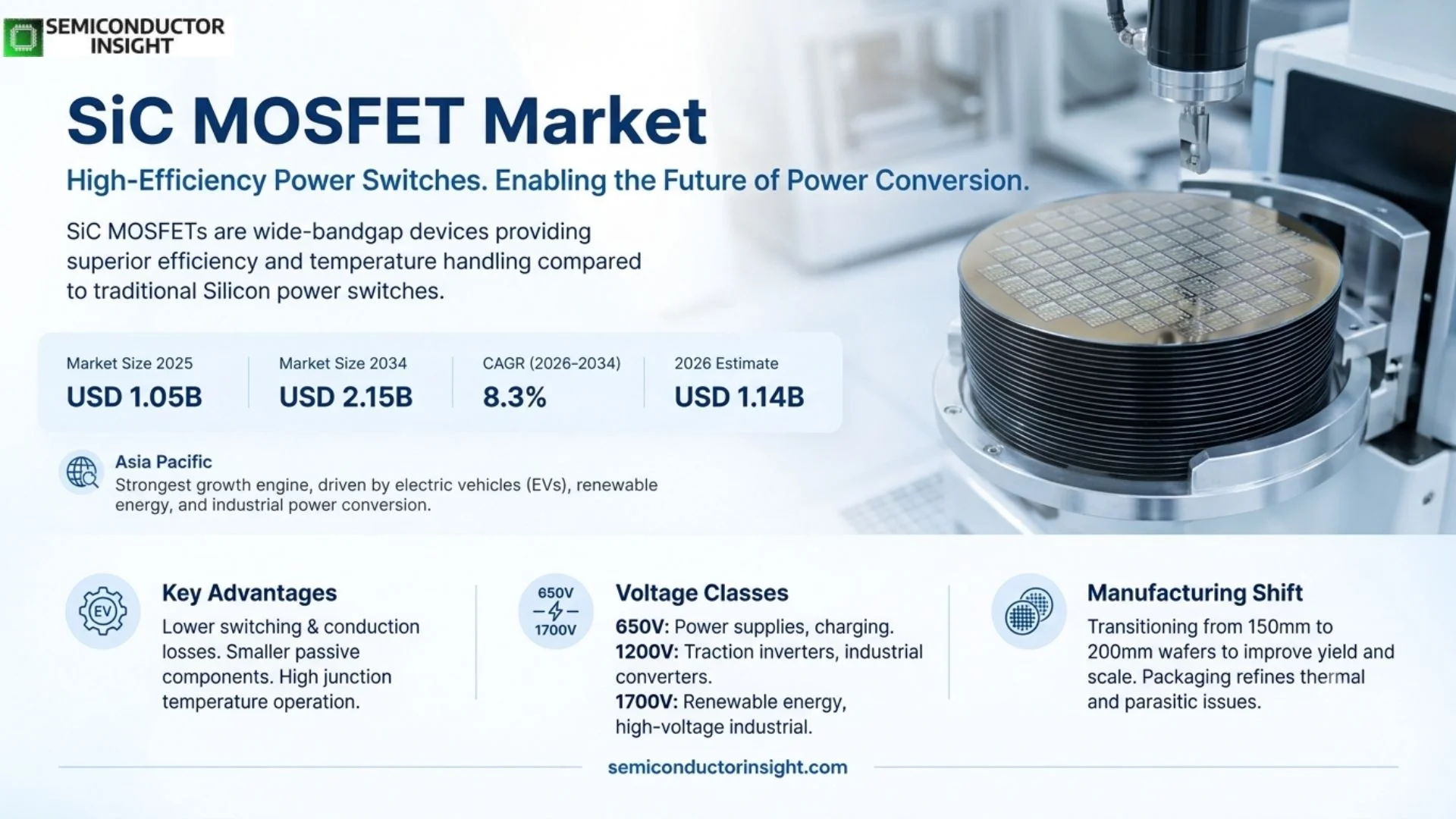
SiC MOSFET market was valued at USD 1.05 billion in 2025 and is projected to reach USD 2.15 billion by 2034, representing an 8.3% CAGR during 2026–2034. The 2026 estimated market size is USD 1.14 billion. Asia Pacific is the strongest regional growth engine through electric vehicles, renewable energy, industrial power conversion and semiconductor manufacturing.
Silicon carbide MOSFETs are wide-bandgap power switches designed for high-voltage and high-frequency conversion. Compared with conventional silicon MOSFETs or IGBTs, SiC devices can reduce switching and conduction losses, operate at higher junction temperatures and enable smaller passive components. These characteristics make them particularly attractive in applications where efficiency, weight and cooling cost have high system value.
Commercial adoption spans 650V, 1200V and 1700V classes. Lower-voltage devices are used in power supplies, charging and selected automotive auxiliaries, while 1200V devices dominate traction inverters and many industrial converters. The 1700V class addresses higher-voltage industrial, renewable and infrastructure systems where silicon devices would require larger losses or more complex series arrangements.
Manufacturing economics are improving as the industry transitions from 150 mm toward 200 mm SiC wafers and refines epitaxy, defect control and device processing. Larger wafers increase potential die output per run, but yield and substrate quality remain decisive. Packaging is equally important because fast SiC switching increases parasitic sensitivity and thermal density.
Segment Analysis: By Type
By voltage class, the market is structured around 650V, 1200V and 1700V SiC MOSFETs. The 1200V class is the main commercial workhorse because it fits 800V-class EV architectures, industrial motor drives, renewable inverters and a broad range of high-power conversion systems.
| Voltage class | Primary use | Market position |
|---|---|---|
| 650V | Used in high-efficiency power supplies, PFC stages, charging, telecom and selected automotive auxiliary systems. Faster switching can reduce magnetic size and improve power density in compact converters. | A high-volume class for lower-voltage high-frequency conversion, especially where designers want a migration path from superjunction silicon MOSFETs. |
| 1200V | Well suited to EV traction inverters, industrial drives, renewable-energy converters, charging infrastructure and server power. The voltage class provides margin for 800V systems while maintaining strong switching performance. | Leading commercial segment. Most major SiC suppliers offer broad 1200V portfolios in discrete, module and bare-die forms. |
| 1700V | Targets higher-voltage industrial drives, solar and wind systems, rail, grid and infrastructure applications. It can simplify converter topologies or reduce series-device count in systems operating above standard 1200V ranges. | A smaller but strategically important segment with higher value per device and strong demand in heavy industrial and energy applications. |
Device form and end-user segmentation
SiC MOSFETs are sold as bare die, discrete packaged devices and power modules. Automotive OEMs and Tier-1 suppliers increasingly use modules for traction systems, while industrial and power-supply designers may select discrete packages when power levels and thermal requirements allow. End users include automotive manufacturers, renewable-energy companies, industrial OEMs and data-center power suppliers.
| Axis | Segments | Commercial implication |
|---|---|---|
| By Device Form | Bare Die · Discrete MOSFET · Power Module | Bare die supports custom module integration, discrete devices serve flexible converter design, and modules combine several MOSFETs with optimized thermal and low-inductance interconnect for high-power systems. |
| By End User | Automotive · Industrial · Renewable Energy · Data Center / Telecom · Rail & Infrastructure | Automotive drives volume and qualification rigor, industrial users value reliability and lifecycle, renewable systems prioritize conversion efficiency, and AI/data-center power creates a newer high-current growth opportunity. |
Segment Analysis: By Application
By application, electric vehicles and automotive power electronics are the leading demand area, followed by industrial motor drives, renewable-energy conversion, charging infrastructure and high-efficiency power supplies. Data-center AI power is creating a new growth pocket for lower-loss high-current conversion.
| Application | Demand characteristics |
|---|---|
| Electric Vehicles | SiC MOSFETs are used in traction inverters, onboard chargers, DC-DC converters and electric compressors. Lower switching and conduction losses can increase driving range or reduce battery and cooling requirements, making SiC economically attractive in premium and 800V vehicle architectures. |
| Industrial Motor Drives | Factories, robotics, pumps and compressors use variable-frequency drives where switching efficiency and thermal reliability directly affect operating cost. SiC enables higher switching frequency and smaller passive components in high-performance drives. |
| Renewable Energy | Solar inverters, wind converters and energy-storage systems use SiC to reduce power-conversion loss and improve power density. Higher switching frequency can reduce magnetics, while higher temperature capability supports compact outdoor equipment. |
| Charging Infrastructure | Fast chargers need efficient AC-DC and DC-DC stages across high power levels. SiC devices reduce heat and can improve cabinet power density, helping charging stations deliver more power within limited space. |
| AI / Data Center Power | AI servers increase rack power density and place more pressure on every conversion stage. SiC MOSFETs can improve efficiency in high-power PSU and intermediate conversion stages, reducing heat and facility-level power loss. |
Regional Analysis
Asia Pacific is the key SiC MOSFET growth region, led by China, Japan and South Korea. China combines large EV and renewable-energy demand with a growing domestic power-semiconductor ecosystem. Japan hosts ROHM, Toshiba and Mitsubishi Electric, while South Korea contributes automotive and semiconductor manufacturing. Europe and North America remain major innovation and automotive markets.
How do regional SiC MOSFET markets differ?
Regional demand is shaped by EV production, industrial electrification, renewable investment and local semiconductor capacity. Asia Pacific leads on manufacturing scale and vehicle output. Europe has strong automotive and energy-efficiency demand. North America combines EV, data-center and domestic SiC manufacturing investment. South America and the Middle East & Africa remain smaller but benefit from renewable and infrastructure expansion.
| Region | Market position | Growth outlook | Demand profile | What decides supplier selection |
|---|---|---|---|---|
| Asia Pacific | Leading growth engine | Very high | EV, renewable & manufacturing | Cost, capacity and automotive qualification |
| Europe | Automotive / industrial leader | High | EV, industrial & energy | Reliability, efficiency and 200 mm migration |
| North America | Technology & data-center hub | High | EV, AI power & industrial | Device performance and local supply |
| South America | Emerging | Moderate | Renewable & industrial | Cost and imported supply |
| Middle East & Africa | Emerging | Moderate | Solar, infrastructure & transport | High-temperature reliability and availability |
Competitive Landscape
Key participants include Infineon Technologies, Wolfspeed, ROHM, STMicroelectronics, onsemi, Microchip Technology, Toshiba, Mitsubishi Electric, Littelfuse, Navitas/GeneSiC and BASiC Semiconductor. Competition is shaped by device efficiency, wafer supply, 200 mm manufacturing, automotive qualification, packaging and long-term supply agreements.
Wolfspeed remains vertically integrated from SiC materials through devices. Its Gen 5 technology, announced in June 2026, is built on a qualified 200 mm device-fabrication platform and targets 750V and 1200V automotive and industrial applications. This vertical structure can reduce material risk while accelerating device optimization.
ROHM competes through EcoSiC devices and modules and completed development of its fifth-generation MOSFET in 2026. The company reported about 30% lower on-resistance at 175°C versus its fourth generation under comparable conditions and is extending the technology into new discrete and module packages.
Infineon has moved its CoolSiC portfolio toward 200 mm production and began customer rollout in 2025. STMicroelectronics, onsemi and Microchip add broad automotive and industrial portfolios, while regional Asian suppliers increase price and capacity competition.
Competitive tier structure
| Tier | Companies | Basis of competition |
|---|---|---|
| Global SiC leaders | Infineon; Wolfspeed; ROHM; STMicroelectronics; onsemi | Large portfolios, automotive qualifications, modules, 200 mm roadmaps and global application support |
| Established power specialists | Microchip; Toshiba; Mitsubishi Electric; Littelfuse | Industrial, automotive and high-voltage products with long power-semiconductor histories |
| Specialist / regional challengers | Navitas / GeneSiC; BASiC Semiconductor | Focused high-voltage SiC, fast product development and regional customer penetration |
Key companies profiled in the report scope
- Infineon Technologies
- Wolfspeed
- ROHM Semiconductor
- STMicroelectronics
- onsemi
- Microchip Technology
- Toshiba Electronic Devices & Storage
- Mitsubishi Electric
- Littelfuse
- Navitas Semiconductor / GeneSiC
- BASiC Semiconductor
SiC MOSFET Manufacturing Capacity & 200 mm Transition
Manufacturing capacity depends on high-quality SiC substrates, epitaxial wafers, device-fab throughput and packaging. The transition from 150 mm to 200 mm is a major strategic step because larger wafers can increase die output per manufacturing cycle. The benefit is realized only if wafer quality, epitaxy and device yield remain high enough to offset the higher complexity of larger crystals.
Infineon’s 200 mm rollout and Wolfspeed’s 200 mm platform show the industry moving from pilot capability to commercial device production. Tool reuse can accelerate the transition, but manufacturers still need qualified epitaxy, defect inspection and process control specific to SiC.
Packaging capacity is also critical. Fast switching makes parasitic inductance more important, while higher current density increases thermal stress. Top-side cooling, low-inductance modules and advanced die attach can unlock more of the intrinsic device performance than a conventional package.
Market Dynamics
Growth is driven by EV powertrains, renewable energy, industrial electrification, fast charging and AI/data-center power. Restraints include substrate cost, crystal defects, qualification time and system redesign. Opportunities center on 200 mm manufacturing, lower on-resistance generations, advanced packaging and higher-voltage applications.
MARKET DRIVERS
Drivers Impact Analysis*
| Factor | Forecast impact* | Geographic relevance | Impact timeline |
|---|---|---|---|
| EV traction and 800V architectures | High | Asia Pacific, Europe, North America | Medium to long term |
| Renewable-energy conversion | High | Global | Persistent |
| Industrial motor drives | Medium to high | Global | Persistent |
| AI / data-center power | Medium to high | North America, Asia, Europe | Medium term |
*Directional analytical rating; it is not a measured contribution to the headline CAGR.
EVs monetize SiC efficiency directly
Lower inverter loss can improve driving range or allow smaller battery and cooling systems. The value is especially strong in 800V architectures where silicon switching losses rise. This makes EV traction one of the most important SiC design-win markets.
Renewable systems reward lower conversion loss
Every efficiency improvement in a solar or storage inverter increases delivered energy and reduces thermal stress. SiC can also raise switching frequency and shrink magnetics, helping manufacturers reduce cabinet size.
Industrial power users value lifecycle savings
Motor drives and UPS systems operate for thousands of hours. Even a small efficiency improvement can reduce electricity and cooling costs over the life of the equipment, supporting SiC adoption despite higher device prices.
AI data centers create a new high-current market
Accelerator racks are pushing power density upward. SiC can improve high-voltage front-end and intermediate conversion efficiency, reducing thermalload and improving facility-level energy use.
MARKET RESTRAINTS
Restraints Impact Analysis*
| Factor | Forecast impact* | Geographic relevance | Impact timeline |
|---|---|---|---|
| SiC substrate cost | High | Global | Persistent |
| Defect and yield management | High | Device manufacturers | Persistent |
| Automotive qualification time | Medium to high | EV supply chains | Medium term |
| System redesign requirements | Medium | Silicon-to-SiC migration | Persistent |
*Directional analytical rating; it is not a measured contribution to the headline CAGR.
SiC substrates remain more expensive than silicon
Crystal growth is slower and technically difficult. Substrate cost therefore remains a meaningful share of device cost, even as larger wafers and more suppliers improve economics.
Defects can reduce usable die output
Micropipes, basal-plane defects and epitaxial imperfections can affect yield and reliability. Manufacturers invest heavily in substrate inspection, epitaxy control and screening to maintain automotive-grade quality.
Automotive design cycles are long
Traction systems require extensive validation for reliability, short-circuit behavior and thermal cycling. New device generations can take years to reach full vehicle volume even when electrical performance is strong.
SiC requires system-level engineering changes
Faster switching can create EMI, gate-driving and layout challenges. Designers may need new drivers, snubbers, cooling and module structures to realize the full benefit without compromising reliability.
MARKET OPPORTUNITIES
Scale 200 mm manufacturing
Larger wafers create a path to lower die cost and higher output if yield remains strong. Suppliers that transition efficiently can improve capacity economics and win long-term automotive programs.
Lower on-resistance without increasing die size
Wolfspeed Gen 5 and ROHM fifth-generation devices show continued device-structure optimization. Lower resistance improves efficiency and allows smaller modules, creating value in EV, industrial and AI power systems.
Expand top-side and low-inductance packaging
ROHM’s 2026 top-side-cooling package illustrates how packaging can increase current density and automate assembly. Similar innovations can broaden discrete SiC use beyond traditional through-hole formats.
Move into higher-voltage infrastructure
1700V and above devices can serve grid, rail, industrial and large renewable systems where silicon requires more devices or higher losses. These applications reward reliability and high temperature capability.
SiC MOSFET Value Chain Analysis
Substrate quality determines the manufacturing ceiling
High-quality SiC crystal growth is difficult and slow. Wafer defects can propagate into epitaxy and reduce device yield, making substrate suppliers strategically important to the entire cost structure.
Device architecture determines loss and reliability
Planar and trench designs balance channel resistance, oxide reliability and switching behavior. Each generation aims to reduce specific on-resistance while preserving robust short-circuit and body-diode performance.
Packaging converts fast switching into system value
Parasitic inductance, thermal resistance and current spreading can negate chip-level advantages. Advanced modules and top-side-cooled packages reduce these penalties and enable higher switching speed safely.
Application engineering closes the adoption loop
Customers need gate drivers, layout guidance, thermal models and reliability data. Suppliers with strong application teams can accelerate design-in and reduce the risk of moving from mature silicon solutions.
Recent Developments in the SiC MOSFET Market
Wolfspeed introduces Gen 5 SiC MOSFET technology
The new 750V and 1200V technology targets lower specific on-resistance and improved switching efficiency and is built on Wolfspeed’s qualified, automated 200 mm device manufacturing platform.
ROHM launches top-side-cooled SiC MOSFET package
ROHM introduced TSC3PAK devices for automotive and industrial systems, combining automated surface mounting with strong heat dissipation for onboard chargers, electric compressors and power supplies.
ROHM completes fifth-generation SiC MOSFET development
ROHM announced its fifth-generation EcoSiC MOSFET with lower on-resistance at high temperature, targeting EV traction, AI servers and industrial equipment.
Wolfspeed commercially launches 200 mm SiC materials
Wolfspeed made 200 mm SiC substrates and epitaxy broadly available, supporting industry scaling for high-performance power devices.
Infineon begins customer rollout from 200 mm SiC production
Infineon started releasing the first products based on its 200 mm SiC manufacturing technology from Villach, covering EV, rail and renewable-energy applications.
REPORT SCOPE & SEGMENTATION
| Attribute | Details |
|---|---|
| Study Period | 2021–2034 |
| Base Year | 2025 |
| Estimated Year | 2026 |
| Forecast Period | 2026–2034 |
| Historical Period | 2021–2025 |
| Market Size 2025 | USD 1.05 billion |
| Market Size 2034 | USD 2.15 billion |
| Growth Rate | CAGR of 8.3% from 2026–2034 |
| Unit | Value (USD Million/Billion) and device/module shipments |
| Segmentation | By Voltage Class, By Application, By Device Form, By End User, By Region |
| By Voltage Class | 650V · 1200V · 1700V |
| By Application | Electric Vehicles · Industrial Motor Drives · Renewable Energy · Charging Infrastructure · AI / Data Center Power · Others |
| By Device Form | Bare Die · Discrete MOSFET · Power Module |
| By End User | Automotive · Industrial · Renewable Energy · Data Center / Telecom · Rail & Infrastructure |
| By Region | Each region analysed by voltage class, application, device form, end user and country marketNorth AmericaUnited States, Canada, MexicoEuropeGermany, Austria, France, Italy and other European marketsAsia PacificChina, Japan, South Korea, India, Southeast Asia and other Asian marketsSouth AmericaBrazil, Chile, Argentina and other South American marketsMiddle East & AfricaSaudi Arabia, UAE, South Africa and other MEA markets |
| Key Companies Profiled | Infineon Technologies · Wolfspeed · ROHM Semiconductor · STMicroelectronics · onsemi · Microchip Technology · Toshiba Electronic Devices & Storage · Mitsubishi Electric · Littelfuse · Navitas Semiconductor / GeneSiC · BASiC Semiconductor |
| Customization Scope | Free report customization equivalent to up to four analyst working days with purchase. Addition or alteration to country, regional and segment scope. |
Frequently Asked Questions
What is the 2025 size of the SiC MOSFET market?
The market was valued at USD 1.05 billion in 2025 and is projected to reach USD 2.15 billion by 2034. The 2026 estimate is USD 1.14 billion and the 2026–2034 CAGR is 8.3%, supported by EV, renewable-energy and industrial-power adoption.
Which voltage class is most important?
The 1200V class is the core commercial segment because it fits 800V EV powertrains, renewable inverters, industrial drives and many charging applications. The 650V class serves lower-voltage high-frequency power conversion, while 1700V addresses higher-voltage industrial and infrastructure systems.
Which application leads demand?
Electric vehicles are the largest high-value application, especially traction inverters, onboard chargers and DC-DC converters. SiC improves efficiency and can reduce cooling requirements, making it attractive in 800V vehicle architectures.
Which region leads growth?
Asia Pacific is the strongest growth engine because China, Japan and South Korea combine EV production, renewable-energy deployment and power-semiconductor manufacturing. Europe and North America remain major automotive and technology markets.
What is the estimated market size in 2026?
The 2026 estimated market size is USD 1.14 billion. Demand expands as more EV, industrial and renewable platforms move from silicon to SiC and as new 200 mm capacity improves supply and cost economics.
Why is 200 mm manufacturing important?
A 200 mm wafer can produce more die per manufacturing cycle than a 150 mm wafer. If yield and material quality remain strong, the larger format can improve cost and capacity. Infineon and Wolfspeed have both moved commercial SiC production onto 200 mm platforms.
What are the main market restraints?
The main restraints are SiC substrate cost, crystal and epitaxial defect control, long automotive qualification cycles and the engineering effort required to redesign gate drive, layout and cooling around faster switching.
How is AI changing SiC demand?
AI servers increase power density and make conversion efficiency more valuable. SiC MOSFETs can reduce losses in high-power front-end and intermediate conversion stages, lowering heat and electricity use in data-center infrastructure.
What technology trend is improving device performance?
Suppliers are reducing specific on-resistance and improving packaging. Wolfspeed Gen 5 and ROHM fifth-generation devices target higher efficiency, while top-side-cooling and low-inductance packages help translate chip performance into smaller, higher-power systems.
What does the report cover?
The report covers 650V, 1200V and 1700V SiC MOSFETs; automotive, industrial, renewable, charging and data-center applications; bare die, discrete and module forms; five global regions; manufacturing analysis; and the major global SiC suppliers.
Research Sources & Evidence Base
View primary and authoritative evidence used in this overview
- Wolfspeed. Gen 5 SiC MOSFET Technology – June 2026 primary evidence on Gen 5 performance and 200 mm manufacturing.
- ROHM. 5th Generation SiC MOSFETs – April 2026 technical announcement covering on-resistance reduction and target applications.
- ROHM. TSC3PAK Top-Side Cooling Package – June 2026 packaging development for automotive and industrial SiC MOSFETs.
- Infineon. 200 mm SiC Product Rollout – February 2025 evidence on first customer products from 200 mm SiC manufacturing.
- Wolfspeed. Commercial 200 mm SiC Materials Portfolio – September 2025 primary evidence on 200 mm substrate and epitaxy availability.
- onsemi. EliteSiC for EV Power Systems – Technical evidence on SiC MOSFET advantages in EV power electronics.

Get Sample Report PDF for Exclusive Insights
Report Sample Includes
- Table of Contents
- List of Tables & Figures
- Charts, Research Methodology, and more...
 Download Sample Report PDF