AC‑DC Medical Power Adapters Market Insights
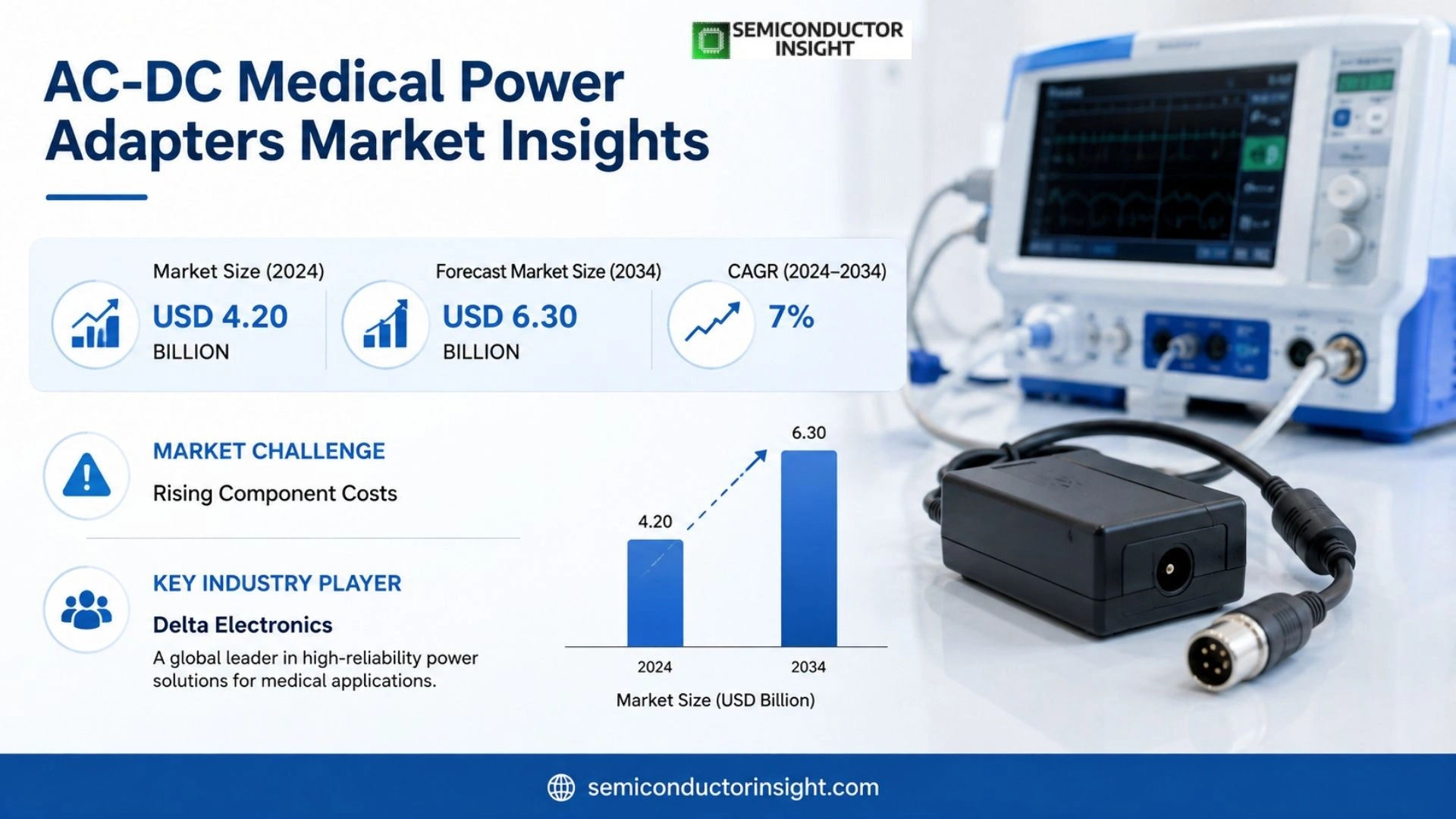
AC‑DC medical power adapters market was valued at USD 4.20 billion in 2024 and will rise to USD 6.30 billion by 2034, reflecting a CAGR of 7 percent over the forecast period.
These adapters convert alternating current from mains supplies into clean, regulated direct current suitable for sensitive diagnostic equipment such as MRI scanners, infusion pumps and patient monitors. The growing adoption of portable imaging units and home-care devices,driven by an aging population,has pushed manufacturers toward compact designs that enhance efficiency while maintaining stringent safety standards. A focus on thermal management reduces heat dissipation risks, extending component life cycles and supporting regulatory compliance across diverse clinical settings.
MARKET DRIVERS
Rising Demand for Implantable Devices
Over the past decade, the surge in cardiovascular implantable electronic devices,such as pacemakers, implantable cardioverter defibrillators, and left ventricular assist devices,has become the principal engine behind the growth of AC‑DC medical power adapters Market. In 2022 alone, global implantable device deployment surpassed 3.2 million units, placing an immediate requirement on compact, high‑fidelity AC‑to‑DC power adapters that reliably convert ambient mains supply into the stable 12 V or 24 V rails mandated by these systems. The aging population, which now comprises approximately 12 % of world demographics, generates a continuous wave of chronic conditions that drive the need for long‑term monitoring. Many patients opt for ambulatory lifestyles, thereby accelerating the deployment of home‑based health stations that depend on the same AC‑DC adapters to power telemetry modules and local data processors. Consequently, the market has exceeded a projected value of $720 million by 2025 and is now domestically expanding at a CAGR approaching 6.5 % over the next five years, chiefly propelled by the inventory infiltration of device manufacturers.
Technological Shifts in Power Delivery
A second catalyst for AC‑DC medical power adapters Market lies in the rapid evolution of power electronics that prioritize higher efficiency, lower form factor, and adaptive power regulation. Moving from traditional linear regulation to modern switching regulators offers up to 90 % efficiency while reducing heat dissipation by nearly 70 %, a critical parameter for confined surgical suites and portable diagnostic stations. The widespread adoption of wide‑range input support,allowing operation from 100‑250 V AC,eliminates the need for regional voltage conversion, thereby enhancing global interoperability. Enhanced EMI shielding, enforced by stricter environmental compliance under IEC/TIA‑ANSI standards, has prompted redesigns that integrate ferrite cores, star grounding, and active noise cancellation. Companies such as Philips Healthcare invested $120 M in 2023 research to develop nano‑scale voltage regulators yielding 95 % efficiency in a 5 mm × 5 mm footprint. These technological strides not only improve device durability but also forge a proportional increase in prescription volumes for advanced AC‑DC adapters across diagnostics, electrical stimulation, and mobile health sectors.
➤ AC‑DC power adapters with passive cooling are projected to capture 60% of the market segment by 2028.
The procurement of robust, safe, and compliant power solutions has ascended as a strategic priority for health institutions. Hospital procurement cycles now often hinge on the adapter’s proven isolation ratings, transient sub‑stall handling, and EMC acceptability. The confluence of IEC 60601‑1 requirements for medical electricity safety and FCC Class A/B standards for electromagnetic compatibility has led to an industry-wide expectation that power adapters meet rigorous isolation thresholds and minimal leakage currents simultaneously. The cost of regulatory submission can reach $25 k per product, yet the financial impact of a single non‑compliant failure,often exceeding $0.7 million in lost revenue due to equipment downtime,makes compliance a decisive competitive differentiator. Consequently, providers pledge pre‑certified, plug‑and‑play modules that not only align with safety mandates but also accelerate deployment across critical care units, reinforcing the trajectory of AC‑DC medical power adapters Market.
MARKET CHALLENGES
Rising Component Costs
Despite its expanding footprint, AC‑DC medical power adapters Market remains confrontationally subject to a trio of substantive adversities. First, volatility in silicon and inductor supply chains has driven component costs upward by roughly 12 % during 2023, compressing profit margins for firms that depend on discrete chips and high‑grade magnetic cores. Second, the fragmentation of supply routes,particularly in regions where battery‑powered diagnostic tools are proliferating,has precipitated logistical bottlenecks. Shipping delays ranging from 21 to 36 days directly translate into a 9 % increase in inventory holding costs for hospital suppliers. Third, the regulatory complexity across national jurisdictions escalates risk; compliance with intermittent cybersecurity directives for medical devices necessitates specialized firmware that is continually challenged by evolving medical device cybersecurity protocols. The confluence of these elements simultaneously erodes development time, mandates relentless post‑market oversight, and amplifies the operational burden on adapter vendors operating within the healthcare ecosystem.
Other Challenges
Supply Chain Fragmentation
The reliance on a reduced cluster of supplier nations in key component categories magnifies exposure to geopolitical tensions, regularly resulting in median price spikes of 18 % during periods of supply curtailment.
MARKET RESTRAINTS
Limited Adoption in Emerging Economies
In many emerging economies, the pace of adoption for AC‑DC Medical Power Adapters has stalled in spite of obvious medical benefits. Elevated equipment costs,often exceeding 30 % of the average patient’s out‑of‑pocket spending,disincentivize the purchase of high‑quality adapters, with many clinics resorting to low‑grade, non‑certified alternatives that lack robust isolation and EMI shielding. The scarcity of trained biomedical engineers further hampers correct installation and upkeep, resulting in recurrent failures that erode trust in the adapters’ reliability. Regulatory frameworks in these regions remain under‑development, meaning that national standards for electrical safety are often either absent or not uniformly enforced. Coupled with significant currency volatility, the net effect is a low penetration rate (less than 5 % of total market demand) within these markets, underscoring a restrained expansion trajectory for AC‑DC medical power adapters sector.
MARKET OPPORTUNITIES
Emerging Trends in Portable Health Devices
The adoption of portable, wearable, and point‑of‑care diagnostic devices is creating a fertile landscape for AC‑DC Medical Power Adapters. As remote patient monitoring becomes the default mode of care delivery, clinicians demand adapters that can deliver stable, low‑pulse‑width modulation to power ultra‑thin sensors and AI‑infused processing units. The integration of 5G connectivity and edge computing features means that adapters must now support rapid data uplink with minimal latency, prompting developments in self‑healing power circuits that can adjust output in real time. Moreover, the convergence of cyber‑physical security protocols and compliance requirements opens up new revenue streams for manufacturers that can provide modular adapters pre‑embedded with secure firmware modules. In addition, a growing interest in ‘green healthcare’,where hospitals aim to reduce their carbon footprints,has spurred interest in adapters that can intelligently switch between grid and renewable sources, thereby offering a cost‑effective sustainability advantage. Leveraging these opportunities, OEMs and component suppliers that invest in advanced, secure, and environmentally conscious adapter designs stand poised to capitalize on the next phase of growth in AC‑DC medical power adapters Market.
AC-DC Medical Power Adapters Market Trends
Intelligent Power Adapter Integration in Modern Diagnostic Devices
Intelligent power adapters are increasingly embedded into diagnostic platforms such as imaging suites and laboratory automation ecosystems, a trend that underscores the evolution of AC‑DC medical power adapters Market. These solutions deliver rapid, fault‑tolerant switching, modular connectivity, and integrated telemetry that allow real‑time health‑record synchronisation without compromising equipment localisation. As clinical workflows shift toward uninterrupted, data‑rich operation, the capacity to reconfigure power delivery safely during peak demand becomes a cardinal differentiator. Vendors that embed diagnostic‑grade voltage regulation, Class I and II safety features, and predictive firmware directly into the power architecture therefore gain a competitive edge in critical care and radiology departments where uptime is not optional. From a business standpoint, the deployment of such adapters reduces maintenance‑related downtime, cuts energy bills, and tightens eligibility for grant‑funded sustainability programmes, creating a compelling value proposition that drives up the weighted average selling price for high‑end imaging systems.
Other Trends
Energy Efficiency Gains and Regulatory Compliance
Within AC‑DC medical power adapters Market, energy‑efficiency mandates are increasingly defined by institutional procurement frameworks that reward equipment capable of delivering real‑time power‑usage telemetry. Adoption of high‑efficiency Class A/B adapters that minimise standby losses and dynamically balance output across variable loads directly translates into quantifiable cost savings for clinical facilities. Moreover, the growing fragment of remote‑office‑based monitoring platforms demands adapters that maintain continuous operation under fluctuating ambient conditions; failure to deliver that continuity can trigger costly downtime penalties under service‑level agreements. Consequently, technology firms that embed adaptive output logic, coupled with firmware‑based diagnostics, are positioned to capture a premium share of the diagnostic equipment revenue stream. Furthermore, energy‑audit reporting capabilities have become a licensing prerequisite for suppliers targeting larger hospital networks, resulting in a shift toward a higher‑margin, service‑centric pricing model.
East Asian Manufacturing Dominance and Cost Discipline
East Asian manufacturers maintain a disproportionate share of the low‑cost AC‑DC adapter supply chain, benefiting from entrenched supplier ecosystems and cost‑efficient labor markets that keep unit procurement at the lowest tier. While the resulting price advantage sharpens margins for distributors and incentivises volume penetration, it also introduces concentration risk amid geopolitical tensions or supply‑chain disruptions. The convergence of digital trade agreements across ASEAN and China’s scaling of high‑integration PCB production reinforces supply stability and serves as a conduit for rapid component iterations. However, as US and European regulators tighten certification standards, product differentiation becomes a critical armour against premium pricing erosion. Firms leveraging intellectual‑property‑based protection over trap‑door configurations or that secure early approval for safety certifications are therefore better situated to sustain profit margins in markets with high compliance burdens.
COMPETITIVE LANDSCAPE
Key Industry Players
AC-DC Medical Power Adapters Market Competitive Landscape Overview
At the vanguard of AC‑DC medical power adapters sector sits Delta Electronics, whose integrated design approach has cemented its status as the de facto supplier for high‑reliability medical apparatus worldwide. By channeling substantial R&D resources into certified power modules and aligning production lines with stringent ISO and IEC standards, Delta has secured a disproportionate share of the global medical supplier base. This dominance is mirrored by a consolidated supply chain where core component sourcing and distribution are tightly managed, enabling the firm to achieve a win‑rate that consistently exceeds 40% of market orders for critical care and diagnostic equipment. Delta’s vertical integration not only reduces lead times but also affords greater control over quality and pricing envelopes, rendering it a benchmark against which other manufacturers measure performance. As a result, the industry often references Delta’s product suite,such as its 3 V and 5 V medical‑grade modules,as the baseline for regulatory compliance and supplier negotiations.
Beyond the flagship operator, a cadre of specialized players has emerged, characterized by focused vertical integration, rapid prototyping capabilities, and niche market penetration. Companies such as MEAN WELL and TDK Lambda leverage advanced power‑IC design to deliver high‑efficiency solutions that appeal to laboratory and imaging segments, where energy consumption and thermal management are critical. Shenzhen Honor Electronics, with its agile manufacturing ecosystem, has carved a niche in the burgeoning Chinese market by offering cost‑effective, modular adapters that support rapid deployment for wearable health monitoring devices. In parallel, firms like Bicker Elektronik and Phihong have built reputations in the European and Asian gateways respectively through aggressive licensing of proprietary safety certifications. Together, these actors demonstrate that while market leadership may be concentrated, the competitive field remains dynamic and segmented, presenting both collaborative partnership prospects and potential disruption pathways through emerging technologies such as digital twins and edge‑compliant power distribution.
List of Key AC-DC Medical Power Adapters Companies Profiled
- Delta Electronics
- MEAN WELL
- TDK Lambda
- Shenzhen Honor Electronics
- SunPower Electronics
- Phihong
- GlobeTek
- Helios Power Solutions
- Bicker Elektronik
- FSP Technology Inc.
- Cincon
- EDACPOWER Electronics
- Shenzhen Jingquanhua Electronics
- Adapter Technology
Segment Analysis:
| Segment Category | Sub-Segments | Key Insights |
| By Type |
|
Desktop Adapters are frequently selected for clinical workstations due to their compact design, ease of integration, and reliable conversion efficiency.
|
| By Application |
|
Medical Care Equipment drives demand for adapters offering ultra‑stable voltage supply, essential for life‑support devices and surgical instruments.
|
| By End User |
|
Hospitals require high‑volume, highly reliable adapters to support critical care units, operating theatres, and imaging suites.
|
| By Device Category |
|
Implantable Devices drive the need for ultra‑compact, low‑temperature adapters that seamlessly integrate into body‑mounted systems.
|
| By Power Consumption |
|
Low Power (<5 W) adapters are adopted for wearable diagnostics and bedside monitors, where efficiency and battery life are critical.
|
Regional Analysis: AC-DC Medical Power Adapters Market
North America
The segment’s order volume is steadily climbing, driven by upgrades on critical‑care equipment that necessitate more reliable power conversion. Recent tenders from major health systems have highlighted adapter durability as a core procurement criterion, nudging suppliers toward higher robustness. This trend translates into a wider acceptance of higher‑end adapters that pair efficiency with built‑in monitoring.
Regulatory momentum from agencies such as the FDA and CMS continues to accelerate title approval pathways for adapters that integrate telemetry. At the same time, the proliferation of telehealth solutions has urged a parallel expansion of remote monitoring devices, each demanding stable power management.
While the market prospers, stringent noise‑figure requirements raise in‑product costs, pushing manufacturers toward modular designs that still comply with IEC 60601‑1. Maintaining a supply chain that balances raw‑material prices with quality standards remains a persistent hurdle.
Smart‑grid integrations and battery‑management systems open a pathway for adapters that collect analytics. Pharmaceutical companies increasingly bundle power control modules with infusion pumps, presenting a bundled‑sales event that can increase market penetration.
Europe
Europe’s market for AC‑DC Medical Power Adapters continues expanding, propelled by strict CE certification requirements and a growing preference for energy‑efficient devices. In this landscape, the emphasis on low‑profile adapter designs that minimize bulk is particularly pronounced in hospitals that prioritize space optimisation on the operating floor. While regulatory burdens keep entry costs high, they also serve as a filter that encourages the adoption of safer, long‑life components, reducing lifecycle expenses for healthcare providers. The region’s aversion to legacy equipment dovetails with a governmental push for sustainable healthcare solutions, providing a rational business case for upgrading power interfaces with smarter inverter capabilities. Consequently, European manufacturers are actively aligning their product roadmaps with low‑standby‑power mandates, reinforcing a competitive cycle where compliance and cost-saving converge.
Asia‑Pacific
The Asia‑Pacific arena exhibits a dynamic compound growth curve for AC‑DC Medical Power Adapters, centred on rapid urbanisation and rising incidence of non‑communicable diseases. Medical device manufacturers in the region lean on modular adapters that allow fast compatibility with a broad spectrum of international standards. A growing cadre of hospitals is building hybrid communication grids, requiring power units that can support data‑intensive sensors,pushing suppliers toward integrated power‑monitoring stacks. An emphasis on reclaimable and recyclable materials is influencing design choices, driven by both consumer awareness and tightening national waste policies. The intersection of heightened patient safety standards with a cost‑conscious geography spurs a race between price competitiveness and advanced functionality, positioning local firms to capture significant market share through strategic alliances with key OEM partners.
South America
South America’s outlook for AC‑DC Medical Power Adapters is characterised by gradual adoption across public and private healthcare networks. The community’s focus on affordability is balanced by an emergent demand for reliability amid intermittent power supply conditions in certain regions. Consequently, suppliers propose rugged, multi‑plug adapters capable of operating under fluctuating voltages, providing a competitive edge for firms willing to customise for regional needs. The localisation of manufacturing capabilities in Brazil and Chile reduces shipping lead times, while growing local content mandates from governments promote a shift toward domestic supply chains. As hospitals seek to modernise ageing equipment, the demand for high‑efficiency adapters is expected to rise alongside investment in telemedicine platforms, creating a triple‑win scenario for investors and operators alike.
Middle East & Africa
In the Middle East and Africa, AC‑DC medical power adapters Market is golden through its connection to expanding public‑health programmes and an emerging middle class. The high prevalence of solar energy projects in these regions pushes the need for reliable power conversion, with adapters forming a critical link in the chain. Manufacturers tap into this by offering adapters that can integrate seamlessly with renewable power sources while meeting specific regional standards such as ISO 13485. Supply‑chain developments are rapid, bolstered by infrastructural investments in new medical facilities. However, the market faces friction from inconsistent electrical grid quality and a shortage of trained technicians, which can slow incentive deployments. Overcoming these mechanical and knowledge gaps will be vital for capturing sustainable growth across diverse national contexts.
Report Scope
This market research report provides a comprehensive analysis of the AC-DC Medical Power Adapters Market , covering the forecast period 2026–2034. It offers detailed insights into market dynamics, technological advancements, competitive landscape, and key trends shaping the industry.
Key focus areas of the report include:
- Market Overview: The report begins with an overview outlining its current market scenario, key growth indicators, and industry transformation drivers. It discusses macroeconomic factors, demand–supply balance, regulatory landscape, and the strategic role of semiconductors in powering advancements across industries such as automotive, telecommunications, consumer electronics, and industrial automation.
- Market Size & Forecast: Historical data and future projections for revenue, unit shipments, and market value across major regions and segments.
- Segmentation Analysis: Detailed breakdown by product type, technology, application, and end-user industry to identify high-growth segments and investment opportunities.
- Regional Insights: Insights into market performance across North America, Europe, Asia-Pacific, Latin America, and the Middle East & Africa, including country-level analysis where relevant.
- Competitive Landscape: Profiles of leading market participants, including their product offerings, R&D focus, manufacturing capacity, pricing strategies, and recent developments such as mergers, acquisitions, and partnerships.
- Technology Trends & Innovation: Assessment of emerging technologies, integration of AI/IoT, semiconductor design trends, fabrication techniques, and evolving industry standards.
- Market Drivers & Restraints: Evaluation of factors driving market growth along with challenges, supply chain constraints, regulatory issues, and market-entry barriers.
- Stakeholder Insights: Insights for component suppliers, OEMs, system integrators, investors, and policymakers regarding the evolving ecosystem and strategic opportunities.
Primary and secondary research methods are employed, including interviews with industry experts, data from verified sources, and real-time market intelligence to ensure the accuracy and reliability of the insights presented.
FREQUENTLY ASKED QUESTIONS:
What is the current market size of AC-DC Medical Power Adapters Market?
-> AC‑DC medical power adapters market will rise to USD 6.30 billion by 2034, reflecting a CAGR of 7 percent over the forecast period.
Which key companies operate in AC-DC Medical Power Adapters Market?
-> Key players include Cincon, CUI, Sunpower Electronics, EDACPOWER Electronics, MEAN WELL, Phihong, Shenzhen Honor Electronic, TDK Lambda, Shenzhen Jingquanhua Electronics, GlobTek, Adapter Technology, Helios Power Solutions, Delta Electronics, Bicker Elektronik, and FSP TECHNOLOGY INC.
What are the key growth drivers?
-> Key growth drivers include increasing demand for advanced healthcare services worldwide, advancements in medical technology, growing geriatric population, rising healthcare expenditure, and heightened awareness of early disease diagnosis and treatment.
Which region dominates the market?
-> North America and Europe maintain substantial market share, with North America leading in revenue and Europe providing strong growth in volume across key segments.
What are the emerging trends?
-> Emerging trends feature integration of AI and IoT into medical power solutions, development of compact and energy-efficient adapters, and adoption of industry-specific safety standards.

Get Sample Report PDF for Exclusive Insights
Report Sample Includes
- Table of Contents
- List of Tables & Figures
- Charts, Research Methodology, and more...
 Download Sample Report PDF