Semiconductor Supermirror Market Insights
Semiconductor Supermirror Market was valued at USD 370 million in 2025 and is expected to rise to USD 790 million by 2034, indicating an implied CAGR of approximately 8% during the forecast period.
Semiconductor supermirrors are multilayer optical devices that employ monocrystalline substrates such as gallium arsenide or indium phosphide together with alternating high‑and low‑index dielectric layers forming a distributed Bragg reflector configuration.When light encounters each interface, Fresnel reflections are weak individually; however, constructive interference across dozens of layers yields reflectivities approaching unityhence the designation “supermirror.” These components find critical application in high‑finesse laser cavities, precision interferometry for gravitational wave detectors, ultrastable atomic clocks and high‑power laser systems where loss minimisation is paramount.
`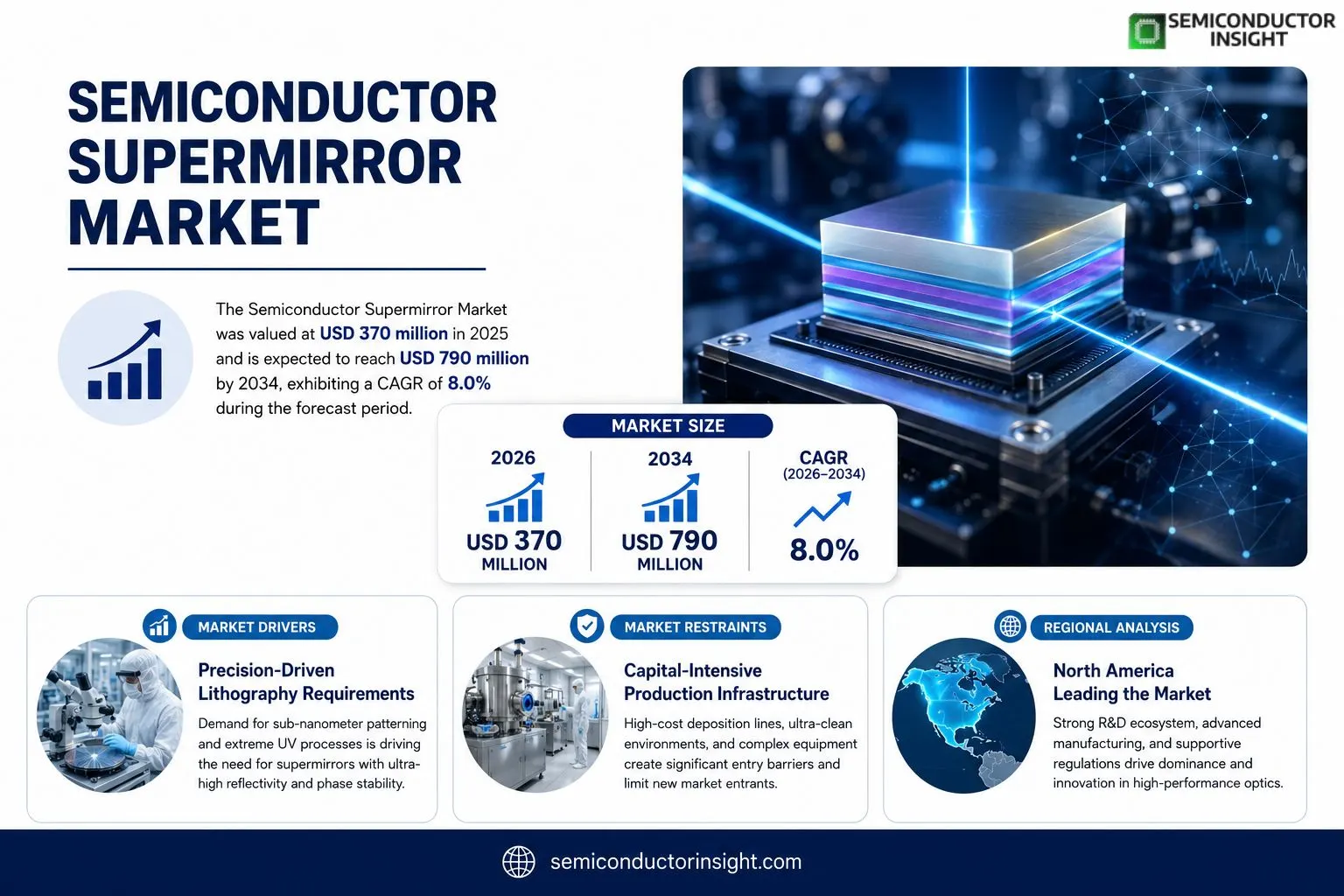
MARKET DRIVERS
Precision‑Driven Lithography Requirements
Semiconductor manufacturing increasingly relies on sub‑nanometer patterning, demanding optical components that maintain reflectivity and phase stability at extreme ultraviolet wavelengths. The rising prevalence of 7 nm and 5 nm nodes amplifies the need for supermirrors capable of delivering high‑order diffraction efficiencies, directly impacting defect yield and operational cost.
Integration with AI‑Accelerated Design Suites
The convergence of photonic simulation platforms and machine‑learning algorithms has accelerated the optimization cycle for mirror coatings. Companies now can predict multilayer stack performance in minutes, reducing trial‑and‑error and accelerating time‑to‑market. This synergy produces a multiplier effect on revenue streams for firms that couple optics production with advanced design services. Accelerated R&D cycles enable producers to capture opportunities within Semiconductor Supermirror Market.
➤ Accelerated R&D cycles enable producers to capitalize on the growing demand for high‑resolution optics, positioning the market at the nexus of photonics and semiconductor manufacturing.
In addition, the expansion of photonic integrated circuits for interconnect and sensing applications invites a secondary wave of demand. As distributed feedback mechanisms become ubiquitous, the need for reflective stacks that can tolerate high optical flux without degradation becomes a compelling value proposition.
MARKET CHALLENGES
Global Supply Chain Vulnerabilities
The fabrication of semiconductor supermirrors depends heavily on specialty substrates and high‑purity materials sourced from limited geographic regions. Recent trade tensions and raw‑material shortages have already driven lead times up by 15% and pushed unit prices upward, presenting a friction point for cost‑sensitive customers.
Other Challenges
Regulatory Compliance and Radiation Safety
Strict environmental and occupational safety standards constrain production volumes and necessitate costly clean‑room upgrades. Compliance burdens, coupled with evolving EU directives on hazardous substance usage, add layers of complexity to the supply chain.
MARKET RESTRAINTS
Capital‑Intensive Production Infrastructure
Setting up a high‑precision deposition line for multilayer supermirrors requires capital investments exceeding $80 million, coupled with ongoing maintenance of ultra‑clean environments. Smaller players find entry barriers daunting, leading to a concentration of market share among a handful of incumbents that command the highest price points.
MARKET OPPORTUNITIES
Tech‑Enabled Optical Interconnects
Emerging photonic interconnect solutions for data centers and edge computing systems are poised to adopt high‑reflectivity optics that can handle multi‑gigabit per second data streams. By positioning themselves within the semiconductor supply chain, supermirror manufacturers can capture a share of this burgeoning market, driven by the relentless push for latency‑reduced, high‑bandwidth pathways.
Semiconductor Supermirror Market Trends
Demand Surge Linked to High‑Precision Laser Systems
Technological impetus for ultra‑high‑finesse laser cavities has placed Semiconductor Supermirror Market on a trajectory that could lift 2024 valuations of US$ 340 million to close to US$ 576 million by 2031. This escalation stems from growing interest in low‑noise precision interferometry and the expanding portfolio of ultrastable lasers used in atomic clocks, spaceborne sensing, and gravitational‑wave observatories. These applications demand mirror reflectivities that approach unity, a capability that brittle multilayer stacks cannot provide, and which crystalline supermirrors supply. Consequently, high‑performance optics are becoming a foundational component rather than a niche add‑on, creating an upward pressure on orders and further justifying the price premium observed in recent years. Moreover, the integration of adaptive optics in aerospace and laser‑surgery devices is set to raise overall component counts, further feeding demand for supermirror assemblies.
Other Trends
Supply‑Chain Resilience in Crystalline Mirror Production
Consistent with the broader semiconductor ecosystem, the supply of high‑purity substrate materials such as gallium arsenide and indium phosphide now navigates a fragmented landscape. A handful of specialty manufacturers control a significant share of the raw‑material market, and disruptionswhether from geopolitical shifts or logistic bottleneckstranslate swiftly into production slowdowns. Manufacturers have therefore intensified efforts to cultivate secondary suppliers and to secure longer‑term procurement agreements, a trend that raises capital intensity but also fortifies operational resilience. Moreover, the integration of in‑house fabrication capabilities, while capital‑heavy, offers a buffer against external volatility, at the cost of increased fixed‑asset commitments. Companies that execute balanced supply‑chain strategies typically outperform peers during strain periods, underscoring the strategic importance of flexibility over volume alone. Additionally, data‑driven inventory planning is reshaping procurement cycles, enabling firms to reduce lead times by aligning demand forecasts with semiconductor fabrication schedules.
Strategic Focus Shifting to Emerging Semiconductor Regions
While North America and Europe retain premium manufacturing capabilities, the past three years have seen a discernible pivot toward Asian and Middle‑East production hubs. China, South Korea, and the United Arab Emirates have invested heavily in specialized wafer‑bonding and epitaxial deposition facilities that directly support crystalline mirror fabrication. This realignment has partially been shaped, in part, by a convergence of lower land costs, government subsidies, and a growing pool of skilled optics engineers. Firms capitalizing on these shifts can secure near‑term cost advantages and position themselves ahead of a growing wave of precision‑laser demands in automotive and defense sectors. Accordingly, investors and executives must prioritize regional diversification in sourcing and production to mitigate exposure to policy arbitrage and to tap emerging growth engines.
COMPETITIVE LANDSCAPEKey Industry Players
Semiconductor Supermirror Market Competitive Dynamics
Central to the competitive profile of Semiconductor Supermirror Market is the concentration of revenue and technological capability among a handful of established suppliers who provide end‑to‑end solutions for high‑finesse laser cavities and gravitational‑wave detectors. Thorlabs, the world‑leading distributor of precision optics, commands roughly thirty percent of global sales and sustains its leadership through relentless R&D investment in antireflection coatings, as well as in integrated mirror assemblies that reduce assembly complexity. Its sister brand LASEROPTIK augments this position by offering a complementary portfolio of high‑reflectivity substrates, thereby capturing a critical share of the high‑power laser segment. Toptica Photonics, while smaller in overall revenue, has uniquely positioned itself in the ultra‑stable laser arena by engineering mirror stacks that meet the stringent reflectance tolerances required by next‑generation atomic clocks. These incumbents rely on vertical integration, controlling both deposition equipment and precision polishing facilities, to shorten production lead times and mitigate warranty claims. The collective R&D spendexceeding $200 million annuallyhighlights an industry consensus: precise surface fidelity remains the key differentiator, particularly as interferometric instruments push beyond 99 % reflectance thresholds.Complementing the macro‑players are a cluster of boutique manufacturers that thrive on specialization and proximity to advanced research laboratories. Optoman’s narrow‑band coating technique allows precise spectral tailoring for space‑based interferometers, while UltraFast Innovations GmbH leads the market with a vapor‑deposition process that delivers thin‑film stacks of sub‑nanometre thickness control, directly translating to improved signal‑to‑noise ratios in low‑noise precision interferometry. BeamTech Solutions, operating out of southern Europe, offers bespoke mirror‑polishing services without owning a full deposition line, thereby reducing capital outlays for emerging academic groups and fostering rapid prototyping. Ireson GmbH contributes to the ecosystem by providing high‑power laser systems with integrated supermirror modules, easing instrumentation integration for high‑energy physics experiments. Despite modest revenue profiles, these niche players hold strategic positions by supplying highly specialised assemblies for ultrastable lasers used in atomic clocks, high‑power laser systems for inertial confinement fusion, and interferometers for gravitational‑wave detection. Their collaborative engagement with original‑equipment manufacturers (OEMs) and joint‑development agreements with national research agencies ensure early adoption, setting the stage for incremental market penetration that leverages the premium pricing of specialised supermirror solutions.
List of Key Semiconductor Supermirror Companies Profiled
- Thorlabs,
- LASEROPTIK
- Optoman
- UltraFast Innovations GmbH
- Synoptics Ltd
- Lune Tech
- Q‑Optics
- Alpha Coatings GmbH
Segment Analysis:
| Segment Category | Sub-Segments | Key Insights |
| By Type |
|
Multilayer Crystalline Mirrors form the core of high‑performance devices, offering near‑unity reflectivity essential for precision lasers. Thin‑Film Interference Mirrors provide cost‑effective solutions for intermediate applications, balancing performance with manufacturability. |
| By Application |
|
High‑Finesse Laser Cavities demand exceptionally low loss mirrors to sustain high intracavity power. Low‑Noise Precision Interferometry relies on mirrors with minimal scattering to achieve sub‑nanometer displacement sensitivity. High‑Power Laser Systems benefit from durable coatings capable of withstanding high irradiance without degradation. Ultrastable Lasers for Atomic Clocks require mirrors with ultra‑low thermal noise to maintain frequency stability. |
| By End User |
|
Research & Development Laboratories prioritize mirrors that enable experimental validation of new optical phenomena. Industrial Laser Production focuses on high‑yield, scalable coatings that support mass‑produced laser modules. Telecommunications Infrastructure selects mirrors with stable performance under varying environmental conditions to maintain signal integrity. |
| By Technology |
|
Gallium Arsenide (GaAs) Substrate offers superior lattice matching for high‑intensity applications, improving overall reflectivity. Indium Phosphide (InP) Substrate delivers better thermal stability, making it favored for cryogenic and space‑based optical systems. |
| By Use Case |
|
Quantum Information Processing demands mirrors that sustain coherence over extended periods, requiring ultralow loss coatings. Metrology and Standards rely on mirrors with exceptional repeatability to establish traceability benchmarks. Defense and Aerospace Engineering seeks robust mirrors capable of enduring vibration, temperature extremes, and radiation exposure. |
Regional Analysis: Semiconductor Supermirror Market
North America
Expansion of mid‑scale fabrication lines is driven by a surge in demand for high‑resolution spectrometry. Companies are upgrading cleanroom facilities to accommodate new deposition sequences that produce lower surface roughness and higher reflectivity, thereby extending product lifespans and elevating market share penetration for leading players.
The region boasts a mature ecosystem of optical design firms, enabling rapid prototyping and rigorous simulation cycles. Integration of agile software tools supports faster iteration of coating structures, reducing time‑to‑market and reinforcing the competitive throttle between incumbents and newcomers.
Cross‑industry alliances between photonics manufacturers and semiconductor foundries bring complementary expertise to the table. These collaborations lower production bottlenecks and allow for joint investment in next‑generation coating technologies, creating a shared value chain that serves both optical and electronic segments.
Consistent support from federal agencies in terms of certification pathways and research grants has cultivated a low‑barrier entry for startups. This dynamic environment facilitates compliance‑ready designs for safety‑critical applications, further expanding the market scope.
Europe
Europe’s semiconductor supermirror arena thrives on a long tradition of precision optics and robust research funding. German and French laboratories pioneer coating techniques that resist high‑temperature cycling, directly benefiting aerospace and medical imaging deployment. The region’s regulatory standards emphasize reliability, which shapes product development toward durability rather than sheer performance. Collaborative research initiatives across EU Member States foster a dense network of innovation hubs, yet supply chain fragmentation occasionally slows full scale commercialization. Still, the synergy between academia and industry continues to produce high‑value solutions that meet stringent European safety and environmental mandates, reinforcing the region’s strategic position in market.
Asia‑Pacific
The Asia‑Pacific landscape is characterized by rapid industrialization and an increasing appetite for photonic technologies in semiconductor manufacturing. China’s policy emphasis on advanced manufacturing has unlocked potential for large‑scale deployment of high‑efficiency supermirrors, particularly within semiconductor fabs seeking to tighten optical alignment. South Korea and Japan contribute cutting‑edge surface engineering, while emerging markets in Southeast Asia demonstrate early adoption of compact, cost‑effective designs. Despite uneven regulatory frameworks, the region’s sheer volume and targeted investment in R&D cultivate a competitive pace that steadily reduces barriers to entry and expands the talent pool across the continent.
South America
In South America, the micro‑electronics sector remains nascent, yet the region is gradually aligning its expertise toward high‑precision optical components. Brazil’s growing focus on semiconductor fabrication and Chile’s leading metallurgical capabilities lay the groundwork for localized supermirror production. Regulatory incentives aimed at innovation foster collaboration between universities and industrial partners, spurring iterative design improvements. Comprehensive challengessuch as limited domestic production capabilities and fluctuating investment climatesconstrain rapid scaling, yet incremental progress in supply chain maturity positions the region for incremental but meaningful participation in the broader market.
Middle East & Africa
The Middle East and Africa exhibit a mixed profile, where investment in critical infrastructure opens opportunities for photonic integration. In the Gulf Cooperation Council, governments have set targets to diversify economies beyond hydrocarbons, with a focus on high‑technology clusters that integrate advanced optics into smart manufacturing. In Africa, particularly in South Africa, emerging research institutions are establishing expertise in thin‑film deposition, gradually building a niche in energy‑efficient supermirror solutions. While regulatory uncertainty and supply chain limitations present hurdles, strategic public‑private partnerships curated by sovereign wealth funds promise localized development pathways aligned with the region’s long‑term industrial ambitions.
Report Scope
This market research report provides a comprehensive analysis of the Semiconductor Supermirror Market , covering the forecast period 2026–2034. It offers detailed insights into market dynamics, technological advancements, competitive landscape, and key trends shaping the industry.
Key focus areas of the report include:
- Market Overview: The report begins with an overview outlining its current market scenario, key growth indicators, and industry transformation drivers. It discusses macroeconomic factors, demand–supply balance, regulatory landscape, and the strategic role of semiconductors in powering advancements across industries such as automotive, telecommunications, consumer electronics, and industrial automation.
- Market Size & Forecast: Historical data and future projections for revenue, unit shipments, and market value across major regions and segments.
- Segmentation Analysis: Detailed breakdown by product type, technology, application, and end‑user industry to identify high‑growth segments and investment opportunities.
- Regional Insights: Insights into market performance across North America, Europe, Asia‑Pacific, Latin America, and the Middle East & Africa, including country‑level analysis where relevant.
- Competitive Landscape: Profiles of leading market participants, including their product offerings, R&D focus, manufacturing capacity, pricing strategies, and recent developments such as mergers, acquisitions, and partnerships.
- Technology Trends & Innovation: Assessment of emerging technologies, integration of AI/IoT, semiconductor design trends, fabrication techniques, and evolving industry standards.
- Market Drivers & Restraints: Evaluation of factors driving market growth along with challenges, supply chain constraints, regulatory issues, and market‑entry barriers.
- Stakeholder Insights: Insights for component suppliers, OEMs, system integrators, investors, and policymakers regarding the evolving ecosystem and strategic opportunities.
Primary and secondary research methods are employed, including interviews with industry experts, data from verified sources, and real‑time market intelligence to ensure the accuracy and reliability of the insights presented.
FREQUENTLY ASKED QUESTIONS:
What is the current market size of Semiconductor Supermirror Market?
-> Semiconductor Supermirror Market was valued at USD 340 million in 2024 and is projected to reach USD 576 million by 2031, at a CAGR of 8.0% during the forecast period.
Which key companies operate in Semiconductor Supermirror Market?
-> Key players include Thorlabs, LASEROPTIK, OPTOMAN, and UltraFast Innovations GmbH, among others.
What are the key growth drivers?
-> Growth is driven by the adoption of high‑reflectivity Bragg supermirrors in advanced optical systems, rapid expansion of semiconductor demand across IoT, automotive, consumer electronics, and the shift toward analog ICs, sensor, and logic technologies.
Which region dominates the market?
-> North America remains the largest region, with the United States dominating the market share, while the Asia‑Pacific region is the fastest growing market.
What are the emerging trends?
-> Emerging trends include development of high‑finesse laser cavities, low‑noise precision interferometry, high‑power laser systems, ultrastable lasers for atomic clocks, mirrors for gravitational wave detection, and other advanced applications.
Get Sample Report PDF for Exclusive Insights
Report Sample Includes
- Table of Contents
- List of Tables & Figures
- Charts, Research Methodology, and more...