MARKET INSIGHTS
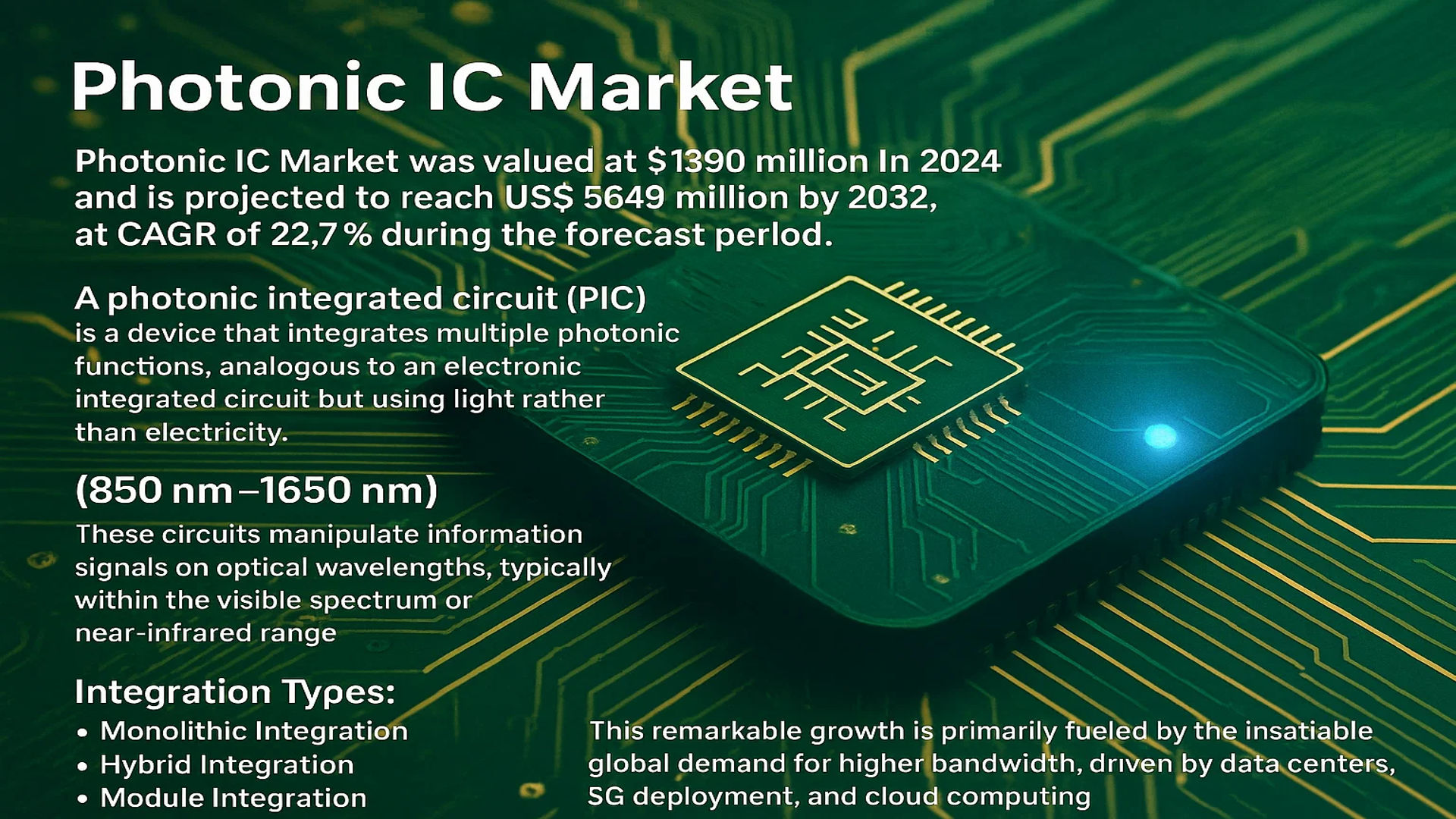
The global Photonic IC Market was valued at 1390 million in 2024 and is projected to reach US$ 5649 million by 2032, at a CAGR of 22.7% during the forecast period.
A photonic integrated circuit (PIC) is a device that integrates multiple photonic functions, analogous to an electronic integrated circuit but using light rather than electricity. These circuits manipulate information signals on optical wavelengths, typically within the visible spectrum or near-infrared range (850 nm-1650 nm), enabling high-speed data transmission and processing. The technology encompasses various integration types, including Monolithic Integration, Hybrid Integration, and Module Integration.
This remarkable growth is primarily fueled by the insatiable global demand for higher bandwidth, driven by data centers, 5G deployment, and cloud computing. Furthermore, advancements in sensing applications, particularly in LiDAR for autonomous vehicles and biomedical diagnostics, are creating significant new opportunities. The market is highly consolidated, with key players such as Intel, Infinera, and Cisco collectively holding a dominant share of approximately 93%. Recent strategic developments, including Intel’s continued investment in its silicon photonics foundry platform, underscore the intense R&D focus aimed at reducing costs and improving performance to unlock next-generation applications.
MARKET DYNAMICS
MARKET DRIVERS
Exponential Growth in Data Traffic to Drive Photonic IC Adoption
The global surge in data consumption, fueled by high-bandwidth applications like video streaming, cloud computing, and 5G networks, is a primary catalyst for the photonic IC market. Traditional electronic integrated circuits are reaching their physical limits in handling this massive data flow efficiently. Photonic ICs, which use light instead of electricity to transmit data, offer significantly higher bandwidth, lower latency, and reduced power consumption. This makes them indispensable for next-generation data centers and telecommunications infrastructure. Investments in upgrading global network infrastructure to support the increasing demand are substantial, directly propelling the need for advanced photonic solutions. The transition towards more connected devices and IoT ecosystems further amplifies this demand, creating a robust growth trajectory for the market.
Advancements in Silicon Photonics to Accelerate Market Expansion
Technological breakthroughs in silicon photonics are significantly lowering the cost and complexity of manufacturing photonic ICs, making them more accessible for widespread commercial use. Silicon photonics leverages existing CMOS fabrication facilities, enabling high-volume production at a reduced cost per unit. This integration allows for the creation of compact, energy-efficient photonic devices that can be mass-produced. Recent developments have focused on improving yield rates and integrating more optical components onto a single chip, enhancing performance while driving down prices. These advancements are crucial for applications in high-performance computing and telecommunications, where efficiency and cost-effectiveness are paramount. The continuous innovation in material science and fabrication techniques is expected to further accelerate market penetration and adoption across various industries.
Rising Demand in Sensing and Medical Applications to Fuel Growth
Beyond communications, photonic ICs are gaining traction in sensing and biomedical applications, opening new revenue streams. In medical diagnostics, they enable highly sensitive lab-on-a-chip devices for rapid disease detection and monitoring. The global focus on healthcare innovation and early diagnosis is driving investment in these technologies. Similarly, in industrial settings, photonic sensors are used for precise environmental monitoring, structural health monitoring, and chemical detection, offering superior accuracy over traditional electronic sensors. The ability of photonic ICs to perform multiple functions on a single chip reduces the size and cost of these systems, making advanced sensing technology more deployable in various fields. This diversification of applications is a key factor in the market’s robust growth forecast.
MARKET CHALLENGES
High Initial Development and Fabrication Costs to Hinder Widespread Adoption
Despite the promising growth, the photonic IC market faces significant economic challenges. The initial research, development, and fabrication costs are substantially higher than those for traditional electronic ICs. Designing photonic circuits requires specialized software and expertise, and fabricating them demands advanced foundries with specific capabilities for handling optical materials. These factors contribute to a higher price point, which can be a barrier for cost-sensitive applications and smaller enterprises looking to integrate the technology. The need for significant capital investment before achieving economies of scale can slow down adoption rates, particularly in price-competitive markets.
Other Challenges
Packaging and Integration Complexities
The packaging of photonic ICs, which involves coupling optical fibers to the chip with extreme precision, presents a major technical hurdle. Achieving low-loss and stable optical connections is difficult and often requires manual alignment, which is not scalable for high-volume manufacturing. This complexity adds to the overall cost and can affect the reliability of the final product. Integrating photonic components with electronic circuits on the same package also introduces design and thermal management challenges that need to be overcome for optimal performance.
Standardization and Interoperability Issues
The lack of universal design standards and interoperability between products from different manufacturers can create fragmentation in the market. This makes it challenging for system integrators to mix and match components, potentially locking them into specific vendor ecosystems. Developing industry-wide standards is crucial for fostering a competitive market and ensuring seamless integration of photonic ICs into broader systems, but progress in this area has been slow.
MARKET RESTRAINTS
Technical Design Hurdles and Material Limitations to Constrain Market Growth
The performance of photonic ICs is highly dependent on the properties of the materials used, such as silicon, indium phosphide, and silicon nitride. Each material has inherent limitations; for example, silicon has a low electro-optic coefficient, making active components like modulators less efficient. Overcoming these material limitations often requires complex design workarounds or the use of more expensive compound semiconductors, which increases the cost and complexity. Designing for high yield and performance consistency across a wafer is another significant challenge that can restrain market growth by limiting the supply of high-quality components.
Shortage of Specialized Engineering Talent to Slow Innovation Pace
The field of integrated photonics is highly specialized, requiring a unique blend of skills in optics, semiconductor physics, and electronic engineering. There is a global shortage of engineers and researchers with this specific expertise, which can slow the pace of innovation and product development. Academic programs focusing on photonics are growing but have not yet produced a workforce large enough to meet industry demand. This talent gap makes it difficult for companies to scale their operations and delays the time-to-market for new products, acting as a significant restraint on the overall growth of the market.
MARKET OPPORTUNITIES
Emergence of Quantum Computing to Unlock New Frontiers for Photonic ICs
Quantum computing represents a revolutionary frontier where photonic ICs are poised to play a critical role. Photons are excellent carriers of quantum information (qubits) due to their low decoherence and ease of manipulation. Research institutions and technology companies are heavily investing in developing photonic-based quantum processors and networks. This emerging application requires extremely precise and stable photonic components, creating a high-value niche market for advanced PICs. The potential for photonic ICs to form the backbone of future quantum internet infrastructure presents a long-term, high-growth opportunity that could fundamentally reshape the market landscape.
Strategic Expansion into Automotive LiDAR and AI Hardware to Diversify Applications
The automotive industry’s rapid shift towards autonomous driving is fueling demand for sophisticated LiDAR systems. Photonic ICs are ideal for creating compact, reliable, and cost-effective solid-state LiDAR sensors that can be mass-produced for vehicles. Furthermore, the explosive growth of artificial intelligence and machine learning is driving the need for specialized hardware. Photonic neural networks and optical computing, which use PICs for ultra-fast, low-energy data processing, are emerging as a promising alternative to overcome the bottlenecks of electronic processors. These new application areas represent significant diversification opportunities beyond traditional telecommunications, promising substantial market expansion.
Increased Government and Private Sector Investments in Photonics Research to Spur Innovation
Recognizing the strategic importance of photonics, governments and private entities worldwide are increasing funding for research and development initiatives. These investments are aimed at overcoming existing technical barriers, reducing production costs, and exploring new applications. Such sustained financial support accelerates innovation cycles, leads to breakthroughs in manufacturing techniques, and helps establish a more robust supply chain. This creates a fertile environment for new market entrants and allows established players to innovate more aggressively, ultimately expanding the overall addressable market and driving future growth.
PHOTONIC IC MARKET TRENDS
Explosive Growth in Data Center and High-Performance Computing Applications
The insatiable global demand for data processing and transfer speed is the primary catalyst for the photonic IC market’s expansion. As data centers evolve to support artificial intelligence, machine learning, and hyperscale computing, traditional copper-based interconnects are becoming a significant bottleneck. This has led to a massive shift towards silicon photonics and indium phosphide-based PICs, which offer vastly superior bandwidth and energy efficiency. The market for data center transceivers alone, a key application for PICs, is projected to grow at a compound annual growth rate of over 15%, with shipments exceeding 25 million units annually. This trend is further accelerated by the rollout of 800G and the impending 1.6T optical modules, which are fundamentally reliant on advanced photonic integration to manage the immense data density and thermal challenges. The energy savings are equally compelling, with photonic solutions reducing power consumption per bit by up to 50% compared to their electronic counterparts, a critical factor for operators facing soaring electricity costs.
Other Trends
Advancements in Hybrid and Heterogeneous Integration
While monolithic integration on a single material platform like silicon or indium phosphide offers elegance, the industry is increasingly embracing hybrid and heterogeneous integration to achieve optimal performance. This approach allows for the combination of the best active components, such as lasers and amplifiers from indium phosphide, with the superior passive waveguiding properties of silicon. This trend is driven by the need for cost-effective, high-yield manufacturing of complex circuits that incorporate a wide range of optical functions. Recent developments have seen successful commercial deployment of co-packaged optics (CPO), where photonic engines are integrated directly alongside application-specific integrated circuits (ASICs) on a common substrate. This tight integration drastically reduces power consumption and latency, which is paramount for next-generation AI clusters and high-frequency trading systems. The market for co-packaged optics is anticipated to see a significant uptake, moving from niche applications to mainstream data center architecture within the next five years.
Expansion into New Application Sectors Beyond Telecommunications
The application landscape for photonic integrated circuits is broadening considerably beyond their traditional stronghold in optical communications. The sensing sector represents a major growth frontier, with PICs being deployed in highly compact and sensitive LiDAR systems for autonomous vehicles, environmental monitoring sensors, and biomedical diagnostic equipment. The global market for photonic sensors is experiencing robust growth, estimated to be valued in the billions of dollars. In biophotonics, integrated photonic chips are revolutionizing medical diagnostics by enabling lab-on-a-chip devices for real-time, label-free detection of biomarkers, viruses, and other analytes. This expansion is fueled by continuous R&D investments from both established players and a vibrant ecosystem of startups, leading to innovative product launches that address specific challenges in healthcare, industrial automation, and consumer electronics. The ability of PICs to provide miniaturized, reliable, and mass-producible solutions is unlocking new markets that were previously inaccessible to bulk optics, ensuring the market’s growth is both sustained and diversified.
COMPETITIVE LANDSCAPE
Key Industry Players
Innovation and Strategic Positioning Drive Market Leadership in High-Growth Sector
The global photonic integrated circuit market exhibits a semi-consolidated structure, characterized by intense competition among established technology giants and specialized innovators. This landscape is driven by rapid technological advancements and the critical need for high-bandwidth communication infrastructure. The market’s projected growth to $5.65 billion by 2032 creates both opportunities and competitive pressures for participants across the value chain.
Intel Corporation has emerged as a dominant force, leveraging its semiconductor manufacturing expertise and substantial R&D investments to advance silicon photonics technology. The company’s recent development of co-packaged optics solutions represents a significant industry advancement, addressing bandwidth demands in data centers and high-performance computing. Their global manufacturing footprint and partnerships with cloud service providers strengthen their competitive position.
HUAWEI Technologies and Cisco Systems maintain substantial market shares through their integrated approach to optical networking solutions. Both companies have strengthened their positions through vertical integration, offering complete systems that incorporate proprietary photonic ICs. HUAWEI’s significant investment in research facilities in China and Europe has accelerated their product development cycle, while Cisco’s acquisition strategy has enhanced their technology portfolio in optical communications.
Specialized manufacturers including NeoPhotonics Corporation and Infinera Corporation have carved out important market positions through technological specialization. NeoPhotonics focuses on high-performance components for coherent communications, holding numerous patents in indium phosphide and silicon photonics. Meanwhile, Infinera’s vertical integration strategy, from chip design to system deployment, provides competitive advantages in product performance and cost structure.
The competitive dynamics are further influenced by ongoing consolidation activities. The acquisition of Luxtera by Cisco and Mellanox by NVIDIA demonstrates how major technology companies are integrating photonic capabilities to enhance their overall product offerings. These strategic moves highlight the growing recognition of photonic integration as a critical technology across multiple applications including data centers, telecommunications, and sensing systems.
List of Key Photonic IC Companies Profiled
- Intel Corporation (U.S.)
- HUAWEI Technologies Co., Ltd. (China)
- Cisco Systems, Inc. (U.S.)
- Ciena Corporation (U.S.)
- Infinera Corporation (U.S.)
- NeoPhotonics Corporation (U.S.)
- Broadcom Inc. (formerly Avago Technologies) (U.S.)
- JDS Uniphase Corporation (U.S.)
- II-VI Incorporated (U.S.)
- NVIDIA Corporation (Mellanox) (U.S.)
- OneChip Photonics (Canada)
- Alcatel-Lucent (Nokia Corporation) (Finland)
- Oclaro, Inc. (U.S.)
- Finisar Corporation (U.S.)
Segment Analysis:
By Type
Monolithic Integration Segment Dominates the Market Due to Superior Performance and Cost-Effectiveness
The market is segmented based on type into:
- Monolithic Integration
- Subtypes: Indium Phosphide (InP), Silicon Photonics (SiPh), and others
- Hybrid Integration
- Module Integration
By Application
Optical Communication Segment Leads Due to Massive Demand from Data Centers and Telecommunication Networks
The market is segmented based on application into:
- Optical Communication
- Subtypes: Data Center Interconnects (DCI), Metro & Long-Haul Networks, and others
- Sensing
- Biophotonics
- Others
By End User
Telecommunication & IT Sector Holds the Largest Share Driven by 5G Deployment and Cloud Computing Expansion
The market is segmented based on end user into:
- Telecommunication & IT
- Healthcare & Life Sciences
- Defense & Aerospace
- Industrial & Manufacturing
- Others
Regional Analysis: Photonic IC Market
Asia-Pacific
The Asia-Pacific region is the dominant force in the global Photonic IC market, driven by massive investments in telecommunications infrastructure and the presence of major manufacturing hubs. China, in particular, is a powerhouse, with its government’s substantial backing for technologies like 5G and data centers, which are critical end-users for PICs. The country’s “Made in China 2025” initiative heavily promotes the domestic semiconductor and photonics industries, leading to rapid technological advancement and production scaling. Japan and South Korea contribute significantly through their leadership in technological innovation and high-volume manufacturing of electronic components. While cost-competitiveness remains a key driver, there is a strong and growing emphasis on developing advanced monolithic integration techniques to enhance performance and reduce power consumption in next-generation networks.
North America
North America is a hub for innovation and high-value PIC development, primarily fueled by robust investments in data centers, high-performance computing (HPC), and defense applications. The United States, home to tech giants and leading PIC manufacturers like Intel, Cisco, and Ciena, sees intense R&D activity focused on increasing bandwidth and energy efficiency for cloud infrastructure. Government initiatives, including the CHIPS and Science Act, which allocates funding for domestic semiconductor research and production, indirectly benefit the photonics sector by fostering a supportive ecosystem for advanced packaging and integration technologies. The market is characterized by a strong demand for cutting-edge products in optical communication and sensing, driven by the need to manage exponentially growing data traffic.
Europe
Europe maintains a strong position in the Photonic IC market, distinguished by its focus on high-precision manufacturing and research excellence. The region benefits from coordinated initiatives like the European Photonics Leadership Council and significant funding through Horizon Europe programs, which aim to bolster the continent’s technological sovereignty. Countries such as Germany, the Netherlands, and the UK are centers for R&D in specialized applications, including automotive LiDAR, quantum computing, and biomedical sensing. Strict regulatory standards and a strong emphasis on sustainability also drive innovation in energy-efficient PIC designs. The market is less volume-driven than Asia-Pacific but competes effectively through superior quality, reliability, and performance in niche, high-value applications.
South America
The Photonic IC market in South America is in a nascent stage of development, with growth primarily linked to gradual modernization of telecommunications networks in key economies like Brazil and Argentina. Investment is often constrained by economic volatility and budgetary limitations, which slows the large-scale adoption of advanced photonic technologies. However, the increasing penetration of mobile internet and cloud services is generating a steady, albeit modest, demand for PICs in data transmission applications. The market currently relies heavily on imports, but there is potential for future growth as regional stability improves and digital infrastructure becomes a greater priority for governments.
Middle East & Africa
This region represents an emerging market with significant long-term potential, particularly in the Gulf Cooperation Council (GCC) nations like Saudi Arabia and the UAE. Ambitious national visions, such as Saudi Arabia’s Vision 2030, which prioritize digital transformation and smart city development, are creating foundational demand for the high-speed optical networks that PICs enable. Investment in new data centers and telecommunications infrastructure is rising. However, the current market size is small, and development is challenged by a lack of local manufacturing capabilities and a need for greater technical expertise. Progress is incremental, but the strategic focus on economic diversification away from hydrocarbons is expected to steadily drive future adoption of photonic integrated circuits.
Report Scope
This market research report provides a comprehensive analysis of the global and regional Photonic IC markets, covering the forecast period 2025–2032. It offers detailed insights into market dynamics, technological advancements, competitive landscape, and key trends shaping the industry.
Key focus areas of the report include:
- Market Size & Forecast: Historical data and future projections for revenue, unit shipments, and market value across major regions and segments.
- Segmentation Analysis: Detailed breakdown by product type, technology, application, and end-user industry to identify high-growth segments and investment opportunities.
- Regional Outlook: Insights into market performance across North America, Europe, Asia-Pacific, Latin America, and the Middle East & Africa, including country-level analysis where relevant.
- Competitive Landscape: Profiles of leading market participants, including their product offerings, R&D focus, manufacturing capacity, pricing strategies, and recent developments such as mergers, acquisitions, and partnerships.
- Technology Trends & Innovation: Assessment of emerging technologies, integration of AI/IoT, semiconductor design trends, fabrication techniques, and evolving industry standards.
- Market Drivers & Restraints: Evaluation of factors driving market growth along with challenges, supply chain constraints, regulatory issues, and market-entry barriers.
- Stakeholder Analysis: Insights for component suppliers, OEMs, system integrators, investors, and policymakers regarding the evolving ecosystem and strategic opportunities.
Primary and secondary research methods are employed, including interviews with industry experts, data from verified sources, and real-time market intelligence to ensure the accuracy and reliability of the insights presented.
FREQUENTLY ASKED QUESTIONS:
What is the current market size of Global Photonic IC Market?
-> Photonic IC Market was valued at 1390 million in 2024 and is projected to reach US$ 5649 million by 2032, at a CAGR of 22.7% during the forecast period.
Which key companies operate in Global Photonic IC Market?
-> Key players include Infinera, Alcatel-Lucent, Avago, NeoPhotonics, HUAWEI, Cisco, Ciena, Intel, Oclaro, JDS Uniphase, Finisar, Luxtera, Mellanox, and OneChip, among others.
What are the key growth drivers?
-> Key growth drivers include exploding data traffic demands, 5G infrastructure deployment, cloud computing expansion, and increasing adoption in sensing and biophotonics applications.
Which region dominates the market?
-> North America currently holds the largest market share, while Asia-Pacific is projected to be the fastest-growing region during the forecast period.
What are the emerging trends?
-> Emerging trends include heterogeneous integration techniques, silicon photonics advancement, quantum computing applications, and AI-optimized photonic circuits.

Get Sample Report PDF for Exclusive Insights
Report Sample Includes
- Table of Contents
- List of Tables & Figures
- Charts, Research Methodology, and more...
 Download Sample Report PDF