Indium Phosphide Semiconductor Market Insights
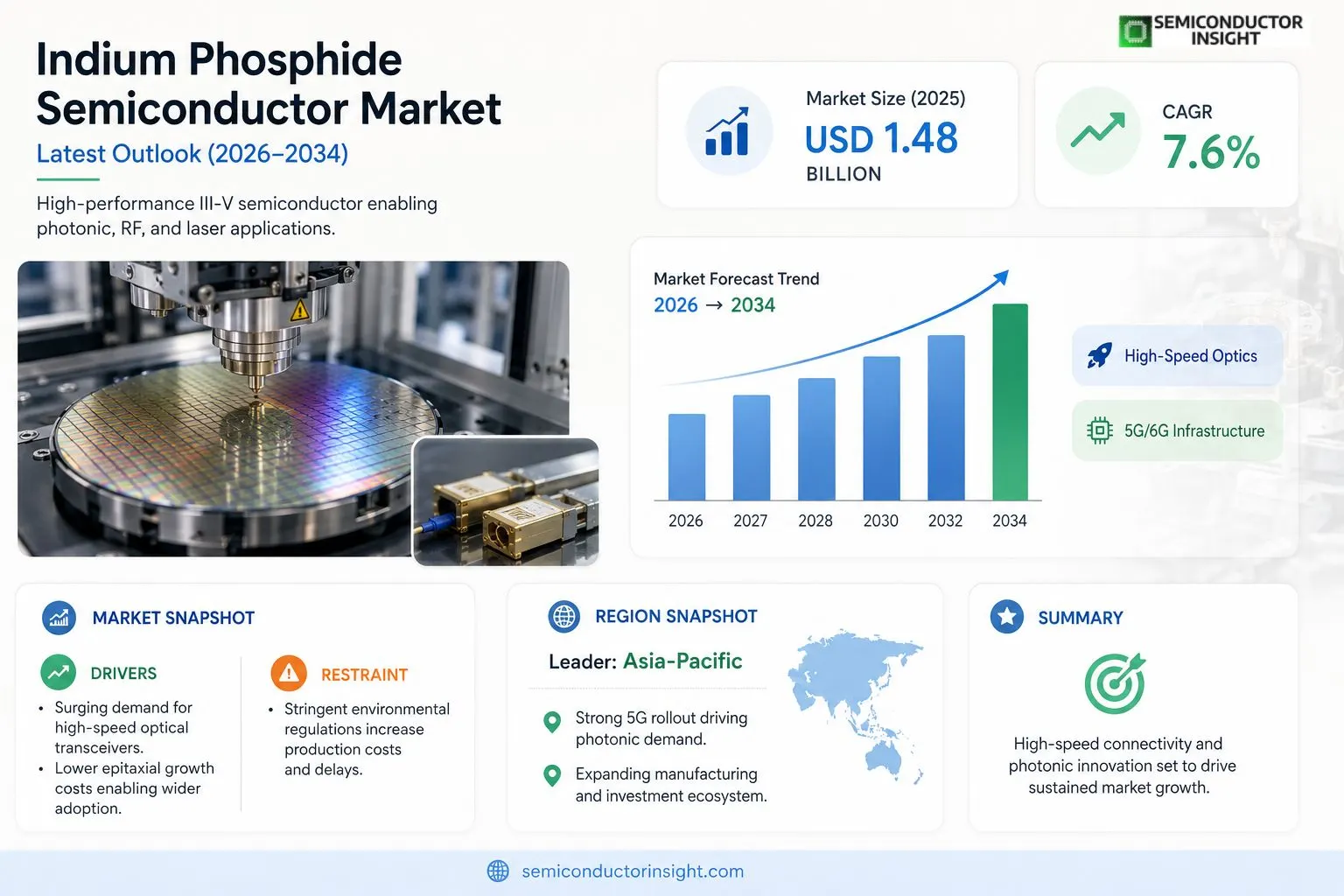
Global Indium Phosphide Semiconductor Market size was valued at USD 1.48 billion in 2025. The market is projected to grow from USD 1.58 billion in 2026 to USD 3.14 billion by 2034, exhibiting a CAGR of 7.6% during the forecast period.
Indium Phosphide (InP) semiconductors are compound‑type III‑V materials prized for their high electron mobility and direct bandgap, enabling high‑frequency radio‑frequency (RF) components, photonic integrated circuits, and laser diodes used in telecommunications, data‑center interconnects, and advanced sensing applications.The market is experiencing rapid growth because demand for high‑speed optical transceivers and fifth‑generation (5G/6G) wireless infrastructure is surging. Furthermore, increased investment in silicon photonics integration drives adoption of InP substrates for coherent optics. Key players such as IQE plc, II‑VI Incorporated, Skyworks Solutions Inc., Lumentum Holdings Inc., and NXP Semiconductors are expanding capacity through new fab lines and strategic partnerships,for example, in March 2024 IQE announced a joint venture with Nokia to supply InP‑based photonic chips for next‑generation network equipment.
MARKET DRIVERS
Rising Demand for High‑Performance Photonic Devices
Indium Phosphide Semiconductor Market is propelled by expanding 5G infrastructure and data‑center interconnects, where InP‑based lasers and photodetectors deliver bandwidths exceeding 100 Gb/s. Telecom operators are upgrading networks, creating a steady influx of orders for high‑efficiency InP transceivers.
Cost Reductions in Epitaxial Growth Processes
Advances in metal‑organic chemical vapor deposition (MOCVD) have lowered wafer‑per‑unit costs by roughly 12 % over the past three years, enabling smaller fab players to adopt InP technology without prohibitive capital outlays. This cost efficiency is encouraging broader adoption in emerging optical‑sensor applications.
➤ The market is projected to surpass $8.5 billion by 2030, driven primarily by telecom, data‑center, and defense segments.
Overall, the convergence of high‑speed connectivity requirements and more affordable manufacturing processes is creating a robust growth engine for the industry.
MARKET CHALLENGES
Supply Chain Constraints for Substrate Materials
InP wafers are produced by a limited number of suppliers, and recent geopolitical tensions have tightened availability, leading to lead times of up to 10 weeks for 200‑mm substrates. This scarcity raises production costs and delays product launches.
Other Challenges
High Capital Expenditure
Establishing a dedicated InP line requires investments of $250‑$300 million for cleanroom upgrades, lithography, and epitaxy tools. Smaller manufacturers often struggle to justify such spend without long‑term contracts.
MARKET RESTRAINTS
Stringent Environmental Regulations
The production of InP involves hazardous phosphine and arsine gases, prompting stricter emissions standards in major manufacturing hubs. Compliance adds operational overhead and may limit plant expansions.Regulatory reviews often extend project timelines by 12‑18 months, especially in regions with zero‑tolerance policies for toxic by‑products, thereby slowing market entry for new players.Furthermore, waste‑management protocols for InP scrap increase disposal costs by an estimated 8 % compared with conventional silicon processes.
MARKET OPPORTUNITIES
Emerging Applications in Integrated Photonics
Integrated photonic circuits leveraging InP platforms are gaining traction in LIDAR systems for autonomous vehicles, where they enable compact, high‑power light sources with rapid modulation capabilities.In quantum computing, InP‑based single‑photon sources are essential for scalable qubit interconnects, positioning the market to benefit from multi‑billion‑dollar investments in quantum technologies.Automotive OEMs project a 30 % CAGR in optical‑sensor modules through 2035, creating a sizable addressable market for InP components that can deliver both speed and reliability.
Indium Phosphide Semiconductor Market Trends
Rising Demand for High‑Speed Optical Transceivers
The adoption of InP‑based photonic components is accelerating as telecom operators upgrade networks to support 5G and emerging 6G services. High‑frequency radio‑frequency (RF) modules and laser diodes built on InP deliver the bandwidth and low‑latency performance required for data‑center interconnects and advanced sensing. This surge in demand is prompting manufacturers to expand production capacity and to integrate InP substrates with silicon photonics platforms, creating more compact and energy‑efficient solutions. In addition, hyperscale data‑center operators are standardizing on InP‑based transceiver modules to meet the strict latency and power‑per‑bit targets of emerging cloud services. Automotive manufacturers are also exploring InP laser sources for LiDAR systems that require longer range and higher resolution. Defense contractors value the radiation‑hard nature of InP devices for secure communications in contested environments. Collectively, these verticals are driving a sustained upward trajectory for component adoption.
Other Trends
Strategic Partnerships and Capacity Expansion
Key industry players are forming alliances to secure supply chains and accelerate technology roll‑outs. In March 2024, a major collaboration was announced between a leading InP wafer supplier and a global telecommunications equipment maker to deliver photonic chips for next‑generation network hardware. Similar joint ventures are emerging across Europe and Asia, where fab lines are being upgraded to increase wafer throughput and improve yield consistency. The joint venture announced in early 2024 illustrates a broader pattern of cross‑border collaboration, with European wafer fabs linking to Asian assembly partners to shorten time‑to‑market. Investment programs in Taiwan and Singapore are earmarked for upgrading epitaxial growth chambers, aiming to boost yield rates above ninety percent. Additionally, several OEMs have signed multi‑year supply agreements that lock in volume commitments, providing financial certainty for fab expansions. These developments collectively reinforce the supply chain resilience required for large‑scale rollout of photonic networks.
Integration of InP with Silicon Photonics
Silicon photonics integration is becoming a focal point for enabling coherent optical communications. By pairing the high electron mobility of InP with the mature manufacturing base of silicon, designers can achieve higher power efficiency while maintaining the narrow linewidth required for advanced modulation formats. This hybrid approach is gaining traction in both enterprise data‑center deployments and high‑performance computing clusters, where scaling optical bandwidth is a critical competitive factor. Performance benchmarking shows that InP‑based modulators can achieve bandwidths exceeding 100 GHz while maintaining low drive voltages, positioning them as a preferred choice for next‑generation coherent optics. The material’s direct bandgap also enables efficient wavelength‑division multiplexing, reducing the need for multiple discrete lasers in dense wavelength‑division systems. Research collaborations between universities and industry are focusing on heterogeneous integration techniques that embed InP active layers onto silicon wafers, promising further cost reductions and scalability. Anticipated advances in packaging technology are expected to simplify thermal management, thereby extending the operational envelope of InP photonic modules.
COMPETITIVE LANDSCAPEKey Industry Players
Indium Phosphide Semiconductor Market – Competitive Landscape
Indium Phosphide (InP) Semiconductor Market was valued at USD 1.48 billion in 2025 and is projected to reach USD 3.14 billion by 2034, expanding at a CAGR of 7.6 %. Growth is driven by surging demand for high‑speed optical transceivers, 5G/6G wireless infrastructure, and data‑center interconnects that rely on InP’s superior electron mobility and direct band‑gap properties. Leading players such as IQE plc, II‑VI Incorporated, Skyworks Solutions Inc., Lumentum Holdings Inc., and NXP Semiconductors dominate the sector by leveraging vertically integrated fabs, strategic joint ventures, and aggressive capacity expansions. For example, IQE’s March 2024 joint venture with Nokia to supply InP‑based photonic chips illustrates how incumbents are cementing supply‑chain control while targeting next‑generation network equipment. These frontrunners benefit from deep IP portfolios, advanced epitaxial growth capabilities, and strong relationships with telecom OEMs, positioning them as the primary sources for RF components, laser diodes, and photonic integrated circuits.Beyond the dominant tier, a diverse set of niche manufacturers contribute to market resilience and innovation. Companies such as NeoPhotonics Corp., Sumitomo Electric Industries Ltd., Fujitsu Ltd., Soitec SA, Mitsubishi Electric Corp., Intel Corporation, Broadcom Inc., Marvell Technology Group Ltd., Ciena Corporation, and other specialist fabs focus on specialized applications ranging from coherent optics to quantum‑photonic research. These firms often partner with foundries or collaborate on custom‑design projects, enabling rapid entry into emerging segments like silicon‑photonic integration and advanced sensing. Their agility and focus on high‑margin, low‑volume products complement the scale‑driven approach of the market leaders, creating a balanced competitive ecosystem that supports sustained growth through both volume production and niche innovation.
List of Key Indium Phosphide Semiconductor Companies Profiled
- IQE plc
- II‑VI Incorporated
- Skyworks Solutions Inc.
- Lumentum Holdings Inc.
- NXP Semiconductors
- NeoPhotonics Corp.
- Sumitomo Electric Industries Ltd.
- Fujitsu Ltd.
- Soitec SA
- Mitsubishi Electric Corp.
- Intel Corporation
- Broadcom Inc.
- Marvell Technology Group Ltd.
- Ciena Corporation
- Finisar (II‑VI subsidiary)
Segment Analysis:
| Segment Category | Sub-Segments | Key Insights |
| By Type |
|
Laser Diodes
|
| By Application |
|
Telecommunications Infrastructure
|
| By End User |
|
Network Equipment Manufacturers
|
| By Integration Approach |
|
Hybrid Silicon‑InP Integration
|
| By Emerging Technology |
|
5G/6G Wireless
|
Regional Analysis: North America
United States
The telecommunications sector is a primary driver for Indium Phosphide semiconductors, necessitating high-frequency devices for 5G and beyond. Demand is increasing for components used in base stations, optical transceivers, and network infrastructure.
The burgeoning demand for high-performance computing and data centers is fueling the adoption of Indium Phosphide semiconductors for their superior speed and efficiency in data transmission and processing.
The defense and aerospace industries utilize Indium Phosphide semiconductors in various applications, including radar systems, communication equipment, and electronic warfare systems, where high reliability and performance are critical.
Emerging applications in automotive electronics, particularly in advanced driver-assistance systems (ADAS) and connected car technologies, are creating new opportunities for Indium Phosphide semiconductors.
Europe
Europe represents a significant and steadily growing market for Indium Phosphide semiconductors. Driven by strong industrial sectors and increasing investments in advanced technologies, the demand for these specialized semiconductors is on an upward trajectory. Key applications in Europe include telecommunications infrastructure upgrades, the development of high-performance computing clusters, and applications within the automotive industry. Government initiatives promoting technological innovation and fostering collaborations between research institutions and industry players are further supporting market expansion. While the region has a strong base of established semiconductor manufacturers, there is a growing emphasis on developing closer supply chains and reducing reliance on external sources. The focus on energy efficiency and sustainable technologies is also driving demand for high-performance, low-power Indium Phosphide semiconductor solutions.
Asia-Pacific
The Asia-Pacific region is emerging as the fastest-growing market for Indium Phosphide semiconductors, propelled by rapid industrialization, increasing technological adoption, and substantial investments in infrastructure development. Countries like China, Japan, and South Korea are leading this growth, with significant demand originating from the telecommunications, consumer electronics, and automotive sectors. The region’s dynamic manufacturing landscape and its role as a global hub for electronics production are key factors driving market expansion. Government support for the semiconductor industry, coupled with a large pool of skilled labor, creates a favorable environment for growth. The growing demand for 5G infrastructure and advanced consumer electronics is expected to further accelerate the adoption of Indium Phosphide semiconductors in the coming years.
South America
South America presents a moderate but gradually expanding market for Indium Phosphide semiconductors. The increasing adoption of advanced telecommunications technologies and a growing focus on digitalization are contributing to this growth. The demand is primarily driven by the telecommunications sector, particularly for infrastructure upgrades and the deployment of high-speed networks. The automotive industry is also showing increasing interest in Indium Phosphide semiconductors for applications in infotainment systems and advanced driver-assistance systems. While the market is currently smaller compared to North America and Asia-Pacific, the long-term growth potential remains significant, driven by the region’s ongoing economic development and increasing connectivity.
Middle East & Africa
The Middle East and Africa represent a nascent but promising market for Indium Phosphide semiconductors. The region is experiencing rapid economic growth and significant investments in infrastructure development, particularly in telecommunications and defense. The increasing adoption of 5G technologies and the expansion of data centers are creating new opportunities for Indium Phosphide semiconductors. The demand is currently focused on telecommunication infrastructure upgrades and defense applications. While the market size is relatively small, the long-term growth potential is substantial, driven by the region’s ongoing development and increasing connectivity needs. Government initiatives promoting technological advancement and digital transformation are expected to further drive market expansion in the coming years.
Report Scope
This market research report provides a comprehensive analysis of the Indium Phosphide Semiconductor Market , covering the forecast period 2026–2034. It offers detailed insights into market dynamics, technological advancements, competitive landscape, and key trends shaping the industry.
Key focus areas of the report include:
- Market Overview: The report begins with an overview outlining its current market scenario, key growth indicators, and industry transformation drivers. It discusses macroeconomic factors, demand–supply balance, regulatory landscape, and the strategic role of semiconductors in powering advancements across industries such as automotive, telecommunications, consumer electronics, and industrial automation.
- Market Size & Forecast: Historical data and future projections for revenue, unit shipments, and market value across major regions and segments.
- Segmentation Analysis: Detailed breakdown by product type, technology, application, and end-user industry to identify high-growth segments and investment opportunities.
- Regional Insights: Insights into market performance across North America, Europe, Asia-Pacific, Latin America, and the Middle East & Africa, including country-level analysis where relevant.
- Competitive Landscape: Profiles of leading market participants, including their product offerings, R&D focus, manufacturing capacity, pricing strategies, and recent developments such as mergers, acquisitions, and partnerships.
- Technology Trends & Innovation: Assessment of emerging technologies, integration of AI/IoT, semiconductor design trends, fabrication techniques, and evolving industry standards.
- Market Drivers & Restraints: Evaluation of factors driving market growth along with challenges, supply chain constraints, regulatory issues, and market-entry barriers.
- Stakeholder Insights: Insights for component suppliers, OEMs, system integrators, investors, and policymakers regarding the evolving ecosystem and strategic opportunities.
Primary and secondary research methods are employed, including interviews with industry experts, data from verified sources, and real-time market intelligence to ensure the accuracy and reliability of the insights presented.
FREQUENTLY ASKED QUESTIONS:
What is the current market size of Indium Phosphide Semiconductor Market?
-> Indium Phosphide Semiconductor Market was valued at USD 1.48 billion in 2025 and is expected to reach USD 3.14 billion by 2034, with a CAGR of 7.6% during the forecast period.
Which key companies operate in Indium Phosphide Semiconductor Market?
-> Key players include IQE plc, II‑VI Incorporated, Skyworks Solutions Inc., Lumentum Holdings Inc., and NXP Semiconductors, among others.
What are the key growth drivers?
-> Key growth drivers include surging demand for high‑speed optical transceivers, deployment of 5G/6G wireless infrastructure, and increased investment in silicon photonics integration.
Which region dominates the market?
-> Asia‑Pacific is emerging as a fast‑growing region due to strong telecom rollout, while North America remains a dominant market for advanced photonic applications.
What are the emerging trends?
-> Emerging trends include adoption of InP substrates for coherent optics, development of photonic integrated circuits, and expansion of InP‑based laser diode solutions for data‑center interconnects.
Get Sample Report PDF for Exclusive Insights
Report Sample Includes
- Table of Contents
- List of Tables & Figures
- Charts, Research Methodology, and more...
 Download Sample Report PDF