Near Memory Compute (NMC) In-SSD Processor Market Insights
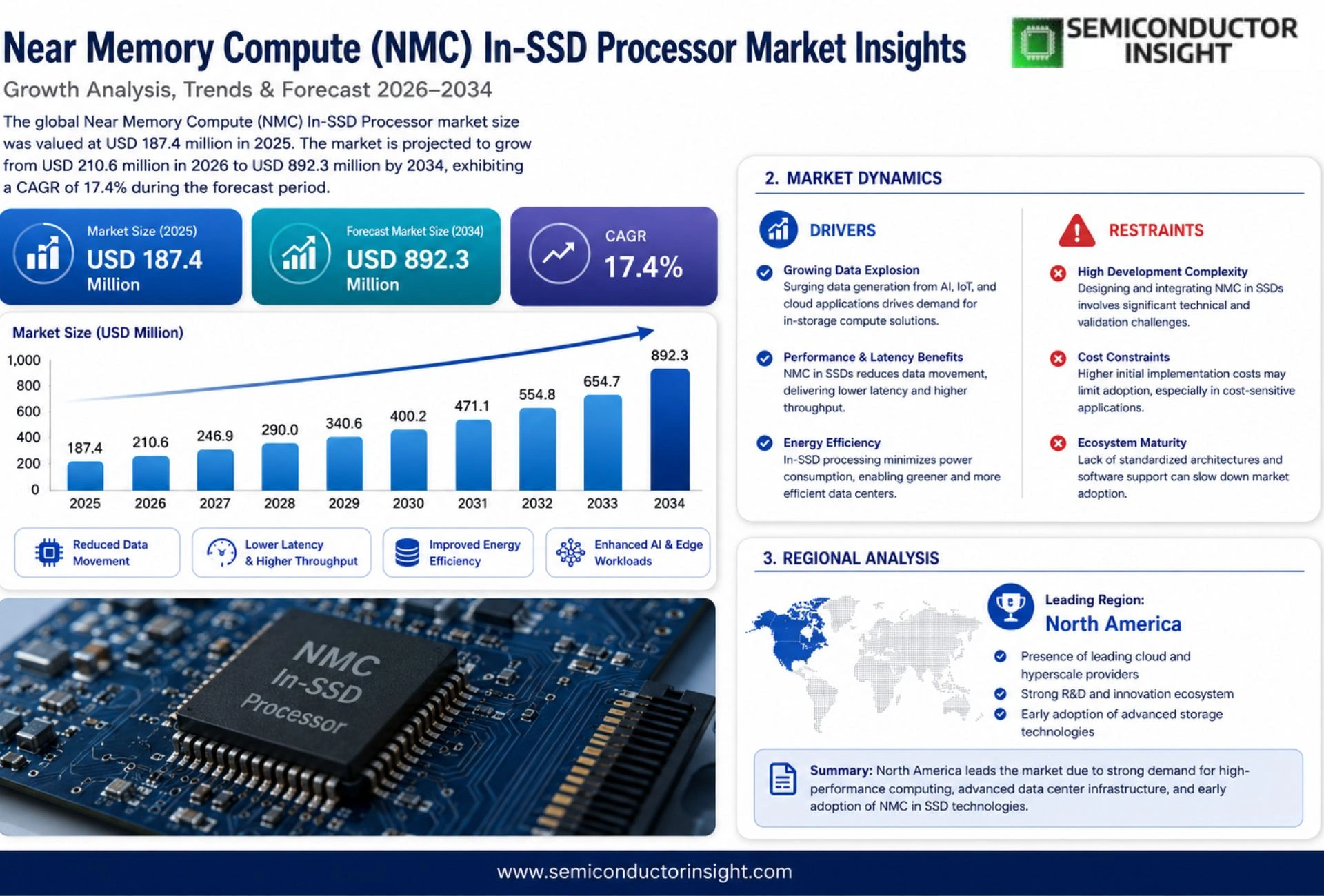
Global Near Memory Compute (NMC) In-SSD Processor Market size was valued at USD 187.4 million in 2025. The market is projected to grow from USD 210.6 million in 2026 to USD 892.3 million by 2034, exhibiting a CAGR of 17.4% during the forecast period.
Near Memory Compute (NMC) In-SSD processors represent an advanced computational architecture that integrates processing logic directly within or adjacent to solid-state drive storage media. By enabling data processing at the storage layer, these processors significantly reduce data movement bottlenecks between storage and host CPU, lowering latency and improving overall system energy efficiency. The technology encompasses a range of processor configurations embedded within SSD controllers, including NAND flash-integrated compute engines, near-storage processing units, and computational storage devices (CSDs) capable of executing database queries, data analytics, compression, encryption, and AI inference workloads natively within the drive.
The market is experiencing robust momentum driven by the exponential growth of data-intensive workloads across cloud computing, artificial intelligence, and enterprise data centers. The widening gap between CPU processing speeds and storage I/O bandwidth — commonly referred to as the memory wall problem — has accelerated industry adoption of in-SSD compute solutions. Furthermore, leading semiconductor and storage companies have actively advanced this space; for instance, Samsung Electronics and ScaleFlux have been prominent in commercializing computational storage solutions, while the Storage Networking Industry Association (SNIA) has formalized the Computational Storage Architecture standard to drive interoperability. Key players operating in this market include Samsung Electronics Co., Ltd., ScaleFlux, Inc., Micron Technology, Inc., Kioxia Corporation, and Western Digital Corporation.
MARKET DRIVERS
Exponential Data Growth Fueling Demand for In-Storage Processing
The rapid proliferation of data-intensive workloads across cloud computing, artificial intelligence, and big data analytics has emerged as a primary driver of Near Memory Compute (NMC) In-SSD Processor Market. As enterprises generate and process increasingly large datasets, the conventional approach of shuttling data between storage and central processing units creates significant bottlenecks, commonly referred to as the “memory wall.” In-SSD processors address this challenge by enabling computation directly within or adjacent to the storage medium, dramatically reducing data movement latency and improving overall system throughput. This architectural innovation is gaining strong traction across hyperscale data centers and enterprise storage deployments.
AI and Machine Learning Workloads Accelerating NMC Adoption
Artificial intelligence inference and training workloads are inherently data-heavy operations that expose the limitations of traditional compute architectures. The Near Memory Compute In-SSD Processor segment is experiencing heightened interest as AI model deployments at the edge and within data centers require low-latency, high-bandwidth data access. By integrating lightweight processing capabilities directly within the SSD controller or NAND flash interface, NMC technology enables accelerated query processing, data filtering, and pattern recognition tasks without burdening the host CPU. This capability is particularly valuable in real-time analytics, recommendation engines, and autonomous systems where processing speed is mission-critical.
➤ Industry analysis indicates that data movement between storage and processor accounts for a disproportionate share of total system energy consumption in modern data centers, making NMC In-SSD architectures a strategically important technology for achieving sustainability and performance goals simultaneously.
The convergence of computational storage standards, including the NVMe Computational Storage specification being advanced by SNIA, is providing a structured framework for widespread commercial deployment of NMC In-SSD processor solutions. Standardization efforts are reducing fragmentation and encouraging broader ecosystem participation from NAND flash vendors, SSD controller developers, and system integrators, collectively reinforcing the market’s upward growth trajectory.
MARKET CHALLENGES
Software Ecosystem Immaturity Constraining Mainstream Deployment
Despite strong technical promise, Near Memory Compute (NMC) In-SSD Processor Market faces considerable headwinds stemming from an underdeveloped software and programming ecosystem. Unlike conventional CPU or GPU-based compute platforms supported by decades of mature toolchains, compilers, and developer frameworks, NMC-based storage processors require specialized programming models that many enterprise IT teams are not yet equipped to adopt. Offloading workloads to in-SSD compute engines demands careful partitioning of application logic, and the absence of standardized APIs or widely supported software development kits slows integration timelines and increases deployment complexity for potential customers.
Furthermore, the lack of unified benchmarking standards makes it difficult for end users to objectively compare NMC In-SSD solutions from competing vendors, adding to procurement uncertainty and potentially delaying purchasing decisions across the enterprise and cloud segments of the market.
Other Challenges
Thermal and Power Management Constraints
Integrating active processing cores within the physical and thermal envelope of an SSD introduces non-trivial engineering constraints. NMC In-SSD processors must operate within strict power budgets to avoid excessive heat generation that could compromise NAND flash endurance and device reliability. Balancing compute performance with thermal dissipation remains an ongoing design challenge for semiconductor and storage vendors competing in this space.
High Development and Integration Costs
The research and development investment required to design, validate, and bring to market a competitive NMC In-SSD processor solution is substantial. Custom ASIC development, firmware engineering, and system-level integration testing represent significant cost barriers, particularly for smaller vendors. These costs may translate into elevated product pricing that limits near-term adoption among cost-sensitive mid-market and SME customers relative to hyperscale cloud operators.
MARKET RESTRAINTS
Architectural Complexity and System Integration Barriers
A principal restraint on Near Memory Compute (NMC) In-SSD Processor Market is the architectural complexity involved in integrating in-storage computation into existing IT infrastructure. Enterprise storage systems, server platforms, and hyperconverged infrastructure are designed around conventional host-centric compute models, and retrofitting NMC capabilities into these environments requires both hardware and software modifications at multiple system layers. Storage administrators and data center architects must contend with changes to I/O path management, data coherency protocols, and workload scheduling, creating friction that slows adoption even among organizations that recognize the long-term performance benefits.
Limited Awareness and Proven Use Case Portfolio Among Enterprise Buyers
The relative novelty of Near Memory Compute In-SSD processor technology means that a significant portion of potential enterprise and cloud customers remain in early evaluation stages rather than active procurement. Decision-makers often require demonstrated, production-validated use cases before committing capital expenditure to emerging compute architectures. While proof-of-concept deployments in database acceleration, genomics processing, and log analytics have demonstrated measurable gains, the broader enterprise market continues to await more extensive case study evidence and vendor support commitments before scaling adoption. This cautious demand posture acts as a meaningful near-term restraint on market revenue growth.
Supply chain dependencies on advanced semiconductor process nodes further restrain the pace at which NMC In-SSD processor vendors can scale production and reduce unit costs, particularly amid ongoing global semiconductor supply dynamics that continue to affect lead times and component availability across the storage industry.
MARKET OPPORTUNITIES
Edge Computing Expansion Creating New Frontiers for NMC In-SSD Processors
The rapid growth of edge computing infrastructure represents one of the most compelling opportunities for Near Memory Compute (NMC) In-SSD Processor Market. Edge nodes deployed in telecommunications, industrial automation, and smart city applications are constrained by limited physical space, power availability, and thermal budgets, making the consolidation of storage and compute functions within a single NMC-enabled SSD a highly attractive architectural proposition. As 5G network densification accelerates edge deployments globally, demand for compact, energy-efficient, and intelligent storage solutions with embedded processing capabilities is expected to grow significantly over the coming years.
Database and Analytics Offloading as a High-Value Commercial Segment
Relational and NoSQL database operators managing large-scale analytical workloads represent a high-value commercial segment for NMC In-SSD processor vendors. Offloading predicate pushdown, data filtering, sorting, and aggregation operations from the host CPU to the storage processor can yield meaningful reductions in query latency and host resource consumption, translating directly into infrastructure cost savings and improved application performance. As database workloads continue to scale in volume and complexity across financial services, healthcare, and e-commerce sectors, purpose-built NMC solutions targeting these use cases are well-positioned to capture growing commercial interest.
Strategic partnerships between NAND flash manufacturers, SSD controller silicon vendors, and hyperscale cloud providers are creating a collaborative ecosystem that could accelerate the commercialization and standardization of Near Memory Compute In-SSD architectures. Co-development agreements and joint reference platform initiatives reduce individual vendor risk while expanding the addressable market, presenting a significant opportunity for market participants to establish durable competitive positions as the technology transitions from early adoption into broader mainstream deployment phases.
Near Memory Compute (NMC) In-SSD Processor Market Trends
Rising Demand for In-Storage Compute to Address the Memory Wall Problem
Near Memory Compute (NMC) In-SSD Processor Market is witnessing accelerating momentum as enterprises and cloud service providers seek to overcome the persistent memory wall problem — the widening gap between CPU processing speeds and storage I/O bandwidth. By integrating processing logic directly within or adjacent to solid-state drive storage media, NMC In-SSD processors enable data to be processed at the storage layer itself, significantly reducing unnecessary data movement to the host CPU. This architectural shift is proving critical for hyperscale data centers managing exponentially growing volumes of data-intensive workloads, where latency reduction and energy efficiency are paramount operational priorities.
Other Trends
Commercialization of Computational Storage Devices (CSDs)
A defining trend Near Memory Compute (NMC) In-SSD Processor Market is the active commercialization of computational storage devices capable of executing complex workloads natively within the drive. These workloads include database queries, real-time data analytics, compression, encryption, and AI inference tasks. Companies such as Samsung Electronics and ScaleFlux have been at the forefront of bringing these solutions to market, while the Storage Networking Industry Association (SNIA) has formalized the Computational Storage Architecture standard to foster interoperability across the ecosystem. This standardization effort is expected to encourage broader industry adoption and reduce integration barriers for enterprise customers.
Integration of AI Inference Capabilities Within SSD Controllers
Another prominent trend shaping Near Memory Compute (NMC) In-SSD Processor Market is the integration of AI inference engines directly into SSD controller architectures. As artificial intelligence workloads proliferate across industries, the ability to perform inference at the storage layer — without routing data back to the host processor — is emerging as a key competitive differentiator. Leading semiconductor and storage companies, including Micron Technology, Kioxia Corporation, and Western Digital Corporation, are actively advancing processor configurations that support NAND flash-integrated compute engines and near-storage processing units optimized for AI-driven applications.
Cloud and Enterprise Data Center Adoption Driving Market Expansion
Cloud computing growth and enterprise digital transformation are serving as powerful catalysts for Near Memory Compute (NMC) In-SSD Processor Market. As data centers continue scaling to support AI training, big data analytics, and real-time workloads, the inefficiencies of traditional storage-to-CPU data transfer pipelines have become increasingly untenable. NMC In-SSD processors offer a compelling solution by offloading compute tasks to the storage tier, improving overall system throughput while reducing power consumption — a critical consideration as data center operators face mounting pressure to improve energy efficiency and operational cost management.
COMPETITIVE LANDSCAPE
Key Industry Players
Near Memory Compute (NMC) In-SSD Processor Market: Competitive Dynamics and Leading Innovators Shaping the Future of Computational Storage
Near Memory Compute (NMC) In-SSD Processor Market is characterized by a concentrated yet rapidly expanding competitive landscape, where a handful of vertically integrated semiconductor and storage giants command significant market influence alongside specialized computational storage startups. Samsung Electronics Co., Ltd. stands as the dominant force in this space, leveraging its unparalleled NAND flash manufacturing capabilities and deep R&D investment to advance in-SSD compute architectures that integrate processing logic directly at the storage layer. The company’s SmartSSD computational storage drives have been commercially deployed across cloud and enterprise data center environments, establishing Samsung as the benchmark competitor in the market. ScaleFlux, Inc. has similarly emerged as a formidable player, offering purpose-built computational storage devices (CSDs) targeting data compression, database acceleration, and AI inference workloads natively within the drive — a positioning that has attracted strong enterprise adoption. The Storage Networking Industry Association (SNIA) Computational Storage Architecture standard, which these and other leading players actively contributed to, is accelerating interoperability and broadening the competitive field as enterprise buyers gain greater confidence in multi-vendor deployments.
Beyond the market leaders, several other significant players are carving out competitive niches across the NMC In-SSD processor value chain. Micron Technology, Inc. and Kioxia Corporation are advancing near-storage processing capabilities within their respective NAND flash platforms, focusing on latency reduction and memory wall mitigation for high-performance computing and AI workloads. Western Digital Corporation continues to invest in computational storage research, integrating processing engines within its enterprise SSD controller architectures. Meanwhile, firms such as NGram (NGD Systems), Eideticom, and Pliops are driving differentiation through software-defined computational storage platforms and high-throughput key-value store acceleration, respectively. The competitive intensity is further heightened by semiconductor IP providers and emerging fabless startups targeting specific verticals including cloud analytics, genomics data processing, and real-time AI inference — all of which are expected to fuel the market’s projected expansion from USD 210.6 million in 2026 to USD 892.3 million by 2034 at a CAGR of 17.4%.
List of Key Near Memory Compute (NMC) In-SSD Processor Companies Profiled
- Samsung Electronics Co., Ltd.
- ScaleFlux, Inc.
- Micron Technology, Inc.
- Kioxia Corporation
- Western Digital Corporation
- NGD Systems, Inc. (Ngram)
- Eideticom Inc.
- Pliops Ltd.
- Innogrit Corporation
- Marvell Technology, Inc.
- Silicon Motion Technology Corporation
- Phison Electronics Corporation
- SK Hynix Inc.
- Yangtze Memory Technologies Co., Ltd. (YMTC)
- Computational Storage Alliance (CSA) Member Ecosystem Participants
Segment Analysis:
| Segment Category | Sub-Segments | Key Insights |
| By Type |
|
Computational Storage Devices (CSDs) represent the leading segment within the By Type classification, driven by their versatile ability to natively execute a broad spectrum of workloads directly within the drive enclosure.
|
| By Application |
|
AI and Machine Learning Inference has emerged as the dominant application segment, propelled by the exponential proliferation of AI workloads across cloud, edge, and enterprise computing environments.
|
| By End User |
|
Cloud Service Providers and Hyperscalers constitute the leading end-user segment, as these organizations operate at the frontier of data-intensive workload management and are uniquely positioned to realize the full transformative benefits of NMC In-SSD processor technology.
|
| By Interface Standard |
|
NVMe-based NMC Processors lead this segment by virtue of the NVMe protocol’s architectural superiority in supporting low-latency, high-parallelism communication between host systems and storage-embedded compute engines.
|
| By Deployment Mode |
|
Cloud-Native Deployment stands as the dominant deployment mode, reflecting the broader industry shift toward cloud-first infrastructure strategies and the concentration of data-intensive workloads within hyperscale cloud environments.
|
Regional Analysis: Near Memory Compute (NMC) In-SSD Processor Market
North America
North America’s hyperscale data center landscape is among the most expansive globally, creating a fertile environment for Near Memory Compute (NMC) In-SSD Processor adoption. Operators are under continuous pressure to improve query throughput and reduce host CPU offloading, making in-SSD processing an architecturally attractive solution that aligns with long-term infrastructure efficiency strategies.
The region hosts a dense cluster of semiconductor design companies and foundry partners actively developing next-generation NMC in-SSD processor architectures. Silicon Valley remains the epicenter of this innovation, where engineering talent, research institutions, and corporate R&D divisions collaborate to push performance boundaries and establish new industry benchmarks for computational storage technology.
Artificial intelligence and machine learning training pipelines in North America are generating unprecedented volumes of unstructured data, intensifying the need for storage solutions capable of in-situ processing. NMC in-SSD processors are increasingly evaluated as a means to accelerate vector database operations and neural network inference tasks without burdening central processing resources, reflecting a fundamental architectural shift.
Government-backed semiconductor investment programs in the United States are creating downstream benefits for Near Memory Compute (NMC) In-SSD Processor Market by incentivizing domestic production capacity and supply chain resilience. These policy tailwinds are encouraging enterprise procurement strategies that prioritize advanced storage compute solutions developed and manufactured within the region.
Europe
Europe represents a strategically important region Near Memory Compute (NMC) In-SSD Processor Market, characterized by strong institutional research programs and a growing emphasis on digital sovereignty. Countries such as Germany, the Netherlands, and France are investing in sovereign cloud infrastructure, which indirectly drives demand for advanced computational storage technologies capable of handling sensitive data workloads locally. The European Union’s focus on data privacy regulations has prompted enterprises to seek storage architectures that minimize data movement, a requirement well-served by NMC in-SSD processor solutions. Research universities across the region are actively publishing foundational work in near-memory processing, and collaborative public-private programs are translating academic insights into commercial prototypes. While Europe’s semiconductor manufacturing base remains less concentrated than North America or Asia-Pacific, strategic partnerships with global chip designers are enabling regional firms to integrate NMC capabilities into enterprise storage product lines, positioning Europe as a steadily growing contributor to the global market through 2034.
Asia-Pacific
Asia-Pacific is emerging as the fastest-evolving region Near Memory Compute (NMC) In-SSD Processor Market, underpinned by the extraordinary pace of digital infrastructure expansion across China, South Korea, Japan, and India. South Korea’s dominant NAND flash memory manufacturers are uniquely positioned to integrate NMC processing capabilities directly into next-generation SSD products, leveraging deep vertical integration across the storage value chain. China’s national ambitions in semiconductor self-sufficiency are accelerating domestic development of computational storage solutions, with state-backed research initiatives targeting near-memory architectures as a strategic priority. Japan’s precision engineering culture and established enterprise storage market continue to support incremental yet meaningful adoption of NMC in-SSD processors in industrial and telecommunications applications. India’s rapidly expanding cloud and data center sector is beginning to evaluate NMC solutions as a cost-effective means of managing the explosive growth in analytics-driven workloads, adding a new demand dimension to the regional market landscape.
South America
South America occupies a nascent but gradually awakening position Near Memory Compute (NMC) In-SSD Processor Market. Brazil serves as the primary engine of regional growth, supported by expanding fintech ecosystems, digital banking infrastructure, and a growing public cloud adoption curve that collectively generate demand for more efficient data processing architectures. While large-scale enterprise deployment of NMC in-SSD processors remains limited due to cost sensitivity and infrastructure maturity constraints, regional system integrators and cloud service providers are beginning to evaluate computational storage as part of longer-term modernization roadmaps. Government-led digital transformation initiatives in Brazil, Chile, and Colombia are creating a more favorable environment for advanced storage technology investments. As global NMC in-SSD processor vendors look to diversify their market presence beyond saturated regions, South America is anticipated to receive increased commercial attention in the latter half of the 2026–2034 forecast period.
Middle East & Africa
The Middle East and Africa region represents an emerging frontier for Near Memory Compute (NMC) In-SSD Processor Market, with growth driven primarily by ambitious smart city programs, sovereign data center construction projects, and the accelerating digital economy in Gulf Cooperation Council nations. Saudi Arabia and the United Arab Emirates are leading regional investment in hyperscale and edge data center infrastructure as part of broader economic diversification strategies, creating foundational demand for high-performance storage compute architectures. NMC in-SSD processor solutions are increasingly relevant in this context, as regional operators seek technologies that optimize energy consumption — a particularly critical consideration given high cooling costs in arid climates. Africa’s market remains at an early stage, though South Africa and select East African technology hubs are establishing digital infrastructure corridors that may support longer-term adoption. Overall, the Middle East and Africa region is expected to contribute incrementally yet progressively to the Global Near Memory Compute (NMC) In-SSD Processor Market through 2034.
Report Scope
This market research report provides a comprehensive analysis of the Near Memory Compute (NMC) In-SSD Processor Market , covering the forecast period 2026–2034. It offers detailed insights into market dynamics, technological advancements, competitive landscape, and key trends shaping the industry.
Key focus areas of the report include:
- Market Overview: The report begins with an overview outlining its current market scenario, key growth indicators, and industry transformation drivers. It discusses macroeconomic factors, demand–supply balance, regulatory landscape, and the strategic role of semiconductors in powering advancements across industries such as automotive, telecommunications, consumer electronics, and industrial automation.
- Market Size & Forecast: Historical data and future projections for revenue, unit shipments, and market value across major regions and segments.
- Segmentation Analysis: Detailed breakdown by product type, technology, application, and end-user industry to identify high-growth segments and investment opportunities.
- Regional Insights: Insights into market performance across North America, Europe, Asia-Pacific, Latin America, and the Middle East & Africa, including country-level analysis where relevant.
- Competitive Landscape: Profiles of leading market participants, including their product offerings, R&D focus, manufacturing capacity, pricing strategies, and recent developments such as mergers, acquisitions, and partnerships.
- Technology Trends & Innovation: Assessment of emerging technologies, integration of AI/IoT, semiconductor design trends, fabrication techniques, and evolving industry standards.
- Market Drivers & Restraints: Evaluation of factors driving market growth along with challenges, supply chain constraints, regulatory issues, and market-entry barriers.
- Stakeholder Insights: Insights for component suppliers, OEMs, system integrators, investors, and policymakers regarding the evolving ecosystem and strategic opportunities.
Primary and secondary research methods are employed, including interviews with industry experts, data from verified sources, and real-time market intelligence to ensure the accuracy and reliability of the insights presented.
FREQUENTLY ASKED QUESTIONS:
What is the current market size of Near Memory Compute (NMC) In-SSD Processor Market?
-> Near Memory Compute (NMC) In-SSD Processor Market was valued at USD 187.4 million in 2025 and is expected to reach USD 892.3 million by 2034, growing at a CAGR of 17.4% during the forecast period from 2026 to 2034.
Which key companies operate Near Memory Compute (NMC) In-SSD Processor Market?
-> Key players include Samsung Electronics Co., Ltd., ScaleFlux, Inc., Micron Technology, Inc., Kioxia Corporation, and Western Digital Corporation, among others.
What are the key growth drivers?
-> Key growth drivers include the exponential growth of data-intensive workloads across cloud computing, artificial intelligence, and enterprise data centers, as well as the widening gap between CPU processing speeds and storage I/O bandwidth — commonly referred to as the memory wall problem — which has accelerated industry adoption of in-SSD compute solutions.
Which region dominates the market?
-> Asia-Pacific is the fastest-growing region, while North America remains a dominant market, driven by large-scale enterprise data center deployments and significant investments in cloud computing and AI infrastructure.
What are the emerging trends?
-> Emerging trends include NAND flash-integrated compute engines, near-storage processing units, and computational storage devices (CSDs) capable of executing database queries, data analytics, compression, encryption, and AI inference workloads natively within the drive, as well as the formalization of the Computational Storage Architecture standard by the Storage Networking Industry Association (SNIA) to drive interoperability.

Get Sample Report PDF for Exclusive Insights
Report Sample Includes
- Table of Contents
- List of Tables & Figures
- Charts, Research Methodology, and more...
 Download Sample Report PDF